
Finding the right CPA isn't just about handing off your tax prep. It's about building a strategic partnership that can genuinely shape your financial future. A good CPA is your trusted advisor, the person who helps you navigate everything from tricky capital gains to the Wild West of crypto taxes, making sure you're not just compliant, but positioned to win.
Why Finding the Right CPA Is a Critical Business Decision

Choosing a Certified Public Accountant is one of the most important relationships you'll ever build for your business or personal finances. Too many people only think about their accountant during the annual tax-season scramble, but their real value is unlocked through year-round guidance.
A great CPA does so much more than file your paperwork correctly. They become a proactive financial ally.
Let’s say you’re a real estate investor here in San Diego, trying to get your head around the capital gains on a recent sale. Or maybe you're a small business owner in Clairemont wrestling with whether an S Corp structure is the right move. These aren't just tax questions—they're major strategic decisions. The right CPA brings the clarity you need to make those calls with confidence.
The Problem with Industry Instability
The U.S. accounting services industry is a massive $145.5 billion market, and there are over 85,000 businesses out there vying for your attention. But behind the scenes, the industry is grappling with high employee turnover. Some public accounting firms see annual churn rates between 15% and 22%.
That instability can hit you directly. You might spend a year building a great rapport with an accountant who finally understands your goals, only to learn they’ve left the firm. Now you’re back to square one with someone new. If you want to dig deeper, you can explore more data on accounting turnover rates to see the full picture.
This constant churn creates inconsistency. For those of us with more specialized needs, like managing rental properties or crypto investments, this disruption is more than just an annoyance. It can lead to missed opportunities and costly mistakes when subtle but critical details get lost in the handoff.
Think of it this way: You wouldn't want a new doctor who doesn't know your medical history to perform surgery. Similarly, you need a financial partner who understands your journey, goals, and unique financial situation.
Investing in a Long-Term Financial Ally
This is exactly why vetting a CPA for their firm's stability and client relationships is just as important as checking their credentials. When you start your search, remember you aren't just hiring a tax preparer for a season. You're investing in a long-term advisor who will grow alongside you.
A stable, dedicated CPA brings a few key advantages to the table:
- Deeper Understanding: Over time, they learn the ins and outs of your finances, which leads to more personalized and effective advice.
- Proactive Planning: A long-term partner helps you look ahead to anticipate financial challenges and opportunities, rather than just reacting to them.
- Consistent Strategy: Your financial strategy remains consistent, not changing with every new person who picks up your file.
Ultimately, figuring out how to find a good CPA comes down to identifying a professional who offers more than just technical skill. You’re looking for a partner who is organized, a clear communicator, and truly invested in your success. They become a core part of your team, helping you build a stronger financial foundation for years to come.
Know What You Need Before You Start Looking

Before you even start looking for a CPA, you need a clear picture of your own financial world. Jumping into the search without this groundwork is a recipe for frustration. You'll waste time talking to accountants who aren't the right fit and might end up paying for services you don't actually need.
Think of it this way: you can't hire the right person for a job if you haven't written the job description. Taking a few moments to outline your needs upfront makes your search targeted and efficient. It gives you the confidence to ask sharp questions and really compare your options.
First, What Services Do You Actually Need?
Start by making a simple list of what you need help with right now, and what you might need a year or two down the road. The more specific you are, the better.
"Help with taxes" is too vague. "Strategic tax planning for my San Diego rental property portfolio" is something a CPA can sink their teeth into.
Your list will probably be a mix of ongoing work and one-time projects. Think through your daily, monthly, and annual financial tasks. If you're new to this, getting a handle on basic accounting for small business can give you a solid starting point.
Here are the common things people hire a CPA for:
- Tax Prep & Filing: Is this just for you (Form 1040), your business (S-Corp, LLC), or a combination?
- Bookkeeping & Financials: Do you need someone to run your QuickBooks, or just give it a sanity check once a quarter?
- Payroll: Are you paying employees or just a few 1099 contractors?
- Tax Planning: Do you want someone who proactively finds ways to lower your tax bill all year, or just a tax preparer?
- Specialty Areas: Do you have crypto gains, complex real estate transactions, or deal with sales tax in multiple states? These require specialized knowledge.
This isn't just about a checklist. You're building a profile of your ideal financial partner—someone whose skills line up perfectly with where your money is going.
Next, How Complex Is Your Situation?
The amount of work involved directly impacts who you should hire and what you'll pay. A CPA needs to know if you have a handful of transactions a month or hundreds.
Getting a rough idea of your numbers helps a CPA give you a fair quote and ensures they actually have the bandwidth to help you. A freelance graphic designer has a much simpler financial life than a restaurant owner in Clairemont juggling daily sales, inventory, and payroll.
Think about these key details:
- Your Business Structure: Are you a sole proprietor, LLC, or S-Corp? Each has very different tax rules.
- Number of Accounts: How many bank, credit card, and investment accounts are we talking about?
- Transaction Volume: Give a rough estimate of your monthly transactions. A ballpark number is all you need.
- The "Weird Stuff": Do you have foreign bank accounts, crypto wallets, or rental properties? Be upfront about anything that isn't straightforward.
Finally, How Do You Like to Work?
The best tax strategist in the world will be a terrible fit if your communication styles are completely different. I've seen more relationships sour over mismatched expectations about response times than anything else.
Are you looking for a hands-off advisor you talk to once a quarter? Or do you want a close partner who's more involved in your day-to-day decisions?
Ask yourself:
- Responsiveness: What do you consider a reasonable turnaround time for an email? 24 hours? 48 hours? Be realistic.
- Technology: Are you comfortable using a secure client portal and cloud software like QuickBooks Online, or do you prefer to drop off a shoebox of receipts?
- Proactivity: Do you want a CPA who pings you with reminders and sets up planning meetings, or are you happy to be the one driving the conversation?
Once you have this blueprint, you're not just looking for "a CPA" anymore. You're looking for a specific type of professional ready to handle your exact financial situation. This is how you find a great partner for the long haul.
Where to Find Vetted and Qualified CPAs
A quick Google search for a CPA will throw thousands of names at you, but the truth is, the best ones rarely show up on the first page of results. To find a CPA who can really move the needle for your business or investments, you need to look where quality is already baked in.
This means tapping into trusted networks and professional circles where CPAs have already been vetted by their clients and peers. It’s about building a shortlist of high-caliber candidates right from the start, saving you a ton of time and frustration down the road.
Start with Professional Organizations
The most reliable place to begin your search is with the official bodies that license and govern CPAs. Think of these as the gatekeepers. Finding someone through their directories gives you an immediate layer of trust because you know they’ve met strict educational, ethical, and professional standards.
Here are the two heavy hitters:
- The American Institute of CPAs (AICPA): This is the national professional organization for every CPA in the country. Their directories are a solid starting point for finding members in good standing, searchable by location and specialty.
- State CPA Societies: Every state has its own society, like the California Society of CPAs (CalCPA). I often find these are even better for local searches because they can connect you with pros who are true experts in your state’s specific tax laws—a must-have for anyone in California.
Finding a candidate through one of these official channels is your first, and easiest, quality check. It confirms they’re a legitimate, credentialed professional who is active in their field.
Leverage Your Professional and Personal Network
Sometimes, the absolute best referral comes from someone you already know and trust. Your own network is an incredibly powerful, and often overlooked, resource for finding top-tier talent. The key is to ask the right people—those whose financial situations mirror your own.
Start by reaching out to:
- Your Attorney: Lawyers, especially those specializing in business, real estate, or trusts, work hand-in-hand with CPAs. They almost always have a short list of accountants they trust implicitly with their clients' finances.
- Your Financial Advisor or Banker: These pros see the finished product of many different accountants' work. They know who is organized, proactive, and gets great results for their clients.
- Other Business Owners: If you know another entrepreneur in your industry or a fellow real estate investor, ask who they use. A recommendation from someone navigating the exact same financial complexities you are is pure gold.
When you ask, be specific. Don't just say, "Do you know a good CPA?" Instead, try, "Who do you recommend for a real estate investor with a handful of LLCs?" or "Do you know a sharp CPA who really gets crypto?" You’ll get much better answers.
Use LinkedIn for Deeper Vetting
Once you have a few names, LinkedIn becomes your next best friend. It’s far more than an online resume; it's a fantastic tool for getting a real feel for a CPA’s expertise and professional standing before you even pick up the phone.
Here’s what I look for on a profile:
- Recommendations and Endorsements: I skip right past the one-click endorsements and look for detailed, written recommendations from actual clients. A glowing review from another small business owner is a huge green flag.
- Published Content: Do they write articles or share insights on topics relevant to you? A CPA who posts about the latest rental property depreciation rules or DeFi tax implications is showing you they're on top of their game.
- Professional Network: Who are they connected to? A strong network that includes attorneys, bankers, and other local business leaders, especially in a specific area like San Diego or Clairemont, shows they are an established and respected member of the community.
A well-maintained and active LinkedIn profile is often a sign of a professional who is engaged, current, and proud of their work. A sparse or outdated profile can be a subtle red flag.
Finally, think outside the box. If you're a crypto investor, forums like Reddit's r/CryptoTax or niche Facebook Groups can be goldmines for finding CPAs who truly understand the space. For more general advice, it can be helpful to review some broader tips for how to find a tax preparer near you to make sure you're covering all your bases. By combining these strategies, you’ll build a list of truly vetted candidates, not just a random collection of names from a search engine.
Vetting Your CPA: How to Check Credentials, Find a Specialist, and Spot Red Flags
Alright, you’ve got a shortlist of potential CPAs. Now the real work begins. This is where you move beyond a friendly phone call or a slick website and start digging into the details that separate a true pro from an average accountant. It’s all about verifying credentials, confirming their niche expertise, and learning to spot the warning signs of a bad fit.
Taking the time to properly vet a candidate is the single most important step. It ensures the person you hire isn't just qualified on paper but is the right partner for your specific financial world, whether you're navigating complex crypto gains or managing a portfolio of rental properties.
This decision tree gives you a roadmap for how to approach the vetting process, depending on how you found your candidates.
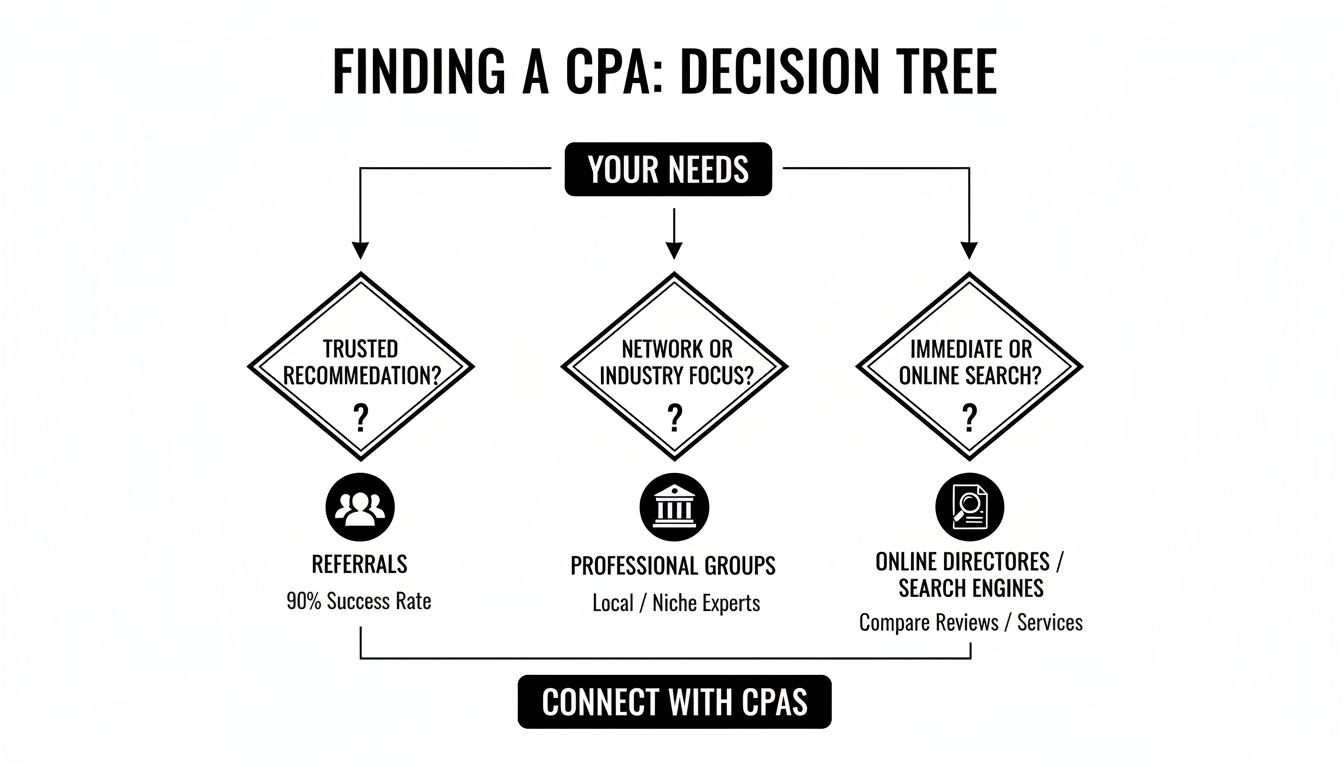
As you can see, whether you start with a referral from a friend or an online search, the next steps involve a systematic process of checking them out to make sure they’re the real deal.
First, Verify Credentials and Understand the Titles
Not all "accountants" are the same, and the letters after their name really do matter. Knowing the difference helps you match the right level of expertise to your needs.
Comparing Financial Professional Credentials
The world of financial pros is filled with acronyms. This table breaks down the most common credentials to help you understand who does what and why it matters for your specific situation.
| Credential | Governing Body | Best For | Key Advantage |
|---|---|---|---|
| Certified Public Accountant (CPA) | State Boards of Accountancy | Comprehensive tax, business advisory, and audit services. | The gold standard. Licensed at the state level with rigorous education and exam requirements. Can represent clients on any IRS matter. |
| Enrolled Agent (EA) | Internal Revenue Service (IRS) | Complex tax issues, IRS disputes, and representation. | Federal license specifically for taxation. EAs are true tax specialists with unlimited practice rights before the IRS. |
| Accountant | Varies (often no single governing body) | General bookkeeping, financial statement preparation, and basic tax returns. | A broad term. Many are skilled, but they don't have the same practice or representation rights as a CPA or EA. |
Choosing the right professional often comes down to the complexity of your finances. While a skilled accountant can handle basic bookkeeping, a CPA or EA brings a higher level of authority and expertise, especially when dealing directly with the IRS.
Always—and I mean always—verify a CPA’s license. Just head to your state’s board of accountancy website. It’s a quick search that confirms their license is active and tells you if they have any disciplinary actions on their record. It's a simple step that provides massive peace of mind.
Why You Absolutely Need a Specialist
A generalist CPA is fine if your financial life fits on a single W-2. But for anything more complex? You need a specialist. Your goal is to find someone who lives and breathes the specific challenges you face every day.
Think about it: a CPA who specializes in real estate will intuitively know the nuances of depreciation schedules, cost segregation studies, and 1031 exchanges that a generalist might have to look up. They save you money because this is their world.
The same goes for crypto. A crypto-savvy CPA understands the tax implications of staking rewards, airdrops, and DeFi lending. You wouldn't ask your family doctor to perform open-heart surgery, so don't ask a general practitioner CPA to handle your highly specialized financial situation. When you interview candidates, ask them point-blank about their experience with clients just like you.
A specialist doesn't just keep you compliant—they proactively find opportunities within your niche to save you money. Their focused knowledge is an investment that can pay for itself many times over.
Learning to Spot the Critical Red Flags
The vetting process is just as much about dodging the wrong CPA as it is about finding the right one. Some red flags are blaring sirens, while others are subtle whispers. Learning to recognize both can save you from a world of financial pain and IRS headaches. The principles of spotting a bad actor are universal, whether you're looking for an accountant or, as detailed in this guide to Finding a Trusted Asset Recovery Company, another type of financial service provider.
Be on high alert for a CPA who:
- Promises a specific refund amount. No ethical professional can guarantee a refund before they’ve even seen your documents. This is a huge red flag and often the signature move of a shady "ghost preparer" who won't even sign your return.
- Has a messy or nonexistent digital footprint. In this day and age, a firm with an outdated website, a ghost town of a LinkedIn profile, or a string of bad online reviews is telling you something. It signals a lack of professionalism or an inability to keep up with the times.
- Is a terrible communicator. If they take forever to respond to your first email or give you vague, wishy-washy answers, just imagine what it’ll be like when you need them during the chaos of tax season.
It’s no secret the accounting profession is facing a talent crunch. Public firms are seeing 15%-22% annual turnover, and with 75% of all CPAs expected to retire in the next 15 years, a firm's stability matters more than ever. The best firms are often the ones that use modern cloud-based tools and create a work environment that attracts and keeps top talent—which translates to better, more consistent service for you.
When you find someone who is both a technical expert and a clear, responsive communicator, you’ve struck gold. If you're still sorting out the different roles, our guide on tax consultants vs. tax advisors can help clarify things even more.
Time to Ask the Right Questions
Think of your first meeting with a potential CPA as less of an interview and more of a two-way conversation. Sure, you're vetting them, but you're also looking for a genuine partner in your financial journey. This is your chance to see past the credentials on their website and get a feel for their communication style, how they think, and whether you actually click.
Walking in with a solid list of questions is key. It helps you steer the conversation and get the answers you need to make a smart decision. I like to group my questions by theme—it keeps the discussion flowing naturally instead of feeling like a rigid interrogation.
Experience and Niche Expertise
This is where you separate the generalists from the specialists. A CPA who knows a little about everything is fine, but one who lives and breathes your specific world—whether that's real estate, e-commerce, or crypto—is invaluable. They'll know the nuances that can save you real money.
Start broad, then drill down into the details that matter to you.
-
"Could you tell me about your experience with clients in [your industry/situation]?"
- What you want to hear: A great answer will involve them talking about other clients with similar profiles (without naming names, of course). They might bring up specific challenges they've helped solve, like navigating cost segregation studies for real estate investors or handling the tax implications of crypto staking rewards.
- What's a red flag: A generic response like, "Oh, we work with all kinds of businesses." That's code for "I don't have the deep expertise you're looking for."
-
"From what you know so far, what are the biggest tax planning opportunities you see for me?"
- What you want to hear: A sharp CPA will immediately start thinking strategically. They might ask a few clarifying questions and then suggest a couple of forward-thinking ideas, like whether an S Corp election makes sense or how to maximize depreciation on a rental property.
- What's a red flag: If their answer is all about filing returns on time and never touches on proactive planning, you're likely talking to a tax preparer, not a strategic advisor.
It’s also smart to check their familiarity with the nitty-gritty. For instance, many small businesses need to understand the IRS rules for 1099 forms, especially when working with contractors or attorneys. A good CPA should know this stuff inside and out.
How They Work: Process and Communication
The most brilliant accountant on earth is useless if they never return your calls. How a CPA runs their practice day-to-day tells you everything about the client experience you can expect. You’re looking for a well-oiled machine, not a chaotic mess.
A CPA’s communication style is a direct reflection of their organizational skills. Clear, timely responses suggest an organized professional who values your partnership; radio silence suggests you’ll be chasing them for answers when it matters most.
Here are a few questions to get to the heart of their process:
- "Who will be my day-to-day contact?" This is a big one. In some firms, you'll meet with a senior partner who then hands your file off to a junior associate. You need to know exactly who you'll be dealing with.
- "What's your typical response time for calls or emails?" A reasonable standard is within 24-48 business hours. If they hesitate or give a vague answer, it could mean they're stretched too thin.
- "How will you keep me in the loop on tax law changes that affect me?" A proactive CPA will have a system, like a newsletter or mid-year check-ins. A reactive one just waits for you to ask.
- "Can you walk me through your new client onboarding process?" A pro will have a clear, step-by-step system for gathering your documents and getting up to speed on your financial history.
The accounting world is facing a major talent crunch right now—the number of people taking the CPA exam in 2022 was the lowest since 2006. This makes it more important than ever to ask about a firm's stability and team structure to ensure you're getting a partner for the long haul.
The Brass Tacks: Technology and Fees
Finally, let's talk tools and money. You need to be on the same page about the technology they use and, just as importantly, how they bill for their services. Getting this wrong can lead to serious frustration.
A modern CPA uses technology to make your life easier.
-
"What software do you use for accounting and communication?" It's good if they're familiar with platforms like QuickBooks Online, but the real question is about security. Ask them how they handle document sharing. A secure client portal is the gold standard; if they're still relying on email attachments for sensitive info, that's a major red flag.
-
"How does your fee structure work? Is it hourly, a fixed fee, or a monthly retainer?" There's no single correct answer here, but transparency is non-negotiable. They should be able to give you a clear estimate based on your conversation. Be very cautious of anyone who gets cagey about costs.
Armed with these questions, you’ll be able to move beyond the sales pitch and find a CPA who is more than just a number cruncher—they'll be a responsive, proactive, and transparent partner invested in your success.
Your Top Questions About Hiring a CPA, Answered
Alright, so you've done the groundwork and you're ready to find a great CPA. But even with a solid game plan, some practical questions always come up as you get closer to making a choice. Let's tackle the most common ones I hear from clients so you can move forward with confidence.
How Much Should I Expect to Pay for a Good CPA?
CPA fees aren't one-size-fits-all—they really depend on where you live, how complicated your finances are, and the CPA's level of experience. For a standard individual tax return, you could be looking at a flat fee anywhere from $300 to over $1,000. It just depends on the moving parts involved.
For small businesses, it's a different story. Many of us work on a monthly retainer, which might range from $500 to several thousand dollars. This usually wraps in ongoing services like bookkeeping, regular advisory calls, and proactive tax planning throughout the year.
The key here is transparency. A good CPA will lay out their pricing structure from the very beginning. They should be able to clearly explain if they charge by the hour, use a flat fee for specific projects, or offer a monthly plan, so you never get hit with a surprise bill.
Should I Go With a Huge National Firm or a Local CPA?
This really boils down to what you actually need. A massive national firm has incredible resources, which is perfect for a big corporation dealing with international tax laws. But for most individuals, investors, and small business owners, that level of firepower is just overkill.
A local firm, like one based right here in San Diego, brings a whole different set of strengths to the table.
- You're a Name, Not a Number: You’re far more likely to build a real, long-term relationship with your CPA, not get handed off to a junior associate every tax season.
- Boots-on-the-Ground Knowledge: They live and breathe California and San Diego-specific tax regulations. That local expertise can be a game-changer.
- They Actually Pick Up the Phone: It's almost always easier to get a quick answer or jump on a call with a smaller, local team that values your business.
For most folks, a dedicated local CPA offers that sweet spot of high-level expertise and a genuinely personal partnership.
"A great local CPA doesn't just know the tax code; they know the community. They understand the local economic landscape and can provide advice that's tailored to your specific environment, whether you're in Clairemont or across the county."
When Is the Best Time of Year to Look for a New CPA?
Timing is everything. If you want my honest advice, the absolute best time to find and switch to a new CPA is during the off-season, which is roughly May through November.
During these calmer months, accountants have way more bandwidth. We can take the time to really dig into your financial history, answer your questions without one eye on the clock, and make sure your onboarding is smooth and thorough. Trying to hire someone new between January and April is a nightmare—we're all completely buried in deadlines for our existing clients.
What Documents Should I Have Ready for Our First Meeting?
Want to make that first consultation incredibly productive? Come prepared. Having your key documents ready helps a potential CPA get a clear picture of your situation fast, which means they can give you a much more accurate quote.
Try to pull these things together before your meeting:
- Tax Returns: Your personal and business returns from the last two years are perfect.
- Official Mail: Any letters or notices from the IRS or state tax agencies are a must-have.
- Business Financials: If you own a business, have your profit and loss statement and balance sheet on hand.
- Software Access: Be ready to grant temporary access to your bookkeeping software, like QuickBooks.
It also helps to jot down a quick list of your biggest questions and financial goals. Showing up organized demonstrates that you're serious and helps kick off the relationship on a really positive note.
At Allied Tax Advisors, we believe finding the right CPA is about building a lasting partnership. Our San Diego-based team is dedicated to providing the clear, proactive, and personalized guidance you deserve. Whether you're navigating crypto gains, managing rental properties, or growing your small business, we're here to help you achieve your financial goals. Schedule your consultation with Allied Tax Advisors today.