
You bought a piece of equipment, signed the credit card slip, and handed the receipt to your bookkeeper. Then the real question shows up. Do you treat that purchase like this month's office supplies and move on, or do you capitalize it and carry it on the books over time?
That choice affects more than bookkeeping. It changes what shows up on your profit and loss statement, what sits on your balance sheet, how clean your records look at tax time, and how much work you create for yourself later. Small business owners often get stuck here because the rules sound technical, but the decision usually becomes much clearer once you use a simple framework.
The practical way to handle it is to think in a sequence. First decide whether the cost should be expensed or capitalized. Then record it correctly in your books. Then look at the tax treatment, because book treatment and tax deductions don't always move in lockstep. If you want consistency year after year, put those rules into a short written policy and follow it.
Table of Contents
- Capitalize vs Expense The Fundamental Decision
- IRS Safe Harbors That Simplify Your Life
- How to Record Capital Assets in Your Books
- Unlocking Tax Savings With Depreciation
- Creating a Bulletproof Capitalization Policy
- Conclusion Your Path to Financial Clarity
Capitalize vs Expense The Fundamental Decision
A simple example helps. Your business buys a new machine, computer setup, or service vehicle. The first question isn't whether it was necessary. The question is whether that purchase gives your business value only now, or whether it keeps helping the business over a longer period.
Start with future benefit
The cleanest rule of thumb is the one-year idea. If the item is used up quickly or mainly benefits the current period, it usually belongs in expense. If it's expected to help the business over more than one year, it may belong on the balance sheet as an asset.
That's what accountants mean by future benefit. You're matching cost to the period that receives the benefit. A box of printer paper helps this month. A new copier helps for years. The paper gets expensed now. The copier is usually capitalized and recovered over time.
A purchase is more likely to be capitalized when it checks these boxes:
- Longer useful life: You expect to use it well beyond the current year.
- Business use: It supports normal operations, not personal use.
- Meaningful cost: It's significant enough that tracking it as an asset makes sense.
- Placed in service cost: The total includes what it took to get the asset ready for use, not just the sticker price.
Practical rule: If replacing the item feels like buying a tool your business will rely on for a while, pause before posting it to repairs, supplies, or miscellaneous expense.
What each choice does to your financial statements
When you expense an item, the full cost hits the profit and loss statement right away. That lowers current-period profit. It also keeps the balance sheet simpler because no long-term asset gets added.
When you capitalize an item, you record it on the balance sheet first. Then you recognize the cost gradually through depreciation or amortization. Profit usually looks higher in the year of purchase than it would if you expensed everything immediately, because only part of the cost flows through the income statement at first.
That difference matters in real life:
- For lenders: Financial statements can look stronger when major long-term purchases are capitalized appropriately instead of dumped into one month's expenses.
- For owners: Current profit may look healthier, but that doesn't mean cash stayed in the business. The cash still went out the door.
- For taxes: Book accounting and tax treatment may differ. You might capitalize an item on the books and still have options to accelerate the tax deduction later.
Here's the analogy I use with clients. Expensing is like eating the whole meal cost today. Capitalizing is like buying a freezer, then recognizing that the freezer helps you store food for years. One is consumed quickly. The other keeps serving the business.
A common mistake is treating every large payment as an asset and every small payment as an expense. Cost matters, but useful life is the starting point. Another mistake is capitalizing routine costs that keep existing equipment running. If the spending doesn't create a new long-term benefit, capitalization may overstate your assets.
The best first-pass question is simple: Did this purchase create or improve something the business will keep using over time? If yes, you may need to capitalize an expense rather than deduct it immediately.
IRS Safe Harbors That Simplify Your Life
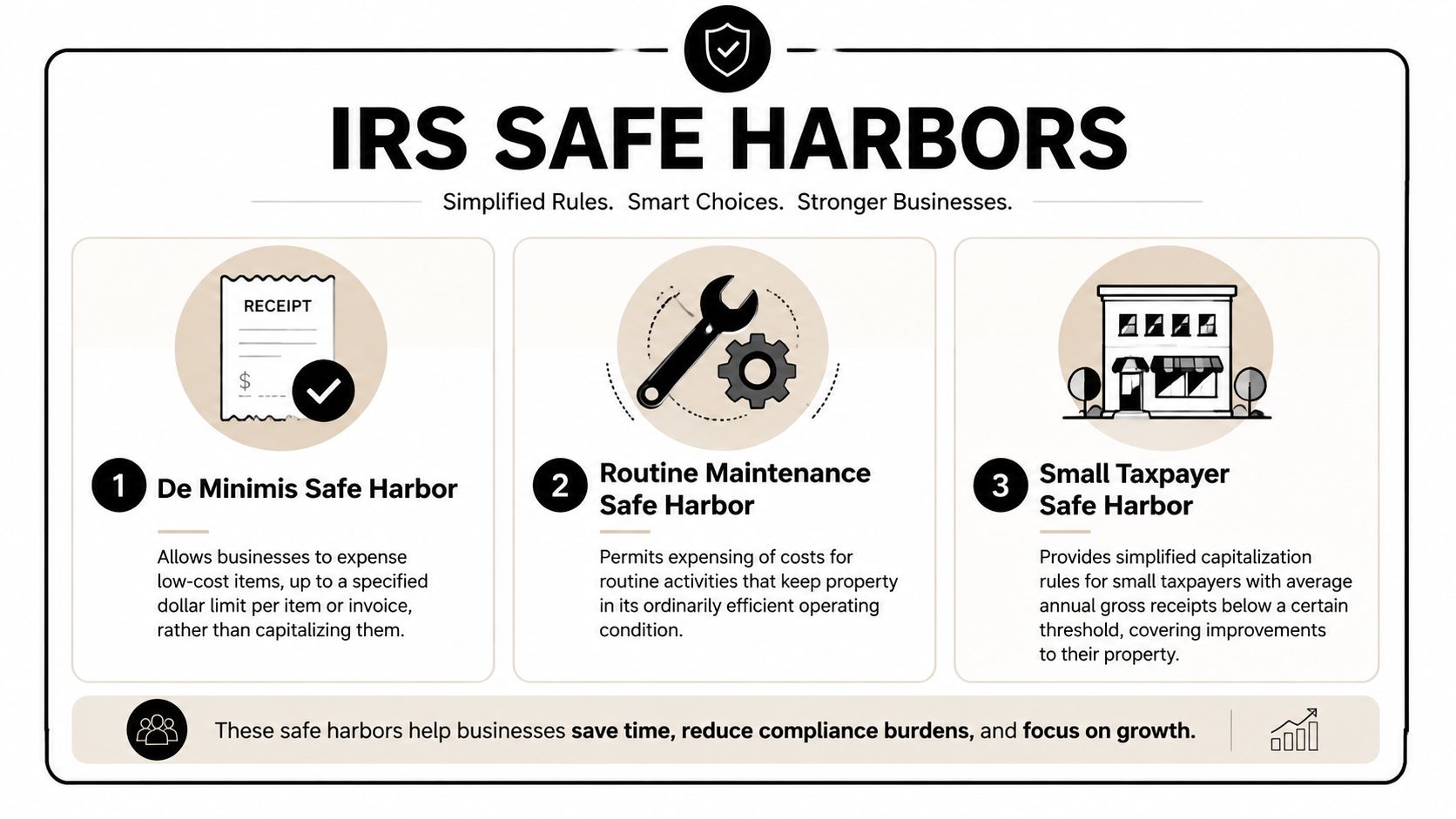
Tax rules around capitalization can turn routine bookkeeping into a slog. Safe harbors exist to reduce that friction. They don't eliminate judgment, but they can make the day-to-day decisions much easier if you use them correctly.
The de minimis election in plain English
The most useful shortcut for many small businesses is the de minimis safe harbor election. It allows qualifying businesses to expense lower-cost items instead of capitalizing them, as long as they meet the rule requirements and apply them consistently.
The threshold depends on whether the business has an applicable audited financial statement. Businesses without that type of statement can generally expense items up to a lower threshold per invoice or per item. Businesses with it may use a higher threshold. The election is made annually with the tax return, and a written capitalization policy should be in place at the start of the tax year if you want the strongest support for your treatment.
What matters in practice is this:
- It reduces clutter: You don't need a fixed asset schedule full of minor equipment.
- It saves time: Your bookkeeper can post qualifying purchases directly to expense.
- It works only with consistency: If similar items bounce back and forth between fixed assets and expense, your records become hard to defend.
If you want a broader explanation of accelerated write-offs after you've handled the capitalization decision, this overview of how bonus depreciation works is a useful next read.
Use safe harbors to simplify real bookkeeping. Don't use them as a reason to stop documenting what you bought and why you treated it that way.
Repairs versus improvements
The lack of a clear distinction often results in messy files. A repair generally keeps property in ordinarily efficient operating condition. An improvement usually makes the property better, adapts it to a new use, or restores it in a more substantial way.
A practical way to think about the improvement analysis is the BAR framework:
- Betterment: Did the work materially improve the property or correct a significant defect?
- Adaptation: Did you change the property so it serves a new or different use?
- Restoration: Did you rebuild, replace a major component, or return the property after serious deterioration?
If the answer points toward one of those categories, capitalization becomes more likely. If the work only keeps the asset functioning as expected, expensing may be appropriate.
Routine maintenance often falls on the expense side. Replacing worn parts, servicing equipment, and ordinary upkeep usually don't create a separate long-term asset. By contrast, a major remodel, structural upgrade, or substantial system replacement often belongs in fixed assets.
A lot of trouble comes from invoice descriptions that are too vague. “Building work” tells you nothing. “Patched wall damage and repainted suite” points toward repair. “Converted storage area into production room” points toward adaptation. Good descriptions make better tax treatment possible.
How to Record Capital Assets in Your Books
Once you decide to capitalize an expense, the next job is to keep the books clean. However, good intentions often fall apart. The owner knows something should be capitalized, but the transaction gets posted to office expense, equipment repair, or uncategorized asset and sits there until year-end.

The basic journal entry logic
The accounting entry is straightforward.
If you expense the purchase immediately, the basic logic is:
- Debit expense
- Credit cash or credit accounts payable
If you capitalize the purchase, the logic changes to:
- Debit fixed asset
- Credit cash or credit accounts payable
Later, you record depreciation separately:
- Debit depreciation expense
- Credit accumulated depreciation
That last step matters because it preserves the original asset cost on the balance sheet while showing how much of that cost has been recognized over time.
Here's the mistake I see most often. Owners post the purchase to a fixed asset account and then forget to track depreciation, disposal, trade-in value, or whether the asset is still in service. A fixed asset schedule isn't just a tax formality. It's your inventory of long-lived costs.
Bookkeeping checkpoint: If you can't answer when you bought it, what account it lives in, and whether you're still using it, your fixed asset register needs work.
How this looks in QuickBooks Online
In QuickBooks Online, start by making sure your account list is organized. If you need a refresher on account structure, this guide to the chart of accounts in QuickBooks helps frame where fixed assets belong.
Then work through the asset setup deliberately:
- Create or confirm the fixed asset account. Common examples are Furniture and Equipment, Vehicles, Computer Equipment, or Leasehold Improvements.
- Enter the purchase with the correct date. Use the actual in-service date, not just the day the bank feed imported it.
- Include the full capitalized cost. That may include delivery, installation, setup, and other amounts needed to place the asset into service.
- Write a useful description. “Dell laptop for front desk check-in station” is better than “computer.”
- Assign a vendor and keep the source document. Attach the invoice or receipt inside QuickBooks if you can.
QuickBooks can store the purchase entry, but many businesses still rely on their accountant or an outside app for depreciation schedules. That's normal. The key is that the asset is posted to the right place from day one so the year-end adjusting entries aren't guesswork.
A workable fixed asset record should include:
- What it is
- When it was placed in service
- What it cost
- Which account it belongs to
- How it will be depreciated for books and tax
- Whether it has been sold, scrapped, or traded in
If you build that habit early, year-end closes become much smoother.
Unlocking Tax Savings With Depreciation
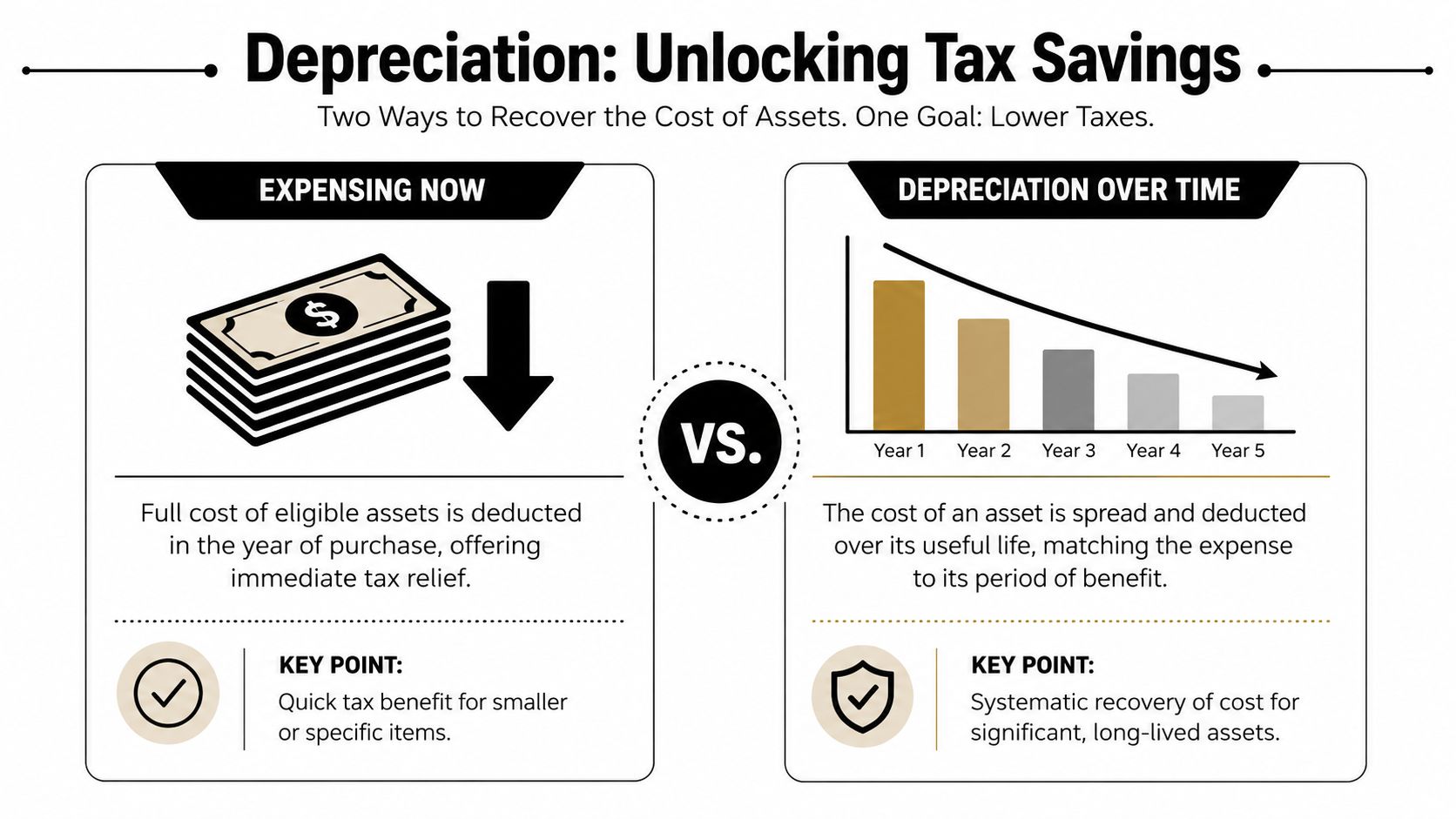
Capitalizing an asset doesn't mean you've lost the deduction. It means the deduction is usually recovered over time, and the method you choose can change the timing in a meaningful way.
Book depreciation versus tax depreciation
For financial statements, depreciation is about matching cost to useful life. For tax, depreciation is often driven by tax law categories, recovery periods, and elections. Those two systems can line up, but they don't have to.
The standard tax framework many businesses hear about is MACRS. It spreads deductions over the recovery life assigned under tax rules. That approach is often the default when no special election is made.
If you want a plain-language refresher before deciding which route fits your return, this essential guide on depreciation for small businesses gives helpful context on how depreciation works in everyday accounting.
Where Section 179 fits
Section 179 can allow a business to deduct the cost of qualifying property in the year it's placed in service instead of recovering it gradually. For many owners, this is the tax tool they're really asking about when they say, “Can I just write the whole thing off?”
Sometimes yes. Sometimes not. Eligibility depends on the type of asset, how it's used, taxable income limitations, and other return-specific factors.
Section 179 is often attractive when:
- You want current-year deduction now: The business has taxable income and can benefit from the immediate write-off.
- You're buying qualifying equipment or certain other property: Tangible business assets are common candidates.
- You want control: Section 179 is elective, so it can be selectively applied rather than applied automatically across every eligible asset.
The trap is using Section 179 without thinking about the bigger picture. An immediate deduction sounds great until it creates a weak year for financial reporting, burns a deduction in a year when your tax rate is already low, or complicates state treatment.
Bonus depreciation and practical trade offs
Bonus depreciation also accelerates cost recovery, but it operates differently from Section 179. It generally follows its own eligibility rules and can apply more broadly in some cases. Depending on the year and the property involved, bonus depreciation may produce a larger immediate deduction than standard depreciation.
For many business owners, the true planning question isn't “Which method gives the biggest write-off?” It's “Which method gives the right write-off for this year and this business?”
Here's the practical comparison:
| Method | How it generally works | Best fit |
|---|---|---|
| Standard depreciation | Deducts cost over time under tax recovery rules | When you want smoother deductions across years |
| Section 179 | Elects immediate expensing for qualifying assets | When current-year taxable income supports a faster deduction |
| Bonus depreciation | Accelerates deduction under separate tax rules | When eligible property and timing make front-loading attractive |
A vehicle purchase is a good example of why advice must be customized. The deduction outcome can vary based on business-use percentage, vehicle type, listed property rules, and whether Section 179 or bonus depreciation applies. Two owners can buy similar vehicles and have very different tax results.
That's why it helps to run the options before filing. A side-by-side estimate often reveals that the “obvious” choice isn't always the best one. If you want the mechanics behind the calculations, this walkthrough on how to calculate depreciation is the right technical companion.
Creating a Bulletproof Capitalization Policy
A capitalization policy sounds formal, but it's really just a written set of house rules. Without one, businesses tend to treat similar purchases differently depending on who entered the bill, how busy the month was, or whether year-end tax planning happened late.
That inconsistency causes problems fast. Financial statements become harder to compare from one period to the next. The tax file gets patched together after the fact. During an audit or lender review, nobody can explain why one equipment purchase was capitalized while a nearly identical one was expensed.
Why a policy matters even for a small shop
A good policy does three things.
First, it creates consistency. If the business buys tablets for the field team this quarter and replacement tablets next quarter, the treatment should be the same unless the facts changed.
Second, it improves delegation. Your bookkeeper doesn't need to text you every time a bill comes in for equipment, furniture, or improvements. They can follow the policy.
Third, it strengthens documentation. If the IRS asks why you expensed some items under your threshold and capitalized others above it, your answer is already in writing.
A useful policy should address:
- Threshold: At what amount will the business generally capitalize items rather than expense them?
- Useful life guidance: How will common asset classes typically be treated?
- Repairs versus improvements: Who decides when a cost should move to fixed assets?
- Documentation: What invoice detail is required before posting?
- Review process: Who approves unusual or borderline items?
A policy doesn't eliminate judgment. It gives judgment a framework, which is what keeps your books defensible.
Sample Capitalization Policy Template
Use this as a starting point and tailor it to your business, industry, and tax posture.
Sample policy language
The business will capitalize purchases of property and equipment that provide a benefit beyond the current year and exceed the company's capitalization threshold. Costs below the threshold will generally be expensed, unless the item is part of a larger asset or project that should be capitalized as a whole.
The capitalized cost will include amounts paid to acquire and place the asset into service. Routine repairs and maintenance will generally be expensed. Improvements that better, adapt, or restore existing property will be reviewed for capitalization. Management reserves the right to capitalize any item when doing so more fairly presents the financial statements.
Sample Capitalization Policy Template
| Asset Class | Capitalization Threshold | Useful Life (Years) |
|---|---|---|
| Computer equipment | Company policy threshold | Based on company policy |
| Office furniture | Company policy threshold | Based on company policy |
| Machinery and equipment | Company policy threshold | Based on company policy |
| Vehicles | Company policy threshold | Based on company policy |
| Leasehold improvements | Company policy threshold | Based on company policy |
Keep the template simple enough that people will use it. If your policy is too technical, your team will bypass it and post everything to miscellaneous expense. That defeats the purpose.
One practical habit helps more than people expect. Review your fixed asset additions at least monthly, not just at tax time. That catches coding errors while the invoices are still easy to find and the details are still fresh.
Conclusion Your Path to Financial Clarity
When you need to capitalize an expense, the decision isn't just about compliance. It's about presenting your business accurately, keeping your books usable, and choosing a tax strategy that fits the year you're having.
The core framework is straightforward. If a cost creates future benefit, capitalization moves into the conversation. If safe harbors apply, they can simplify your process. If an item is capitalized, your books need a clean asset record and a plan for depreciation. If you want those decisions to stay consistent, put them into a written policy and follow it.
Most bookkeeping problems in this area don't come from complicated tax law. They come from inconsistent handling, vague invoices, and rushed year-end cleanup. The businesses that handle this well make the decision early, document it clearly, and review fixed asset activity throughout the year.
That's also where tax planning becomes more useful. A purchase can be right for operations and still need careful timing for tax purposes. Section 179, bonus depreciation, and standard depreciation each have a place. The best answer depends on your income, the type of asset, and how you want deductions to land across years.
If your books are messy or you're making larger purchases this year, don't wait until return prep to sort it out.
If you want help setting a capitalization policy, cleaning up fixed assets, or planning the tax treatment of major purchases before year-end, Allied Tax Advisors can help you build a clear process that supports both accurate books and smarter tax decisions.