
You're paying for care so you can keep working, and that usually means two separate headaches land in the same week, the child care bill and the tax return. The Dependent Care Tax Credit can help, but only if you line up the rules correctly, especially when an employer FSA or a state credit is also in the mix. A lot of families miss savings because they assume every child care dollar works the same way on the return, and it doesn't.
Table of Contents
- Understanding the Dependent Care Tax Credit
- Who Qualifies for the Dependent Care Credit
- Identifying Qualified Care Expenses
- How the Credit Is Calculated
- Coordinating with Employer Benefits and State Credits
- How to Claim the Credit on Your Tax Return
- Common Mistakes and When to Consult a CPA
Understanding the Dependent Care Tax Credit
A parent can do everything right during the week, then reach tax time and wonder whether those daycare receipts help. The Child and Dependent Care Tax Credit, often called the CDCTC, is the federal credit that addresses that problem for working taxpayers who pay for qualifying care so they can work, look for work, or attend school. It is nonrefundable, so it can reduce tax but does not create a refund by itself.

A credit directly reduces tax, while a deduction only lowers taxable income. If that distinction still feels fuzzy, this plain-English explanation of tax deductions vs. tax credits shows why the difference matters so much here.
Why this credit still confuses people
The rules sound simple at first, then the details start stacking up. Under the standard pre-2021 framework, the credit is based on up to $3,000 of expenses for one qualifying person or $6,000 for two or more, with a rate that ranges from 35% down to 20% as AGI rises, beginning to phase down at $15,000 and reaching 20% once AGI exceeds $43,000.
That older structure matters because it explains why the credit has often felt narrow. The federal rules have changed over time, and the temporary expansion in tax year 2021 showed how different the credit can look when Congress raises the expense limit and the percentage applied to those expenses.
Practical rule: the federal credit is most useful when you have both qualifying care expenses and enough tax liability to use it.
Who Qualifies for the Dependent Care Credit
A good way to sort out this credit is to ask three questions in order. Was the expense work-related. Do you have earned income. Did you identify the care provider on Form 2441 (IRS). If any one of those answers fails, the credit usually falls apart.
The taxpayer test
The credit is built for working households, not just households with child care bills. The care has to help you work, or help your spouse work if you file jointly, and the general rule is that you need earned income to support the claim.
For many readers, earned income is the first point of confusion. Earned income includes wages and self-employment income, money from active work, not passive returns from savings or investments.
The qualifying person test
The care has to be for a qualifying person, which is usually a child under age 13 or another dependent who can't care for themselves. That matters because the credit is tied to the dependent, not just to the fact that you paid someone to watch a child.
A qualifying child for this credit isn't the same thing as a child care expense. The child has to fit the tax rule first, then the expense has to fit the work rule.
The work-related purpose test
The expense has to exist so you can work or look for work. If a babysitter is covering you while you're at your job interview, that can fit the purpose of the credit, but if the payment is really for convenience rather than work access, the IRS may not view it the same way.
Marital status also matters in practice. A married couple filing jointly generally has to satisfy the work-related rule for both spouses, and if you are trying to sort out income definitions while you plan the return, a review of adjusted gross income can help you see where the credit percentage starts to change. For parents comparing federal rules with employer benefits and state programs, this is also the point to check whether a dependent care FSA changes the amount left for the federal credit. If your care arrangement includes a birth support provider, you may also want to review how to deduct birth support so you do not mix up a personal expense with a qualifying care cost.
Identifying Qualified Care Expenses
Not every family expense that feels child-related counts. The IRS draws a line between care that lets you work and expenses that are really education, enrichment, or personal convenience, so the safest habit is to ask, “Did this payment buy me working time?” before you add it to your tax file.
What usually counts
Payments to daycare centers, babysitters, and summer day camps are the kinds of expenses families usually think of first. The key is that the service has to be care, not schooling, and it has to support your ability to work.
Care for a dependent child can also qualify in other practical settings, as long as the work-related requirement is met. The details matter more than the label on the invoice, which is why provider records and payment descriptions should stay clean.
What usually doesn't count
Private school tuition is the classic misunderstanding. Even if tuition includes a supervised environment, the IRS doesn't treat ordinary tuition as a dependent care expense for this credit.
Overnight camps are another common trap. A summer day camp can fit, but the overnight version usually doesn't because the service is no longer just daytime care. That distinction matters more than parents expect when they're filling a summer calendar.
Relatives, informal care, and real-life gray areas
Payments to a relative can be tricky, because family help doesn't automatically become a qualifying tax expense. The deciding issue is still whether the person is providing qualifying care under the IRS rules and whether the provider information is properly reported.
If you're comparing this kind of child care planning with other family-service expenses, a separate guide on how to deduct birth support can be useful context, even though it's dealing with a different tax question entirely.
Keep the invoice, the provider's identity, and the purpose of the care aligned. If any one of those pieces is fuzzy, the expense gets harder to defend.
How the Credit Is Calculated
A family's child care bill can look simple on paper and still be hard to translate into a tax credit. The calculation becomes clearer if you treat it like a short checklist. First, sort out which expenses qualify. Then apply the expense cap. After that, use your income to find the credit rate. The result is the amount of credit you can claim.
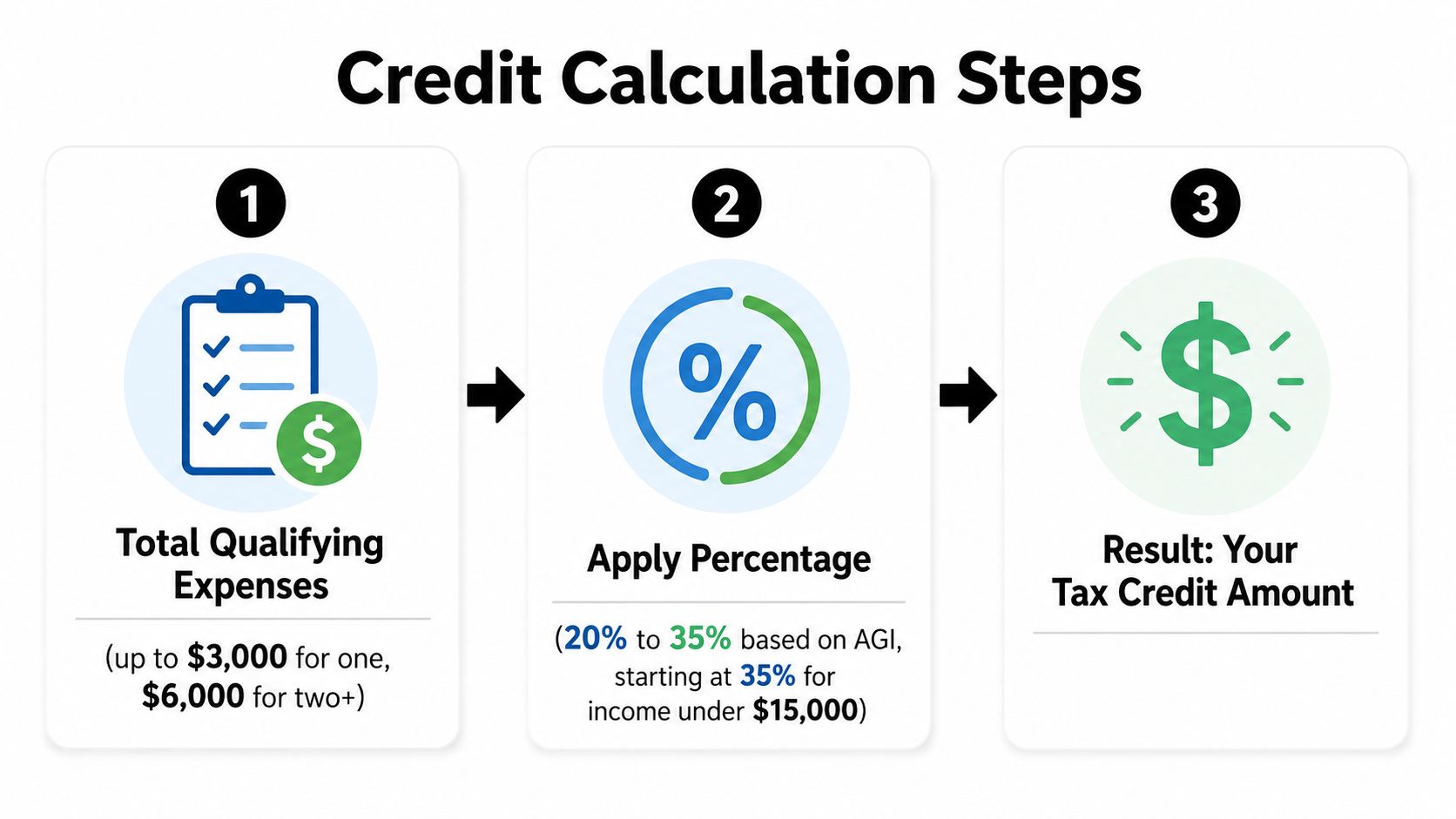
Step one, start with the expense cap
The federal rules do not let you use every dollar of child care cost. You can count only up to $3,000 of expenses for one qualifying person or $6,000 for two or more when figuring the credit. That is why a family may spend far more on care than the tax form will recognize.
The Tax Policy Center explains the same basic idea in plain terms. The credit is limited by an expense cap and is nonrefundable, so it can lower the tax you owe, but it cannot create a refund beyond your liability (Tax Policy Center).
Step two, apply the percentage
Once you know the qualifying expense amount, the next layer is the credit rate. Under regular law, the rate runs from 20% to 35%, and it falls as AGI rises. A larger bill does not automatically mean a larger credit. Income can pull the credit down even when the care costs stay the same.
That is why two families with the same daycare invoice can end up with very different tax results. If one family lands in a higher income bracket, the percentage applied to the cap is lower, so the tax benefit shrinks.
Step three, watch the nonrefundable limit
A credit is only helpful if you have tax for it to offset. Because this one is nonrefundable, it can reduce your federal tax to zero, but it does not pay you back for more than you owe. Families with low federal income tax liability may not be able to use the full credit even when their care costs are well above the cap.
Step four, check the temporary 2021 benchmark
The temporary 2021 rules were much more generous. The rate was 50%, the expense limits were higher, and the Senate Joint Economic Committee said the expansion made over 9.1 million families eligible for an average credit of $2,244 (Senate Joint Economic Committee). That older benchmark helps explain why the current rules can feel tight by comparison.
A practical way to think about the credit is to compare it with a payroll deduction. If you use a dependent care FSA, part of your care cost may already be paid with pre-tax dollars, which leaves less expense available for the credit. The Superstar Nannies tax guide is a helpful reference for the reporting side of caregiver payments, especially when you are checking whether the payroll records and the credit calculation line up.
Coordinating with Employer Benefits and State Credits
A common planning mistake is treating all child care help as if it works the same way. The federal credit, a dependent care FSA, and state credits can all affect the same family budget, but each one uses a different rule set. If you line them up in the wrong order, you can accidentally count the same expense twice or leave tax savings on the table.
Employer FSA first, credit second
A dependent care FSA lets you set aside pre-tax dollars for dependent care, which lowers taxable income during the year (WEX Benefits). That is useful on its own, but it also reduces the pool of expenses that can be used for the federal credit, because any reimbursed or pre-tax amount has to be removed before the credit is calculated.
The easiest way to think about it is as a two-step ledger. First, the FSA comes off the top. Then the remaining out-of-pocket child care costs are the ones that may still count for the credit.
Choosing between the two
The better fit depends on how much child care you pay, how much your employer plan covers, and whether your federal tax bill is large enough to use the credit. If your annual care costs are well above the FSA amount, you may still have qualifying expenses left after the FSA is used.
Careful planning matters. A dependent care FSA can produce tax savings through payroll, while the federal credit depends on your remaining eligible expenses and your tax situation, so the right choice is often about balance rather than picking one benefit and ignoring the other.
California residents can often stack more
For San Diego families, the state layer deserves a separate look because California has its own Child and Dependent Care Expenses Credit. That means the federal return is not always the end of the story, and a household may be able to use both a federal benefit and a state benefit if the facts fit.
A broader comparison of family benefit systems in other countries can help clarify the idea of coordination. The article on understanding Tax-Free Childcare vs vouchers gives a useful outside point of reference, even though the tax rules are different from U.S. law.
Planning rule: treat the employer benefit as the first filter, then see what expenses remain for the federal return, then check the state return separately.
How to Claim the Credit on Your Tax Return
Filing is the point where the credit stops being an idea and becomes part of your return. The IRS expects the provider details, the dependent information, and the correct form, so one missing piece can slow the filing process or keep the credit from showing up the way you expected.
What to gather before you file
Keep the name, address, and Taxpayer Identification Number (TIN) of your care provider. You also need Form 2441, Child and Dependent Care Expenses, because that is where the earned-income rules and the dollar limits are applied before the credit is figured.
If your provider is a daycare center, a babysitter, or another paid caregiver, gather the year-end records before filing season starts. Reconstructing payments later from bank statements is possible, but it creates avoidable confusion and makes it easier to miss something.
How Form 2441 functions
Form 2441 is the bridge between your receipts and the credit on the return. It ties together who received care, who provided it, and whether the expenses fit the work-related rule.
A clean filing package usually includes:
- Provider identity details. Name, address, and TIN exactly as reported.
- Payment records. Enough proof to show the amounts were paid.
- Dependent details. The child or other qualifying person tied to the claim.
- Benefit coordination records. Any employer FSA reimbursements or pre-tax amounts that reduced your eligible expenses.
Why this step deserves care
The most common filing errors come from having a valid expense but incomplete paperwork. The IRS reads forms, not intentions, so a careful return is the difference between a smooth credit claim and a notice that sends you back to the records.
If your return includes multiple care providers, split schedules, or an employer benefit on top of the federal credit, review the paperwork before you file. If you want help deciding whether your return needs a second look, this guide on how to find a good CPA is a practical place to start.
Common Mistakes and When to Consult a CPA
A family can do most of the credit correctly and still miss the mark because one piece was handled in isolation. The usual trouble spots are counting expenses that do not qualify, overlooking how an employer FSA reduces the expenses left for the federal credit, or assuming every child care payment counts without checking the provider details on Form 2441.
The errors I see most often
One frequent mistake is treating the credit like a general child care subsidy. It works more like a narrow tax rule, tied to work-related care and limited by your tax liability, so a family can meet the care requirement and still receive less than expected.
Another common issue is benefit coordination. If your employer offered a dependent care FSA, those reimbursed dollars cannot be counted again for the federal credit, so the planning has to happen before the year ends, not on filing day. It is like pouring water into two pitchers and expecting the same gallon to fill both.
State credits can add another layer. A credit from California or another state may follow its own rules, so the federal return and the state return should be checked together instead of treated like separate puzzles.
When professional help makes sense
Some returns deserve a second set of eyes because the rules start to overlap quickly. Self-employment, divorce or shared custody arrangements, and income changes can all affect how the credit works in practice, and those facts deserve a careful review.
If you are trying to choose the right person to help, this guide on how to find a good CPA is a practical place to start.
A CPA can also help you sort out the order of operations. First come the qualified expenses, then any employer FSA amounts, then the federal credit, and then any state credit that may apply. That sequence matters because the wrong order can make a return look right on paper while still missing part of the benefit.
If the credit affects your year-end planning, do not wait until the refund is already delayed. A quick review before filing can prevent a much longer cleanup later.
If your child care costs, employer benefits, and federal credit all meet in the same tax return, Allied Tax Advisors can help you sort through the rules with a clear plan instead of guesswork. Visit Allied Tax Advisors to get personalized tax guidance that matches your family's situation and helps you claim the dependent care tax credit correctly.