
A San Diego business owner can make a smart decision on paper and still choose the wrong entity for California. A solo consultant in North Park might see the familiar federal S corporation pitch, while a two-person agency in Kearny Mesa may prefer an LLC's flexibility. Both can work, but California adds its own layer of franchise taxes, gross-receipts fees, payroll requirements, and filing obligations.
The right answer depends on more than profit. You need to compare California entity-level tax, owner payroll, liability protection, ownership plans, administrative tolerance, and whether your income comes from active services or passive investments. This guide puts the California Franchise Tax Board rules at the center of the decision, then turns them into practical recommendations.
Table of Contents
- The California Entity Decision Most Owners Get Wrong
- Formation Steps and First-Year Costs in California
- How California Taxes Each Entity at the FTB Level
- Liability Protection and Governance Compared
- Owner-Level Taxes Including Payroll and PTE Elective
- Which Owners Should Pick Which Entity
- Your Decision Checklist and Next Steps With Allied Tax Advisors
The California Entity Decision Most Owners Get Wrong
Consider a freelance UX designer who clears a strong year serving technology companies from a home office in North Park. The business has one owner, no outside investors, and relatively few expenses. The owner has heard that an S corporation can reduce payroll-tax exposure by dividing compensation between wages and distributions. The LLC, meanwhile, sounds easier and more flexible.
That comparison is incomplete. In California, a plain LLC owes the $800 annual minimum franchise tax, and an LLC with California-source gross receipts of $250,000 or more can owe a separate graduated fee. The California Franchise Tax Board's LLC guidance lists the fee tiers, including $900 for receipts from $250,000 to $499,999, $2,500 from $500,000 to $999,999, $6,000 from $1,000,000 to $4,999,999, and $11,790 at $5,000,000 or more.
An S corporation has a different California calculation. The state imposes 1.5% of S corporation net income, subject to an $800 minimum, as described in the California S corporation tax comparison. The tax is tied to profit, not gross receipts. That distinction matters for businesses with high revenue and modest margins.
Planning rule: Never compare an LLC and an S corporation using federal payroll-tax savings alone. Put the California FTB charge, payroll administration, and owner-level tax treatment on the same worksheet.
Here's the practical takeaway for a small owner:
- A plain LLC usually wins on simplicity. It works well when ownership may change, profits fluctuate, or the business has passive or rental income.
- An S corporation can win for a profitable owner-operated service business. The owner must run payroll, pay a defensible salary, and maintain clean books.
- California revenue matters separately from profit. An LLC can face a gross-receipts fee even when its profit margin is not especially high.
- The election isn't permanent in spirit. Your business can revisit the tax classification as profit, ownership, payroll, and investment plans change.
A $100,000 profit year may look similar under both structures at first glance. The actual answer changes once California's fixed charges, gross-receipts rules, 1.5% S corporation tax, payroll costs, and owner distributions enter the analysis.
Formation Steps and First-Year Costs in California
California formation starts with the legal entity, not the tax election. A business owner generally files LLC formation documents with the California Secretary of State, creates an operating agreement, obtains an EIN from the IRS, and opens a dedicated business bank account. The legal documents establish how the company operates, while the bank account and bookkeeping records help preserve separation between business and personal finances.
For an LLC, the first-year planning file should include:
- Articles of Organization. The California filing fee is $70, according to the state's formation fee schedule referenced in the startup-cost guidance from Allied Tax Advisors.
- Operating agreement. Even a single-member LLC benefits from written rules covering ownership, authority, contributions, and distributions.
- EIN and banking. Use the EIN to identify the business and keep business revenue and expenses separate.
- Statement of Information. An LLC generally files this every two years, with a $20 fee under the plan's California cost assumptions.
- FTB registration and tax planning. Budget for the $800 minimum franchise tax in the first year, subject to the applicable California rules for the entity and filing period.
An LLC that elects S corporation treatment still begins as an LLC under California law. The owner then files IRS Form 2553 for the federal election and sets up payroll before taking owner compensation. California filing treatment follows the S corporation classification, including the requirement to file Form 100S once the business has income and the election applies.
Formation and Year-One Costs
| Cost Item | Plain LLC | LLC with S Corp Election |
|---|---|---|
| California formation filing | $70 | $70 |
| Operating agreement or governing documents | Varies | Varies |
| EIN and business bank account | Usually no government fee | Usually no government fee |
| California Statement of Information | $20 every two years | LLC filing cycle applies, plus S corporation filings |
| California minimum franchise tax | $800 | $800 minimum, with S corporation tax rules also applying |
| Federal tax election | Not applicable | Form 2553 |
| Payroll setup and processing | Usually not required for owner draws | Required for owner-employees receiving wages |
| Registered-agent or office service | Optional, varies | Optional, varies |
The S corporation election doesn't create a new legal entity by itself. It changes the tax classification and adds payroll, corporate tax filing, and compensation controls. Owners considering an investment-focused structure should also review specialized guidance on structuring your investing LLC because an operating service company and a property-holding company often need different planning.
A realistic first-year budget should include the state formation filing, legal or document-preparation help, the California minimum tax, bookkeeping, payroll if elected, tax preparation, and any registered-agent service. Don't treat the $70 filing fee as the cost of becoming operational. The recurring compliance workload usually drives the larger difference between a plain LLC and an S corporation election.
How California Taxes Each Entity at the FTB Level
California draws a sharp line between a default LLC and an LLC taxed as an S corporation. A California LLC generally owes the $800 minimum franchise tax, plus an LLC fee based on California-source gross receipts once those receipts reach $250,000. The FTB treatment for an LLC taxed as a corporation confirms that an LLC and an S corporation don't use the same state-level calculation.
For a plain LLC, the critical figure is gross receipts, not profit. The published fee table assigns $0 below $250,000, $900 from $250,000 to $499,999, $2,500 from $500,000 to $999,999, $6,000 from $1,000,000 to $4,999,999, and $11,790 at $5,000,000 or more. Those amounts are separate from the annual $800 minimum tax.
An S corporation uses net income as the key base. California imposes 1.5% of S corporation net income, with an $800 minimum tax floor. It doesn't use the LLC's gross-receipts fee schedule because the underlying legal entity began as an LLC.
FTB Exposure at Three Profit Levels
The table below isolates the state-level mechanics. It assumes the LLC's California-source gross receipts fall into the same general range as the profit level shown, which may not be true for every business. It also omits owner-level income tax, payroll tax, deductions, credits, and other taxes.
| Profit Level | Plain LLC FTB Tax | LLC with S Corp Election FTB Tax |
|---|---|---|
| $150,000 | $800 minimum, with no LLC gross-receipts fee below $250,000 | $800 minimum because 1.5% of profit is below the minimum |
| $400,000 | $800 minimum plus $900 LLC fee | 1.5% of net income, subject to the $800 minimum |
| $1,000,000 | $800 minimum plus $6,000 LLC fee if receipts fall in that tier | 1.5% of net income, subject to the $800 minimum |
This comparison shows why revenue and profit must be modeled separately. An LLC with $1,000,000 of receipts and comparatively modest profit can still owe the fee attached to that receipt tier. An S corporation with the same receipts may have a very different state calculation because California looks to net income for the 1.5% tax.
The filing mechanics also differ. A plain LLC commonly works through the California LLC information-return process, while an LLC taxed as an S corporation files as an S corporation. Owners should review the California Form 568 instructions for the LLC filing framework and coordinate that review with the entity's actual tax classification.
Liability Protection and Governance Compared
Tax treatment shouldn't decide the legal structure by itself. Both an LLC and an S corporation can separate business obligations from the owner's personal assets, but neither structure protects an owner who treats the company as a personal wallet or ignores required formalities.
An LLC usually gives a small business more operating flexibility. Members can manage the company directly or appoint a manager, and the operating agreement can address profit allocations, voting, transfers, buyouts, and death or disability. That flexibility helps when two owners contribute different amounts of cash, labor, or intellectual property.
An S corporation follows a more formal corporate framework. It uses shareholders, directors, and officers, and the company should document major decisions, maintain records, and handle stock ownership carefully.
Liability and Governance
| Factor | LLC, default | S Corp |
|---|---|---|
| Ownership | Members, with flexible admission and transfer rules | Shareholders, subject to S corporation eligibility limits |
| Management | Member-managed or manager-managed | Directors and officers |
| Profit allocations | Often flexible under the operating agreement and tax rules | Generally tied to stock ownership and one class of stock |
| Formalities | Operating agreement and required state filings | Corporate records, governance actions, payroll, and tax filings |
| Investor flexibility | Can accommodate varied member arrangements | Restrictive ownership rules can limit investor types |
| Transfer planning | Amend operating agreement or transfer membership interests | Issue or transfer stock under corporate and tax rules |
| Liability risk | Protection can fail if the owner commingles funds or undercapitalizes the entity | Protection can fail if corporate formalities and separateness are ignored |
S corporations also face ownership restrictions that don't apply in the same way to LLCs. The S corporation rules generally limit the company to 100 shareholders, require a single class of stock, and restrict ownership by nonresident aliens. An LLC can generally support multiple members, varied economic arrangements, and investor categories through its operating agreement.
Governance matters: If you expect partners, family ownership, outside capital, or succession planning, don't accept an S corporation election merely because it sounds tax-efficient.
An LLC may be the better legal container even when S corporation tax treatment could be considered later. California's $800 minimum means the LLC already carries a state-level entity charge, but its day-to-day governance can remain more adaptable than a corporation.
Owner-Level Taxes Including Payroll and PTE Elective
The FTB calculation is only one part of the decision. The owner also needs to understand how compensation, payroll, distributions, and California's pass-through entity tax interact.
A default single-member LLC generally passes business profit through to the owner, and ordinary active business income is generally exposed to self-employment tax under federal rules. An S corporation divides owner compensation into wages and distributions. Wages are subject to employment taxes, while properly handled remaining distributions generally aren't, as described by California's S corporation tax guidance.
That split creates an opportunity, but it also creates a compliance obligation. An owner-employee must receive reasonable compensation for the services performed. A consultant who performs nearly all client work can't label most cash flow as distributions and assign an artificially small salary. Payroll records, job duties, industry compensation, time spent, and company profitability all matter when defending the allocation.
Read the practical payroll requirements before making the election, including the details in this S corporation payroll guide. The payroll system must withhold and report employment taxes, issue wage statements, and reconcile compensation with the corporation's books.
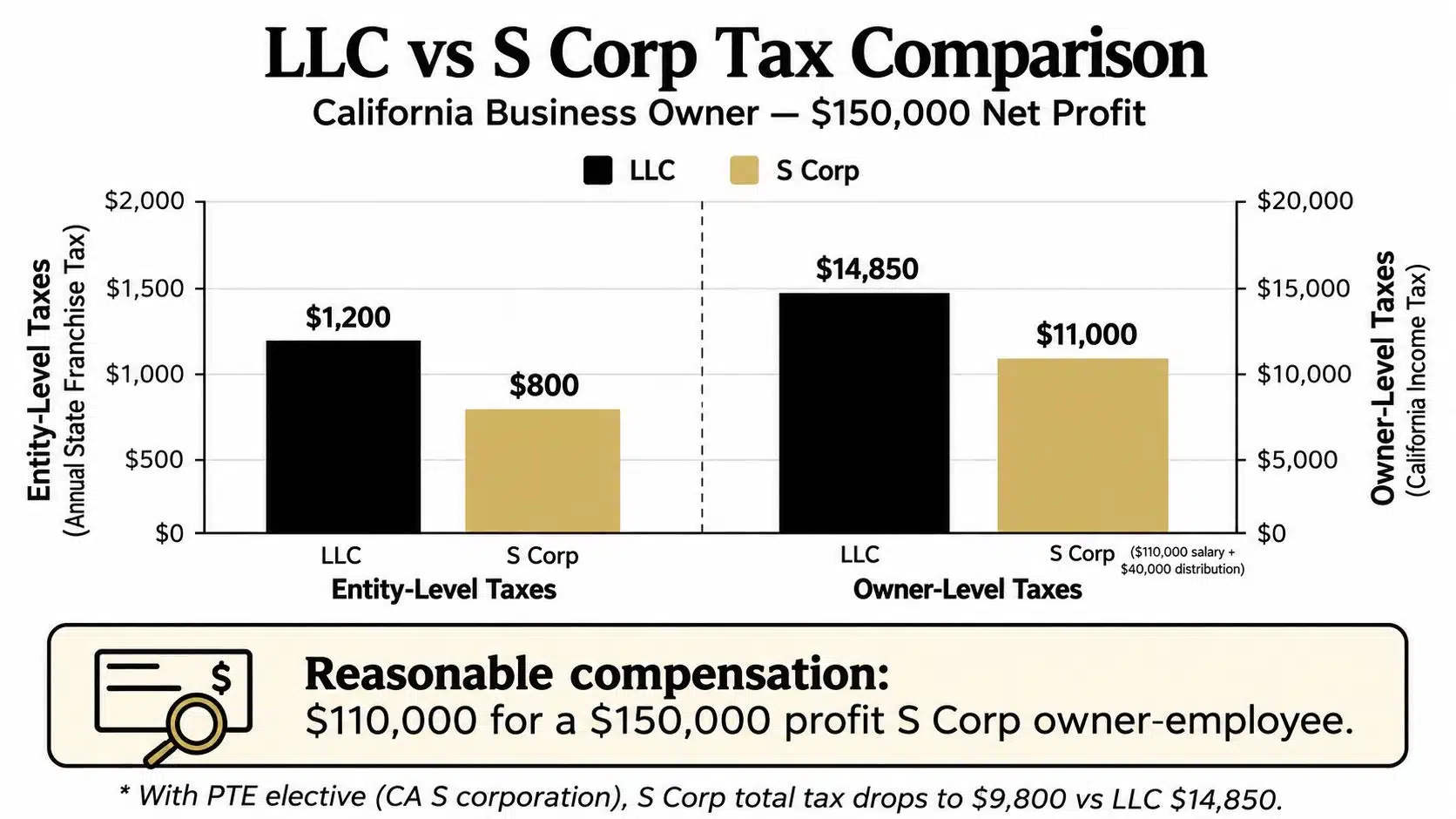
The chart presents a specific illustration for a California owner with $150,000 of net profit. It shows $1,200 of annual state franchise tax for the LLC and $800 for the S corporation, alongside owner-level tax figures of $14,850 for the LLC and $11,000 for the S corporation. Its callout uses $110,000 of reasonable compensation and $40,000 of distribution for the S corporation example, with the stated PTE illustration reducing S corporation total tax to $9,800 compared with $14,850 for the LLC.
Those figures are an illustration, not a universal result. Your actual outcome depends on salary, deductions, filing status, payroll costs, retirement planning, health coverage, other income, and the business's California-source receipts.
California's PTE elective tax adds another planning layer. The FTB states that the election uses 9.3% of qualified net income and has been extended through 2026 to 2030, with election timing and payment mechanics affecting owner-level credits. Some LLC owners may prefer partnership or disregarded-entity taxation to preserve flexibility around that credit structure. Others may benefit from S corporation treatment when the payroll burden and reasonable salary still leave meaningful savings.
Which Owners Should Pick Which Entity
The same California tax rules produce different recommendations for different owners. The deciding factor isn't a slogan such as “LLC for flexibility” or “S corp for savings.” It's the relationship between owner labor, profit, receipts, ownership, and the amount of administrative work the business can handle.
The solo consultant in Scripps Ranch
A management consultant billing $250,000 with a healthy profit margin is the classic S corporation candidate. The owner performs active services, can establish a defensible salary, and may have enough remaining profit for distributions to justify payroll and additional filing work.
The deciding factor is active owner labor combined with recurring profit. If the business has inconsistent income or the owner needs nearly all cash as wages, the election may not justify its extra administration.
The two-partner architecture firm
Two architects may value equal ownership, flexible allocations, and a clear process for admitting a future partner. A multi-member LLC taxed as a partnership often handles those needs more naturally than an S corporation, particularly when the partners contribute different hours, capital, or business-development effort.
The deciding factor is ownership flexibility. A strong operating agreement should address voting, deadlock, capital calls, distributions, buyouts, and what happens if one architect leaves.
The Del Mar couple with rental properties
A couple holding three rental properties may need separate property-level liability analysis, insurance, financing review, and estate-planning coordination. An LLC can accommodate passive rental ownership and transfer provisions without forcing the structure into an owner-employee payroll model.
The deciding factor is passive activity and transfer planning, not payroll-tax savings. Rental income doesn't automatically create the same S corporation opportunity as an active consulting business, and putting investment assets into an operating structure can create avoidable complications.
The high-income La Jolla professional practice
A professional practice approaching $600,000 may have enough recurring net income to examine S corporation treatment closely. Payroll tax planning, reasonable compensation, California's 1.5% net-income tax, and the PTE elective tax can materially affect the owner's cash flow, but professional licensing and ownership rules must also be reviewed.
The deciding factor is repeatable operating profit after a properly supported salary. A high-revenue practice with weak margins may not produce the same result as a high-margin practice with stable collections.
The entity follows the business model. Choose for how owners work, get paid, invest, and transfer interests, not just for the current year's tax return.
Your Decision Checklist and Next Steps With Allied Tax Advisors
Use this checklist before filing formation documents or submitting an S corporation election. The purpose is to produce a decision, not to collect abstract pros and cons.
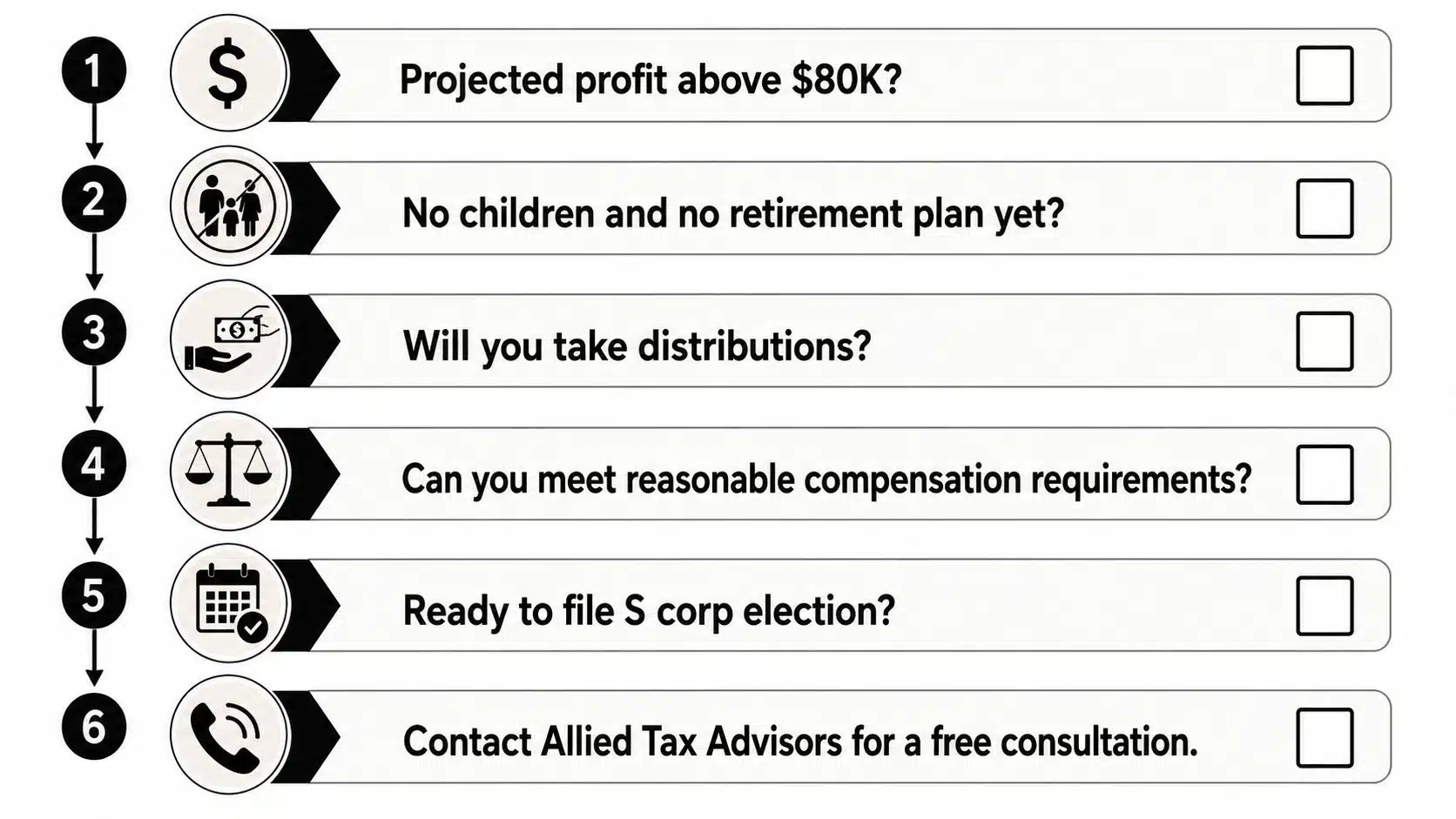
- Project profit above $80,000? Build a two-year comparison using the California 1.5% net-income tax for S corporation treatment versus the LLC's $800 minimum plus any applicable gross-receipts fee, using the FTB rules cited earlier.
- No children and no retirement plan yet? Review how payroll, retirement contributions, health coverage, and family employment could affect the broader plan. Don't decide from entity tax alone.
- Will you take distributions? Estimate the amount that could remain after a commercially reasonable salary, payroll expenses, operating costs, and tax reserves.
- Can you meet reasonable compensation requirements? Document the owner's role, hours, credentials, client responsibilities, and comparable compensation before choosing S corporation status.
- Are you ready to file the election and run payroll? Confirm Form 2553 timing, California Form 100S filing, payroll withholding, wage reporting, and bookkeeping procedures.
- Does ownership or investment use point toward an LLC? Choose a multi-member LLC when partners need flexible economics, investors need varied rights, or rental and passive activities dominate.
A plain LLC is reasonable when the business is new, profit is uncertain, ownership is evolving, or administrative simplicity matters most. Revisit the structure when the income pattern becomes stable instead of rushing into payroll before the numbers support it.
An S corporation is appropriate when the owner operates an active business, expects recurring profit, can pay reasonable compensation, and will maintain payroll and corporate records. A multi-member LLC taxed as a partnership is often the better fit when several owners need flexible allocations and governance.
Allied Tax Advisors can help San Diego owners model the alternatives, form an LLC, prepare S corporation filings, manage California compliance, process payroll, and evaluate the PTE election. Bring your prior two years of returns, current profit-and-loss statement, ownership plans, and projected receipts to a 30-minute planning call so the recommendation reflects your actual business rather than a generic threshold.
Allied Tax Advisors can compare California LLC and S corporation treatment, coordinate formation and Form 2553 filings, and handle FTB, payroll, and PTE-related compliance. Visit Allied Tax Advisors to request a planning conversation and bring your recent returns and current business numbers.