
U.S. startup costs typically range from about $3,000 for a lean microbusiness to $200,000 or more for a capital-intensive venture, depending on the model. If you're staring at rent deposits, software subscriptions, insurance, and your own personal cash gap, the essential question isn't what a business costs to start, it's how much cash you need before you can breathe.
Table of Contents
- What Founders Really Mean by Business Startup Costs
- One-Time Setup Costs vs Ongoing Operating Costs
- Sample Cost Ranges by Business Type
- A Step-by-Step Method to Calculate Your Startup Costs
- Where the Money Actually Goes Inside a Startup
- Financing Options and Cost-Reduction Strategies
- Tax Treatment and Recordkeeping for Startup Spending
- Your Next Steps and How Allied Tax Advisors Can Help
What Founders Really Mean by Business Startup Costs
Founders usually undercount startup costs because they focus on the launch bill and ignore the cash needed to survive the first stretch after opening. A business can look inexpensive on paper, then demand far more once rent deposits, software, insurance, inventory, and owner runway are all included. That gap is where budgets break and where tax planning gets sloppy, because the launch cost and the after-tax burden are not the same number.
The number you quote is never the whole number
Business startup costs sit in three separate pools of cash. Launch spend covers the entity filing, licenses, initial build-out, branding, and other work needed to get the business ready to operate. Working capital keeps bills paid while revenue is uneven and customers pay late. Contingency reserve covers the problems founders always assume will wait until later, then do not.
Practical rule: if the bank account only covers launch spend, the budget is incomplete and the runway is short.
That split also matters for taxes. Some startup spending may be treated differently from ordinary operating expenses, and that changes the cost after tax. If you mix the buckets, you will misread both your cash runway and your tax exposure.
The lower-end benchmark proves some businesses can start lean. The U.S. Small Business Administration has long estimated that many microbusinesses can begin with about $3,000, while most home-based businesses need roughly $2,000 to $5,000 to launch, which is a useful benchmark for lean service models and other home-based work Business News Daily on startup cost benchmarks. The same source also shows that other business models require much more cash, depending on the type of business and where it operates.
That is the frame founders need. Stop asking, “What does it cost to start a business?” Ask, “How much cash do I need so the business can survive after launch, and how much of that cash will be deductible now versus later?” The answer belongs in your bank account and in your tax plan, not just in a pitch deck.
One-Time Setup Costs vs Ongoing Operating Costs
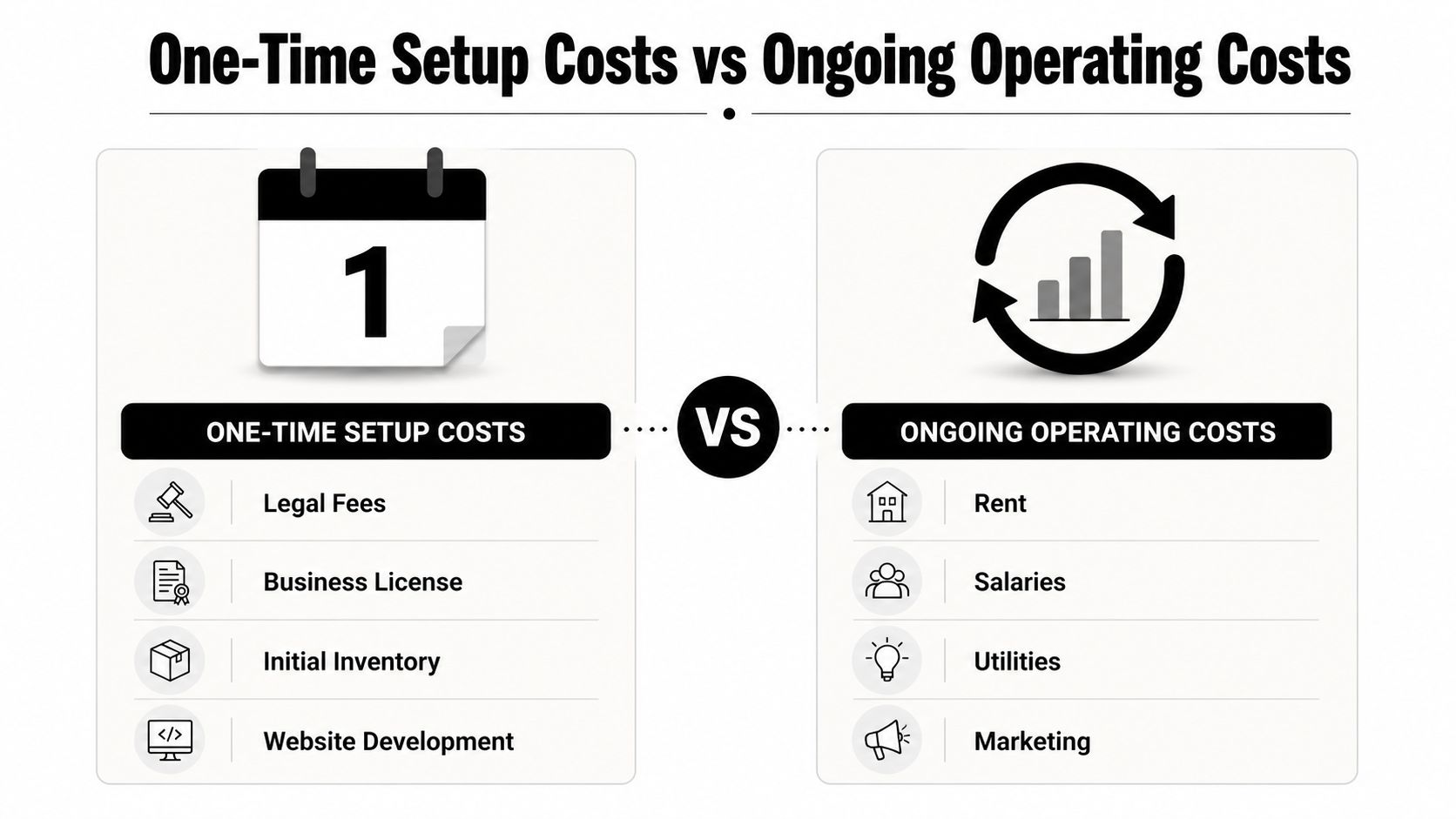
A common budgeting mistake is mixing one-time setup costs with recurring operating costs. The first group gets the business ready to open. The second group keeps the business alive after launch. A useful way to keep them straight is to treat setup costs as the upfront buy-in and operating costs as the monthly burn.
The launch bucket is not the whole budget
One-time setup costs usually cover entity formation, permits, licenses, initial inventory, branding, website development, and any build-out required before you can sell. These are easy to recognize because they happen before revenue starts. They also tempt founders into thinking the budget is finished once the opening check clears.
Ongoing operating costs are the part that strains cash flow. Rent, payroll, utilities, marketing, software subscriptions, and insurance keep coming after launch, and they often arrive before the business has steady revenue. That is why startup budgets need to separate opening spend from recurring burn, because runway disappears fast when those costs sit in the same bucket Xero startup business costs guide.
What belongs in each bucket
Use a clean split when you build your list.
- Legal and formation: entity setup, filings, and initial counsel belong in the one-time bucket.
- Equipment and inventory: if you buy it to open, it usually belongs in launch spend.
- Software and subscriptions: if you keep paying for it monthly, it is an operating cost.
- Payroll and rent: those are recurring burn items, not startup decorations.
Tax treatment matters here too. Some startup spending does not hit the tax return the same way a normal operating expense does, so the after-tax burden can differ from the sticker price. A founder who ignores that difference will overstate how much cash is available for runway and understate how much the launch really costs.
For SaaS founders, Cutting SaaS tooling costs often means trimming recurring software before it becomes part of the burn rate, not after the bank account is already tight.
The point is simple. If you only budget the launch bucket, you understate the cash required and overstate how close you are to opening. Founders who separate these buckets make sharper funding choices, cleaner tax decisions, and fewer bad calls when the checking account starts to thin.
Sample Cost Ranges by Business Type
Averages are seductive and mostly useless. A solo consultant, an online store, and a restaurant do not live in the same cost universe, and your budget should not pretend they do. Start with the model you plan to run, then price that model line by line.
Pick the closest business model, not the prettiest average
Use the industry range that matches your setup. Startup-cost guidance shows how sharply launch budgets change by business type, from light service models to capital-heavy storefronts and food businesses LendingTree startup costs by industry. Some founders open with very little cash, while others need a far larger launch pool, and the spread is wide enough to make generic averages almost useless.
| Business Type | Typical Launch Range | Main Cost Driver |
|---|---|---|
| Service business | about $3,000 to $10,000 | Labor, tools, and client acquisition |
| Online business | about $5,000 to $50,000 | Website build, software, and digital marketing |
| Retail business | about $50,000 to $150,000 | Inventory and storefront setup |
| Restaurant | about $175,000 to $750,000 or more | Build-out, equipment, and staffing |
| Funded tech venture | can move quickly into the high range | Product development and early hires |
Each of those drivers has a different tax profile. Inventory-heavy businesses push more cash into COGS, while labor-heavy models push more into payroll, payroll tax, and contractor reporting, so the same launch budget can leave very different after-tax runway. That is why two founders can spend the same amount and still face very different tax bills and cash pressure.
The first-year picture matters too. Online-only business owners average about $35,000 in first-year spending, while storefront owners average about $100,000 LendingTree startup costs by industry. Those are not targets. They are reminders that physical space changes the cash need fast, and rent, fixtures, and local staffing do more damage to runway than most founders expect.
For digital founders trying to keep tooling lean, Cutting SaaS tooling costs is a useful reference point because software stack choices can move a budget from controlled to bloated. The tax angle matters here too. Subscription-heavy spend usually hits operating expense treatment, while overbuying tools raises burn without building much balance-sheet value.
If you need a quick way to sanity-check your own figures, compare each line item against a simple startup balance sheet example from allied tax advisors. That keeps you focused on what gets capitalized, what gets expensed, and what drains cash immediately.
The right comparison is never “What do startups cost?” It is “What does my model cost to launch, and which line item drives the bill?”
A Step-by-Step Method to Calculate Your Startup Costs
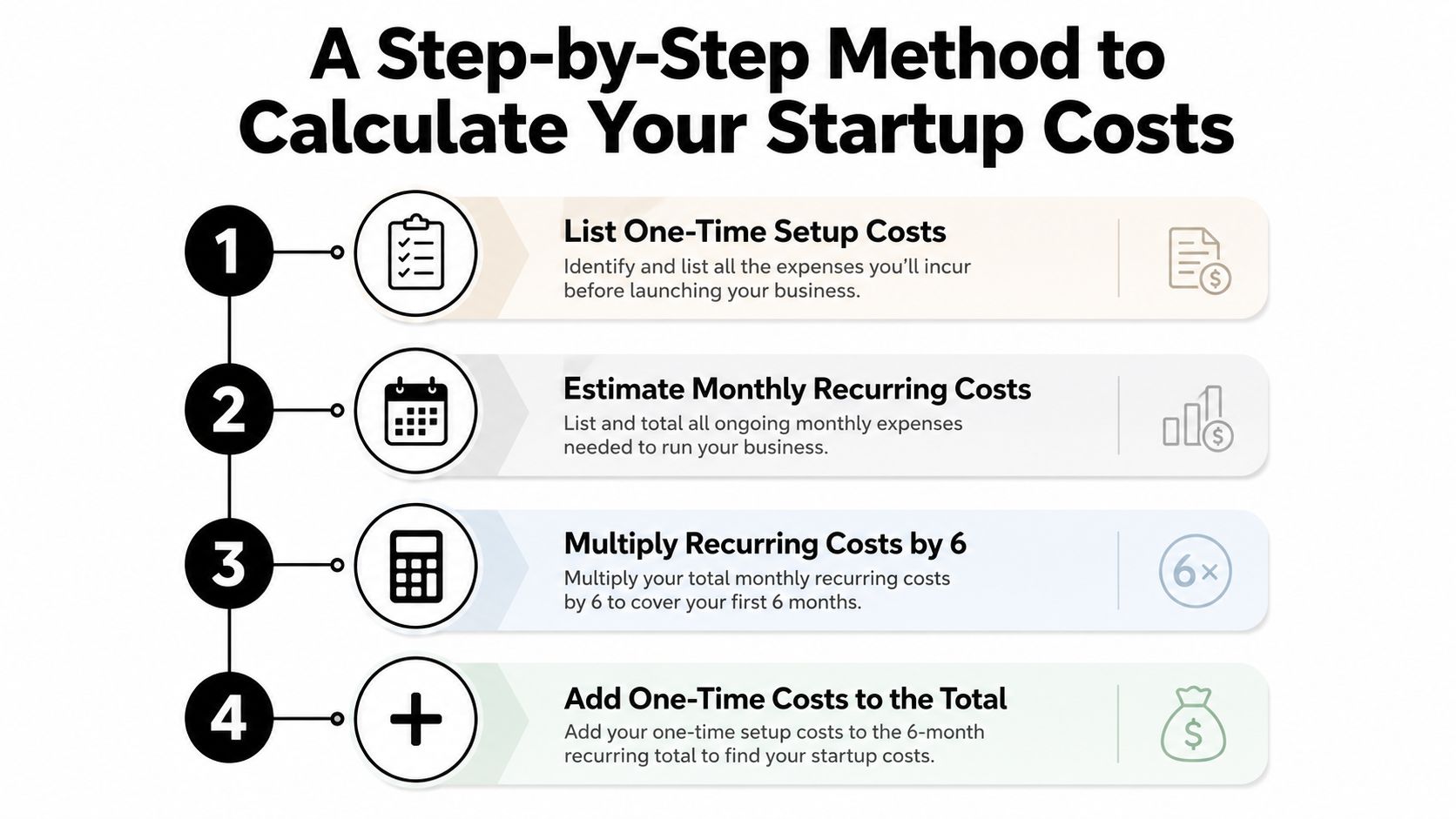
A clean estimate beats a hopeful estimate every time. I tell founders to build the number in four passes because that is the only way to keep launch spend, runway, and contingency from getting mashed into one vague total. The goal is not just to know what you will spend. It is to see which costs may fall under startup cost tax rules, which costs become ordinary operating expenses after launch, and which costs drain cash immediately.
Start with the monthly burn, not the dream number
Use this sequence:
- List one-time setup costs. Add formation, equipment, initial inventory, branding, and build-out. These items often sit in a different tax bucket than routine expenses, so do not throw them into one pile and call it a budget.
- Estimate monthly recurring costs. Put rent, software, marketing, insurance, and payroll-related items on the page. These are usually the costs that matter most once the business is active, because they are typically deductible as ordinary expenses when incurred.
- Multiply recurring costs by the runway you need. Decide how many months the business must support itself before revenue becomes dependable. That number should reflect your sales cycle, your hiring plan, and how much slack you have in the bank.
- Add a contingency buffer. Reserve extra cash for overruns, slower-than-expected launches, and bad assumptions in vendor quotes or build-out estimates.
Practical rule: if you do not include a contingency line, you are assuming every vendor quote, software bill, and launch delay will behave perfectly. They will not.
Take the fictional founder from the opening. If her launch spend is modest, but her recurring costs eat cash for several months, the total balloons fast. That is normal. The mistake is not the size of the number, it is failing to see the number early enough to fund it properly.
A sample balance sheet for a small business helps founders separate initial spend from what comes after launch. That matters because startup spending, operating spending, and cash on hand do not belong in the same bucket. If you want the budget to survive a tax review, you need clean categories from the start.
The runway choice is the key judgment call. A longer runway is safer if you are hiring early, paying rent, or waiting on sales cycles. If your model is lean and digital, the runway can be shorter, but you still need enough cash to survive the ugly middle, when the money is gone and revenue has not normalized yet.
Where the Money Actually Goes Inside a Startup
A launch budget that looks tidy on paper can still drain cash fast once you staff the business. The first place founders miss is employee compensation. In many startup budgets, it is the largest cost center, while office space, marketing, technology, and administrative costs take smaller but still meaningful shares Silicon Valley Bank startup costs and expenses plan. Employee compensation also creates payroll tax obligations from day one, so the cash burden is higher than salary alone.
Labor changes the burn rate more than founders expect
Every hire brings more than pay. Payroll taxes, benefits, and management overhead all sit on top of compensation, which is why labor-heavy startups burn cash faster than asset-heavy ones. A two-person consulting firm can need more working capital than a one-person e-commerce store if both founders are paying themselves and keeping the business moving.
The core issue is structure. A startup with more people than product runs out of time before it runs out of plans. A leaner model can preserve cash longer because software and hosting do not grow the way headcount does.
Read the budget by pressure point, not by category name
- Employee compensation: treat this as the main burn item if you are hiring early.
- Office space and rent: fixed commitments stay fixed, even when revenue softens.
- Technology and software: these costs stay hidden until subscriptions stack up.
- Marketing and advertising: spending only works if the campaign can run long enough to produce customers.
- Administrative costs: small items, recurring bills, easy to miss.
Bottom line: if your startup budget looks cheap, it usually means you have not counted people yet.
Service businesses catch founders off guard for that reason. They buy fewer assets, but they still pay for time, coordination, and delivery capacity. A founder who reads those cost centers clearly can fund more realistically, hire more cautiously, and protect cash runway with better cash flow management for small businesses. That same discipline matters if you are building a borrowing plan too, which is why SBA 7(a) qualification tips matter before you assume debt will solve the gap.
Financing Options and Cost-Reduction Strategies
A founder's funding choice should match the shape of the burn. Bootstrapping keeps equity intact, but it forces discipline every week. Debt preserves ownership, but it adds repayment pressure and interest expense. Investor capital can speed up hiring and product work, but it also raises the stakes on how quickly you turn spending into revenue.
Match the money source to the cost profile
A lean digital launch does not need the same financing plan as a build-heavy company. Solo software startups can often stay in a relatively narrow early spend range, mainly because the money goes to development tools, hosting, no-code platforms, and the first marketing tests IdeaProof startup cost calculator. Team-based launches with product development, paid acquisition, and early hires push the budget much higher because each new commitment adds fixed cash demand before sales settle in.
That gap matters for tax planning too. Debt financing creates interest payments that are usually deductible, while equity financing changes ownership and can affect future tax events in ways founders often ignore. The launch budget and the after-tax burden are two different numbers, and you should plan for both before you sign anything.
Reduce cost without breaking the business
- Use no-code tools first: they let you validate the offer before you pay for custom development.
- Share space before signing a lease: coworking and shared offices reduce fixed commitments.
- Use contractors before hires: this keeps headcount flexible while demand is still uncertain.
- Phase the launch: sell the first version before you spend on polish.
Cutting costs should protect runway, not starve the business. If you slash spending in the wrong place, you end up buying the same thing twice.
Debt can still make sense, but only if the repayment schedule fits your cash cycle. Review SBA 7(a) qualification tips before you assume a government-backed loan will solve a funding gap. I would rather see a founder take a smaller loan they can service cleanly than force a larger note that drains working capital.
A practical cash plan matters just as much as the source of funds, which is why cash flow management for small business belongs next to any financing discussion. The goal is simple. Keep enough cash in the business long enough for the launch to produce revenue.
Tax Treatment and Recordkeeping for Startup Spending
A founder spends money before launch, opens the doors, then finds out the tax result is not the same as the cash spent. That is the mistake to avoid. Startup spending gets limited startup treatment, while ordinary post-launch expenses are handled differently. A $10,000 pre-launch marketing spend is treated differently than a $10,000 post-launch spend. The first is amortized over 180 months, while the second is generally deducted in the year it is incurred. That timing gap changes both tax liability and runway, and the rules summarized in the provided research allow up to $5,000 of qualifying startup costs to be deducted immediately Mercury startup deductions 2026.
Startup costs and operating expenses are taxed differently
The IRS draws a clear line between pre-launch and post-launch spending. Before the business is active, qualifying startup costs get the limited startup treatment. After the business begins active operations, ordinary and necessary expenses are generally deductible in the year incurred Mercury startup deductions 2026. A software bill, ad spend, or vendor invoice can shift tax treatment depending on whether the business is still setting up or already operating.
Keep receipts, dates, and business purpose notes from day one. If you wait until tax season, you'll be guessing.
Organize the records before the deduction matters
Keep startup spending separate from operating spending in the books. Keep business accounts separate from personal accounts. Track every receipt with a business purpose. The tax side is unforgiving when records are messy, especially for entity formation costs, pre-opening vendor payments, and anything that could be mistaken for personal spending Mercury startup deductions 2026.
A few decisions belong in the same conversation:
- Separate accounts: keep business spending clean from day one.
- Chart of accounts: classify startup, organizational, and operating costs differently.
- Accounting method: cash or accrual changes how costs show up in the books.
- Sales tax and payroll setup: register early so those obligations do not get added later.
For a practical tracking framework, how to track business expenses is worth using before your books get noisy. The same discipline also supports the broader after-tax picture, because third-party research notes a meaningful gap between annual expenses and what startup costs can offset in that discussion of access to capital for underserved businesses Third Way report on unlocking capital for underserved businesses.
The blunt takeaway is simple. Your launch budget and your after-tax burden are not the same number. If you do not track both, you will misread your real cash need.
Your Next Steps and How Allied Tax Advisors Can Help
Build your plan around one page, not a pile of notes. List the one-time setup costs, estimate monthly operating burn, multiply by the runway you need, and add a contingency reserve. Then ask one question before you move forward, whether the money source is savings, debt, or outside capital. Can the business carry this cash plan without breaking the owner?
Gather these three items before you speak to an advisor
- Entity choice: LLC, S corporation, or another structure.
- Three-month expense forecast: your rough burn model, not a wish list.
- Owner compensation plan: how you'll pay yourself once the business opens.
That's enough to have a useful conversation before the first hire, the first lease, or the first invoice above a few thousand dollars. Wait longer, and the advice gets more expensive because the cleanup gets bigger.
Allied Tax Advisors handles entity formation, S Corporation and LLC filings, sales-tax management, payroll processing via IRIS software, QuickBooks bookkeeping, and ongoing advisory for startup and small business clients. For a founder in San Diego, that means the launch budget, the books, and the tax setup can all be handled in one place instead of patched together across different vendors.
If your numbers are still fuzzy, get them in order now. If your numbers are already real, get them reviewed before you sign a lease or hire your first employee.
If you're ready to turn a rough startup budget into a tax-aware launch plan, talk with Allied Tax Advisors before the cash starts moving. They can help you organize formation, bookkeeping, payroll, and startup-cost treatment so your opening budget matches your actual tax burden. Visit Allied Tax Advisors and get the numbers checked before the mistakes get expensive.