
You're staring at a California LLC tax packet, or maybe just a browser tab full of CA Form 568 instructions, and the first feeling is usually the same. The form looks technical, the schedules look disconnected, and one missed attachment can turn a routine filing into a notice from the Franchise Tax Board. For a first-time LLC owner, the primary challenge isn't filling in boxes, it's understanding why the form exists and which parts are relevant for your business.
California treats Form 568 as the annual Limited Liability Company Return of Income, so it isn't just a tax worksheet, it's the state's main compliance return for LLCs that aren't taxed as corporations. The filing pulls together ownership reporting, income allocation, member information, and the state-level tax calculation in one package. If you're organizing your books, checking whether you even need to file, or trying to avoid unnecessary penalties, this guide gives you the practical reading of the form that the official booklet doesn't always spell out in plain English. For a broader planning view on entity choice, tax advantages of an LLC can help frame why California's LLC rules matter so much in the first place.
Table of Contents
- Decoding Form 568 Your Essential First Step
- Determining Your Filing Obligation Who Must File
- Gathering Your Essential Documents and Information
- A Line-by-Line Guide to Completing Form 568
- Navigating the Most Common Schedules K-1 D and IW
- Filing Deadlines Payments and E-File Mandates
- Common Mistakes and When to Consult a Professional
Decoding Form 568 Your Essential First Step
The first time a California LLC owner opens the Form 568 package, it's easy to think it's just another state form with a long list of lines to complete. It's really the state's annual accounting of the LLC's existence, its members, and its California tax footprint. The return also pulls in the annual $800 LLC tax and, when applicable, the LLC fee tied to California income, which is why the form matters even when the business had a quiet year.
A helpful way to think about Form 568 is this, it's the state's record of whether your LLC existed, who owned it, what happened during the year, and how California should tax it. That's why the booklet asks for both entity details and ownership details, not just income numbers. The structure is designed to standardize reporting so the Franchise Tax Board can reconcile the return with member-level schedules and payment records, which is also why the filing can feel more demanding than a simple annual tax payment.
Practical rule: if you treat Form 568 like a compliance package instead of a single-page tax return, the filing becomes much easier to assemble.
For a new owner, the best mindset is to separate the return into two jobs. First, confirm the LLC is required to file. Second, gather the numbers and schedules that support the filing. That approach keeps the process steady instead of reactive, and it prevents the common mistake of starting with income lines before you've even confirmed whether the return is due under your LLC's tax classification. A useful companion reference on that classification is what is tax classification for LLC, because the filing logic changes depending on how the entity is treated.
Determining Your Filing Obligation Who Must File
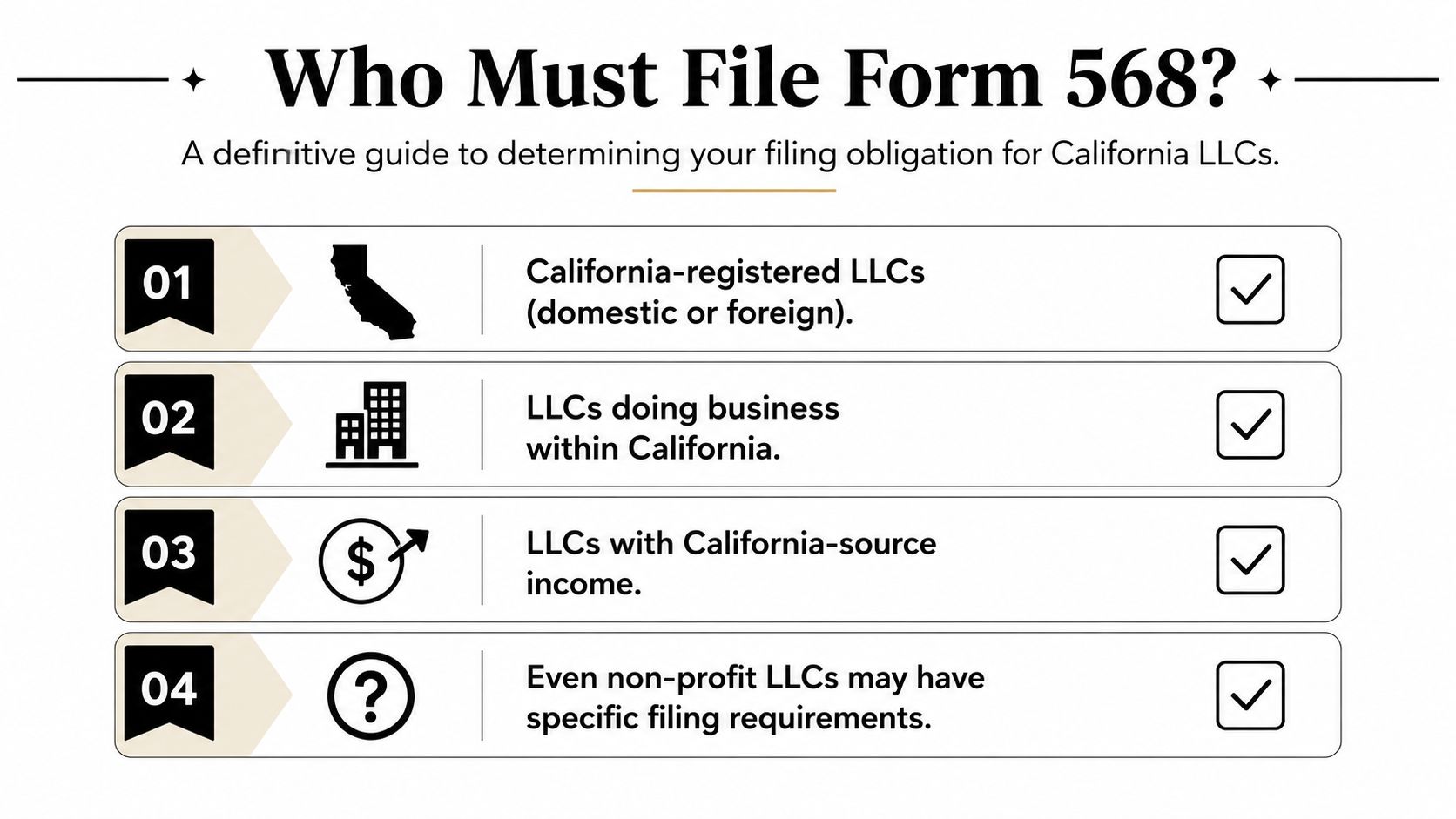
The cleanest answer is that Form 568 is a mandatory annual return for LLCs that aren't taxed as corporations, including entities doing business in California, those organized in California, and those with California-source income. The filing deadline is typically the 15th day of the fourth month after the tax year ends, which is generally April 15 for calendar-year LLCs, as reflected in practitioner guidance on California LLC filing timing linked here. That basic rule is broad, but the actual confusion comes from edge cases.
Start with registration and California activity
If the LLC was formed in California, registered with the Secretary of State, or operated in the state, the safest working assumption is that Form 568 is on your calendar. California's filing framework ties the return to entity presence and California-source activity, not just whether the business had a profit. That matters because a dormant entity can still have a filing obligation even when it had no customer revenue.
Single-member and dormant LLCs need special care
Owners often find this part challenging. Public guidance varies in how it describes single-member disregarded LLCs, inactive entities, and LLCs with no California-source income, which is why many filers get conflicting answers when they search online. The practical question isn't only whether tax is due, it's whether a full Form 568 return is still required and which schedules belong on it. For a deeper legal framing around entity formation and compliance, Legal guidance for California entrepreneurs is a helpful outside resource, especially if you're deciding whether the LLC's structure itself is the source of the filing obligation.
California filing rules reward precision. If the LLC exists in California's system, don't assume inactivity removes the reporting duty.
Foreign LLCs and California-source income
An out-of-state LLC can't ignore California just because it was formed elsewhere. If it has California-source income or is otherwise doing business in the state, the return may still apply. The key is to map the LLC's tax classification, where the work was performed, and whether California activities create reporting obligations even when the business is small or newly operating. In practice, that means the filing decision should be made before you start entering numbers, not after.
If you want a quick gut check, ask three questions. Was the LLC organized or registered in California, did it do business in California, and did it earn California-source income? If the answer to any of those is yes, Form 568 deserves attention right away.
Gathering Your Essential Documents and Information
Before opening the return, gather the documents that drive the entries. A clean Form 568 filing starts with the LLC's EIN, the California Secretary of State file number, a current profit and loss statement, and a balance sheet from your accounting system. If you use QuickBooks, this is the point where your books either help you or slow you down, because the state return works best when your federal and state numbers reconcile cleanly.
Build the filing packet before you start typing
You'll also want the federal return or federal tax schedule that your LLC used for the year. That lets you trace the same income and deduction categories into the California return without guessing at line items. For multi-member LLCs, member details matter too, including each owner's name, address, tax ID number, and their profit, loss, or capital percentages. Those ownership details support the state's member reporting and help explain the allocation schedule later in the process.
A useful way to prepare is by assembling one folder, digital or paper, with these items:
- Entity basics: LLC name, EIN, Secretary of State file number, principal business address.
- Financial support: year-end profit and loss, balance sheet, federal return, and any workpapers that explain unusual items.
- Member data: names, addresses, tax IDs, and ownership percentages for each member.
- Payment records: prior estimated payments, extension payments, and any amount already remitted to the state.
Don't confuse zero activity with no filing duty
The biggest trap in this stage is assuming no activity means no return. Current public guidance still shows confusion around dormant LLCs, California-source income, and single-member disregarded structures, and that confusion often leads to missing filings or unnecessary notices. If the LLC is registered or otherwise within California's filing net, an empty year still needs to be evaluated carefully, even if the return ends up simple.
Practical rule: if you can't tie every number on the return back to a document, pause and fix the books first.
That mindset saves time later because Form 568 is built from support, not memory. Once the documents are ready, the rest of the return becomes a transfer exercise instead of a hunt through old statements and tax software screens.
A Line-by-Line Guide to Completing Form 568
A first-time filer usually makes Form 568 harder than it needs to be. The cleanest approach is to follow the form in order, starting with the LLC's identity, then the ownership details, then the items that determine whether the return owes only the annual tax or the annual tax plus the LLC fee. That sequence matters because California uses the early lines to match the entity to its state record before it evaluates the amounts later on.
Get the identity lines right first
Name, address, EIN, file number, and tax year may look routine, but these fields are the quickest way to avoid a return that gets slowed down or questioned. If any of them do not match the state record or the current filing period, the rest of the form becomes harder to complete and easier to misread. Careful filers treat the opening lines as a checkpoint, not a box to rush through.
The most important ownership item on Side 2 is Question K, which asks for the total number of members. The 2025 instructions require that number, and it matters because the state uses member count as part of its reporting structure per the FTB booklet. Enter the actual ownership count from your records, not a guess based on who was active at any point during the year.
Understand the fee logic before you calculate it
California Form 568 is not just an income reporting return. The instructions state that the LLC fee applies when total California income is $250,000 or more, and the annual LLC tax is $800 as stated by the FTB. Those are two separate obligations, one tied to the LLC's existence and one tied to California income at the state's threshold.
A practical way to read the form is straightforward. First, determine the LLC's California income figure used for the fee calculation. Then compare that amount to the threshold. If the threshold is reached, the fee is added on top of the annual tax. If it is not reached, the return still generally carries the annual LLC tax obligation.
Move through payments and final balance carefully
After the income and fee sections, the return asks whether the LLC made payments during the year. Extension payments, estimated payments, and any other amounts already sent to the FTB need to be entered exactly as paid if you want the balance due or overpayment to come out correctly. If those figures do not match your confirmations, stop and reconcile them before filing. That single review prevents a lot of avoidable notices.
Practical rule: the final page should reflect what the state already received, not what you think you sent.
Question L, the principal business activity code, is another place where small errors create unnecessary friction. Use the code that best matches the LLC's actual activity, not the broadest code that seems close enough. That keeps the filing consistent with what the business really does.
Navigating the Most Common Schedules K-1 D and IW
Form 568 rarely stands alone. The schedules that travel with it tell California how income, deductions, and special items flow through the LLC to its members and how the LLC fee base is measured. If the main return is the skeleton, the schedules are the documentation that gives it shape.

Schedule K-1 and why member reporting matters
For a multi-member LLC, Schedule K-1 (568) is the document that allocates the LLC's items to each member. That's not just a distribution worksheet, it's the state-level record of who gets what share of income, deductions, and credits. If the LLC has more than one member, each person needs the right schedule because the state return and the member returns have to agree on the allocation framework.
Many new owners often make a costly assumption. They think the company return is enough by itself. It isn't. The member schedules are part of the filing package, and when they're missing or inconsistent, the state can't match the return cleanly.
Schedule D and capital transactions
Schedule D (568) becomes relevant when the LLC has California capital gain or loss items that need to be reported separately. A simple operating company may never touch it, but an LLC with asset sales, investment activity, or other capital events may need to include it. The practical point is that not every gain belongs in the same bucket, and California wants the transaction type identified correctly instead of folded into ordinary business income.
Schedule IW and fee support
Schedule IW, the LLC Income Worksheet, is the schedule that helps determine the fee basis for the LLC when the return needs the state's income measurement. It matters most when the business has more than one income footprint or when the filing includes items that affect the California fee calculation. If your LLC operates across lines, locations, or states, this worksheet helps keep the fee logic connected to the actual California portion of the business.
Form 3832 and member capital records
Form 3832, the LLC's List of Members and Capital, supports the ownership reporting side of the return. It's especially useful when the ownership structure changes or when you need a clearer capital record for each member. The state uses these attachments to make the main form more than a summary, which is why leaving them out creates friction later.
For broader payroll and retirement-plan compliance comparisons, essential Form 5500 information for HR is a useful reminder that California LLC filings aren't the only return packages where attachment discipline matters.
Filing Deadlines Payments and E-File Mandates
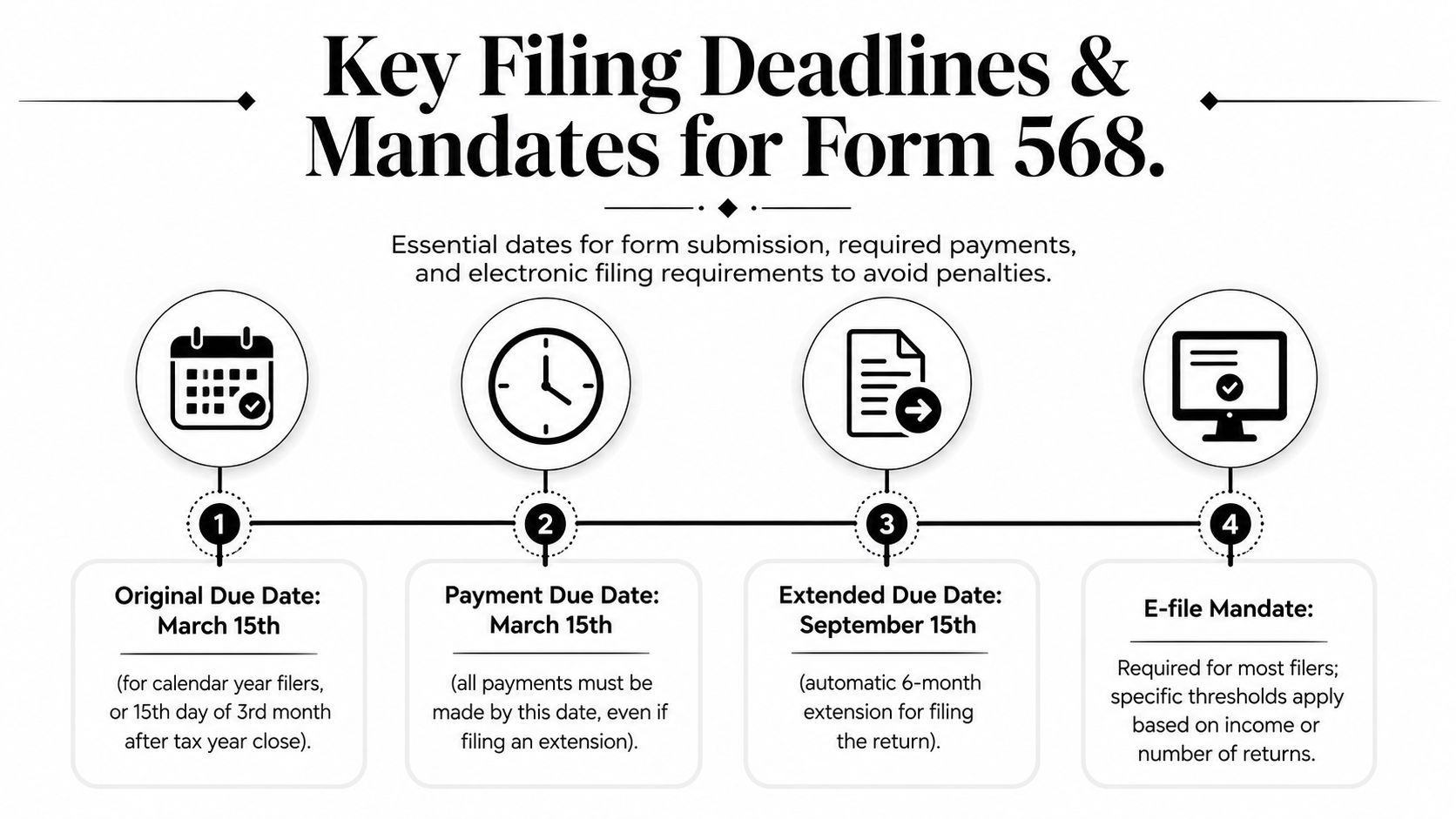
California Form 568 has two separate clocks. One controls the filing date, the other controls when the LLC tax is paid. For calendar-year LLCs, the return is generally due April 15, and an extension only gives more time to file, not more time to pay. That distinction matters because many first-time filers assume the extension covers the whole package, then discover the payment was late even though the return went in on time.
File on time, pay on time
Keep the filing due date and the payment due date in separate calendar entries. That simple step prevents one of the most common Form 568 errors, assuming the filing extension also delays the tax due.
The annual tax should be handled by the original deadline even if the return is filed later under extension. If the LLC has a payment due, treat that as a separate action item, not a line that gets bundled into the filing process.
Use the payment channel that matches your workflow
California guidance points LLC owners toward FTB Web Pay or mailing Form 3522 as noted in the e-filing guide. Web Pay usually works better for owners who want one confirmation trail and an easier match between the payment and the return. A mailed voucher can still do the job, but it requires tighter tracking and more lead time so the payment does not get lost in the mail or overlooked in the records.
Keep the payment confirmation with the return package. If the state later questions timing, that proof matters more than recollection.
Know when e-filing is required
California also requires e-filing for some LLCs. Current guidance says LLCs with assets of $10 million or more or more than 100 members must e-file according to the referenced filing guidance. That rule matters for growing LLCs and investor-backed entities, because the filing method can change as the ownership base or asset level changes.
For LLCs that also make estimated payments, a separate reminder system keeps those payments from getting mixed into the return deadline. California estimated taxes guidance helps owners keep that payment calendar straight. The state does not adjust deadlines around a busy week, so the filing plan has to account for both timing and method from the start.
For broader payroll and retirement-plan compliance comparisons, essential Form 5500 information for HR is a useful reminder that California LLC filings are not the only return packages where attachment discipline matters.
Common Mistakes and When to Consult a Professional
The costliest Form 568 mistakes usually come from routine oversights. An owner may use the wrong California income figure for the LLC fee, leave out a required member schedule, or treat a quiet year as if no filing were needed. None of those errors looks dramatic at first, but they can trigger notices, delay processing, and create penalties that take far more time to clear up than the original return would have taken to prepare correctly.
The errors that cause the most trouble
One common mistake is mixing up the annual tax with the LLC fee. Another is failing to include K-1s for members in a multi-member LLC. A third is sending in a return for a dormant or single-member entity without first checking whether the tax classification or California activity still creates a filing requirement. These errors usually come from rushing, not from bad intent.
The cleaner approach is to pause whenever the return does not match the books neatly. If the LLC has activity in multiple states, a property sale, unusual capital activity, or ownership changes during the year, the filing becomes more technical very quickly. In those cases, a preparer can save time by matching the right schedule to the right fact pattern instead of trying to force everything into a standard template.
When professional help is the better move
Professional help becomes especially useful when the LLC has multi-state income allocation, rental property reporting, a sale of business assets, or a member structure that changed during the year. Those situations are not just about getting the form done, they are about getting the filing position right. If the wrong approach is used, fixing it later often costs more than preparing it correctly the first time.
For a California owner, that is a strong reason to ask for help early. Form 568 looks like a compliance form, but it also requires classification and allocation judgment. The more moving parts the LLC has, the more valuable a review becomes before the return is filed. If you are facing a first-time filing, a missing schedule, or uncertainty about whether Form 568 even applies, our team at Allied Tax Advisors can help you file with confidence. Contact us before you submit the return, a careful review now is far easier than answering an FTB notice later.