
A federal amended tax return is only worth filing when the change affects your tax, legal filing position, or compliance exposure. The IRS reports that an average of 3.2 million tax units, about 2% of individual income tax return filers, filed an amended federal individual return each year from Tax Years 2013 through 2020, so Form 1040-X is common, but it still shouldn't be filed automatically.
You may be looking at a corrected W-2, a forgotten deduction, a missing 1099, or an IRS notice that makes the original return look wrong. The natural reaction is to download Form 1040-X and start typing. That's usually backward.
An amended return is a triage decision first and a form-filing task second. You need to determine whether the IRS expects you to correct the issue, whether it can fix the issue during processing, whether the change affects later returns, and whether the expected benefit justifies a process that can consume substantial time. The IRS instructions place the average taxpayer burden for Form 1040-X at 9 hours, with an average cost of $200 per return (IRS Form 1040-X instructions).
The published IRS processing window is generally 8 to 12 weeks, with some cases taking up to 16 weeks, and the agency says taxpayers should wait about 3 weeks after submission before using its amended-return status tool (IRS amended-return guidance). In practice, independent coverage citing FY 2025 IRS data reported average processing of more than 5 months for individual amended returns and more than 13 months for business amended returns, creating a serious difference between the official expectation and the operational reality.
Table of Contents
- Deciding Whether You Actually Need to Amend
- What Form 1040-X Looks Like and What to Attach
- E-File Versus Paper and Which Path You Qualify For
- Refunds, Balances Due, and Interest Explained
- Real Timelines and What to Do When Yours Is Late
- Documentation Habits That Prevent Costly Mistakes
- Putting It All Together With a Pre-Filing Checklist
Deciding Whether You Actually Need to Amend
Start with one question: What changed, and does that change require taxpayer action?
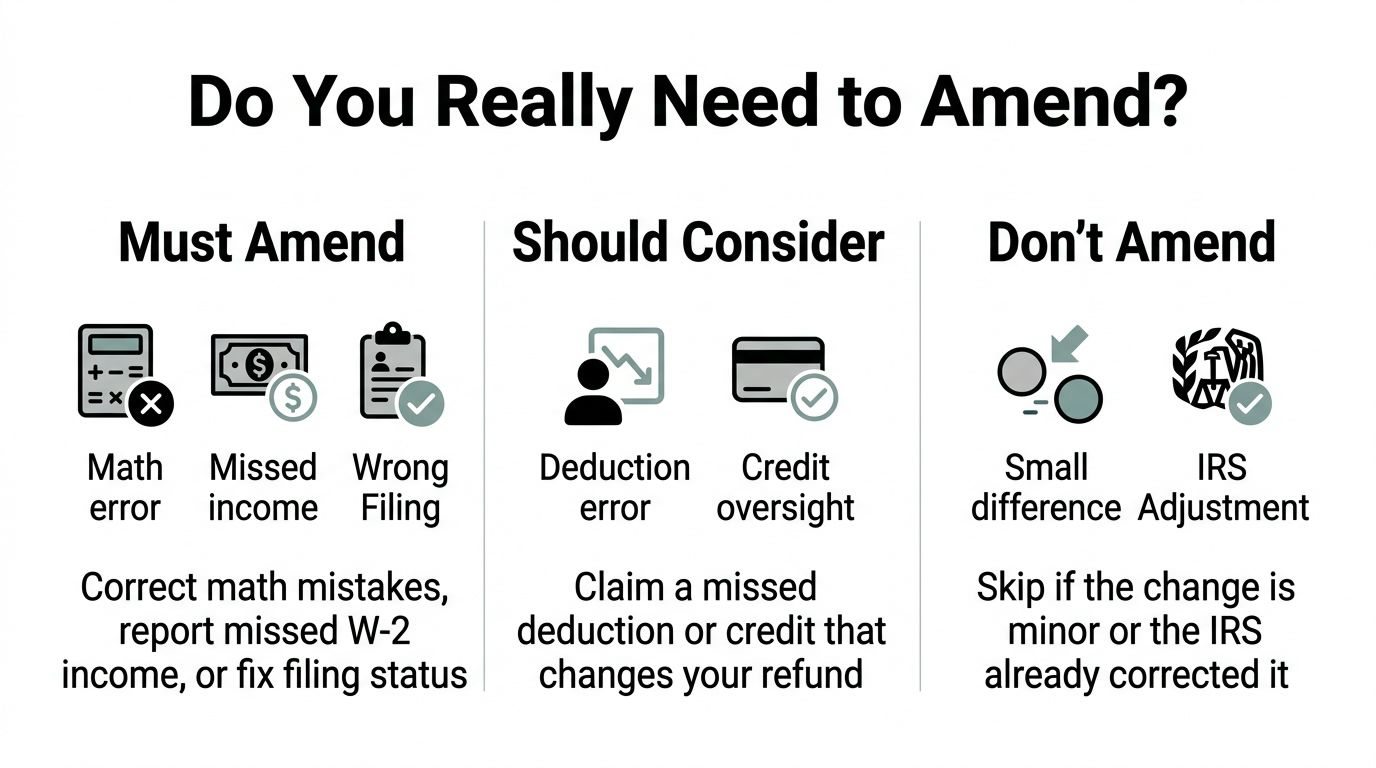
The IRS says an amended return may be needed when you change filing status, income, deductions, credits, dependents, or tax liability (IRS guidance on when and how to amend). That list is broad, but it doesn't mean every mistake requires Form 1040-X. Experienced preparers sort the issue into three practical categories.
Situations that usually require an amendment
You should normally consider amending when you discovered income that wasn't reported, received a corrected information document, used the wrong filing status, claimed the wrong dependent, or omitted a deduction or credit that materially changes the return. A missed W-2 is a straightforward example. The additional wages can affect adjusted gross income, taxable income, withholding, credits, and possibly state reporting.
The same applies when the original return contains a tax computation error that the IRS won't automatically resolve. Don't assume an amended return is limited to refunds. If the corrected figures increase tax, filing voluntarily can reduce the risk that the IRS discovers the discrepancy first and sends a notice with added interest or penalties.
Situations where the IRS may fix the problem
Some arithmetic errors and certain missing schedules can be handled by the IRS during processing. The agency may correct a mathematical mistake or request a schedule associated with information already present on the return. That's why filing an amendment before understanding the issue can create duplicate work or conflicting submissions.
Wait for the corrected form if an employer or financial institution hasn't issued it yet. An amendment based on an incomplete replacement document often creates another amendment later.
When filing can hurt more than help
Don't amend merely to chase a trivial difference, claim a credit you didn't qualify for, or respond to a problem the IRS has already corrected. A small expected refund can disappear into the time required to reconstruct the original return, prepare schedules, document the change, and monitor the case.
Check the refund statute before doing any work. An older-year amendment can fail if the applicable filing window has closed. Review the detailed discussion of how far back you can amend taxes before assuming an old return remains open.
If identity theft is involved, don't treat the amendment as the entire solution. You may also need specialized help for identity theft victims from Superior to address the broader credit and account consequences.
Practical rule: Amend only when the dollar change, legal correction, or compliance exposure justifies the delay and administrative burden.
The IRS's own data shows amended returns aren't isolated edge cases. Higher-income taxpayers, married couples filing jointly, and filers using Schedules A, C, D, or E were more likely to amend, which gives the process broad relevance for investors, landlords, wage earners, and small-business owners (IRS amended-return information).
What Form 1040-X Looks Like and What to Attach
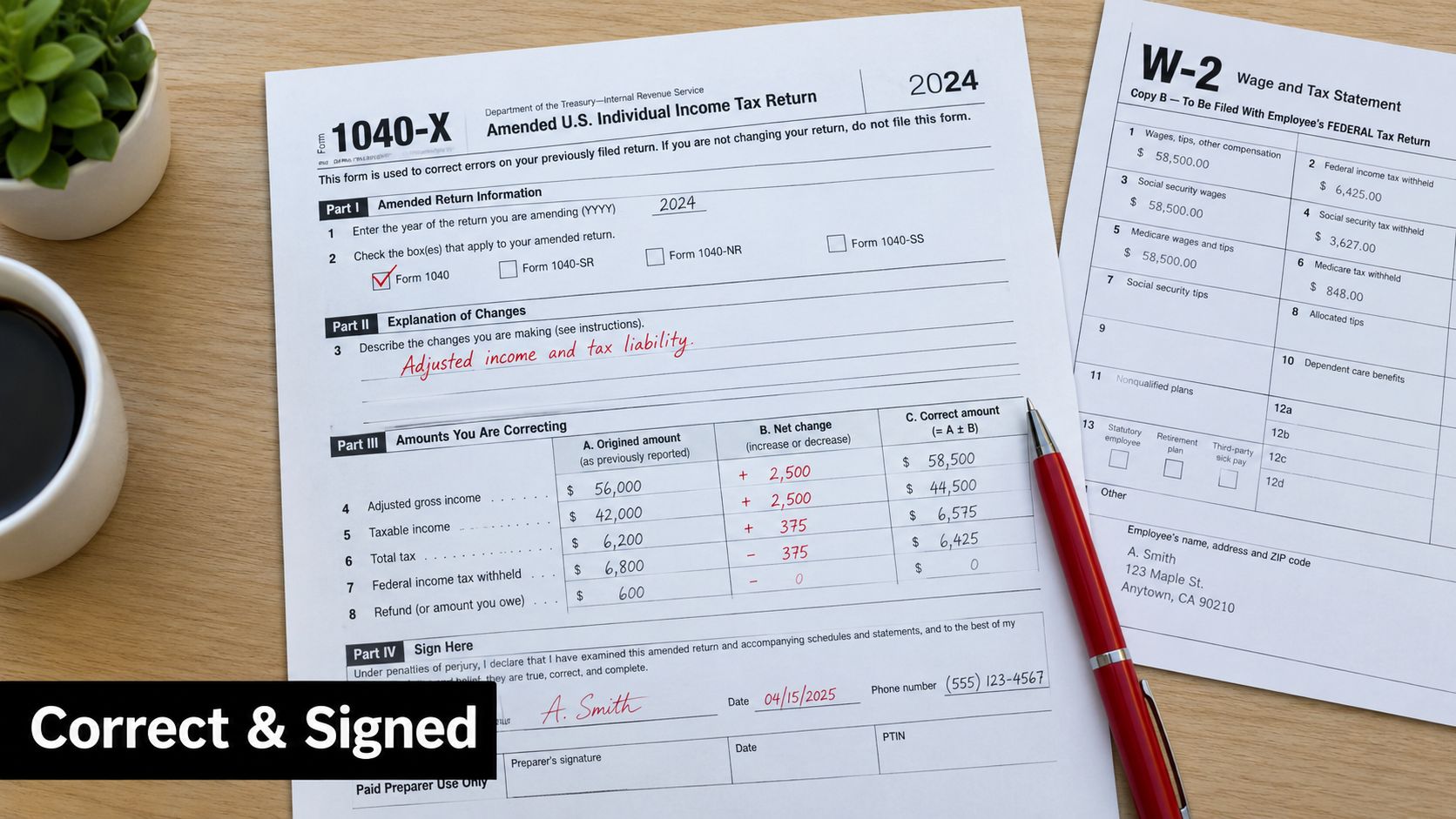
Form 1040-X is short, but the preparation is not. The form asks you to show the original figures, the corrected figures, and the resulting difference in a way an IRS examiner can follow without reconstructing your entire return.
Use a missed W-2 as the working example. Suppose your original return omitted wages and federal withholding from an employer. Column A should carry the figures exactly as they appeared on the filed return. Column C should show the corrected figures after adding the wages and withholding. Column B shows the net change between the two columns.
Build the amended packet around changed lines
The form's explanation box is where many self-prepared amendments go wrong. “Forgot income” isn't enough. Identify the document, issuer, and reason for the correction, such as a corrected W-2 from the employer and the date it was issued. Clear explanations reduce the chance that the IRS has to send correspondence to understand a change that should have been obvious.
Attach only the supporting forms and schedules affected by the amendment. A missed W-2 may require:
- The corrected Form 1040 presentation showing the revised totals.
- Schedule 1 if the income change flows through that schedule.
- Schedule 3 if a credit changes there.
- The corrected W-2, W-2c, or reissued 1099 supporting the revised entry.
- Any other schedule whose line items change because of the additional income.
You don't attach the entire original return as a duplicate. The original return is represented through Column A, while the amended figures and affected schedules explain Column C.
Order the documents for review
Put Form 1040-X first. Follow it with the revised Form 1040 pages, then the affected schedules in filing order, and then the third-party documents supporting the change. Make the packet self-contained. An IRS employee should be able to start with the amended form, trace each changed line to a schedule, and trace the schedule to a document.
Don't bury the reason for filing in a long narrative. State what changed, why it changed, and how the corrected document supports the figures. If the amendment changes more than one tax year, prepare each year as its own complete analysis rather than treating the years as one combined filing.
E-File Versus Paper and Which Path You Qualify For
The submission choice is primarily an eligibility decision, not a preference. For federal individual amended returns, the IRS says Form 1040-X can generally be e-filed for the current tax year and the two prior tax periods when the original return was also filed electronically. If the original return was paper-filed, or the year isn't eligible, the amendment must be mailed (IRS Form 1040-X instructions).
E-file makes sense when supported tax software accepts the specific year and amendment. You get an electronic acknowledgment through the filing system, and supported software may allow direct deposit for a resulting refund. That doesn't guarantee rapid IRS processing. Electronic submission removes a delivery problem, not the agency's review backlog.
Paper is required when the year or filing method makes e-file unavailable. Use a complete copy of the submission, keep the mailing evidence, and send the package using a trackable service. For important amendments, certified mail with return receipt gives you a defensible record of delivery.
| Factor | E-File | Paper |
|---|---|---|
| Eligibility | Current year and two prior tax periods, subject to IRS and software support | Required when e-file eligibility isn't available |
| Proof of submission | Electronic acknowledgment from the filing system | Mailing receipt and delivery record |
| Refund routing | Direct deposit may be available through supported filing software | Generally a paper check, unless the applicable refund instructions allow another method |
| Main risk | Software may not support the specific amendment | Lost, misrouted, or delayed paper delivery |
| Best choice | Use when the year qualifies and the original return was electronically filed | Use when required, and mail with tracking |
Before transmitting, verify that the software supports the exact tax year and all changed schedules. Electronic signatures and authorization procedures also matter, so review the firm's guidance on electronic signatures and the IRS when a preparer or representative is involved.
The shortcut is simple. E-file when the year qualifies and the original return was electronically filed. Paper-file when the IRS requires it, and document the mailing from the moment it leaves your hands.
Refunds, Balances Due, and Interest Explained
An amendment can create a refund or a balance due. The underlying mistake may be identical, but the cash-flow consequences move in opposite directions.
Consider the missed W-2 example. If the omitted withholding exceeds the additional tax created by the wages, the corrected return may produce a refund. If the additional tax is greater than the withholding and credits, the amended return may show an amount owed. Form 1040-X recalculates the final position. It doesn't preserve the original result because the original return already produced a refund.
When the amendment produces a refund
The IRS generally processes the original return and its original refund separately from the amended return. Don't assume the agency will immediately reverse an earlier refund before calculating the corrected result. Keep the original refund records, then compare the amended calculation with the IRS account once the amendment posts.
Interest on an overpayment is generally based on the federal short-term rate plus 3 percentage points, as described in the Form 1040-X instructions (IRS Form 1040-X instructions). The amount and timing depend on the account, the filing, and the IRS's handling of the claim, so don't use a generic calculator to predict the final payment.
When the amendment creates a balance due
A balance due doesn't start on the day you file Form 1040-X. Interest generally relates back to the original payment due date, not the amendment date. The IRS can also assess a failure-to-pay penalty of 0.5% per month, subject to the applicable rules, until the balance is paid (IRS Form 1040-X instructions).
Paying only the newly calculated tax can leave accrued interest and penalties unresolved. Get an updated account balance or follow the IRS payment instructions for the corrected liability. If the amendment responds to an IRS notice, follow the notice's payment and response directions instead of sending an uncoordinated second explanation.
| Trigger | What happens after filing | Interest treatment | What to watch for |
|---|---|---|---|
| Corrected return creates a refund | IRS reviews the amended figures and issues the approved overpayment | Possible overpayment interest under the applicable rules | The original refund and amended refund may be handled separately |
| Corrected return creates tax due | IRS posts the revised liability and expects payment | Interest can run from the original payment due date | Penalties and accrued interest may remain after the base tax is paid |
| Amendment follows an IRS notice | IRS matches the filing against the notice and account | Depends on the underlying assessment and payment dates | Use the notice instructions and keep proof of your response |
The safest approach is to calculate the corrected tax, then separately account for the account balance, interest, and penalties. Don't treat the number on your worksheet as the final IRS balance.
Real Timelines and What to Do When Yours Is Late
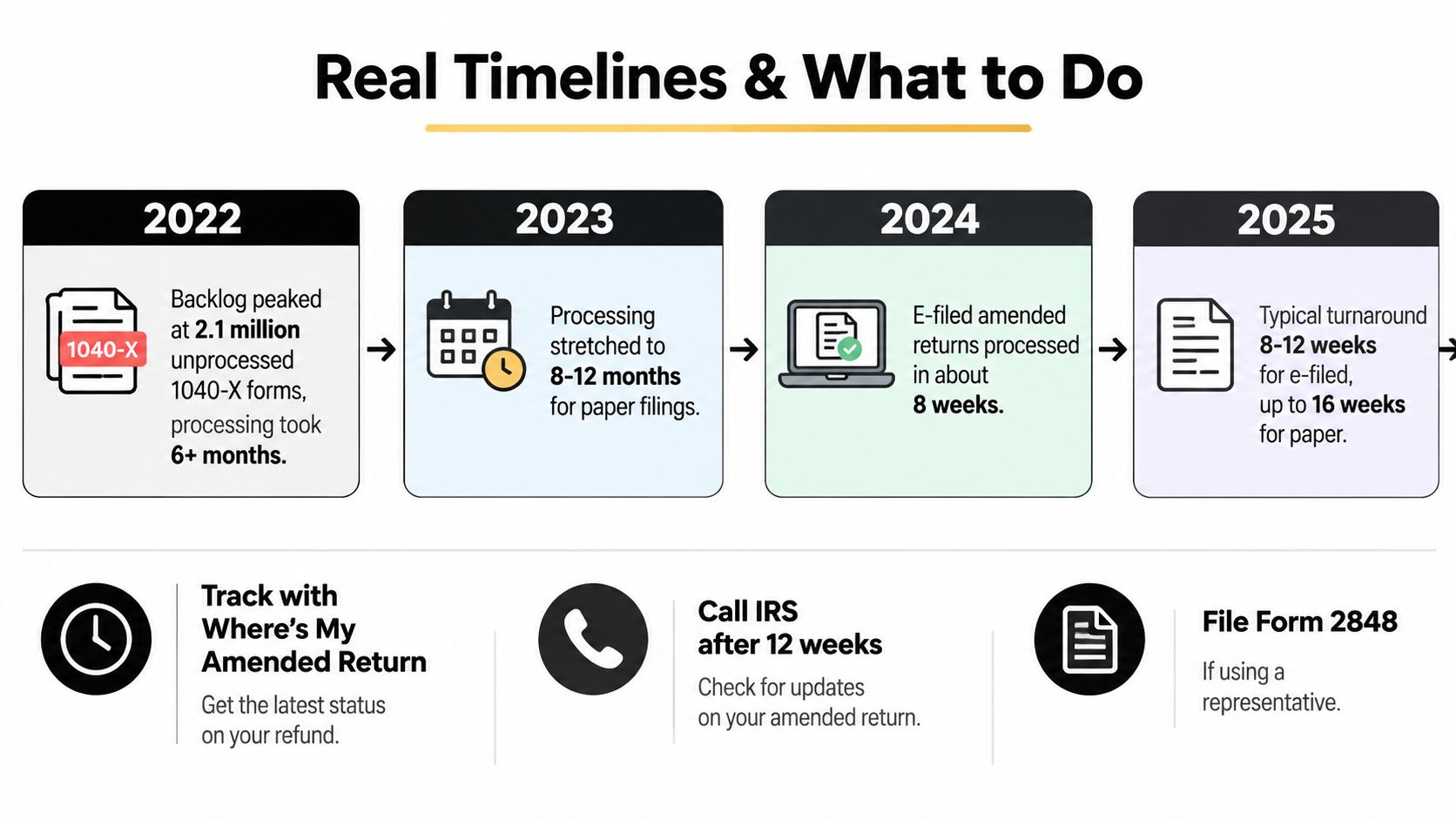
The IRS tells taxpayers to wait about 3 weeks after filing before checking amended-return status, and it publishes an 8 to 12 week processing window, with some cases extending to 16 weeks (IRS amended-return frequently asked questions). That is the official baseline, not a promise.
Recent independent coverage citing FY 2025 IRS data reported that individual amended returns averaged more than 5 months, while business amended returns averaged more than 13 months. Those figures describe a very different operating environment from the consumer-facing estimate. Treat the published window as a point for preparation and follow-up, not as a guarantee that a refund will arrive.
Read the account, not just the status tool
Where's My Amended Return can confirm that an amendment entered the system, but the displayed date may not tell you whether an employee actively reviewed the return. The transcript gives a more useful account trail when available. Code 150 generally reflects the return posting, while code 806 generally reflects federal withholding credited to the account. Neither code, by itself, proves that every amended line has been approved or that a refund is about to issue.
Look for the amended-return activity, account adjustments, notices, and refund transactions together. If the transcript shows the filing but no corresponding resolution, preserve a copy and move to follow-up rather than repeatedly submitting the same amendment.
Escalate based on the problem
Use a staged response:
- After the initial receipt period: Confirm delivery or electronic acceptance, then wait for the IRS status system to recognize the filing.
- After the published processing window: Review the transcript, check for notices, and contact the IRS amended-return channel if the account remains unresolved.
- When the delay causes hardship: Request help from the Taxpayer Advocate Service and explain the specific financial or administrative harm.
- When the case has become extreme: A Taxpayer Assistance Order request may be appropriate when the IRS delay creates significant hardship and ordinary channels haven't resolved the issue.
Separate a paper backlog from a refund hold. A missing schedule, math inconsistency, dependent conflict, or unsupported credit can trigger manual review. A correctly documented return can still wait in a paper-processing queue. The remedy differs, so identify the cause before escalating.
Documentation Habits That Prevent Costly Mistakes
The most expensive amended-return errors usually aren't exotic tax-law mistakes. They're omissions, mismatched figures, missing schedules, weak explanations, and refund calculations that don't reconcile to the supporting documents.
An IRS and TIGTA review found 44 of 246 amended-return transactions in its sample were associated with potentially erroneous refunds, an error rate of 17.89%. The review identified missing third-party documentation, missing required forms or schedules, and incorrect math as recurring causes, and reported that 22 of the 44 potentially erroneous refunds were issued on at least one amended return (TIGTA review of amended-return processing).
Reconcile instead of retyping
Pull the original filed return, the corrected return, and every document supporting the change. Put the original and corrected figures side by side, then mark only the lines that change. Retyping the entire return from memory is how unchanged figures become accidental changes.
Use a reconciliation sheet for wages, withholding, income, deductions, credits, tax, payments, and refund or balance due. The sheet doesn't replace Form 1040-X. It proves that Column B is the actual difference between Columns A and C.
Match documents to the correction
A corrected W-2 generally requires the corrected wage and withholding information. A reissued 1099 should match the revised income, basis, or withholding entry. A Schedule C change should tie to revised business records and a clear profit-and-loss explanation. A capital-gain correction should reconcile the revised Form 8949 and Schedule D to the broker statement or other basis records.
Dependent and credit changes deserve extra attention. Two returns claiming the same Social Security number can create a mismatch that requires documentation and correspondence. If a credit is added or removed, attach the required eligibility support, including Form 886-H-EIC or comparable documentation where applicable.
Use this release checklist
- Original return: Keep the filed return, acceptance record, and original account information.
- Changed lines: Confirm every Column B amount equals the corrected figure minus the original figure.
- Supporting documents: Attach each affected W-2, W-2c, 1099, receipt, schedule, or eligibility statement.
- Signatures and preparer details: Check taxpayer signatures, paid-preparer information, and authorization documents.
- Submission record: Save the final transmitted file or complete paper copy, delivery proof, and all IRS notices.
Attach the affected schedules, not an undifferentiated stack of every tax form you own. A focused packet gives the IRS a clear audit trail and gives you a clear defense if the account later disagrees with the amendment.
Putting It All Together With a Pre-Filing Checklist
A reliable federal amended-return process follows a fixed order:
- Confirm the original return was filed. Form 1040-X changes a filed return. It isn't a substitute for an original return that was never submitted.
- Identify the exact change. Decide whether the IRS may correct the issue or whether you need to report it.
- Check the filing deadline. Don't spend hours preparing an amendment until you confirm the refund statute remains open.
- Rebuild the corrected figures. Use the original return as Column A, the corrected return as Column C, and reconcile the difference in Column B.
- Prepare the support packet. Include only the schedules and documents affected by the change.
- Choose the submission path. E-file if the tax year and original filing method qualify. Otherwise, paper-file with delivery evidence.
- Plan for the account result. A refund, balance due, interest, and penalties each require separate attention.
- Set a follow-up date. Check the status after the IRS receipt period, then use transcripts and escalation channels if the case goes materially beyond the published window.
Keep your records organized with a practical tax document checklist. Your file should show not just what you changed, but why the change is correct and when you submitted it.
A San Diego taxpayer should hand the amendment to a CPA or enrolled agent when it involves multiple years, an entity-type change, an amended return paired with an IRS notice, or a corrected tax liability exceeding $15,000. Rental property, crypto transactions, S-corporation items, capital-gain basis, and carryovers also deserve professional review when one year's change can affect later returns or state filings.
The right goal isn't to file Form 1040-X quickly. It's to file the right amendment, with a complete record, and with a follow-up plan that reflects how the IRS processes amended returns.
Allied Tax Advisors handles federal amended returns, including Form 1040-X preparation, supporting-document review, IRS notice coordination, and related tax planning for individuals and businesses. If your amendment involves multiple years, rental property, crypto, an S corporation, or a significant balance due, visit Allied Tax Advisors to discuss the facts before you file.