
Let's get straight to the point: political donations are not tax deductible on your federal income tax return. The Internal Revenue Service (IRS) is crystal clear on this, whether you're donating to a specific candidate, a political party, or a Political Action Committee (PAC).
The Hard and Fast Rule on Political Donations

This isn't some obscure tax loophole; it's a fundamental part of U.S. tax policy. The core idea is to prevent the government from indirectly funding political campaigns. Think about it—a tax deduction lowers your taxable income, which in turn reduces the amount of tax you owe.
If you could deduct political contributions, the government would be giving up tax revenue to support your chosen candidate or party. It would essentially be a government subsidy for political activity, which could create an uneven playing field in elections.
The tax code explicitly bars deductions for any money, property, or services given to influence elections or support lobbying efforts. Getting this wrong can be a costly mistake, potentially leading to an IRS audit and penalties. For a deeper dive into the risks, Schwab.com offers some great insights.
Political Gifts vs. Charitable Giving
This is where people often get tripped up. We’re used to hearing about tax-deductible donations, but those almost always refer to contributions made to qualified charities, like a 501(c)(3) organization. The key difference is the organization's purpose and its official IRS designation.
Knowing this distinction is crucial for smart financial planning. It helps you separate your personal civic engagement from your tax-advantaged philanthropy. It's also vital to understand the difference between tax deductions vs. tax credits, as they impact your finances in completely different ways.
To make this distinction as clear as possible, let's look at a quick comparison.
Political vs. Charitable Donations At a Glance
The table below breaks down the essential differences in how the IRS treats these two common types of contributions.
| Contribution Type | Tax Deductibility (U.S. Federal) | Recipient Organization | Purpose |
|---|---|---|---|
| Political Donation | Not Deductible | Candidates, political parties, PACs, lobbying groups | To influence legislation or support a candidate for public office |
| Charitable Donation | Generally Deductible | Qualified 501(c)(3) organizations | To support charitable, religious, scientific, or educational missions |
Ultimately, while both actions involve giving money to a cause you believe in, only one comes with a potential tax benefit. Your support for a political campaign is a personal choice, whereas a donation to a registered charity is recognized by the government as a public good worthy of a tax incentive.
Why the IRS Draws a Hard Line on Political Contributions
It’s one of the most common tax questions during an election year: "Can I deduct my political donations?" The short answer is a firm no, but the reason behind this rule is key to understanding our tax system.
The IRS isn’t just being difficult. Its stance is built on a foundational principle: keeping the U.S. tax system from subsidizing political campaigns and agendas. Think about what a tax deduction really is—it's a government subsidy. It lowers the real cost of an expense by reducing your taxable income.
If you could write off a political donation, the government would be giving up tax revenue. This would mean taxpayer money was indirectly funding a specific candidate, party, or cause, creating an uneven playing field where the government itself favors certain political outcomes.
Keeping the System Fair
At its heart, this rule is about protecting the integrity of our elections. If donations were deductible, it could give wealthier donors and corporations an even bigger voice in politics. Their ability to make large, tax-subsidized contributions would be amplified, potentially overshadowing the support of average citizens.
By making political giving a purely personal expense, the tax code ensures that when you support a candidate, that support comes straight from your own pocket—not with a discount courtesy of Uncle Sam.
The rule against deducting political donations is all about transparency and preventing the tax system from being used to influence politics. It frames political support as a direct choice by an individual, not an activity subsidized by the federal government.
What Counts as a "Political Contribution"?
The IRS takes a very broad view here to close any potential loopholes. It's not just about cutting a check to a candidate running for president. The no-deduction rule covers a wide range of activities you need to be aware of.
Essentially, any direct or indirect contribution to the following is not tax-deductible:
- Candidates for Public Office: This applies to everyone, from your local school board race to federal elections.
- Political Parties: Any money given to national, state, or local party committees.
- Political Action Committees (PACs): These are the groups that raise money to elect or defeat candidates.
- Lobbying Groups: Payments to organizations whose primary purpose is to influence legislation aren't deductible as charitable gifts.
- Fundraising Events: That ticket you bought for a campaign dinner or fundraising gala? It's not a write-off.
This even extends to non-cash or "in-kind" contributions. For example, if you donate office supplies or offer your graphic design services to a campaign for free, you can't assign a value to it and deduct it. The IRS treats all forms of political support the same way: as a personal, non-deductible expense.
Navigating the Difference Between Political and Charitable Giving
It's a great feeling to support a cause you're passionate about, whether it's a political campaign or a local charity. But when it comes to tax time, the IRS draws a very clear, bold line between the two. The tax rules for political and charitable giving are worlds apart, and it all boils down to one thing: the organization's official tax status.
Simply put, donations you make to a political candidate, a political party, or a Political Action Committee (PAC) are never tax-deductible. On the flip side, contributions to qualified 501(c)(3) organizations—think public charities and private foundations—are generally deductible, but only if you itemize your deductions. The reason is that their work is strictly charitable, educational, or religious in nature, not political.
Verifying an Organization's Status
How can you be sure your donation will count? Before you write that check, a quick search can prevent a major headache later. The IRS makes it easy with a free online tool called the Tax Exempt Organization Search. A few clicks on this database will confirm if an organization has that coveted 501(c)(3) status.
For instance, a donation to the American Red Cross to help with disaster relief is deductible because they are a registered 501(c)(3). But a contribution to a presidential campaign? Not a chance. Taking a moment to verify an organization’s status empowers you to give with confidence and plan your finances accordingly.
This flowchart can help you quickly figure out if your donation is likely to be deductible.
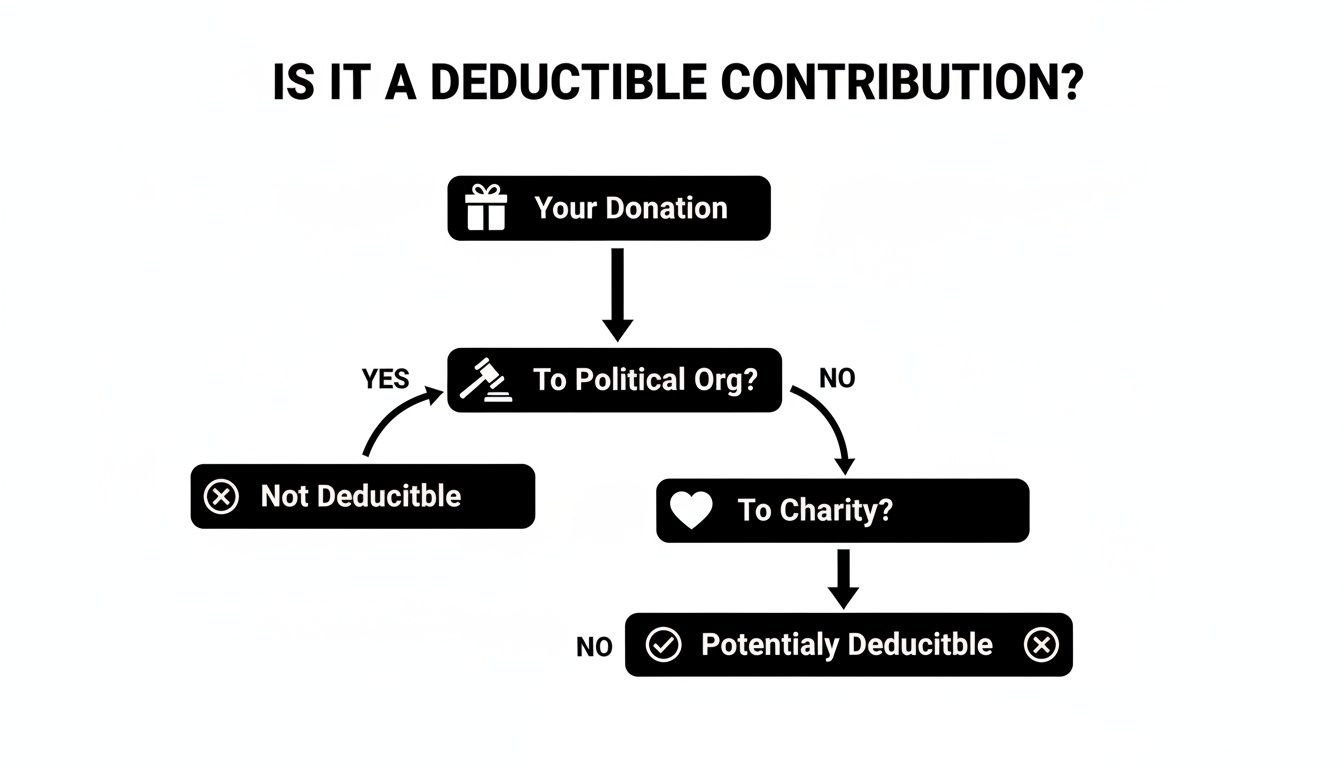
As you can see, the path to a tax deduction almost always starts with giving to a qualified charity.
The Nuances of Tax-Exempt Groups
This is where things can get a little tricky. You'll run into other types of tax-exempt groups, like 501(c)(4) organizations. These are often called "social welfare" groups, and they're allowed to engage in some political and lobbying activities. Because of that political involvement, donations made to them are typically not tax-deductible.
Key Takeaway: Just because an organization is a "non-profit" or "tax-exempt" doesn't automatically mean your donation is tax-deductible. Only contributions to qualified 501(c)(3) organizations are eligible.
For anyone looking to donate, it's worth spending a little time understanding the implications of 501(c)(3) status for different groups. Remember, to claim any of these charitable deductions, you have to itemize on your tax return. You can learn more about how that works in our guide comparing the https://alliedtax.com/standard-deduction-vs-itemized-deductions/. Making the right choice here is key to getting the full tax benefit from your generosity.
How Other Countries Approach Political Donations
The American stance on not allowing tax deductions for political donations can feel like a hard-and-fast rule, but it’s far from the only game in town. A quick look around the globe shows that many countries take a completely different approach, often using their tax systems to actively encourage citizens to donate to political causes.
Seeing how others handle this gives us a much richer context for why U.S. law is structured the way it is.
France: A Direct Incentive Through Tax Credits
France offers a compelling alternative. Instead of a deduction, they provide a generous income tax credit for political donations. French donors can claim a credit for 66% of their contribution, which is a powerful motivator.
This essentially means the government co-funds a portion of an individual's political support. Interestingly, this has created a dynamic where people weigh their political giving against their charitable giving based on tax benefits.
Research shows a fascinating link here. When the tax "price" of donating to charity went up, political donations saw a bump. A €267 million drop in certain types of charitable giving between 2016 and 2017 corresponded with a €758,117 increase in political contributions, suggesting a direct trade-off for donors. You can dig deeper into how French tax policy influences giving habits and see the data for yourself.
Canada: A More Measured Middle Ground
Canada also uses tax credits, but their system is designed differently. It’s tiered, meaning the credit percentage decreases as the donation amount increases.
Here’s how it works at the federal level:
- A 75% credit on the first $400 you donate.
- A 50% credit on the next $350.
- A 33.33% credit on the next $525.
The total federal credit you can get is capped at $650. It’s a nice incentive, but it hasn’t pushed political giving to the same level as charitable giving in Canada. It strikes a balance—encouraging participation without creating the strong substitution effect seen elsewhere.
Global Approaches to Political Donation Tax Treatment
The table below gives a quick snapshot of how the tax treatment of political donations varies significantly across these key countries, highlighting different national priorities.
| Country | Tax Treatment | Mechanism | Key Limitation |
|---|---|---|---|
| United States | Not deductible or creditable | Strict separation of political and charitable giving | No tax benefit for individuals or businesses. |
| Canada | Partially creditable | Tiered federal tax credit | Maximum federal credit is $650 annually. |
| France | Partially creditable | Flat-rate income tax credit (66%) | Credit applies up to 20% of taxable income. |
As you can see, there is no one-size-fits-all solution. Each country's tax code reflects its unique cultural and political philosophy on the role of government in funding the democratic process.
These global examples make one thing crystal clear: the U.S. ban on deducting political donations isn't an accident. It's a deliberate policy choice rooted in the idea of keeping the tax system politically neutral. While other nations use tax breaks to spur political engagement, the U.S. tax code is designed to draw a firm line between private political support and tax-subsidized philanthropy.
Smart Tax Strategies for the Civic-Minded Donor
So, we've established that political donations won't get you a tax break. But that doesn't mean your civic-minded giving can't be tax-efficient. The key is to think strategically, separating your political contributions from your philanthropic ones and taking full advantage of the deductions the IRS does allow.

The core strategy is actually quite simple. Focus your tax-deductible dollars on qualified 501(c)(3) charities whose missions you believe in. When you itemize, these donations directly reduce your taxable income. This, in turn, frees up personal funds that you can then choose to put toward the non-deductible political causes you want to support.
Aligning Your Philanthropic and Political Goals
Think about the core issues that fuel your political passions. Is it environmental protection? Maybe it's education reform or access to healthcare. The good news is that for almost every political issue, you can find dedicated 501(c)(3) organizations doing incredible, non-partisan work in that same arena.
- Love the Environment? Beyond donating to a specific green campaign, consider supporting a 501(c)(3) charity focused on conservation, land trusts, or clean energy research.
- Passionate About Social Justice? You can contribute to non-profits that provide legal aid to underserved communities or advocate for change through objective research and education.
This two-pronged approach lets you make a real-world impact on the causes you champion while also getting a tax benefit for your generosity. It's all about making every dollar work smarter for you.
Interestingly, this "separate bucket" approach is distinctly American. Research has shown that in Canada, for example, political and charitable giving are often linked, where making one type of donation actually increases the likelihood of making the other. You can read more about how giving habits differ internationally on Carleton.ca.
For those looking for a more advanced strategy, a Donor-Advised Fund (DAF) can be a powerful tool. With a DAF, you can contribute cash, stocks, or other appreciated assets, get an immediate tax deduction for the full amount, and then recommend grants to your favorite charities over time. It’s a great way to streamline your giving and manage the financial side of your philanthropy, especially with potential charitable giving tax changes on the horizon.
Navigating the Gray Areas: Common Questions on Political Donations
Let's tackle some of the real-world scenarios that often trip people up. When you get into the specifics of business, advocacy groups, and non-cash contributions, things can get a little murky. Here’s how to handle these common situations.
Can My Business Deduct a Political Sponsorship?
This is a frequent question from business owners looking to get involved. The short answer is almost always no.
If your company pays to sponsor a political convention or even just buys an ad in the event program, the IRS considers that an indirect political contribution. It doesn't matter if it feels like advertising; it's still treated as support for a political cause and is not deductible as a business expense.
What About Donations to Lobbying Groups?
Many people donate to groups that fight for causes they believe in, often called "social welfare" organizations or 501(c)(4)s. These groups are a vital part of our political landscape, but your donations to them are not tax-deductible.
While these organizations are tax-exempt themselves, they don't have the specific 501(c)(3) status that makes a donation a charitable contribution on your tax return.
Are In-Kind Donations Treated Differently?
What if you give something other than cash? Maybe you offer free printing services to a local campaign or let them use your office space for a weekend. This is called an "in-kind" contribution.
From a tax perspective, there’s no difference. The fair market value of the goods or services you provide is treated just like a cash donation—meaning it is not tax-deductible. It’s still a form of political support, and the same rules apply.
While political giving has clear tax rules, the financial world is full of complexities. For those with a broader interest in how different financial instruments are treated, exploring resources on the tax implications of stablecoins can offer useful perspectives on compliance in the digital age.
Finally, keep in mind that while federal law is quite clear, a handful of states have occasionally offered small tax credits for making in-state political donations. These programs are rare and their rules change frequently, so it's always best to check with a local tax professional to see if anything applies to you.