
You've done the responsible things. You've saved consistently, you use your workplace plan, and you want some money growing tax-free in a Roth IRA. Then your income rises and you hit the Roth contribution wall. Suddenly the account that seemed built for disciplined savers appears closed to you.
That's the moment many people start searching for backdoor Roth IRA limits and get a frustrating mix of half-answers. One guide says it's easy. Another says it's risky. A third mentions the pro-rata rule in one sentence, even though that's the part that can create the biggest tax surprise.
A Backdoor Roth IRA can be a smart, IRS-compliant strategy. But the actual process isn't just “put money in, move money over, done.” If you already have pre-tax IRA money, the rules get less forgiving. The expensive mistakes usually happen in the messy details, not in the basic concept.
Table of Contents
- You Earn Too Much for a Roth IRA Or Do You?
- Decoding the Backdoor Roth IRA Strategy
- The Two-Step Process for a Clean Conversion
- The Pro-Rata Rule The Most Critical Limit
- Navigating Key Dates and Tax Forms
- Beyond the Backdoor Exploring Alternatives
- Your Financial Safety Check When to Consult a CPA
You Earn Too Much for a Roth IRA Or Do You?
A lot of high earners think the conversation ends when they learn their income is too high for a direct Roth IRA contribution. It doesn't. In many cases, it just changes the route you take.
The confusion usually starts with MAGI, or modified adjusted gross income. If you're not sure how that number works, this plain-English guide to modified adjusted gross income is worth reviewing before you act. The Roth rules use MAGI, not just your salary, and that distinction matters.
The key point is simple. A Backdoor Roth IRA isn't a separate account type. It's a method. You make a nondeductible contribution to a Traditional IRA, then convert that amount to a Roth IRA. Because the income restriction applies to direct Roth contributions, not to the conversion itself, many higher-income households can still get money into a Roth through this route.
That's why people talk about the strategy as a side door. The front entrance has an income screen. The connecting door does not.
Practical rule: The backdoor method bypasses the direct Roth income test. It does not bypass every other IRA rule.
That last sentence is where many articles stop too early. The backdoor strategy can work well, but only if you understand what kind of “limit” you're dealing with. Some limits are straightforward, like the annual contribution cap. Others are hidden in tax mechanics, especially if you already own pre-tax IRA money.
Decoding the Backdoor Roth IRA Strategy
A high earner often reaches the same point. You find out your income is too high for a direct Roth IRA contribution, then assume the Roth option is gone for the year. That is where expensive mistakes start, because the rule that blocks the front door is not the same rule that governs a conversion.
A Backdoor Roth IRA is a tax process, not a special account. You contribute to a Traditional IRA first, usually as a nondeductible contribution, and then convert those dollars to a Roth IRA. If you want a broader primer on how a Roth conversion works in practice, that can help before you get into the mechanics.
Why this strategy exists
The backdoor strategy exists because the tax code treats two actions differently. Direct Roth IRA contributions have income limits. Roth conversions do not. That split creates an opening for higher-income taxpayers who cannot contribute to a Roth IRA the usual way.
The easiest comparison is a building with two doors that lead to the same room. The front door checks income. The side hallway does not. But the side hallway has its own rules, and that is where many simple online explanations leave people exposed.
The limits that matter most
The phrase backdoor Roth IRA limits causes confusion because it sounds like there is a special contribution cap for this strategy. There is not.
Your annual IRA contribution limit still applies. The backdoor method changes the route, not the amount you are allowed to put in. Vanguard explains in its guide to how to set up a backdoor IRA that for 2026 you can contribute up to $7,500 to an IRA, or $8,600 if you're age 50 or older, and the contribution cannot exceed your earned income for the year.
Here is the practical framework.
| Filing Status | Direct Roth Contribution Issue | Maximum Annual IRA Contribution Under 50 | Maximum Annual IRA Contribution Age 50+ |
|---|---|---|---|
| Single filer | Income can phase you out of a direct Roth contribution | $7,500 | $8,600 |
| Married filing jointly | Household income can phase you out of a direct Roth contribution | $7,500 | $8,600 |
Clients usually get tripped up in three places:
- “The backdoor lets me contribute extra.” It does not. You still live under the same annual IRA cap.
- “My income is too high, so I cannot use an IRA at all.” High income can block a direct Roth contribution. It does not block the backdoor process by itself.
- “I can do this even without earned income because the second step is a conversion.” The conversion step does not create contribution eligibility. If your starting contribution is invalid, the strategy is already off track.
The practical lesson is simple. The visible limit is the annual contribution cap. The less visible limit is whether your facts allow the strategy to stay clean. If you already have pre-tax IRA money sitting in another account, the math can change in ways that surprise people, which is why the actual risk in a backdoor Roth is often not the contribution limit. It is the tax bill that appears later when the process was set up the wrong way.
The Two-Step Process for a Clean Conversion
A high earner often gets into trouble here because the steps look simple on paper. You put money into a Traditional IRA, then move it to a Roth IRA. The expensive mistakes happen in the setup, the timing, and the tax reporting.
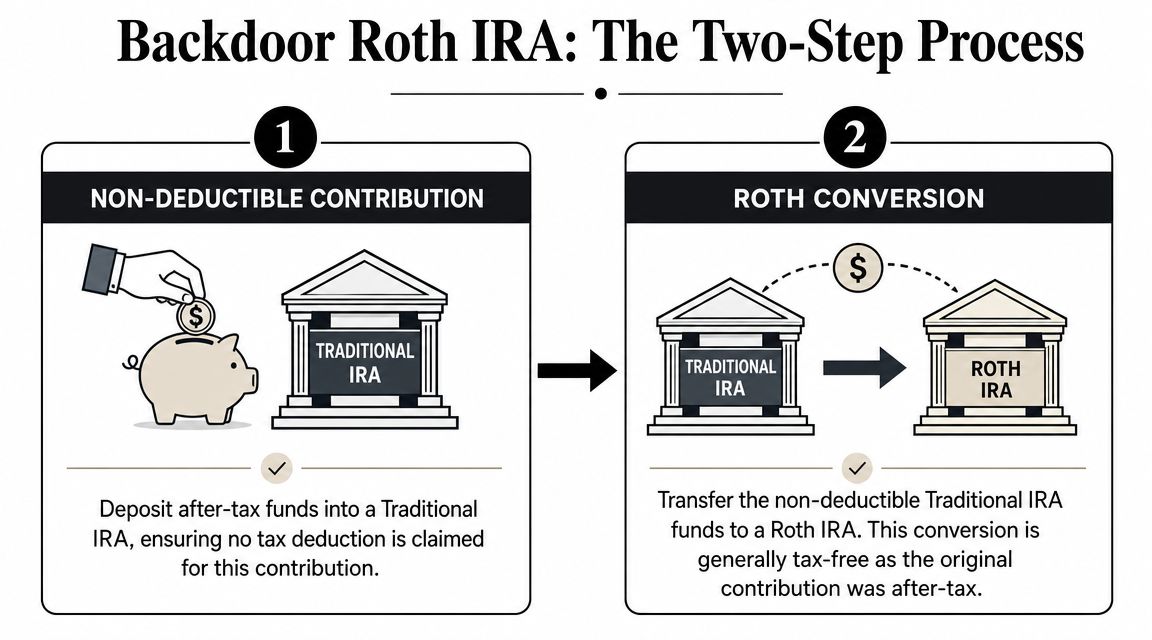
Step one fund a Traditional IRA with after-tax money
Start by making a contribution to a Traditional IRA using after-tax dollars. For a clean backdoor Roth, that contribution is usually nondeductible.
That word matters. A lot.
“Nondeductible” means you do not claim a tax deduction for the contribution on your return. You are creating what tax pros call basis, which is your already-taxed money inside the IRA. Basis works like a receipt. It shows the IRS that this portion should not be taxed again when handled correctly.
This is one of the easiest places to slip. If you or your tax software accidentally deduct the contribution, you have changed the character of the transaction. The conversion can still happen, but the tax result is no longer the clean version people expect.
If you are deciding whether the strategy makes sense in your bigger tax plan, this guide on how to convert to a Roth IRA properly can help you frame the decision.
Step two convert to a Roth IRA
Once the nondeductible contribution lands in the Traditional IRA, you convert that amount to a Roth IRA. The mechanics are straightforward. The tax treatment is where people need to pay attention.
If the contribution sat in the account long enough to earn interest before the conversion, that small amount of growth is generally taxable when converted. That surprises people. They expected the whole move to be tax-free, but only the after-tax contribution itself was already taxed.
Here is the clean version of the process:
- Open or use a Traditional IRA.
- Make a nondeductible contribution with after-tax money.
- Keep records showing you did not deduct that contribution.
- Convert the funds to a Roth IRA.
- Report the transaction correctly on Form 8606.
Form 8606 is the paper trail that keeps after-tax dollars from being taxed a second time. Skip that form, and you make it much harder to prove which money was already taxed.
A simple way to view the process is this: step one creates the after-tax ingredient, and step two moves that ingredient into the Roth account. If nothing else is mixed in, the result is usually clean. If pre-tax IRA money is lurking elsewhere, the situation changes fast.
The Pro-Rata Rule The Most Critical Limit
This is the part many high earners miss, and it's the part that creates the most expensive misunderstandings.
People search for backdoor Roth IRA limits expecting to find one number. In practice, the harshest limit often isn't the annual contribution cap. It's the pro-rata rule.
Why people get blindsided
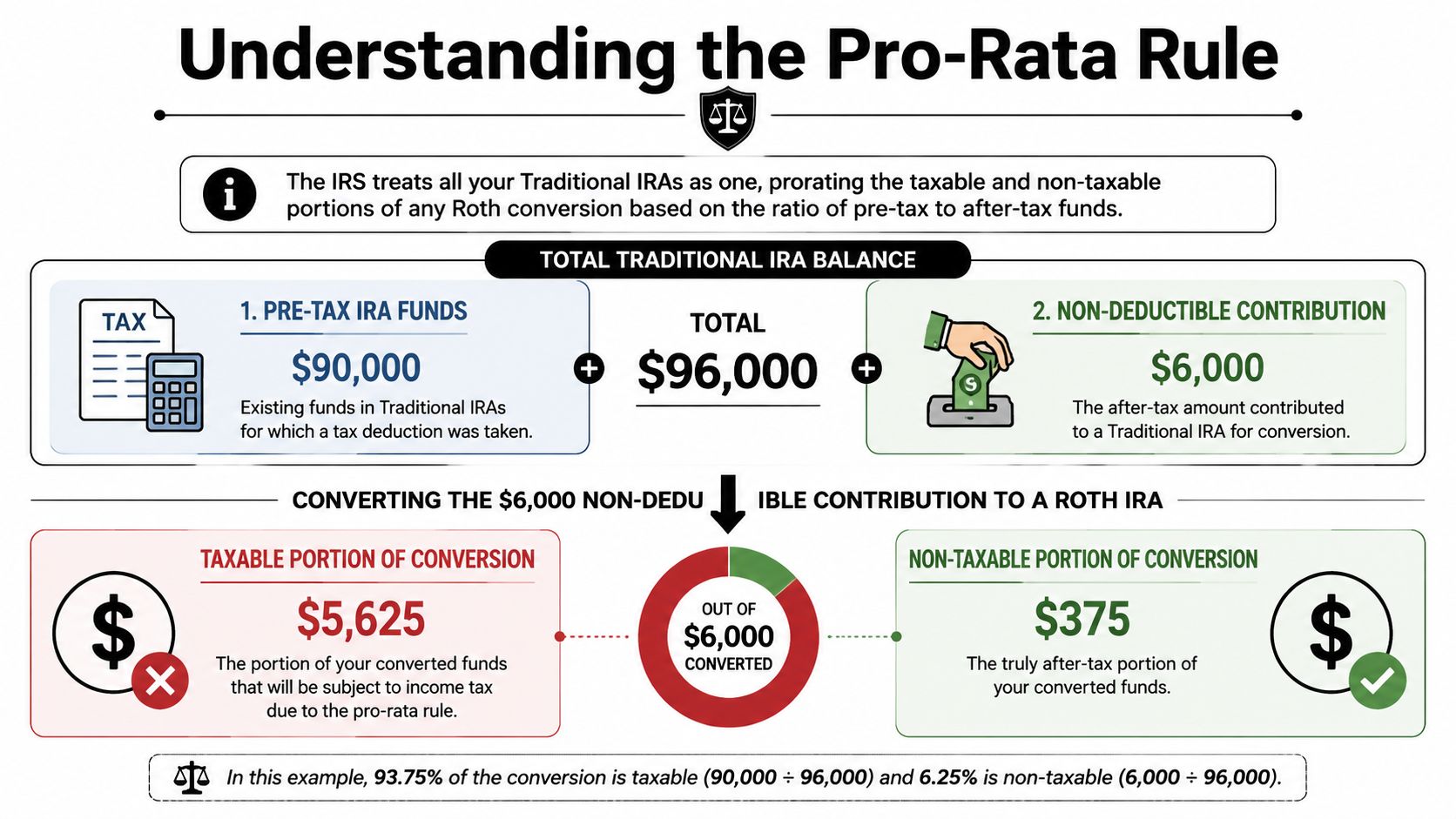
Bogleheads explains in its Backdoor Roth reference that if any pre-tax Traditional IRA balance remains on December 31, the pro-rata rule applies. That means the IRS doesn't let you isolate only your new after-tax contribution for tax-free treatment if you also have other pre-tax IRA money sitting elsewhere.
This catches people who say things like:
- “My old rollover IRA is at another brokerage, so it shouldn't matter.”
- “I converted only the new contribution, not the old IRA.”
- “I opened a fresh IRA just for the backdoor, so the accounts are separate.”
For tax purposes, separate account statements don't necessarily mean separate treatment. The IRS looks across your relevant IRA balances and applies a ratio.
A simple example of a partly taxable conversion
Use a simple kitchen analogy. If you pour cream into black coffee, you can't later spoon out “just the cream.” The IRS treats pre-tax and after-tax IRA money in a similar blended way once the pro-rata rule applies.
Suppose you already have a large pre-tax rollover IRA from an old employer plan. Then you make a nondeductible Traditional IRA contribution for a backdoor Roth and convert that amount. You might think, “I converted my after-tax money, so there shouldn't be tax.”
That's not how the calculation works when pre-tax IRA money still exists at year-end.
Here's the practical outcome:
| Situation | Result |
|---|---|
| You have no pre-tax Traditional, SEP, or SIMPLE IRA money at year-end | A backdoor conversion may stay relatively clean |
| You have pre-tax IRA money on December 31 | Part of the conversion can become taxable under the pro-rata rule |
You don't need complicated math to understand the principle. If most of your IRA money is pre-tax, then most of the converted amount is usually treated as pre-tax for tax purposes.
Bottom line: The pro-rata rule is why two taxpayers can do the same “two-step” process and get very different tax results.
Common situations that trigger trouble
The most common trouble spots aren't exotic. They're ordinary financial housekeeping issues.
- Old rollover IRA from a prior job: Many people forget that an old rollover IRA is still pre-tax IRA money for this purpose.
- SEP IRA from freelance or business income: Self-employed savers often overlook SEP balances when planning a backdoor conversion.
- SIMPLE IRA still on the books: Even if it's inactive, it can still affect the tax calculation.
- Year-end surprises: Someone converts early in the year, then rolls pre-tax money into an IRA later and accidentally changes the year-end picture.
A useful way to think about the backdoor strategy is this: the annual contribution limit tells you how much can enter the process, but the pro-rata rule tells you how cleanly it can pass through.
That's why a CPA often starts with an inventory question, not a conversion question: “What do you already have in Traditional, SEP, and SIMPLE IRAs?” If the answer is “I'm not sure,” that's the risk signal.
Navigating Key Dates and Tax Forms
The tax mechanics don't end once you complete the conversion. Timing and reporting are what keep a valid strategy from turning into a messy return.
When the contribution has to happen
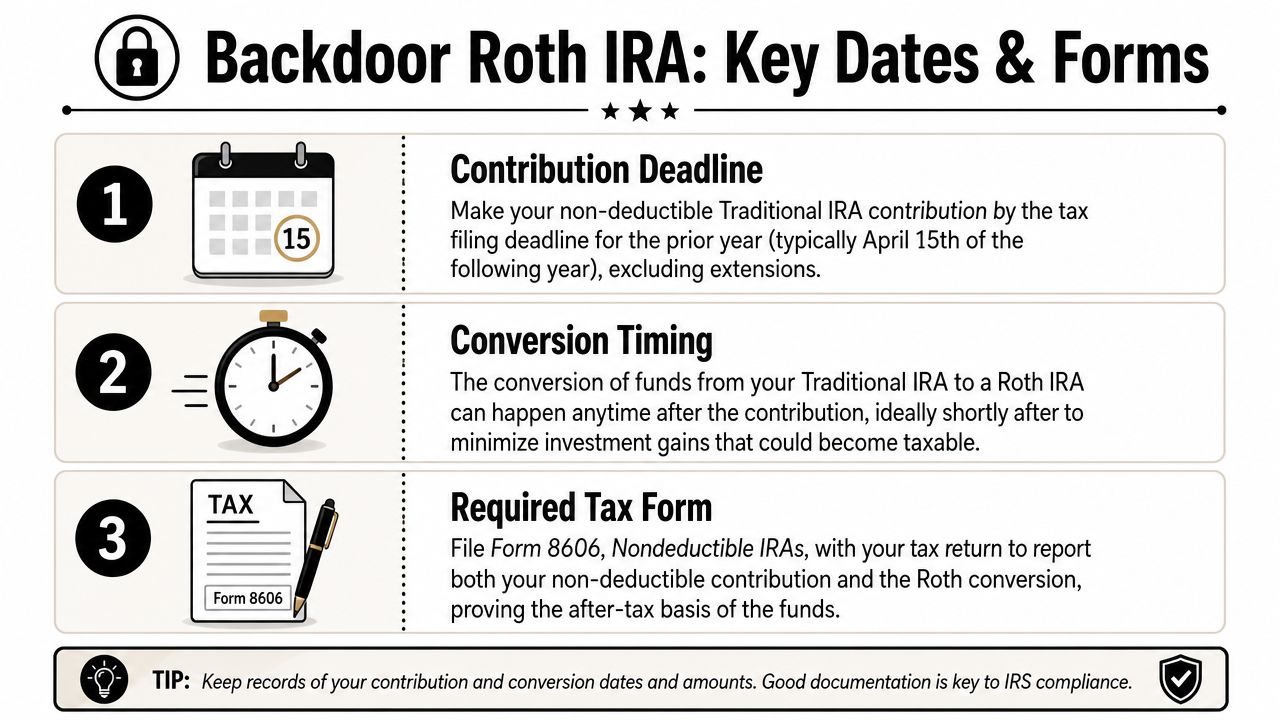
Morningstar notes, as summarized in the verified guidance above, that the nondeductible Traditional IRA contribution must be reported on Form 8606 and must be made by the tax-filing deadline for the year involved. If you need a quick refresher on the timing, this guide to the IRA contribution deadline lays out the calendar rules clearly.
That deadline matters because people often assume they can fix everything later with an extension. IRA contribution timing doesn't work that way just because your tax return filing date moves.
The waiting period myth
One persistent myth is that you must wait a set number of days or months after funding the Traditional IRA before converting it. The cleaner practical approach is usually the opposite. Many taxpayers convert shortly after the contribution settles to reduce the chance that earnings build up inside the Traditional IRA before conversion.
Why does that matter? Because extra growth in the Traditional IRA can complicate the tax result. Even small amounts can create additional reporting questions that didn't need to exist.
Convert with intention, not with delay. Unnecessary waiting often creates avoidable mess.
What Form 8606 is doing for you
Form 8606 is the recordkeeper for your after-tax basis. It connects the dots between the nondeductible contribution and the Roth conversion so the IRS can see which dollars were already taxed.
Think of it as your receipt file. If the receipt is missing, the IRS system won't automatically know that part of your IRA money was after-tax.
A simple checklist helps:
- After the contribution: Keep confirmation that the Traditional IRA contribution was made for the intended tax year.
- At conversion time: Save the transaction record showing money moved from the Traditional IRA to the Roth IRA.
- At tax filing: Make sure Form 8606 is included and consistent with the rest of the return.
Many errors happen because taxpayers assume the brokerage paperwork alone is enough. It isn't. Custodians report transactions. Your tax return explains their character.
Beyond the Backdoor Exploring Alternatives
Sometimes the best answer isn't the standard backdoor Roth at all. That surprises people, especially after they've spent hours reading about the two-step method.

Backdoor Roth versus mega backdoor Roth
A Backdoor Roth IRA uses IRA rules. A mega backdoor Roth is different. It generally depends on a workplace 401(k) plan that allows after-tax contributions and also allows the right kind of in-plan conversion or movement out to a Roth destination.
People often combine these names as if they're the same thing. They aren't. One uses IRA mechanics. The other depends heavily on employer plan design. If your plan doesn't offer the needed features, the mega version isn't available.
Backdoor Roth versus a standard Roth conversion
A standard Roth conversion is simpler to describe but often bigger in tax impact. You convert existing pre-tax IRA money to a Roth IRA and pay income tax on the converted amount as required.
That can make sense in the right planning year. It can also create a larger immediate tax cost than someone expected.
Here's a quick comparison:
| Strategy | What it usually involves | Main question |
|---|---|---|
| Backdoor Roth IRA | Nondeductible Traditional IRA contribution, then Roth conversion | Do you have pre-tax IRA balances that trigger pro-rata issues? |
| Mega backdoor Roth | After-tax 401(k) contributions with plan-specific Roth movement options | Does your employer plan allow it? |
| Standard Roth conversion | Converting existing pre-tax IRA money | Are you prepared for the tax cost this year? |
Retirement planning also rarely happens in isolation. Many households looking at Roth strategies are also deciding how to prioritize other tax-advantaged accounts. If that's you, Fintrack's guide to HSA accounts gives a helpful overview of another account type that often belongs in the same planning conversation.
The important point is that “Roth strategy” is a category, not a single move. The right tool depends on your income, your existing account mix, your employer plan options, and your tolerance for current-year tax cost.
Your Financial Safety Check When to Consult a CPA
A backdoor Roth can be a clean annual habit for some households. For others, it's one of those transactions that looks easy until you trace the tax consequences across all accounts.
You should strongly consider professional help if any of these apply:
- You already own pre-tax IRA money: Traditional, SEP, and SIMPLE IRA balances are the first red flag because of the pro-rata rule.
- You have an old rollover IRA from a former employer plan: This is one of the most common sources of accidental taxable conversions.
- You're not sure whether you took a deduction for the Traditional IRA contribution: If the tax treatment of the contribution is fuzzy, the conversion reporting can go sideways fast.
- Your account records don't line up cleanly: Missing confirmations, partial conversions, and unclear year designations create avoidable filing problems.
- You're confused by Form 8606: That confusion isn't minor. It usually means the transaction needs review before filing.
- You're considering moving retirement money around before year-end: Timing changes can affect whether the strategy stays clean.
A good CPA doesn't just prepare the return after the fact. They pressure-test the plan before you create a tax bill you didn't intend.
That's especially true with backdoor Roth IRA limits. The visible limit is the annual contribution cap. The hidden limit is whether your broader IRA situation lets the conversion work the way you think it will.
If you have no pre-tax IRA balances, clear records, and a straightforward fact pattern, the process may be manageable. If you have rollover money, self-employment retirement accounts, or uncertainty about prior reporting, professional review is often the cheaper decision.
If you want help reviewing IRA balances, spotting pro-rata issues before year-end, or reporting a backdoor Roth correctly on your return, Allied Tax Advisors can help you plan the move before it becomes an avoidable tax problem.