
You log into QuickBooks, glance at the bank balance, then glance at your actual bank app, and the two numbers don't even live in the same universe. There are old transactions sitting in Uncategorized Expense, customer payments that look off, maybe a loan account that never got set up right, and tax season is getting uncomfortably close.
That's the moment most owners tell themselves they'll deal with it later.
Bad idea.
Messy books aren't just annoying. They block good decisions, create tax risk, slow down financing, and waste your time every single month you keep working around them. Bookkeeping cleanup services aren't a luxury for “big” companies. They're a practical reset for any business that's tired of flying blind.
Table of Contents
- Understanding Bookkeeping Cleanup Services
- Telltale Signs Your Business Needs a Cleanup
- The Cleanup Process Step by Step
- Pricing Models and What to Expect
- How to Choose a Cleanup Service Provider
- Your Next Steps and Cleanup FAQs
Understanding Bookkeeping Cleanup Services
A bookkeeping cleanup is not routine bookkeeping. It's not data entry. It's not “just catch me up.”
It's a financial deep cleaning. If monthly bookkeeping is tidying the kitchen every day, cleanup is pulling the fridge away from the wall, scrubbing behind it, fixing what's broken, and getting the room back to a usable condition.
What cleanup actually means
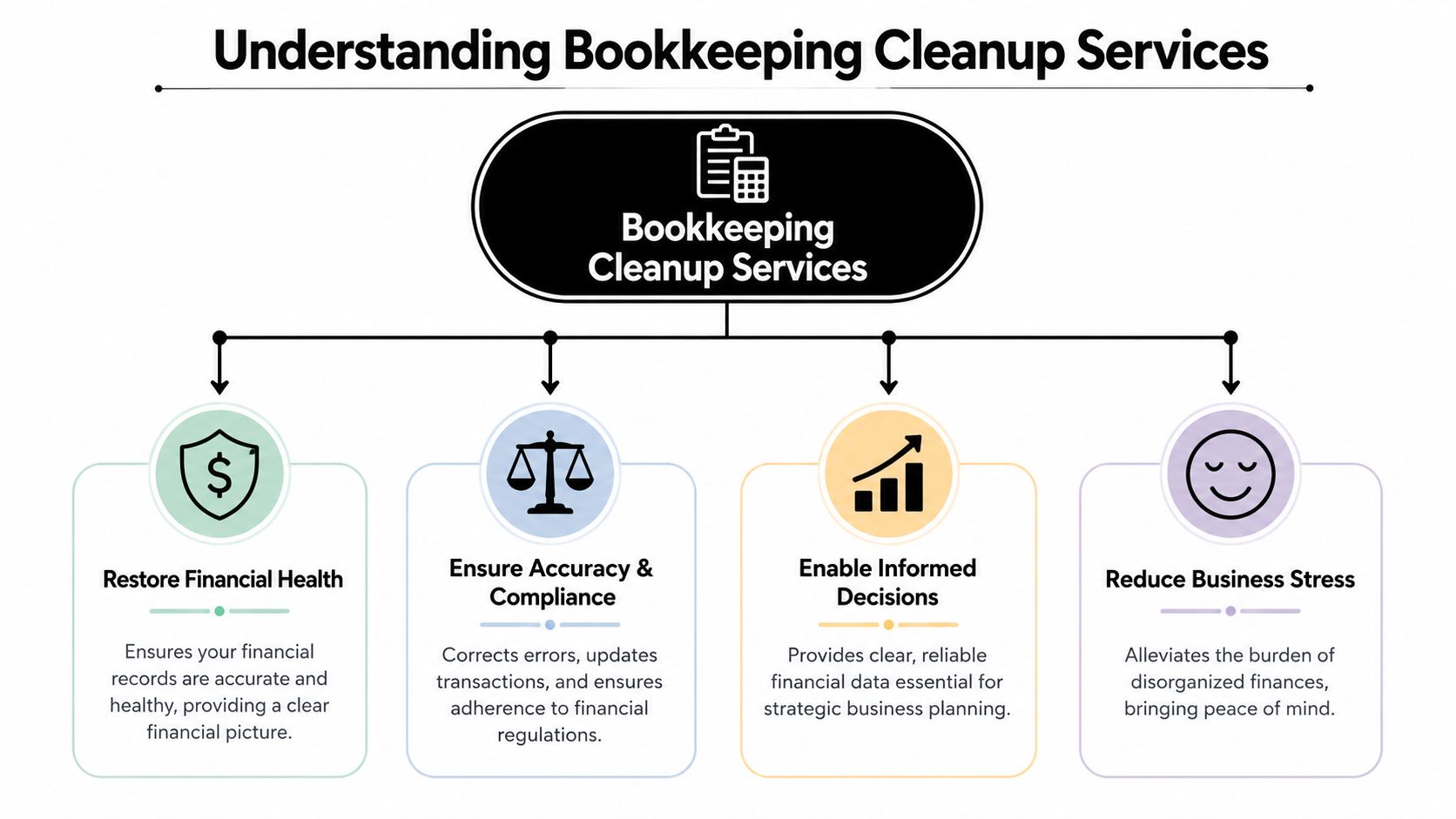
The technical term is period close remediation. In plain English, that means someone goes back through your records, traces uncategorized or duplicate transactions, corrects chart-of-accounts mistakes, reconciles bank and credit card accounts, and rebuilds your core reports so the general ledger matches the underlying records, as described in NorthStar Bookkeeping's explanation of period close remediation.
That distinction matters because owners often confuse three different jobs:
| Service | What it does | What it does not do |
|---|---|---|
| Cleanup | Fixes wrong entries, duplicate transactions, broken balances, and reconciliation problems | It does not replace ongoing monthly bookkeeping |
| Catch-up | Enters missing months of activity that were never recorded | It does not automatically fix old errors |
| Ongoing bookkeeping | Maintains current records month by month | It does not repair historical damage on its own |
If you want a plain-English refresher on day-to-day recordkeeping, Allied Tax's guide to small business bookkeeping basics is a helpful starting point before you tackle older problems.
Practical rule: If your reports exist but you don't trust them, you probably need cleanup, not just catch-up.
A good cleanup also forces a business to confront system problems. Sometimes the issue isn't the software. It's that nobody set up accounts correctly, nobody reconciled consistently, or different systems stopped agreeing with each other. That's why operations-focused resources like Lighthouse Consultants' financial problem solving can be useful when the bookkeeping mess points to a wider finance-process problem.
Why this matters beyond tax season
Owners usually call when taxes are due. That's understandable, but it's too narrow.
The value of bookkeeping cleanup services is that they turn unreliable reports into usable ones. Once the errors and unreconciled balances are removed, your Profit and Loss statement and Balance Sheet become tools you can manage from. You can see whether margins make sense, whether cash is really available, and whether liabilities are recorded correctly.
That changes decisions.
You stop guessing at owner draws. You stop delaying loan applications because the lender packet would fall apart under scrutiny. You stop handing your tax preparer books that need to be decoded first. Cleanup is an expense on paper, but in practice it's a risk-reduction project that protects future growth.
Telltale Signs Your Business Needs a Cleanup
Most owners don't need an accountant to tell them the books are messy. They need someone to tell them that the mess is costing them money, time, and options.
The symptoms owners usually ignore

Run through this checklist.
Your bank balance doesn't match your accounting software.
This usually means accounts weren't reconciled correctly, transactions were duplicated, or items are missing. If the cash number is wrong, every decision built on that number is shaky.You've got a pile of uncategorized transactions.
Uncategorized activity is not harmless. It usually means expenses and income are sitting in limbo, which can distort profitability and tax reporting.Your Profit and Loss looks odd, but you can't explain why.
Maybe meals are mixed into cost of goods sold. Maybe loan payments are buried in expense accounts. Maybe owner transactions are running through the business incorrectly. If you can't explain the report, you can't manage from it.You avoid your Balance Sheet.
That's common. It's also a warning sign. Old liabilities, negative asset balances, stale loans, and strange equity entries often hide there.Your CPA keeps asking follow-up questions.
If tax prep turns into a scavenger hunt every year, the bookkeeping isn't supporting the tax work. It's creating extra work.
What those symptoms really cost you
Here's the part most guides skip. The cost of inaction is not abstract.
- Financing gets harder: Lenders want believable statements, not reports full of suspense.
- Tax prep gets slower: The professional has to clean the books before they can file from them.
- Cash decisions get worse: Owners hold back when they should invest, or spend when they shouldn't.
- Stress remains high: You keep carrying a background problem that never goes away.
If you're constantly “working around” your books instead of relying on them, that's already the diagnosis.
A messy file cabinet is irritating. Messy books can affect payroll timing, tax filings, and whether you trust your own numbers. If two or more signs on this list sound familiar, stop normalizing it. Cleanup is probably overdue.
The Cleanup Process Step by Step
Most owners fear cleanup because they assume it will be chaotic, invasive, and impossible to follow. A solid process feels the opposite. It's structured, collaborative, and usually less dramatic than the mess you've been living with.
How a real cleanup engagement unfolds

Most cleanups move through a sequence like this:
Diagnostic and scoping
The accountant reviews your books, spots problem areas, and defines the cleanup period. At this stage, they figure out whether the issue is simple backlog or deeper structural damage.Document collection
You provide bank statements, credit card statements, loan documents, payroll reports, sales tax records, and access to your accounting software.Reconciliation and correction
This is the heavy lifting. The team matches accounts to source records, fixes duplicate entries, reclassifies transactions, and resolves mismatches.Subledger review
Accounts receivable, accounts payable, payroll, and loan balances get checked to make sure the detail supports the totals.Final reporting and handoff
You receive refreshed financial statements and a cleaner chart of accounts, along with notes on what was fixed and what should happen going forward.
A professional cleanup workflow usually includes gathering source documents, reconciling bank and credit card accounts, reviewing receivables and payables, checking payroll and tax filings, and cleaning up the chart of accounts. It also differs from catch-up work because catch-up fills missing records while cleanup fixes incorrect entries, duplicates, and misclassifications, as outlined in MBS's bookkeeping cleanup checklist.
If you want to understand one of the most important pieces in that process, Allied Tax's guide to bank account reconciliation explains why this step is the backbone of reliable books.
What you need to provide
Your part matters. Cleanup doesn't work well if you disappear after the kickoff.
Here's what usually helps the project move smoothly:
- Fast access: Bank statements, login access, and payroll reports should be provided early.
- Context on unusual transactions: Large owner draws, loans, one-time equipment purchases, and transfers need explanation.
- Responsiveness: Questions will come up. A delay in answers often stalls the whole project.
- A decision-maker: Someone has to approve assumptions and confirm what's business-related.
The cleanest cleanup projects aren't the ones with perfect records. They're the ones where the owner answers questions quickly.
Some firms report that most cleanup projects finish in 2 to 4 weeks once documents are collected, which is a useful planning benchmark if you're trying to get ahead of taxes, payroll, or financing, according to Acelerar Technologies' overview of cleanup timelines and pricing.
Pricing Models and What to Expect
A messy set of books can cost you far more than the cleanup bill. It can delay a loan, inflate your tax prep fees, hide cash flow problems, and leave you making decisions from bad numbers.
That is why pricing matters, but scope matters more.

Why cleanup quotes vary so much
Cleanup pricing changes based on risk, not just volume. Two companies can have the same number of monthly transactions and get very different quotes if one has clean reconciliations and the other has broken opening balances, uncategorized loan activity, payroll errors, or sales tax accounts that do not match filed returns.
As noted earlier, some providers place small-business cleanup work anywhere from the low thousands to much higher project totals. That spread makes sense. The main driver is how much detective work and correction the file needs, not how many lines sit in the bank feed.
Common pricing models work like this:
| Pricing model | How it works | My take |
|---|---|---|
| Hourly | You pay for time spent | Fine for a small, contained issue. Dangerous if the books are messy and nobody has defined the scope. |
| Fixed fee | You pay one amount for a defined project | Better for budgeting if the quote spells out what is included and what triggers added cost. |
| Diagnostic plus fixed fee | You pay for a review first, then get a scoped project quote | The best fit for messy books. It reduces surprises for both sides. |
I recommend the diagnostic-plus-fixed-fee model for most cleanup jobs. It costs a little more upfront, but it lowers the chance of a vague quote turning into a long, expensive back-and-forth. That is not extra overhead. It is risk control.
What drives the price up
Transaction count gets too much attention because it is easy to measure. Complexity is what moves the bill.
A six-month cleanup with moderate activity can still be expensive if the provider has to trace owner payments, rebuild account balances, sort out old loans, or correct payroll postings that hit the wrong liability accounts. Those fixes matter because they affect taxes, lender reporting, and how much confidence you can place in your financial statements.
If you are comparing project quotes to ongoing monthly support, Allied Tax's overview of bookkeeping service rates for small businesses gives useful context on how firms separate recurring work from catch-up and cleanup work. For a broader outsourcing perspective, NineArchs LLC's bookkeeping advice can help you evaluate what belongs with an outside provider versus what should stay in-house.
What you should receive for the fee
Do not pay for cleanup based on a vague promise to "tidy up the books." Pay for defined deliverables.
You should expect items like these:
- Reconciled bank and credit card accounts
- A cleaned-up general ledger
- Corrected chart of accounts
- Updated Profit and Loss and Balance Sheet
- Support for tax-ready records and management reporting
You should also know the period being cleaned up, what assumptions were made, and what is outside scope. If loan balances still need lender statements or payroll filings still need review, that should be stated clearly in writing.
Cheap cleanup gets expensive fast when your CPA, lender, or tax preparer has to fix it all over again.
My advice is simple. Buy clarity, not the lowest number. The right cleanup fee is an investment in cleaner taxes, better financing odds, and sharper decisions. The wrong cheap quote can leave you with the same mess, just in a prettier package.
How to Choose a Cleanup Service Provider
Not every bookkeeper is built for cleanup work. Ongoing monthly entry is one skill. Untangling historical errors is another.
Questions that reveal real expertise
Ask direct questions. If the answers are vague, move on.
How do you handle missing documents?
You want a real process, not a shrug.What happens if opening balances are wrong?
This tells you whether the provider can deal with structural issues, not just miscoded expenses.Will you review loans, payroll, A/R, and A/P, or only bank transactions?
A bank-only cleanup can leave major problems untouched.What reports will I receive at the end?
If they can't name the deliverables clearly, that's a problem.Who will do the work?
In tax-sensitive situations, I'd rather see involvement from credentialed professionals such as CPAs or Enrolled Agents, not just data processors.How do you document changes?
You should know what was fixed and why.
For owners weighing outsourcing in general, resources like NineArchs LLC's bookkeeping advice can help you think through what to delegate and what to keep close.
Why diagnostics beat guesswork
A flat quote given after a quick glance sounds convenient. It's often sloppy.
Some providers now recommend a diagnostic plus fixed-fee model because the primary cost driver may not be transaction volume at all. It may be broken opening balances, missing months, and repair work across linked accounts, as explained in Xenett's analysis of hidden cleanup complexity.
That's why I prefer a provider who says, “Let me review the file first.”
A good diagnostic does three important things:
- It exposes hidden complexity before anyone promises a fee.
- It reduces surprise billing once the engagement starts.
- It tells you whether the provider understands cleanup work.
This is also where one practical option may be relevant. Allied Tax Advisors provides bookkeeping support for small businesses alongside tax and compliance services, which can matter when the cleanup issues spill into payroll, sales tax, or return preparation.
A confident provider doesn't rush to quote from a screenshot. They inspect the file, identify the damage, and then price the repair.
If a firm insists every cleanup is simple, they haven't done enough of them.
Your Next Steps and Cleanup FAQs
The next step is not to stare at the mess longer. It's to get a real diagnosis and a cleanup plan.
What to do now
Start by gathering the basics. Pull bank and credit card statements, loan documents, payroll records, prior tax returns, and access to your accounting software. Then make a short list of what feels wrong. Accounts that don't reconcile, reports you don't trust, old balances that never clear.
Bring that package to a professional and ask for a scoped review.
If you're in San Diego and your books are holding up taxes, cash-flow decisions, or financing conversations, get help before the next deadline forces a rushed fix. Cleanup done early gives you options. Cleanup done late usually costs more in stress.
Can I do the cleanup myself
Yes, sometimes.
If the issues are minor, you understand your accounting system, and you know how to reconcile accounts properly, you may be able to handle basic cleanup. But most owners shouldn't DIY a file they already don't trust. The risk isn't just wasting time. It's making the books look cleaner while leaving the underlying errors in place.
Can you fix multiple years of messy books
In many cases, yes.
Older files are harder because memory fades, documents go missing, and mistakes spread across more periods. But age alone doesn't make cleanup impossible. It just makes proper scoping more important. The first question is whether the historical records can still be supported well enough to rebuild reliable statements.
How does cleanup help with taxes and loans
Clean books support both.
For taxes, cleanup helps produce records your tax preparer can use without guessing. For loans, cleanup gives lenders financial statements that tie back to reality. In both cases, the benefit is credibility. You're not asking a CPA or banker to trust numbers that clearly need work.
Will cleanup interrupt my daily operations
Usually not, if the process is organized.
Most of the work happens in the background after access and documents are provided. You'll need to answer questions and review issues, but you shouldn't have to stop running the business. In fact, the point is the opposite. Cleanup clears away old confusion so you can get back to operating with confidence.
If your books are behind, inconsistent, or just plain unreliable, talk to Allied Tax Advisors. A professional cleanup review can show you what's broken, what it will take to fix, and how to turn your records into something useful for taxes, cash-flow decisions, and growth.