
The most popular advice about buying a house and taxes is also the most misleading: “You'll get big tax breaks once you own.” A home can create valuable deductions, but ownership doesn't automatically turn a purchase into a tax shelter. For many households, the tax question is whether the deductions beat the standard deduction, how local property taxes will change after purchase, and which closing costs will matter only when you eventually sell.
The largest mistake is evaluating a home by its mortgage payment alone. A sound analysis includes purchase-time taxes, reassessment risk, deductible interest, property taxes, closing-cost basis, and future capital gains. The cheaper home on the listing page may carry a heavier long-term tax bill than a more expensive property in a jurisdiction with stable assessments.
Table of Contents
- Why Your Home Purchase May Not Deliver the Tax Breaks You Expect
- Closing Costs and How They Affect Your Tax Basis
- Mortgage Interest and Property Tax Deductions Explained
- The Property Tax Reassessment Trap for New Buyers
- First-Time Homebuyer Tax Provisions and Transfer Taxes
- Capital Gains Exclusion and Future Sale Tax Planning
- Your Homebuyer Tax Planning Checklist and Recordkeeping System
Why Your Home Purchase May Not Deliver the Tax Breaks You Expect
Buying a house doesn't guarantee a dramatic reduction in your federal tax bill. Mortgage interest and real estate taxes generally matter only when you itemize deductions, and many homeowners find that their eligible itemized expenses don't exceed the standard deduction. The purchase may still be financially sensible, but the tax benefit could be smaller than the sales pitch suggests.
The deduction calculation comes after the purchase decision
The federal rules impose meaningful limits. The IRS explains that homeowners may deduct state and local real estate taxes, but the federal deduction is capped at $10,000 under the rule described in its homeowner guidance (IRS tax benefits for homeowners). The Tax Policy Center also notes that the mortgage interest deduction is limited to interest on up to $750,000 of mortgage debt for homes bought or improved after December 14, 2017.
Those limits can interact in frustrating ways. A homeowner may have substantial mortgage interest and property taxes, yet still receive little incremental benefit if itemized deductions don't exceed the standard deduction. Even when itemizing wins, the deduction reduces taxable income. It doesn't reimburse the homeowner dollar for dollar.
Practical rule: Never increase your offer because you think the tax deduction will make the home affordable. Price the property as though the deduction may be limited, then treat any actual tax benefit as a secondary advantage.
The better question is net after-tax housing cost, not “How large is my deduction?” Start with the full monthly obligation, then account for the likely property-tax bill, insurance, maintenance, financing cost, and closing charges. A deduction can soften a cost, but it doesn't erase that cost.
The tax plan starts before the offer
Before making an offer, estimate three separate figures:
- Immediate acquisition cost: Include transfer taxes, recording charges, lender fees, and prepaid items.
- Annual ownership cost: Use the likely post-purchase assessment, not just the seller's current tax bill.
- Future sale exposure: Track basis-related costs and improvements from the first day of ownership.
That framework is more reliable than assuming every homeowner receives the same federal benefit. Your filing status, other itemized deductions, mortgage size, local tax system, and intended use of the property all affect the result.
Closing Costs and How They Affect Your Tax Basis
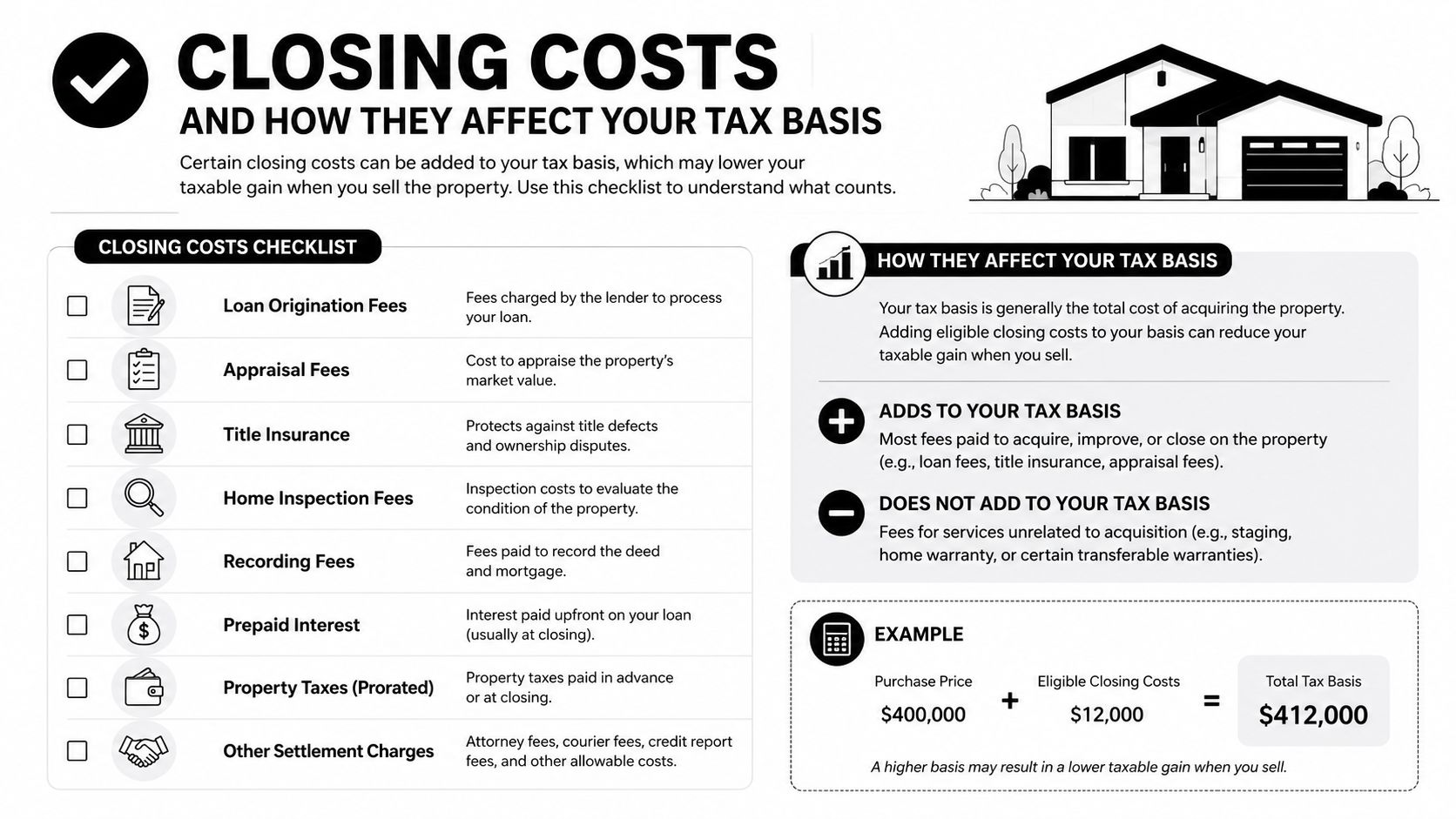
Your closing disclosure contains several different tax categories. Treating every charge as a current deduction is a costly error. Some expenses may be deductible under specific rules, some become part of your home's tax basis, and others provide no personal tax benefit.
Sort every line item by tax treatment
Begin with the settlement statement and create three columns.
Potential current deductions may include qualifying mortgage interest and certain discount points, subject to IRS requirements. Mortgage points generally need to relate to the purchase or improvement of a qualified home, appear properly in the loan documents, and satisfy other conditions. Don't assume that a fee described as “points” qualifies just because it appears near other financing charges.
Basis additions generally include eligible acquisition costs and later capital improvements. Title-related charges, transfer taxes, legal fees connected with acquiring the property, and similar costs may affect the amount you're treated as having invested in the home. They usually don't produce an immediate deduction, but they can reduce taxable gain when you sell.
Personal or nondeductible charges may include costs that don't meet the rules for a current deduction or basis adjustment. Lender administrative fees, routine repairs, and certain service charges need careful classification rather than automatic treatment.
The distinction matters because basis is part of your future sale calculation. Your starting basis typically begins with what you paid, then increases for eligible acquisition costs and capital improvements. When you sell, a higher documented basis generally reduces the gain subject to tax.
Use a written basis schedule
Suppose your purchase documents contain $15,000 of costs that don't qualify as current deductions but do qualify for basis treatment. If you add them to your records, the future gain calculation starts with a higher investment in the property. The eventual tax savings depend on your sale price, exclusion eligibility, tax rate, and the legal treatment of the sale. The point is not that the entire $15,000 becomes a tax refund. The point is that losing the documentation can permanently increase taxable gain.
Keep the settlement statement, purchase contract, lender documents, title policy, invoices, and proof of payment together. The cost-basis guidance from Allied Tax Advisors can help you organize the calculation, but your records should stand on their own.
Don't confuse repairs with improvements
A new roof, room addition, or substantial renovation can affect basis because it adds lasting value or extends the property's useful life. Routine repairs generally don't receive the same treatment. Keep invoices that identify the work, date, property, contractor, and amount paid.
Create a digital folder named for the property and a spreadsheet with four fields: date, description, vendor, and amount. Add a note explaining whether the expense is an acquisition cost, capital improvement, repair, financing cost, or personal expense. That simple system protects your future tax position far better than trying to reconstruct decades of spending before a sale.
Mortgage Interest and Property Tax Deductions Explained
Mortgage interest is not automatically deductible just because you made a mortgage payment. For U.S. taxpayers, the debt must be secured by a qualified home, and the proceeds must have been used to buy, build, or substantially improve that home. The deduction is available only when you itemize on Schedule A, as the IRS explains in Publication 530.
Mortgage interest has both a purpose test and a debt limit
For post-2017 acquisition debt, the deduction generally applies to interest on the first $750,000 of mortgage principal, or $375,000 if married filing separately, under the IRS rules. A larger mortgage can produce more total interest, but the tax benefit doesn't grow without limit.
That creates a direct planning tradeoff. If part of a home-equity loan or line of credit funded a vehicle, vacation, or unrelated personal expense, the interest may not qualify under the home-acquisition rules. If the proceeds funded a substantial improvement, the analysis may be different, but retain the loan documents and receipts.
Property taxes create a separate limitation. The IRS homeowner guidance identifies the $10,000 federal cap for state and local real estate tax deductions. In a high-tax location, you may pay considerably more than the amount you can use for the federal itemized deduction.
Itemizing is a comparison, not a reward for owning
Add qualifying mortgage interest, allowable property taxes, charitable gifts, eligible medical expenses, and other itemized deductions. Then compare that total with the standard deduction available to your filing status for the relevant tax year. The correct choice is the one that produces the lower taxable income, not the one that includes more homeowner expenses.
Use this matrix as a planning tool. It illustrates the decision method without pretending that one mortgage or tax figure fits every taxpayer.
| Scenario | Mortgage Interest | Property Tax after SALT cap | Total Itemized | Standard Deduction | Better Choice |
|---|---|---|---|---|---|
| Lower-interest loan, moderate taxes | Add actual amount | Add allowable amount | Add all itemized deductions | Use applicable amount | Choose the larger total |
| Large loan within acquisition-debt rules | Add qualifying interest | Add allowable amount | Add all itemized deductions | Use applicable amount | Choose the larger total |
| High-tax property above the federal limit | Add qualifying interest | Limit to allowable amount | Add all itemized deductions | Use applicable amount | Often requires careful comparison |
| Nonqualifying loan use | Exclude ineligible interest | Add allowable amount | Add eligible items only | Use applicable amount | Choose based on eligible total |
The mortgage-interest deduction guide from Allied Tax Advisors can help you test the calculation against your loan purpose and filing position.
Private mortgage insurance requires current-year verification. Its treatment can change, so don't rely on an old homebuyer article or a prior-year tax return. Ask your preparer to confirm whether premiums qualify for the return you're filing.
The Property Tax Reassessment Trap for New Buyers
The seller's property-tax bill is not a dependable forecast of yours. In some jurisdictions, purchasing a home triggers a reassessment based on the new market value. A long-time neighbor may retain an older assessment while you receive a materially higher bill for a comparable property.
A 2026 Lincoln Institute analysis found that the average effective property-tax rate on a median homestead across 53 large U.S. cities was 1.213% in 2025, and it highlights cases where new homebuyers can pay roughly double the property taxes of neighbors because assessments reset after purchase (Lincoln Institute analysis).
A lower price can hide a higher tax burden
Buyers often compare two homes by price, interest rate, and insurance. That misses the local assessment regime. A less expensive property in a fiscally stressed city with purchase-based reassessment can create a larger annual tax obligation than a pricier home in a market where assessments change more gradually or remain stable for existing owners.
The tax bill also affects affordability beyond the first year. Lenders may include property taxes in escrow, but a post-closing reassessment can create an escrow shortage and higher future payments. Your budget should withstand the likely reassessment, not merely the seller's current bill.
The seller's tax bill is historical information. Your purchase price and the jurisdiction's assessment rules determine the risk you're accepting.
Research the rule before you negotiate
Ask the local assessor's office or a qualified real estate tax professional:
- Purchase trigger: Does a sale reset the assessed value?
- Timing: When does the new assessment take effect?
- Tax rate: Which local rates, levies, and special assessments apply?
- Exemptions: Does the property qualify for a homestead exemption, and must you apply?
- Appeal process: Can you challenge the assessment, and what evidence is required?
Calculate an estimated effective rate by dividing the likely annual property tax by the purchase price. Then compare that result with nearby jurisdictions, not just nearby listings. A home inspection protects you from physical defects. Property-tax research protects you from a recurring financial defect that may last for as long as you own the property.
First-Time Homebuyer Tax Provisions and Transfer Taxes
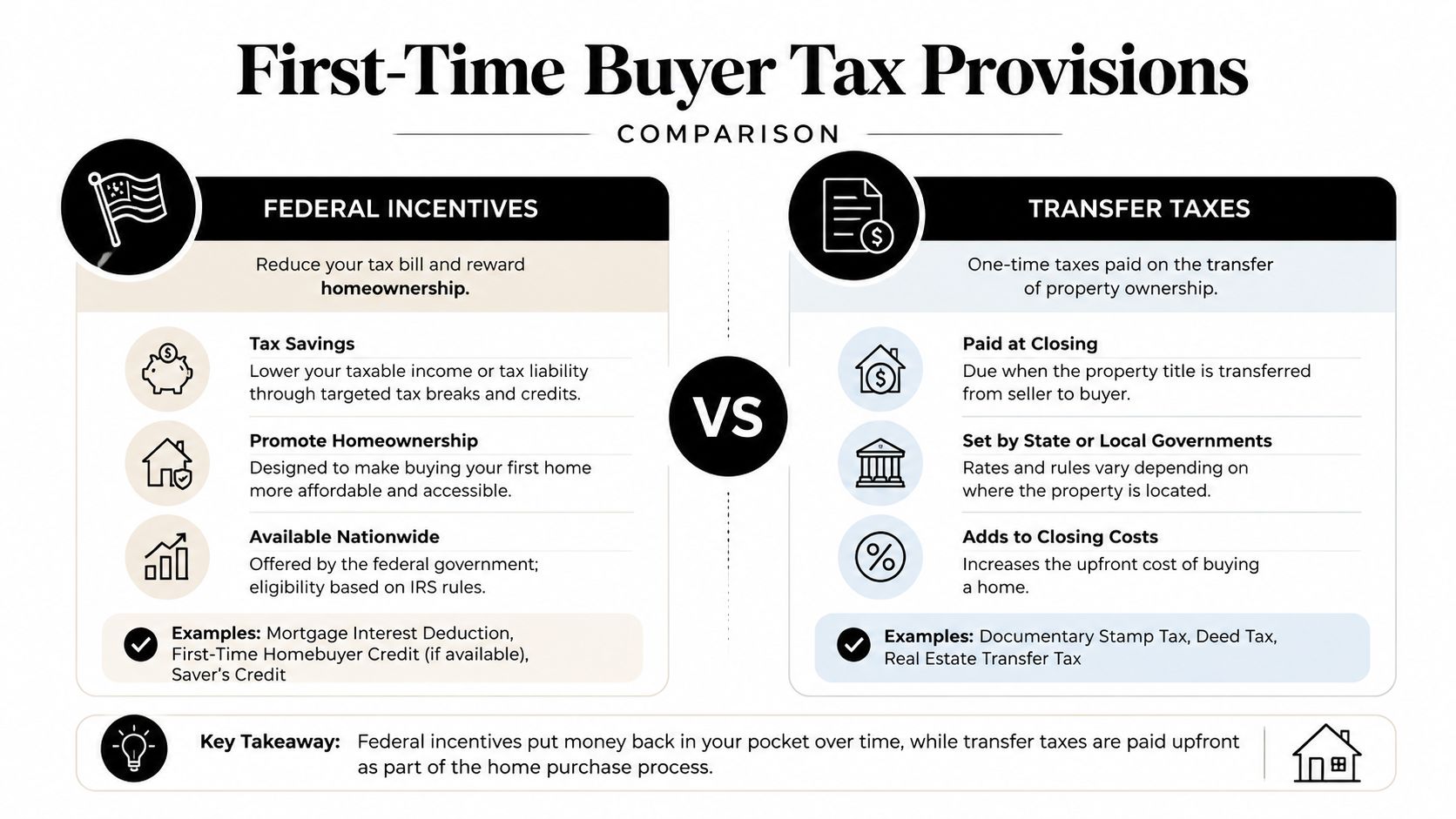
First-time buyer benefits come from different systems, and they shouldn't be lumped together. A federal provision may affect income tax. A state program may offer a credit or financing assistance. A transfer tax or stamp duty is generally an upfront transaction cost assessed when the property changes hands.
Across OECD countries, all 38 OECD countries levy recurrent taxes on immovable property, while 30 also levy transaction taxes on property purchases, according to the OECD report on housing taxation. Transaction taxes are usually calculated using market value at sale and are generally paid by the buyer. They're often flat-rate rather than progressive, although only seven OECD countries use progressive rates, four provide exemptions below a threshold, and six offer preferential treatment for first-time buyers.
U.S. provisions require eligibility checks
Potential U.S. tools include mortgage credit certificates, state-level credits or deductions, and penalty-free IRA withdrawals for qualifying first-time purchases. The rules vary by program. “First-time buyer” can mean someone who hasn't owned a principal residence during a specified period, not necessarily someone who has never owned any real estate.
Check the administering agency before relying on a benefit. Confirm the income limits, property limits, occupancy requirements, application deadline, and whether the program affects your federal tax basis or future sale calculation. A benefit that arrives after closing won't fix an offer that ignored transfer taxes.
The UK illustrates threshold risk
The UK provides a clear example of why buyers must use current regional thresholds. On April 1, 2025, the first-time-buyer stamp duty relief threshold fell from £425,000 to £300,000, while the ceiling for relief dropped from £625,000 to £500,000, as reported in HMRC-linked coverage (UK stamp duty changes and homebuyer taxes). The same reporting states that first-time buyers paid about £408 million in stamp duty from April 2025 to March 2026, compared with £101 million in the prior year.
The practical lesson is simple. A small change in purchase price can move a buyer across a breakpoint and create a substantial closing liability. Before signing, model the total price, applicable rate, relief, and the cost of being just above the threshold. Treat transfer tax as part of the acquisition budget, not as a minor settlement detail.
Capital Gains Exclusion and Future Sale Tax Planning
Your purchase records matter most when you sell. The general U.S. primary-residence exclusion can remove up to $250,000 of gain for a qualifying single filer and $500,000 for qualifying married taxpayers filing jointly, subject to the ownership and use requirements described in IRS guidance and summarized in home-sale capital gains rules from Allied Tax Advisors.
The central test is usually the two-out-of-five-year ownership and use rule. You generally need to own and use the home as your principal residence for the required period before sale. Keep evidence of occupancy, including utility records, insurance records, and tax documents.

Basis is your long-term defense
Your taxable gain is not just the sale price minus the original contract price. Eligible acquisition costs, documented capital improvements, and certain selling expenses can affect the calculation. That's why the basis schedule created at closing should remain active throughout ownership.
Track additions such as major renovations, structural work, and qualifying systems. Separate them from ordinary maintenance. If you convert the property to a rental, preserve the date of conversion, valuation records, depreciation schedules, and rental-period expenses. The tax treatment can become significantly more complicated than a primary-residence sale.
Rental conversion changes the analysis
A home sold as a primary residence may qualify for the residence exclusion if the tests are satisfied. A rental property brings depreciation and recapture considerations, and converting a home from personal use to rental use can affect the eventual gain calculation. Don't wait until listing day to reconstruct the property's history.
If you're comparing a future sale across borders, review a current resource covering U.S. and Canada capital gains rates. Rates and exclusions differ, and a calculator can help identify the questions to take to a tax professional.
An unforeseen job change or health issue may support a partial exclusion in some circumstances, but eligibility depends on the facts and applicable rules. Plan the sale date around residence requirements when possible. A few months of documented occupancy or a carefully timed sale can matter more than a small deduction claimed during the purchase year.
Your Homebuyer Tax Planning Checklist and Recordkeeping System
Tax planning works best as a timeline, not a last-minute filing exercise. Use one property file, one basis ledger, and one annual review date.
Before closing
- Request reassessment information: Ask the assessor how a sale affects the property's assessed value and when the change appears.
- Estimate the tax bill: Use the likely post-purchase assessment, applicable rate, special levies, and available exemptions.
- Review transfer taxes: Confirm who pays them, whether a first-time-buyer relief applies, and whether the benefit has a price threshold.
- Test itemizing: Estimate qualifying mortgage interest, allowable property taxes, charitable gifts, and other itemized deductions.
- Consult before signing: Have a tax professional review the purchase structure if you'll rent part of the property, use a home office, or expect a cross-border issue.
At closing
Download the complete closing disclosure and retain the purchase contract, deed, lender statement, title documents, and proof of funds. Mark each charge as a possible current deduction, basis addition, financing item, prepaid expense, or personal cost.
Don't rely on memory or the lender's year-end statement to reconstruct acquisition costs. Record the purchase price, eligible basis additions, and ownership date immediately.
During the first year
Apply for the homestead exemption if your jurisdiction requires a separate application. Confirm that escrow reflects the likely tax bill rather than blindly accepting the initial estimate. Save the annual mortgage-interest statement and every property-tax payment record.
For improvements, keep permits, invoices, contracts, and payment confirmations. Record the date and nature of the work, not just the total amount.
Ongoing
Review the tax file annually, especially after refinancing, adding a rental unit, changing occupancy, or making a major improvement. Revisit the capital-gains exclusion timeline before accepting a job relocation or listing the property.
Buying a house and taxes should be managed as one financial decision. Allied Tax Advisors offers individual tax preparation and planning, real estate tax support, capital gains guidance, and rental-property compliance assistance. Visit Allied Tax Advisors before closing if you want a professional review of reassessment risk, basis records, and your expected after-tax cost.