
Selling your home is a huge financial milestone, and the profit you make is often substantial. The good news? You might not have to pay a dime in taxes on it. Thanks to a generous IRS rule, most homeowners can exclude up to $250,000 of that profit from their income—or $500,000 if you're married and filing jointly.
This tax break, officially known as the Section 121 exclusion, is a true game-changer, letting many sellers walk away with their entire profit, tax-free.
Understanding Capital Gains Tax on a Home Sale

At its heart, a capital gain is just the profit you make when you sell something for more than you paid for it. If you bought a vintage comic book for $50 and sold it a few years later for $500, your capital gain is $450. The same principle applies to selling your house, but the stakes are much higher—and so are the potential tax benefits.
The tax you owe on that profit is called the capital gains tax. How much you'll pay hinges on one critical factor: how long you owned the property.
Short-Term vs. Long-Term Capital Gains
The IRS splits capital gains into two distinct categories, and the tax treatment for each is worlds apart. Luckily for homeowners, the vast majority of home sales land in the much friendlier category.
To make this crystal clear, here’s a quick breakdown of how these two types of gains stack up against each other.
Short-Term vs Long-Term Capital Gains At a Glance
| Feature | Short-Term Capital Gains | Long-Term Capital Gains |
|---|---|---|
| Holding Period | An asset owned for one year or less. | An asset owned for more than one year. |
| Tax Rates | Taxed at your regular income tax rate (e.g., 10%, 22%, 35%, etc.). | Taxed at preferential rates: 0%, 15%, or 20%, based on your income. |
| Relevance to Home Sales | Very rare. Most people live in their homes for longer than a year. | The standard for home sales, unlocking lower tax rates. |
As you can see, holding onto your property for more than a year is the first, most basic step to securing a lower tax bill. This is a foundational part of any sound financial plan and a key piece of the overall due diligence process you should undertake before selling.
The Home Sale Exclusion: Your Biggest Tax Advantage
The single most important rule to understand is the Section 121 exclusion. This is the powerhouse provision that allows single filers to shield up to $250,000 in profit from taxes, and married couples to shield a whopping $500,000. For a huge number of homeowners, this exclusion wipes out their tax liability completely.
Of course, you have to meet certain ownership and use tests to qualify. Learning the ins and outs of this rule is the key to https://alliedtax.com/capital-gains-tax-explained-how-to-minimize-your-tax-liability/.
It's worth noting, however, that these $250,000 and $500,000 thresholds were established way back in 1997. They haven't been adjusted for inflation since. In today's hot real estate market, especially in high-cost areas, home appreciation has easily blown past these decades-old limits, creating an unexpected tax crunch for some longtime homeowners.
How to Qualify for the Tax-Free Home Sale Exclusion
When you sell your home, the most valuable tool in your financial toolbox is the home sale exclusion, officially known as Section 121. This isn't some minor deduction; it's a huge tax break. Single filers can exclude up to $250,000 of profit, and married couples filing jointly can exclude a whopping $500,000.
For most homeowners, this means the profit they make is completely tax-free.
So, how do you get your hands on this fantastic benefit? The IRS has a three-part checklist to ensure the tax break goes to genuine homeowners, not property flippers. You need to pass the Ownership Test, the Use Test, and the Look-Back Test.
Let's walk through each one so you know exactly what you need to do.
The Ownership Test
First up, you need to prove you’ve owned the home for a decent amount of time. The rule is simple: you must have owned the property for at least two years during the five-year period ending on the date you sell it.
The good news is that these two years don't have to be consecutive. Maybe you owned it for a year, rented it out for a bit, then moved back in for another year before selling. That works! You’d still meet the ownership test.
There’s also a nice bit of flexibility for married couples. Only one spouse needs to meet the ownership test for the couple to claim the full $500,000 exclusion.
The Use Test
Next, the IRS wants to see that this was your actual home, not just a property you owned. This is the Use Test. You must have lived in the house as your primary residence for at least two of the five years leading up to the sale.
Just like the ownership rule, the two years of living there don't need to be a single, unbroken stretch. You could live there for 18 months, move out for a year, and then come back for another six months to hit the 24-month total.
Key Takeaway: The Use Test is all about proving the home was your main digs. The IRS looks at things like the address on your driver's license, where you're registered to vote, and even where you do your banking to figure out which home is your primary one.
For married couples, this test is a team effort. Both spouses must meet the Use Test to be eligible for the full $500,000 exclusion. If only one of you meets it, you'll likely be limited to the $250,000 amount.
This quick decision tree can help you see if you’re on the right track.
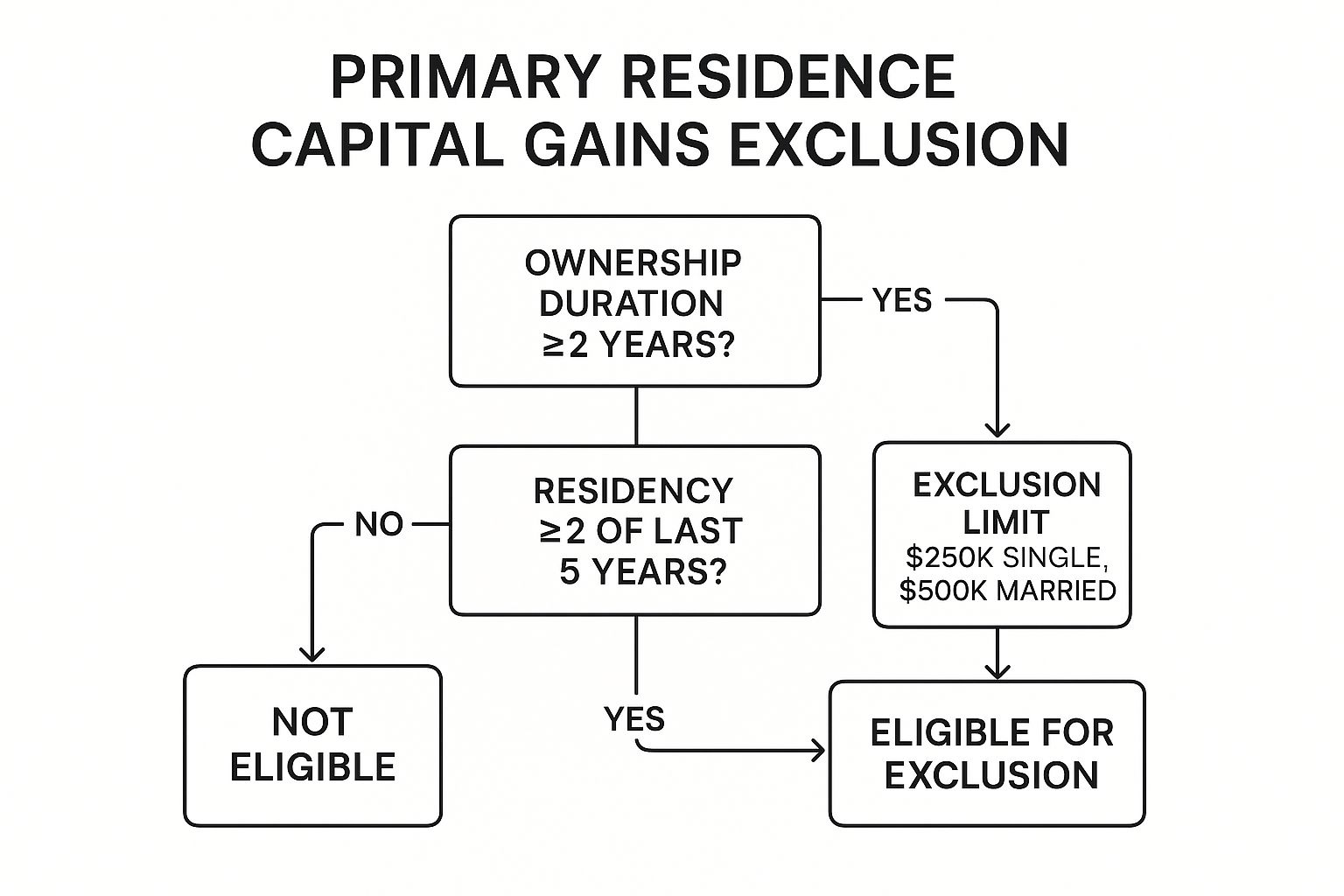
As you can see, passing both the ownership and use tests is the main hurdle to jump to secure your tax-free profit.
The Look-Back Test
Last but not least is the Look-Back Test. This one's straightforward: you can only claim this exclusion once every two years.
So, if you sold another home and used this tax break within the last two years, you can't use it again for this sale. It’s designed to stop people from claiming the exclusion on multiple properties in a short span. It's a one-exclusion-per-two-years rule, not a once-in-a-lifetime deal.
What About Special Circumstances?
Life isn’t always simple, and the tax code has some built-in exceptions for certain situations. It pays to know if one applies to you.
- Military and Foreign Service: If you’re a member of the uniformed services, the Foreign Service, or the intelligence community on qualified extended duty, you can get a break. The five-year test period can be suspended for up to 10 years, making it much easier to meet the residency requirement even with frequent relocations.
- Divorce: The rules are forgiving when a marriage ends. If a home is transferred to you from your spouse as part of a divorce settlement, you can add their years of ownership and residency to your own.
- Death of a Spouse: If your spouse passes away, you may still be able to claim the full $500,000 exclusion. You just have to sell the home within two years of their death and not have remarried, assuming you both met the requirements right before they died.
These three tests—Ownership, Use, and Look-Back—are the pillars of qualifying for this major tax benefit. Nail these, and you can walk away from your home sale with your profit in your pocket, not the taxman’s.
Calculating Your Home Sale Profit for Tax Purposes

Before you can figure out if you owe the IRS a dime, you need to know exactly how much profit you made on your home sale. Spoiler alert: it's not as simple as taking the sale price and subtracting what you originally paid.
The good news is that the IRS allows for some key adjustments that can seriously shrink your taxable gain. Let's walk through how to calculate your net profit the right way.
H3: Start with Your Home's Cost Basis
First things first, you need to find your home's cost basis. Think of this as your total, all-in investment when you first bought the place. It’s more than just the sticker price.
Your starting basis includes:
- The purchase price you paid for the home.
- Certain settlement or closing costs, like title insurance, legal fees, and transfer taxes.
Your best bet is to dust off the settlement statement you received at closing. That document is your treasure map for this part of the calculation.
H3: Factor in Your Capital Improvements
This next step is one that homeowners often forget, and it can be a costly oversight. Over the years, you've probably poured money into making your house a better home. The IRS lets you add the cost of these capital improvements to your basis.
This creates what’s called an adjusted basis. A higher adjusted basis lowers your taxable profit, which is precisely the goal.
So, what counts? A capital improvement is a project that adds significant value to your home, extends its useful life, or adapts it for new uses. This is a world away from simple repairs, which just keep things in working order.
- Improvements (Add to Basis): A new roof, a full kitchen remodel, adding a deck, or finishing a basement.
- Repairs (Do Not Add to Basis): Repainting a bedroom, fixing a leaky faucet, or patching a hole in the drywall.
Key Insight: This is why keeping meticulous records of major home projects is so important. Every receipt for a new furnace or a bathroom renovation is a tool to help you reduce your potential tax bill down the road.
H3: Subtract Your Selling Expenses
Now that you have your adjusted basis, there’s one last step. You get to subtract the costs you incurred to sell your home. These expenses directly reduce your total gain, which can further minimize what you might owe.
Common selling expenses you can deduct include:
- Real estate agent commissions (this is usually the biggest one).
- Advertising fees or professional home staging costs.
- Legal fees for the closing.
- Title insurance and escrow fees.
A key part of this process involves understanding home price appreciation and its impact on your sale profit, as a hot market makes these basis adjustments even more crucial for managing your capital gains tax on home sales.
H3: Putting It All Together: A Calculation Example
Let's see how this works in the real world with a quick example.
Here's a sample calculation to show you how all these numbers fit together. This table breaks down the entire process, step by step, so you can see how to arrive at your final gain. You can use the "Your Numbers" column to follow along with your own figures.
Sample Capital Gain Calculation
| Calculation Step | Example Figure | Your Numbers |
|---|---|---|
| 1. Selling Price | $750,000 | |
| 2. Selling Expenses (Commissions, fees, etc.) | -$45,000 | |
| 3. Amount Realized (Line 1 – Line 2) | $705,000 | |
| 4. Original Purchase Price | $400,000 | |
| 5. Purchase Closing Costs | +$5,000 | |
| 6. Capital Improvements (New kitchen, roof) | +$60,000 | |
| 7. Adjusted Basis (Line 4 + 5 + 6) | $465,000 | |
| 8. Total Gain (Line 3 – Line 7) | $240,000 |
As you can see, the homeowners' total capital gain is $240,000. Because this is well under the $500,000 exclusion for a married couple, they'll owe absolutely nothing in federal capital gains tax.
This simple exercise shows just how valuable it is to track your improvements and expenses over the years. It can literally save you thousands.
What Happens If Your Profit Exceeds the Limit?
Selling your home for a big profit is a fantastic outcome, but it often comes with a nagging question: what happens if that profit blows past the $250,000 or $500,000 exclusion? It sounds scary, but the reality isn't as bad as you might think. You absolutely do not pay tax on your entire gain.
The key is that you only owe tax on the amount that's above your exclusion limit. A great way to visualize this is to think of your exclusion as a giant, tax-free bucket. You get to fill it to the brim with profit, and everything inside is yours, free and clear. You only have to worry about the profit that spills over the top.
Long-Term Capital Gains Rates Are Your Friend
The good news keeps coming. Since you've almost certainly owned your home for more than a year, any taxable profit is considered a long-term capital gain. This means it gets taxed at special, lower rates, not your ordinary income tax rate.
For 2024, those rates are 0%, 15%, and 20%. The rate you end up paying depends on your total taxable income for the year, which includes the taxable chunk of your home sale profit.
- 0% Rate: This usually applies to folks with lower taxable incomes.
- 15% Rate: This is the sweet spot where most taxpayers land.
- 20% Rate: Reserved for those in the highest income brackets.
This tiered system keeps things fair. The IRS doesn't just look at your home sale in a vacuum; it considers your entire financial picture for the year to determine what rate you'll pay on that extra gain.
Important Takeaway: The tax isn't a flat penalty. It's a progressive system where the rate on your excess profit is tied directly to your total annual income. This makes it critical to know where you stand financially in the year you sell.
Putting It All Together: A Real-World Example
Let's walk through a quick scenario to make this crystal clear.
Imagine a married couple files their taxes jointly. They sell their home and walk away with a $600,000 capital gain. Because they meet the requirements, they can claim the full $500,000 home sale exclusion.
-
Find the Taxable Gain: First, they subtract their exclusion from the total profit.
- $600,000 (Total Gain) – $500,000 (Exclusion) = $100,000 (Taxable Gain)
-
Determine Their Tax Bracket: Let's say their other income for the year, plus this $100,000, puts them squarely in the 15% long-term capital gains bracket.
-
Calculate the Final Tax Bill: Now, they just apply that rate to the taxable portion.
- $100,000 (Taxable Gain) x 15% (Tax Rate) = $15,000 (Tax Owed)
So, even after making a massive $600,000 profit on their home, their final federal tax bill for the sale is a much more manageable $15,000.
One More Thing: The Net Investment Income Tax
If you're a high-income earner, there's one more layer to be aware of: the Net Investment Income Tax (NIIT). This is an extra 3.8% tax that can apply to certain types of investment income, and yes, that includes the taxable part of your home sale gain.
The NIIT typically kicks in when your modified adjusted gross income (MAGI) tops $200,000 for single filers or $250,000 for married couples. If you're over that threshold, that 3.8% tax may get tacked on to your regular capital gains rate for any profit above the exclusion.
It's also worth remembering that a property's history matters. If your primary home was a rental property in the past, for example, you'll need to look into the specific rules for rental property depreciation recapture, as that income is taxed differently.
Making Sense of Special Rules and Common Exceptions

While the main home sale exclusion rules cover most people, life doesn’t always fit into a neat little box. Sometimes you have to move unexpectedly or sell a property with a complicated past.
The good news is that the tax code has some built-in flexibility for these unique situations. Understanding these special rules and exceptions can be a real game-changer for your tax bill, especially when your home sale is anything but typical.
The Valuable Partial Exclusion
So, what happens if you’re forced to sell your home before you hit that two-year ownership and use milestone? Life happens. A sudden job change, a family health crisis, or another major event can throw a wrench in your plans. Luckily, the IRS often allows you to claim a partial exclusion on your profit.
Instead of the full $250,000 or $500,000 exemption, you can claim a prorated amount. Think of it this way: if a single person lived in their home for just one year (half the required time) before a qualifying move, they could still exclude up to $125,000 of their gain. It’s a fair compromise.
To qualify for this partial break, your move generally has to be for one of these reasons:
- A Change in Place of Employment: This usually counts if your new job is at least 50 miles farther from the home you sold than your old job was.
- Health-Related Reasons: You might qualify if you moved to get medical care for yourself or a family member, or to provide care for someone.
- Unforeseen Circumstances: This is a catch-all for significant life events you couldn't have predicted, like a divorce, the death of a spouse, or even the birth of twins from a single pregnancy.
Selling a Second Home or Investment Property
It's crucial to remember that the generous Section 121 exclusion is strictly for your primary residence—the place you call home. When you sell a vacation cabin, a second condo, or a rental property you've never lived in, the rules are completely different.
Any profit you make on these types of sales is fully taxable as a capital gain.
Key Consideration: Since these properties don't qualify for the home sale exclusion, the entire profit is subject to long-term or short-term capital gains tax rates, depending on how long you owned them.
There is a potential strategy here, but it requires some long-term planning. If you can move into that second home and make it your primary residence for at least two years before you sell, you can then qualify to use the exclusion on that property.
When Your Home Was Once a Rental
Things get a bit more complex if you’re selling a home that you've both lived in and rented out. You can still claim the exclusion for the time it was your main home, but there's a catch: you have to account for any depreciation you claimed while it was a rental.
This is called depreciation recapture. The IRS basically says, "You got a tax deduction for depreciation all those years, so you can't get a second tax break on that same amount now." They require you to pay tax on the total depreciation you took.
This recaptured amount is taxed at a special maximum rate of 25%, separate from your regular capital gains. The rules for inherited properties that may have been rented out are even more distinct, so it’s a good idea to understand the specific capital gains tax on inherited property if that’s your situation.
Getting It on the Record: How to Report Your Home Sale to the IRS
You’ve navigated the sale, signed the papers, and handed over the keys. The last step is making sure Uncle Sam is in the loop. Even if you're certain you owe zero tax because of the home sale exclusion, you might still have to report the transaction on your tax return. Getting this right keeps you compliant and prevents those dreaded IRS letters down the line.
The main trigger for reporting is a little form called Form 1099-S, Proceeds From Real Estate Transactions. The closing agent or attorney usually sends this out, and it tells the IRS the gross amount you received from the sale. If you get a 1099-S in the mail, the IRS already knows about the sale and will be looking for it on your return, even if you don't owe a dime. Ignoring it is a recipe for an automated notice.
The Tax Forms That Matter
When you sit down to do your taxes, you'll be working with two main forms to report your home sale: Form 8949 and Schedule D.
Think of Form 8949 as your detailed worksheet. This is where you lay out all the specifics—when you bought the house, when you sold it, your cost basis (including all those improvements!), and the final sale price. It’s where you show your math.
After you've calculated the final gain or loss on Form 8949, you carry that number over to Schedule D (Capital Gains and Losses). This is the summary that gets attached to your main Form 1040. If you qualify for the full exclusion, you'll report the sale and then show the exclusion amount, which brings your taxable gain down to zero.
Crucial Reminder: Your records are your best friend at tax time. Without receipts and statements, you can't prove your cost basis, and that almost always means paying more tax than you need to.
Why Meticulous Records Are Your Secret Weapon
Keeping good records isn't just about being organized; it's about saving real money. When it comes to your home's basis, you can only include what you can prove. Be sure to hang on to these key documents in a dedicated file:
- Closing Statements: You'll need the HUD-1 or Closing Disclosure from when you bought the home and the one from when you sold it.
- Proof of Purchase Price: Your original sales contract is the best evidence.
- Receipts for Capital Improvements: Keep every invoice for that kitchen remodel, new roof, or finished basement. Bank or credit card statements can work as backup.
- Records of Selling Expenses: Don't forget to track what you paid in real estate commissions, legal fees, and other costs to sell the home.
This focus on real estate gains isn't unique to the U.S. Governments around the world have their own take. In Japan, for example, the combined tax rate can climb as high as 39.63%. On the other hand, countries like Jamaica skip a capital gains tax altogether, opting for a 2% transfer tax on the sale instead. To see how different tax systems stack up, check out PwC's global tax summary.
Got Questions? We've Got Answers
It's completely normal to have questions when you're trying to figure out the tax rules for selling your home. The details can get tricky. Let's walk through some of the most common scenarios homeowners ask about.
Can I Use the Home Sale Exclusion More Than Once?
Yes, you absolutely can! A lot of people mistakenly think this is a one-time deal, but it’s not.
The key is that you can claim the exclusion every time you sell a primary home, as long as you meet the eligibility rules. The main constraint is what's called the Look-Back Test. You just can’t have used the exclusion for another home sale within the two years right before the sale you’re planning now. This makes the tax break a fantastic, reusable benefit for people who move every few years.
How Does a Divorce Impact the Exclusion?
The IRS has some pretty flexible rules for couples going through a divorce, so you don't lose out on this valuable tax break.
- Selling the house together? If you sell the home as part of the divorce, you can still combine your exclusions. That means you can shield up to $500,000 of gain from taxes, provided you both meet the use test.
- What if one spouse keeps the house? If one of you gets the home in the divorce settlement, you get credit for the time your ex-spouse owned and lived in the home. This is a huge help, as it means you can still qualify for your full $250,000 exclusion later on without having to restart the two-year clock.
What's the Difference Between an Improvement and a Repair?
Getting this right is crucial because it directly affects your home's adjusted basis and, ultimately, how much tax you'll owe. It really comes down to a simple idea: did the work add real value or was it just maintenance?
An improvement adds to your home's value or significantly extends its life. Think of it as an upgrade. A repair, on the other hand, just keeps your property in good shape. It's simply upkeep.
For instance, putting on a new roof, completely remodeling your kitchen, or adding a new deck are all capital improvements. These costs get added to your basis. In contrast, fixing a leaky pipe, patching a hole in the drywall, or repainting a bedroom are just repairs. They're considered routine maintenance and don't change your basis.
Do I Owe Capital Gains on a Home I Inherited?
Typically, no—at least not right away. When you inherit property, you benefit from a powerful tax concept called a "stepped-up basis."
This means the home's cost basis is automatically reset to its fair market value on the date the person you inherited it from passed away. So, if you turn around and sell the house pretty quickly, there's usually very little, if any, gain to be taxed.
And if you decide to move in and live there for at least two years, you can then use the standard home sale exclusion on any appreciation that happens from that point forward.
Working through these specific situations is where having an expert in your corner can make all the difference. The team at Allied Tax Advisors lives and breathes real estate taxation. We can help you apply these rules to your personal financial picture to make sure you keep as much of your money as possible. Find out more about our personalized tax planning services.