
Before you can even begin to calculate your federal income tax, you have to find your starting point: your Adjusted Gross Income (AGI). This isn't just a random number; it's the foundation of your entire tax return. Essentially, it's your total income minus a specific set of deductions. Get this figure right, and you're on the right track. Get it wrong, and it can throw everything else off.
Your Financial Starting Line: Calculating Adjusted Gross Income

Think of your AGI as the bedrock of your tax return. Every other calculation, from tax brackets to credits, builds upon this single, critical number. It’s more than just what you earn from your primary job; it’s a comprehensive look at all your income, which is then refined by some key adjustments.
Nailing your AGI is non-negotiable. Why? Because it directly impacts which tax deductions and credits you qualify for later on. A small mistake here could snowball, causing you to miss out on valuable savings or even calculate your tax liability incorrectly. For a more detailed breakdown, check out our guide that simplifies what Adjusted Gross Income is and how to calculate it.
Tallying Up Your Total Gross Income
First things first, you need to pull together every dollar that came in during the year. For many people, especially freelancers, investors, or small business owners, income is a mosaic of different streams that go far beyond a simple W-2 paycheck.
You’ll need to account for everything the IRS considers income. This typically includes:
- Wages, Salaries, and Tips: The basics, usually found on your Form W-2.
- Business Income: If you're a freelancer or run your own business in Clairemont, this is your total revenue before you start subtracting expenses.
- Investment Earnings: This covers dividends, interest from a savings account, or capital gains from selling an asset.
- Rental Income: Any money you collected from tenants.
- Other Income: This is a catch-all for things like unemployment benefits or even alimony.
Applying Above-the-Line Adjustments
Once you have your total gross income, it's time to chip away at it with "above-the-line" deductions. These adjustments are incredibly valuable because you can take them whether you itemize or take the standard deduction. They lower your AGI directly, which can be a game-changer.
Some of the most common adjustments people make are:
- Traditional IRA Contributions: Contributions you made to a traditional IRA are often deductible, up to the annual limit.
- Student Loan Interest: You can deduct up to $2,500 of the interest you paid on student loans.
- HSA Contributions: Money you put into a Health Savings Account is a fantastic deduction.
- Self-Employment Tax: If you work for yourself, you get to deduct one-half of the self-employment taxes you paid.
Key Takeaway: These aren't just random expenses. They are specific, IRS-approved adjustments that shrink your gross income to find your AGI. Skipping them is like turning down free money.
Let’s see how this works in the real world. Imagine a small business owner here in Clairemont. Her income for the year was $80,000 from her business, $1,500 in stock dividends, and $500 in savings account interest. Her total gross income is $82,000.
Throughout the year, she contributed $6,000 to her traditional IRA and paid $2,000 in student loan interest. To find her AGI, we do this:
$82,000 (Gross Income) – $6,000 (IRA) – $2,000 (Student Loan Interest) = $74,000.
This $74,000 is her AGI—the crucial number she'll use for all her other tax calculations, not the $82,000 she started with.
Making The Right Choice: Standard vs. Itemized Deductions

Alright, you've calculated your AGI. Now you’ve hit a fork in the road, and this next decision can seriously impact your final tax bill. Will you take the simple route with the standard deduction, or is it worth the effort to itemize? This is one of the most important choices you'll make when you calculate federal income tax.
The standard deduction is exactly what it sounds like—a straightforward way to lower your taxable income without any fuss. It’s a set dollar amount based on your filing status, age, and a few other factors. For millions of people, it’s the easiest and most logical path. No receipts, no tracking, no headaches.
But if you’re a homeowner, self-employed, or had a year with hefty medical bills, taking the time to itemize can be a game-changer. The rule of thumb is simple: if your specific deductible expenses add up to more than the standard deduction, itemizing will almost always save you money.
What Can You Actually Itemize?
When you itemize, you’re essentially creating a list of specific, IRS-approved expenses you paid during the year. While there are many potential deductions, most people’s lists are built around a few common, high-impact categories.
- Mortgage Interest: This is often the biggest deduction for homeowners. You can typically deduct the interest paid on up to $750,000 of mortgage debt on your primary residence.
- State and Local Taxes (SALT): This bucket includes your property taxes and either your state income taxes or sales taxes (you can't take both). Keep in mind, the SALT deduction is capped at $10,000 per household annually.
- Charitable Donations: If you made contributions to qualified charities, you can deduct them. This applies to cash gifts as well as the value of donated goods.
- Medical and Dental Expenses: This one has a high bar. You can only deduct unreimbursed medical costs that exceed 7.5% of your AGI, so it usually comes into play only in years with major health events.
For people in specific situations, like real estate investors, getting into the weeds on every possible write-off is critical. Digging into resources that explain tax deductions for property investors can make a huge difference in managing your overall tax liability.
A Clear Comparison: Standard vs. Itemized
The choice really comes down to a simple math problem: which deduction is bigger? You'll add up all your potential itemized expenses and compare that total to the standard deduction for your filing status. This handy table breaks down some common scenarios to help you see how it plays out.
Standard Deduction vs. Itemizing: A Quick Comparison
A side-by-side look at common scenarios to help you decide which deduction method is more beneficial for your financial situation.
| Filing Status | Standard Deduction Amount | When to Consider Itemizing (Example Scenarios) |
|---|---|---|
| Single | $14,600 | You paid the full $10,000 in SALT and $5,000 in mortgage interest. Your $15,000 total is more than the standard, so you should itemize. |
| Married Filing Jointly | $29,200 | Your household paid $10,000 in SALT, $18,000 in mortgage interest, and gave $2,000 to charity. The $30,000 total makes itemizing worthwhile. |
| Head of Household | $21,900 | You paid $8,000 in property taxes, $12,000 in mortgage interest, and had $3,000 in charitable gifts. Your $23,000 total makes itemizing the better choice. |
Ultimately, running the numbers is the only way to know for sure. For a deeper dive into this topic, you can explore our complete guide on the standard deduction versus itemized deductions to help you feel confident in your choice.
Making The Final Call
This isn’t just about the math; it’s a strategic decision. If your itemized total is just a hundred dollars or so over the standard deduction, you have to ask yourself if the time spent digging up records is worth the small tax savings.
On the other hand, if you're a homeowner in a high-tax state or you’re particularly generous with your charitable giving, itemizing is often a no-brainer that can save you thousands.
Insider Tip: Don't just assume the standard deduction is your best bet, especially if your financial life has changed. Buying a house, starting a business, or even a shift in your charitable habits can easily tip the scales in favor of itemizing.
The key is to run the numbers both ways before you file. Most tax software does this automatically, but understanding why you're making the choice empowers you to make smarter financial decisions throughout the year, not just at tax time.
So, How Do US Tax Brackets Actually Work?
The way the U.S. progressive tax system works is probably one of the most misunderstood concepts in all of personal finance. There's a common myth that if you earn more money and get bumped into a higher tax bracket, your entire income is suddenly taxed at that higher rate.
Let’s clear that up right now: thankfully, it doesn't work that way at all.
Our system is marginal. This just means your income is carved up into different chunks, and each chunk gets taxed at a progressively higher rate as you move up the ladder. Once you really get your head around this, calculating your federal income tax and making smarter money moves becomes so much easier.
What "Marginal Tax Rate" Really Means
Think of tax brackets like a series of buckets. As you earn money, you start filling the first bucket. Once it’s full, the overflow spills into the next bucket, which has a slightly higher tax rate. You only pay that higher rate on the money that falls into that new bucket, not on every dollar you’ve earned up to that point.
This design ensures you never lose money by earning more. It's a fundamental principle.
Your marginal tax rate is simply the rate you pay on your very last dollar of taxable income—it’s the highest bracket your earnings touch. On the flip side, your effective tax rate is the real-world percentage of your total taxable income that you actually pay in taxes. It will always be lower than your marginal rate.
The big idea behind a progressive tax system is that people with higher incomes can shoulder a larger percentage of the tax burden. The system is set up to be less of a financial strain on lower-income households.
Understanding this difference is everything. When you sit down to figure out your federal tax bill, you aren't just multiplying your income by a single rate. Instead, you're calculating the tax on each slice of your income separately and then adding it all up.
Let’s Walk Through a Real-World Example
Alright, let's put this into practice. Imagine a single person with $60,000 in taxable income for the 2024 tax year. They aren't going to pay a flat percentage on that whole amount. Their income gets taxed piece by piece as it moves through the brackets.
Here’s exactly how it breaks down using the 2024 tax brackets for a single filer:
- 10% Bracket: The first $11,600 of their income gets hit with a 10% tax.
- Tax: $11,600 x 0.10 = $1,160
- 12% Bracket: The next chunk of their income, everything from $11,601 up to $47,150, is taxed at 12%.
- Amount in this bracket: $47,150 – $11,600 = $35,550
- Tax: $35,550 x 0.12 = $4,266
- 22% Bracket: The final bit of their income, from $47,151 all the way up to their $60,000 total, is taxed at 22%.
- Amount in this bracket: $60,000 – $47,150 = $12,850
- Tax: $12,850 x 0.22 = $2,827
To get their total tax bill, we just add the tax from each bracket together:
$1,160 + $4,266 + $2,827 = $8,253
See what happened? Even though this person is technically in the 22% marginal tax bracket, their actual effective tax rate is way lower: ($8,253 / $60,000) = 13.76%. That's the progressive system doing its job.
It Works the Same for Every Filing Status
The underlying logic is identical no matter how you file, but the income thresholds for each bracket will be different. Let's run through another common scenario: a married couple filing their taxes together with a combined taxable income of $110,000.
Using the 2024 brackets for those married filing jointly:
- The first $23,200 is taxed at 10% ($2,320).
- The income from $23,201 to $94,300 is taxed at 12% ($8,532).
- The rest of their income, from $94,301 up to $110,000, is taxed at 22% ($3,454).
Their total federal income tax comes out to $2,320 + $8,532 + $3,454 = $14,306. Their marginal rate is 22%, but their effective tax rate is just 13.01%.
This progressive structure is a core part of the U.S. tax code. While the rates for 2025 will run from 10% to 37%, the system is designed to make sure higher earners chip in a larger share. In fact, 2020 data showed that while the average effective tax rate was 13.6%, the top 1% of earners paid 42% of all individual federal income taxes, while the bottom 50% contributed less than 3%. For a deeper dive into these numbers, you can learn more about income tax distribution in the United States.
Knowing how these brackets truly function is empowering. Let’s say you’re thinking about a side gig that might push you into a higher tax bracket. Now you can accurately figure out the tax impact on just that extra income, not your entire salary. This knowledge turns tax planning from a guessing game into a clear strategy.
You've crunched the numbers on your income, taken your deductions, and run it all through the tax brackets. It feels like you're at the finish line, but hold on—this is where the real magic happens. Now we get to the part that can dramatically slash your tax bill: credits and payments.
Deductions are great, but they only chip away at your taxable income. Tax credits are a whole different beast. They are a dollar-for-dollar knockout punch to the actual tax you owe. A $1,000 tax credit literally saves you $1,000. That makes it infinitely more powerful than a $1,000 deduction.
Refundable vs. Non-Refundable Credits: What's the Difference?
It’s really important to know that not all credits are built the same. They come in two flavors, and the distinction can mean hundreds or even thousands of dollars in your pocket.
- Non-Refundable Credits: These can zero out your tax liability, but that's their limit. Say you owe $800 in taxes and qualify for a $1,000 non-refundable credit. Your tax bill gets wiped out, which is fantastic, but the extra $200 just vanishes.
- Refundable Credits: Now these are the ones you really want. They also reduce your tax bill to zero, but any credit left over gets paid out to you as a refund. Using the same example, if you owe $800 and have a $1,000 refundable credit, you pay nothing and the IRS sends you a check for $200.
My Take: I always tell people to think of non-refundable credits as a coupon that makes your purchase free. Refundable credits are more like a gift card—if you don't use the full balance, you get the rest back in cash.
Knowing which type you’re eligible for is key to getting an accurate picture of your final tax situation.
Common Credits That Pack a Punch
There are dozens of tax credits out there, but a few consistently make a huge difference for millions of Americans every year.
The Child Tax Credit, for instance, is a game-changer for parents. For those paying for college, the American Opportunity Tax Credit can be a massive help in offsetting tuition costs for the first four years of higher education.
Making your home more energy-efficient can also put money back in your pocket through various tax credits. And for working folks with lower-to-moderate incomes, the Earned Income Tax Credit is one of the most significant credits available. You can learn more about who qualifies in our detailed guide on what is the Earned Income Credit.
And for those in real estate, getting a handle on more advanced strategies can offer huge tax advantages. For example, understanding a 1031 exchange is a powerful way to defer capital gains taxes and seriously lower your overall tax burden.
Don't Forget the Taxes You've Already Paid
Okay, one final step before you get to the bottom line. You need to subtract all the federal income tax you've already paid during the year. For most people with a traditional job, this part is pretty simple.
You'll need to account for:
- Federal income tax withheld from your paychecks: Your employer has been sending this to the IRS for you all year. The total amount is right there in Box 2 of your Form W-2.
- Quarterly estimated tax payments: This is a big one for freelancers, business owners, or anyone with significant investment income. These are the payments you sent directly to the IRS each quarter.
Tallying these up correctly is absolutely crucial. This is the moment of truth when you find out if you get a refund or if you still owe a bit more. I’ve seen it happen time and again—people forget to include their quarterly payments and end up with a nasty, unexpected tax bill. Don't let that be you
Let's Walk Through an Example: Meet Alex
Theory is one thing, but seeing the numbers in action is where it all clicks. To really get a feel for how to calculate federal income tax, let's follow a real-world scenario from start to finish.
We'll use a fictional freelance graphic designer named "Alex" who lives in San Diego and files as a single individual. Alex has a few different income streams, which makes this a perfect, practical example to see how all the pieces fit together.
This is where we'll connect the dots between AGI, deductions, tax brackets, and credits to turn abstract tax rules into a concrete process you can actually use.
Starting with Alex's Income and AGI
First things first, we need to add up all the money Alex earned this year. As a freelancer, Alex's income isn't a single W-2 figure—it's coming from multiple sources.
- Freelance Graphic Design: Alex’s primary business brought in $95,000 in gross revenue.
- Rental Property: A small condo Alex owns generated $24,000 in rent.
- Savings Account Interest: Alex also earned $1,000 from a high-yield savings account.
Add it all up, and Alex's total gross income is $120,000.
Now, let's figure out Alex's Adjusted Gross Income (AGI) by subtracting those "above-the-line" deductions. Being self-employed gives Alex some important adjustments to make.
- Business Expenses: Alex tracked $15,000 in legitimate business expenses—things like software subscriptions, marketing costs, and a home office. This brings the net income from the design business down to $80,000.
- Rental Expenses: The rental property wasn't all profit. It came with $14,000 in expenses like mortgage interest, property taxes, and repairs. The net rental income is now $10,000.
- Self-Employment Tax Deduction: Alex paid $11,304 in self-employment taxes and gets to deduct half of that, which is $5,652.
- IRA Contribution: To save for retirement, Alex put $7,000 into a traditional IRA.
So, let's do the math to find the AGI:
$80,000 (Net Business) + $10,000 (Net Rental) + $1,000 (Interest) – $5,652 (SE Tax) – $7,000 (IRA) = $78,348.
There it is. Alex's AGI is $78,348. This number is the foundation for everything else we're about to do.
Choosing the Best Deduction Method
Next up, Alex needs to make a choice: take the standard deduction or go through the process of itemizing? For a single filer in 2024, the standard deduction is a flat $14,600. To see if itemizing makes more sense, Alex has to tally up all the potential itemized deductions.
- State and Local Taxes (SALT): Alex paid $4,500 in California state income tax and another $3,000 in property taxes on a primary home. That’s a total of $7,500.
- Mortgage Interest: The interest paid on the home mortgage was $6,000.
- Charitable Donations: Alex gave $1,000 to a favorite local animal shelter.
The grand total for Alex's itemized deductions is $7,500 + $6,000 + $1,000 = $14,500.
The Verdict: It's a close one, but the $14,500 from itemizing is just under the $14,600 standard deduction. Alex is definitely better off taking the standard deduction. It not only provides a slightly bigger tax break but is also way simpler.
Now we can nail down Alex's taxable income:
$78,348 (AGI) – $14,600 (Standard Deduction) = $63,748.
Applying the Progressive Tax Brackets
With a taxable income of $63,748, it's time to run that number through the 2024 marginal tax brackets for a single filer. It's not as simple as multiplying by a single percentage; different chunks of income get taxed at different rates.
- The first $11,600 is taxed at 10%: $1,160
- The next chunk, from $11,601 to $47,150, is taxed at 12%: ($35,550 x 0.12) = $4,266
- The rest, from $47,151 up to $63,748, falls into the 22% bracket: ($16,598 x 0.22) = $3,651.56
Adding those amounts together gives us Alex’s initial tax bill before any credits or payments: $1,160 + $4,266 + $3,651.56 = $9,077.56.
Finalizing with Credits and Payments
We're in the home stretch. The last step is to account for any tax credits and, just as importantly, the taxes Alex has already paid during the year.
As a responsible freelancer, Alex made four quarterly estimated tax payments of $2,500 each. That's a total of $10,000 already sent to the IRS.
This is where tax credits come in, chopping your tax bill down dollar-for-dollar.
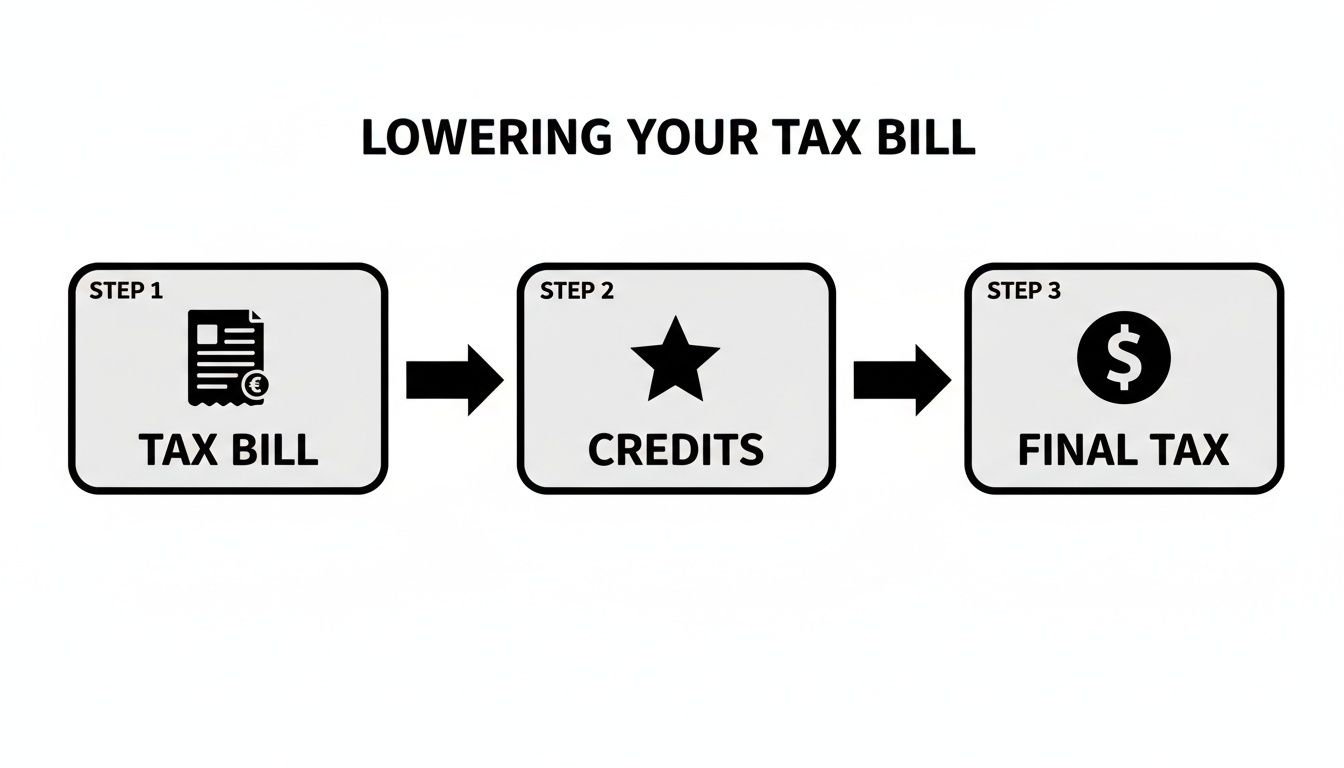
As this shows, credits are applied directly against the tax you owe, making them much more powerful than deductions, which only reduce your taxable income.
Let's do the final calculation for Alex:
$9,077.56 (Initial Tax Bill) – $10,000 (Estimated Payments) = -$922.44.
That negative number is good news—it means Alex overpaid. Alex is due a federal tax refund of $922.44. By following each step methodically, a potentially confusing financial year becomes a clear, manageable tax situation.
Answering Your Federal Tax Questions
Even with a step-by-step guide, it's normal to have some questions pop up. The U.S. tax code has so many layers, and everyone's financial picture is a little different. Let's dig into some of the most common questions we hear from people trying to figure out their taxes.
Marginal vs. Effective Tax Rate: What’s the Real Difference?
This is probably one of the most confusing parts of the tax system for folks, but the concept is pretty straightforward once you see it laid out.
Your marginal tax rate is just the rate you pay on your last dollar earned. It’s whatever tax bracket you happen to land in. So, if your income puts you in the 22% bracket, that's your marginal rate.
But that’s not what you actually pay on your total income. Your effective tax rate is the real-deal percentage. You find it by taking your total tax bill and dividing it by your total income. Since we have a progressive tax system where different chunks of your income are taxed at different rates, your effective rate will always be lower than your marginal one. It gives you a much better sense of your true tax burden.
How Do Capital Gains Fit Into My Tax Calculation?
This is a big one. Profits from selling assets—think stocks, bonds, or real estate—are handled completely differently than your regular paycheck. The key here is how long you owned the asset before selling it.
-
Short-term capital gains: If you held the asset for a year or less, the profit gets taxed just like your regular income. It’s added on top of your salary and taxed at your normal marginal rate.
-
Long-term capital gains: Now, if you held that asset for more than a year, you get a much better deal. These profits are taxed at special, lower rates, which are 0%, 15%, or 20%, depending on your income level.
Being strategic about when you sell an asset can make a huge difference in your tax bill. It's a classic example of where a little planning goes a long way.
A Quick Tip: Don't underestimate the importance of timing. Holding an investment for just one extra day could be the difference between paying a 35% tax rate on your profit versus a much more manageable 15% rate.
What are the Most Common (and Costly) Mistakes People Make?
After years of helping clients, I can tell you the biggest blunders are often the simplest. You’d be surprised how many errors come down to basic math mistakes or picking the wrong filing status after a major life event like getting married or divorced.
Another one we see all the time is people missing out on deductions and credits they’re entitled to, just because they didn't know they existed. Forgetting to report income is also a frequent trip-up, especially that 1099-NEC from a side hustle, which can quickly get you a notice from the IRS.
Finally, sloppy record-keeping can really hurt you. If you’re going to itemize deductions for things like business expenses or charitable gifts, you absolutely have to have the paperwork to prove it. If you get audited and can't back up your claims, those deductions get tossed out, and you could be looking at a much bigger tax bill than you planned for.
You don't have to figure out the maze of federal taxes by yourself. The team at Allied Tax Advisors is here to bring clarity to your situation and make sure you’re using every strategy available to you. Let us help you find some financial peace of mind. Learn more about our personalized tax services and schedule a consultation today.