
When it's time to figure out the calculation of tax on rental income, the very first thing you need to nail down is what the IRS actually considers income. It's a common rookie mistake to think it’s just the monthly rent checks, but the real definition is much broader.
Think of it this way: things like advance rent you collected for next year or a security deposit you didn't return are all part of the equation. And it’s all taxed at your ordinary income tax rate, not the more favorable capital gains rate. Getting this part right from the get-go is the key to accurate tax returns and staying out of trouble.
Establishing Your Foundation for Accurate Tax Calculation

Before you even think about deducting expenses, you need a complete and honest picture of your total taxable rental income. The IRS looks at all the revenue your property generates, not just the cash that hits your bank account each month.
This isn't just about ticking a box for compliance; it's about setting a solid financial foundation for your entire investment strategy. For example, how you choose to own the property—say, through a limited company—can have significant tax implications. If you're exploring that route, a detailed guide to limited company mortgages is a great place to start understanding the financial side of that decision.
What Counts as Rental Income
To calculate your taxes correctly, you have to gather every piece of the income puzzle first. This means accounting for every single dollar (or dollar equivalent) your property brought in.
To help you get started, here's a quick checklist of everything that counts as reportable rental income. Some of these might surprise you if you're a new landlord.
Your Complete Rental Income Checklist
| Income Source | Example Scenario | Is It Taxable Income? |
|---|---|---|
| Monthly Rent Payments | Your tenant pays you $2,000 on the first of every month as per their lease agreement. | Yes |
| Advance Rent | A tenant pays their first and last month's rent upon signing a lease in December. | Yes, both months are income in the year you receive the cash. |
| Non-Returned Security Deposits | You keep $500 of a security deposit to cover damages beyond normal wear and tear. | Yes, that $500 is income in the year you keep it. |
| Tenant-Paid Expenses | The lease says you pay for trash service, but the tenant pays the $50 bill directly for one month. | Yes, you must report that $50 as income (but you can also deduct it as an expense). |
| Services in Lieu of Rent | A professional painter offers to paint the entire interior, a $3,000 value, in exchange for a month's rent. | Yes, you must report the $3,000 fair market value as income. |
A critical mistake many investors make is overlooking these non-cash or less frequent income sources. Diligent tracking from the start ensures your gross income figure is correct, preventing future complications with the IRS.
How Rental Income Is Taxed
Once you have your total income, the next concept to grasp is how the IRS taxes it. The profit from your rental property isn't taxed on its own; it gets added to all your other income, like your salary from a day job.
As of 2025, this net rental income is subject to ordinary income tax rates, which range from 10% to 37%, depending on your total taxable income and filing status. This can sometimes be a surprise for new investors, as it could easily push you into a higher tax bracket.
Your final tax bill really depends on your complete financial situation, which is ultimately summarized by your adjusted gross income. If you want a deeper dive, our guide on what is adjusted gross income breaks it all down.
Calculating Your Total Gross Rental Income

Before we can even think about deductions, we need a solid starting number. This is your gross rental income, and it's the foundation for your entire tax calculation. Think of it as every single dollar your property generated for you over the year, before a single expense is subtracted.
It’s a common rookie mistake to just add up the twelve monthly rent checks and call it a day. The reality is, the IRS has a much broader definition of rental income. Getting this number right from the start is non-negotiable for filing an accurate return that won’t attract unwanted attention.
A Real-World Duplex Scenario
Let's ground this in a practical example. Say you own a duplex with two identical units, Unit A and Unit B, both rented out for the full year. To get your gross income, you have to meticulously account for every payment you’ve received from both tenants.
If the rent for each unit is $1,800 a month, your baseline starts at $43,200 for the year ($1,800 x 2 units x 12 months). But that's just the beginning. The real work is in digging up all the other bits of income that are easy to forget.
Tallying the "Extras"
Most rental properties have other income streams beyond the monthly rent. These might seem small, but they absolutely must be included in your gross income. Overlooking them means you're underreporting, and that's a big red flag for the IRS.
Here are some of the usual suspects:
- Late Fees: The tenant in Unit A was late on rent three times, and you charged a $50 fee each time. That’s $150 in taxable income.
- Pet Fees: Your tenant in Unit B has a dog and paid a $300 non-refundable pet fee. Yep, that’s income.
- Application Fees: Did you charge application fees? Any amount you pocketed above your actual cost for the credit and background checks is considered income.
- Other Revenue: If you have coin-op laundry machines or charge for assigned parking, all that cash counts.
In our duplex example, we've already found another $450 to add to our base rent. See how quickly it adds up?
Pro Tip: Keep a separate bank account exclusively for your rental property. It makes tracking every dollar—in and out—incredibly simple and creates a clean paper trail if you ever need it.
Getting Security Deposits Right
Here’s where a lot of landlords get tripped up. When you first receive a security deposit, it is not income. The reason is simple: you’re expected to give it back. It’s a liability, not revenue.
But, that changes the moment you keep any part of it. Let's say when the tenant in Unit A moved out, you had to keep $250 of their $1,800 deposit to fix a hole they put in the wall. That $250 you kept is now taxable income for the year you kept it. The $1,550 you returned to them? Not income.
Putting It All Together: Final Gross Income
Now let’s put all the pieces from our duplex example together. This is the final number that goes at the top of your Schedule E.
| Income Source | Unit A | Unit B | Annual Total |
|---|---|---|---|
| Standard Rent | $21,600 | $21,600 | $43,200 |
| Late Fees | $150 | $0 | $150 |
| Pet Fee | $0 | $300 | $300 |
| Kept Security Deposit | $250 | $0 | $250 |
| Total Gross Income | $22,000 | $21,900 | $43,900 |
By being thorough, we’ve determined our landlord's total gross rental income is $43,900. This is the critical starting point. Now we can move on to the fun part: subtracting all of our allowable expenses to shrink our tax bill.
Taking Advantage of Every Allowable Expense
Once you’ve tallied up your gross rental income, the real work begins: subtracting every legitimate expense you incurred. This is where smart landlords make their money—or at least, keep more of it. It’s all about chipping away at your taxable income to lower that final tax bill.
The IRS allows you to deduct costs that are both ordinary and necessary for managing and maintaining your property. These are the expenses that keep your rental in good shape and occupied by tenants. Think of them as your primary tool for reducing what you owe, but be warned: meticulous record-keeping is non-negotiable.
The Most Common Operating Deductions
While the list of possible write-offs is long, a few usual suspects pop up on nearly every landlord's tax return. These are the everyday costs of being in the rental business. As you go through the year, just remember the burden of proof is on you. Keep every receipt, every invoice, and every bank statement organized.
Here are some of the biggest and most common deductions you should be tracking:
- Mortgage Interest: This is often the single heaviest deduction you'll have. The interest you pay on the loan for your rental property is fully deductible. You'll find the total amount on Form 1098 from your lender.
- Property Taxes: Those state and local property tax bills you pay every year? They are 100% deductible against your rental income.
- Insurance Premiums: The cost of your landlord insurance policy—covering things like fire, theft, and liability—is another key deduction.
- Professional Fees: Did you pay an accountant to help with taxes or a lawyer to draft a lease? Those fees are deductible as long as they relate to your rental activity.
- Property Management Fees: If you hire a professional to handle the day-to-day operations, their fees are a straightforward business expense you can write off.
It’s easy to overlook the small stuff, but it adds up fast. That $50 trip to the hardware store for new smoke detectors or the $100 you paid for a deep clean between tenants? Each one directly reduces your taxable income, dollar for dollar.
Repairs vs. Improvements: A Critical Distinction
This is one of the most crucial—and frequently confused—areas of landlord tax law. Understanding the difference between a repair and an improvement is fundamental because the IRS treats them in completely different ways.
A repair simply keeps your property in good working order. It's about maintenance and restoring something to its original condition, not substantially upgrading it. Think fixing a leaky faucet, patching drywall, or replacing a single broken window. The best part? The entire cost of a repair is deductible in the year it occurs.
An improvement, however, adds significant value to your property, extends its useful life, or adapts it for a new purpose. We're talking about big-ticket items like a new roof, a full HVAC system replacement, or a gut kitchen renovation. You can't write off these costs all at once. Instead, you must capitalize them and recover the cost over time through depreciation—typically 27.5 years for a residential rental.
Repairs vs Improvements: A Landlord's Guide
Getting this classification right is essential for maximizing your deductions while staying compliant. Here's a quick comparison to help you tell the difference.
| Expense Type | Example | Tax Treatment |
|---|---|---|
| Repair | Fixing a clogged drain pipe in the bathroom. | Fully Deductible in the current tax year. |
| Improvement | Replacing all the old cast iron plumbing with new PVC pipes throughout the house. | Capitalize and Depreciate over 27.5 years. |
| Repair | Painting a single room to cover up scuffs from a previous tenant. | Fully Deductible in the current tax year. |
| Improvement | Adding a new deck to the back of the property. | Capitalize and Depreciate over 27.5 years. |
Getting this wrong can be a huge red flag for the IRS. Mistaking a major improvement for a simple repair is a common audit trigger. If you're ever on the fence, it's always smart to talk it over with a tax pro. And if you want to dig deeper into turning your expenses into major tax wins, this guide can help you Maximize Your Short Term Rental Tax Deductions.
Document Everything—No Exceptions
Let’s be blunt: if you can't prove you spent it, you can't deduct it. The IRS demands that you keep detailed records to back up every single expense you claim. This isn't just a good idea; it's a legal requirement.
You don't need a complicated system. A simple spreadsheet, accounting software like QuickBooks, or even just neatly organized digital folders with scanned receipts will do the job. The key is consistency.
For every single expense, make sure your records show:
- The amount you paid.
- The date of the payment.
- A clear description of what it was for (e.g., "Plumbing repair for Unit B kitchen sink").
- Who you paid (the vendor's name).
Keeping records this detailed does more than just prepare you for a potential audit. It gives you a crystal-clear financial overview of how your property is performing, turning the year-end tax scramble into a calm, organized process.
The Real Estate Investor's Secret Weapon: Depreciation
Now we get to the real magic. After you’ve accounted for all your operating expenses, there's one more deduction that separates the pros from the rookies: depreciation.
Think of it as a "phantom expense." It’s a powerful, non-cash deduction that lets you lower your taxable income without a single dollar actually leaving your bank account. The IRS understands that buildings wear out over time, and they allow you to write off a portion of your property's value each year to account for this wear and tear.
This is how savvy investors can generate positive cash flow but show a paper loss to the IRS, legally minimizing their tax bill.
First, You Need to Calculate Your "Basis"
Before you can claim this game-changing deduction, you have to figure out your property's cost basis. This isn't just what you paid for the house. The basis is the total figure you'll be allowed to depreciate over the property's useful life.
You start with the purchase price, then add in certain closing costs—things like title insurance, legal fees, and recording fees that you can't deduct elsewhere.
But here’s the crucial part: you have to subtract the value of the land. The IRS only lets you depreciate the building itself, since land doesn't technically wear out. A quick look at your property tax assessment will usually break down the land value, or you can get a formal appraisal.
Let's walk through an example:
- You buy a rental property for $400,000.
- You pay $8,000 in closing costs that aren't otherwise deductible.
- The tax assessor says the land is worth $80,000.
- Your depreciable basis is: ($400,000 + $8,000) – $80,000 = $328,000.
That $328,000 is the magic number we'll use for our depreciation calculation.
The 27.5-Year Rule and How It Works
The IRS uses a system called the Modified Accelerated Cost Recovery System (MACRS) to handle this. For residential rental properties, the rule is simple and non-negotiable: you depreciate the asset over 27.5 years.
The math is straightforward. You just divide your depreciable basis by 27.5 to find your annual deduction.
Using our number from before:
$328,000 (Basis) ÷ 27.5 (Years) = $11,927 per year.
This means you get to deduct $11,927 from your rental income every single year you own the property. You didn't actually spend that money this year, but you get to claim it as an expense anyway. For a deeper dive into the mechanics, our complete guide to depreciation on a rental property covers all the details.
A Quick Warning: This deduction isn't optional. The IRS considers it mandatory. If you fail to claim it, you can't just skip it. When you sell the property, you'll have to pay "depreciation recapture" tax on the amount you should have taken. Don't leave this money on the table.
While the 27.5-year rule is the standard in the U.S., it's fascinating to see how differently this is handled around the world. Taxation rules for rental income vary wildly across more than 80 countries, with many offering their own unique depreciation schedules and deductions. You can get a sense of the global landscape by exploring the rental taxation rules on Global Property Guide.
Tying It All Together: How Depreciation Wipes Out Taxable Income
So, how does this "phantom expense" really save you money?
Let’s say that after paying the mortgage interest, insurance, taxes, and repairs, your property produced a net operating income of $10,000. That’s cash in your pocket.
Without depreciation, you’d be paying taxes on that $10,000. But watch what happens when we apply our deduction:
- Net Operating Income: +$10,000
- Depreciation Deduction: -$11,927
- Taxable Rental Income/(Loss): -$1,927
Just like that, your profitable rental property now shows a $1,927 loss on your tax return. This paper loss can often be used to offset income from other sources, which is the core strategy real estate investors use to build wealth while paying surprisingly little in income tax.
Bringing It All Together on Your Tax Return
You’ve done the legwork. You’ve meticulously tracked your income, tallied up every last operating expense, and calculated that all-important depreciation deduction. Now it's time to put all those pieces together and see where you stand. This is the moment of truth where all your record-keeping boils down to a single number: your net rental income or loss.
But hold on. If your calculations show a loss, don't automatically assume you can use it to wipe out the taxes on your regular paycheck. The IRS has some very specific guardrails in place, known as the Passive Activity Loss (PAL) rules, and every landlord needs to know how they work.
Finalizing Your Net Rental Income or Loss
Let's circle back to our running example one last time. We've already nailed down the income, expenses, and depreciation. Now, we just combine them.
- Gross Rental Income: +$43,900
- Total Operating Expenses: -$18,500 (this includes mortgage interest, taxes, insurance, repairs, etc.)
- Depreciation Deduction: -$11,927
Running the math is straightforward: $43,900 – $18,500 – $11,927 = +$13,473.
In this scenario, the property turned a taxable profit of $13,473. This figure flows through to your personal tax return, gets added to your other income (like your W-2 wages), and is taxed at your ordinary income tax rate.
Understanding Passive Activity Loss Rules
So, what happens if the numbers shake out differently and you end up with a loss? This is where things get interesting. By default, the IRS considers rental real estate a "passive activity." That’s a fancy way of saying you generally can't use losses from your rental to offset your "non-passive" income, like the salary from your day job.
The idea is to stop investors from buying properties just to generate paper losses that shelter their primary income. Instead, any passive losses you can't immediately use are "suspended." They get carried forward to future years, where you can use them to offset future rental profits or to reduce the capital gain when you eventually sell the property.
The Passive Activity Loss rules are designed to ensure that losses from an investment activity can only be used to offset income from similar investment activities. It’s a crucial concept that trips up many new landlords.
Thankfully, the IRS carved out a major exception that helps most small-scale landlords.
The Special Allowance for Active Landlords
This exception is a game-changer: the $25,000 Special Allowance. It allows you to deduct up to $25,000 in rental property losses directly against your non-passive income, but you have to meet two conditions.
- Active Participation: You have to be actively involved. This doesn’t mean you’re a full-time property manager. As long as you’re making key management decisions—like approving tenants, setting rental terms, and okaying major repairs—you’ll likely qualify.
- Income Limitation: There's an income cap. To take the full $25,000 deduction, your Modified Adjusted Gross Income (MAGI) needs to be $100,000 or less. The deduction starts phasing out after that and disappears completely once your MAGI hits $150,000.
For middle-income investors, this special allowance is a lifeline that makes the tax benefits of a rental property immediately accessible.
The Qualified Business Income Deduction
There’s another powerful deduction to be aware of: the Qualified Business Income (QBI) deduction, also known as the Section 199A deduction. If you qualify, you can deduct up to 20% of your net rental income.
To get the QBI deduction, your rental has to be treated as a genuine business, which means you operate it with regularity and continuity. The IRS created a helpful safe harbor: if you spend at least 250 hours a year on your rental activities (and document it!), you’ll generally qualify. Keeping a detailed log of your time is non-negotiable if you plan to claim this one.
Reporting on Schedule E
Finally, all these numbers find their home on one form: IRS Form 1040, Schedule E, Supplemental Income and Loss. This is where you lay it all out for the IRS—your total rent collected, a categorized list of all your expenses, and your depreciation claim. It’s the official scorecard for your rental property.
For a deeper dive into filling this out correctly, check out our complete guide on the main rental income tax form.
The journey from figuring out your property's basis to applying these special tax rules can feel complex, but it follows a logical path.
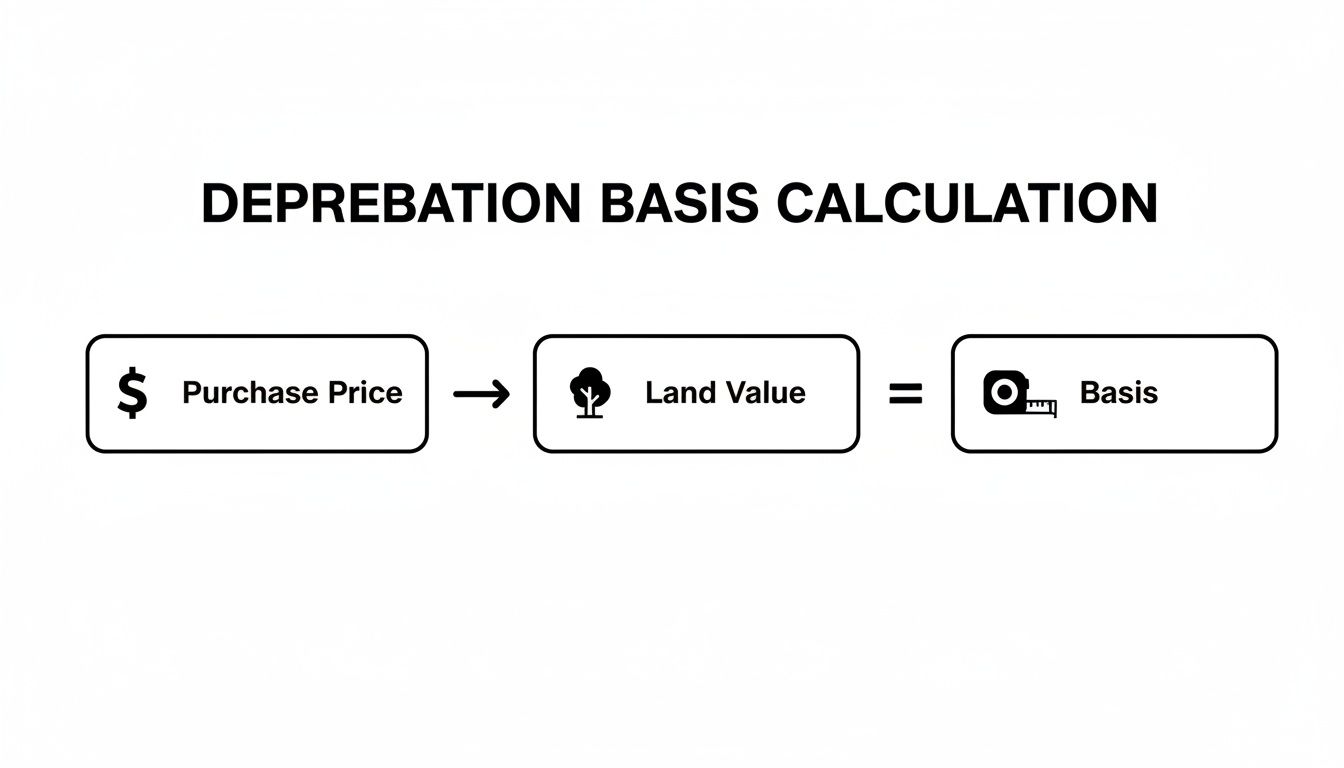
This chart simplifies the starting point for depreciation, which is a cornerstone of the final tax calculation you'll make on Schedule E. Getting these details right is more important than ever, as tax laws are always in flux. Staying informed about how policies are changing both at home and abroad is just part of being a savvy investor.
FAQs: Answering Your Top Rental Tax Questions
When you get into the nitty-gritty of rental property taxes, a few specific questions always seem to pop up. Landlords, both new and experienced, often run into the same tricky situations. What happens when a unit is empty? How do you handle your own sweat equity? What's the deal with security deposits?
Getting these answers right is crucial for filing your taxes correctly and with confidence. Let's walk through four of the most common questions we hear from property investors to clear up any confusion.
What Can I Deduct If My Property Is Vacant?
An empty property doesn't automatically mean your deductions stop. The key here is that the property must be actively available for rent. As long as you’re making a real effort to find a new tenant—running ads, listing it with a realtor, or holding showings—you can keep deducting all the usual operating expenses.
Think of it this way: the IRS considers holding the property for its business purpose (renting it out) an ongoing activity. That means your mortgage interest, property taxes, insurance premiums, utilities, and other carrying costs are still fully deductible during that vacancy. The moment you take it off the market for personal use, however, those deductions stop.
Can I Deduct My Own Labor for Repairs?
This is one of the clearest rules from the IRS: no. You can never deduct the value of your own time or labor spent working on your properties. The reasoning is pretty straightforward—you can't create a deductible expense by "paying" yourself for your own work.
Now, what you absolutely can deduct are the out-of-pocket costs for materials. If you spend your weekend painting a rental between tenants, the cost of the paint, brushes, rollers, and drop cloths is a valid expense. The value you place on that weekend of your time, though, is not.
Here's a crucial distinction: If you hire a painter to do the exact same job, their entire invoice is 100% deductible as a business expense. That payment covers both their labor and their materials. This is something to keep in mind when weighing a DIY project against hiring a professional.
How Should I Handle Security Deposits?
Security deposits are a frequent source of confusion. When a tenant first hands you a deposit, it's not income. You should think of it as a liability on your books because you're legally obligated to return it when the lease ends (assuming the tenant holds up their end of the bargain).
The deposit only becomes taxable income at the moment you legally keep all or part of it. For instance, if you withhold $300 from a deposit to repair damages or to cover a final month of unpaid rent, that $300 must be reported as income in the year you made that decision. Any amount you properly return to the tenant has zero impact on your taxes.
What Are the Most Important Records to Keep?
Think of meticulous record-keeping as your best friend and your number one defense against an IRS audit. Without clear documentation, even the most legitimate deductions can be thrown out. Your job is to create an undeniable paper trail that backs up every single number on your Schedule E.
At the bare minimum, you need to be disciplined about saving these documents:
- Proof of Income: Keep copies of every lease agreement and all bank statements that show rent deposits.
- Expense Receipts: This means everything. Save every receipt, invoice, and bill for repairs, supplies, insurance, and any professional services you use.
- Closing Documents: Your settlement statement from when you bought the property is non-negotiable. It's essential for establishing the cost basis you need for depreciation.
- Mileage Logs: If you're deducting vehicle expenses, you need a detailed log. It should show the dates, mileage, and business purpose for every trip you make to your rental property.
Navigating the complexities of rental property taxation requires expertise and attention to detail. The team at Allied Tax Advisors is dedicated to helping real estate investors like you ensure compliance and maximize their returns. From calculating depreciation to handling multi-state filings, we provide the specialized guidance you need. Let us help you build a sound financial strategy for your investments by visiting us at https://alliedtax.com.