
You're probably here because something about California sales tax doesn't feel intuitive.
A San Diego business owner sells three things in the same day and only some of them are taxable. A nonprofit treasurer assumes federal tax-exempt status solves everything. A company buys equipment and hears the word “exemption,” then learns later that the tax wasn't eliminated at all, only reduced. Those are the moments that create notices, amended returns, and expensive cleanup.
California sales tax exemptions are useful, but they're also easy to misuse. The costly mistakes usually come from assumptions, not bad intent.
Table of Contents
- Your Guide to California Sales Tax Exemptions
- The Foundation of California Sales Tax
- Common Sales Tax Exemptions for Every Business
- Specialized Exemptions for Industry and Commerce
- How to Claim and Document Your Exempt Sales
- Audit Risks and Compliance for San Diego Businesses
- Frequently Asked Questions
Your Guide to California Sales Tax Exemptions
A North Park café is a good example of how confusing this gets in real life. The owner sells hot coffee, cold packaged beans, branded mugs, and sandwiches. Some of those transactions may be taxable, some may not be, and the answer depends on what's sold, how it's sold, and whether the business has the right support in its records.
That's why california sales tax exemptions aren't just a list you glance at once. They affect pricing, invoices, point-of-sale setup, vendor purchases, and audit exposure. A business can over-collect tax and upset customers, or under-collect tax and end up paying the difference later out of its own pocket.

For small businesses, the practical question isn't “What's exempt in theory?” It's “What do I charge tax on today, and what proof do I need if someone questions it later?” That's the mindset that keeps sales tax manageable.
A clean process matters more than memorizing edge cases. Most businesses do better when they categorize sales properly, collect exemption documents before closing exempt transactions, and review unusual items before they become recurring problems. If you need a broader look at collection and filing mechanics, this overview of California sales tax services is a useful companion to the exemption rules.
Practical rule: If a transaction feels “probably exempt,” stop there. “Probably” is where many sales tax problems begin.
The Foundation of California Sales Tax
California starts with a basic rule. It taxes retail sales of tangible personal property, meaning physical items people can see, touch, measure, or move.
The important part is what sits outside that rule. California imposes a 7.25% base state sales tax on tangible goods while also maintaining a narrow taxable base by exempting virtually all services and many necessities, including unprepared grocery food, prescription medications, medical devices, diapers, and feminine hygiene products, as summarized in California taxation rules. That same framework also leaves many services and certain non-physical transactions outside the normal sales tax system.

What California usually taxes
Think in categories first, not exceptions first.
| Transaction type | General treatment |
|---|---|
| Physical goods sold at retail | Usually taxable |
| Most services | Generally not taxable |
| Many basic necessity items | Often exempt |
| Some digital and intangible items | Often outside traditional sales tax treatment |
That structure is why business owners get tripped up. They hear California has a high sales tax rate and assume the state taxes almost everything. It doesn't. The rate is significant, but the taxable pool is narrower than many people expect.
Why this matters in practice
A useful way to think about it is a fishing net with large openings. The net catches many retail sales of physical goods. It lets a lot of services and exempt essentials pass through.
That means exemption analysis usually starts with two questions:
- Is the sale of tangible personal property?
- If yes, does a specific exemption or exclusion apply?
If you reverse that order, you'll waste time chasing exemptions that aren't even needed. I often see this with consultants, designers, and professional firms that assume they need a sales tax exemption strategy when the core issue is whether their work is taxable at all under California rules.
A high rate doesn't mean a broad tax base. In California, that distinction matters every day.
Where owners make the first mistake
Many businesses label items too broadly. They call all food exempt. They call all software taxable. They call all nonprofit transactions exempt. None of those shortcuts are reliable.
A better approach is to map your revenue by line item. If your invoice or POS system mixes taxable goods with non-taxable sales under one generic product category, you're creating confusion before the CDTFA ever asks a question.
Common Sales Tax Exemptions for Every Business
The exemptions most businesses see aren't the glamorous ones. They're the everyday categories that sit inside inventory purchases, customer invoices, and routine operations. If you handle these well, you reduce a lot of unnecessary risk.
A resale sale is exempt only when the paperwork is right
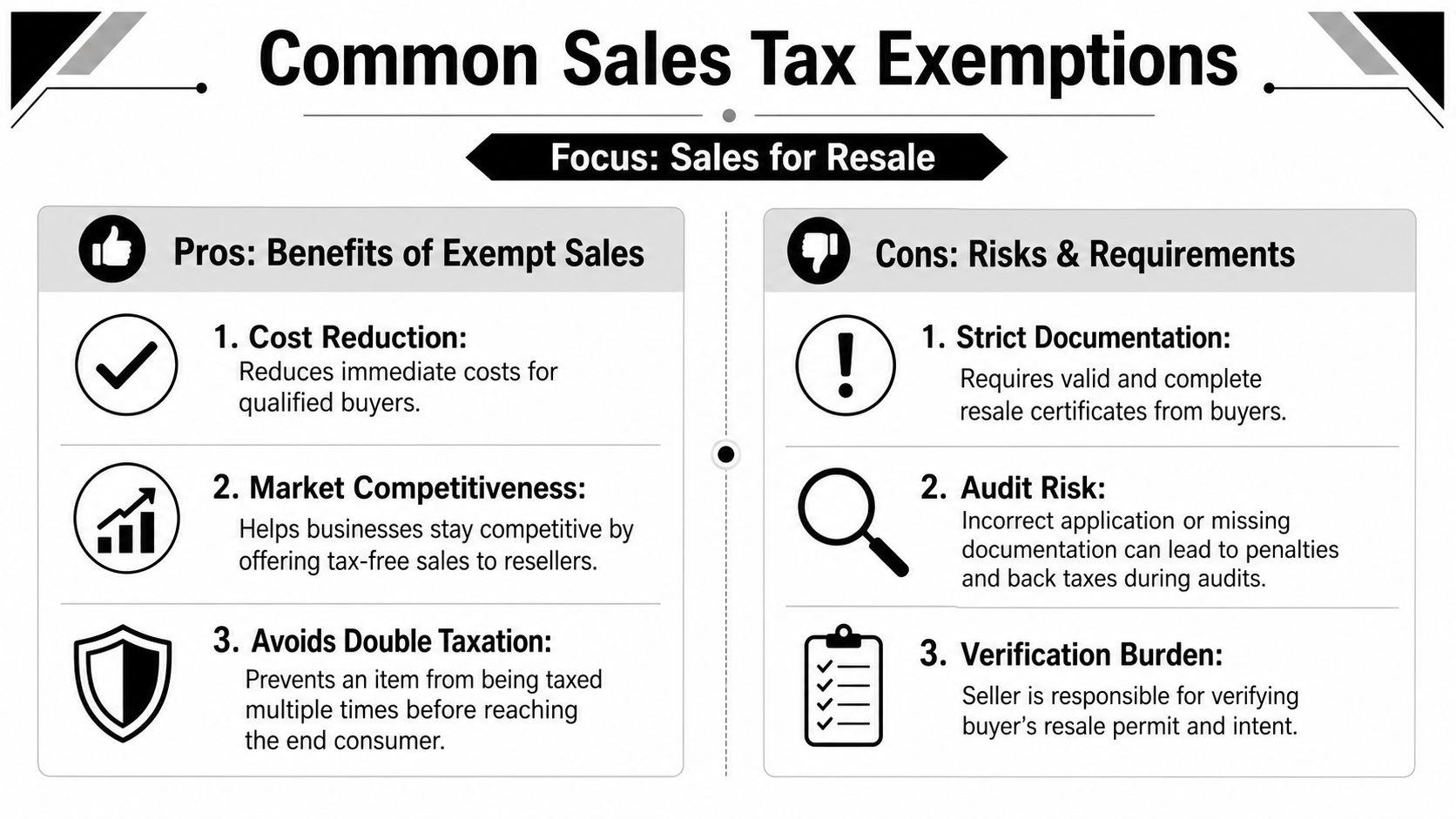
One of the most common exemptions is the sale for resale. If your customer is buying inventory to resell rather than consume, the transaction may be treated as exempt at that stage.
That sounds simple. It isn't, unless the documentation is complete.
For a seller, the exemption isn't based on what the buyer says casually over the phone. It's based on receiving a valid resale certificate and accepting it in good faith. If the certificate is incomplete, inconsistent, or tied to a purchase that doesn't fit the buyer's business activity, you should slow down before removing tax.
Common trouble spots include:
- Mismatch problems: A buyer claims resale treatment for items that don't fit its normal line of business.
- Rushed onboarding: Sales staff skip certificate collection because they don't want to delay the order.
- File decay: The business had a certificate once, but can't locate it when records are reviewed later.
The nonprofit blanket error
This is the misconception I see most often with California nonprofits.
Many people assume that 501(c)(3) status automatically creates a California sales tax exemption. California does not apply that kind of broad rule. The CDTFA position, as summarized in this discussion of common California sales tax exemption mistakes, is that there is generally “no similar broad exemption from California sales and use tax” for nonprofits, even when federal income tax exemption exists.
That has real consequences. A nonprofit can still be a taxable seller. If it sells merchandise or provides sales unrelated to a narrow exemption category, sales tax may still apply.
The federal exemption letter is not a sales tax pass.
For San Diego nonprofits, expensive errors commonly stem from a particular misconception. Board members and volunteers often know the organization is tax-exempt for federal income tax purposes, so they assume the same answer applies to merchandise tables, gala sales, gift shop items, or regular retail activity. California doesn't treat those categories as automatically exempt just because the organization is charitable.
A safer way to look at nonprofit sales is this:
- Entity status matters less than transaction type.
- Narrow exemptions must be supported.
- Assuming blanket exemption is risky.
Exempt essentials still require careful item review
Some exemptions are familiar enough that owners stop checking details. Food is the best example. Many grocery-type items are exempt, but businesses often sell mixed products and prepared items that don't fit neatly into one bucket.
Prescription medicine is another area people understand broadly, but that doesn't mean every health-related item gets exempt treatment automatically. The right habit is to review the actual product category, not the general theme of the product.
Here's the practical takeaway. The most common california sales tax exemptions help legitimate businesses avoid tax where the law allows it. But the exemption only works when the item, buyer, and records all line up.
Specialized Exemptions for Industry and Commerce
Some California exemptions are designed less for day-to-day retail and more for investment-heavy industries. These rules matter because they can materially affect equipment purchasing decisions, budgeting, and timing. They also show why the word exemption can be misleading. In several cases, California offers a partial exemption, not a zero-tax result.
Manufacturing and R and D equipment
California's Manufacturing and Research and Development equipment partial exemption under R&TC section 6377.1 reduces the sales and use tax rate to 3.3125% for qualified persons until June 30, 2030, according to the CDTFA's manufacturing and R&D partial exemption guidance.
That's a valuable rule for businesses buying qualifying machinery and equipment used primarily in manufacturing, research, or electric power generation. But owners make two mistakes here.
First, they hear “exemption” and assume no tax applies. Second, they assume any business equipment qualifies. Neither is safe. This is a targeted rule tied to qualified persons and qualified use, not a general discount on capital spending.
A practical screening list helps:
- What is being purchased: Machinery and equipment are the starting point.
- How it will be used: Primary use matters.
- Who is buying it: The purchaser has to fit the statutory category.
If a company buys office furniture, general supplies, or software, this rule usually isn't the place to start. Businesses should review the asset class carefully before taking the reduced rate.
Teleproduction equipment
California also provides a partial exemption for teleproduction and postproduction equipment. The reduced rate structure applies in this area as well, but the administrative side matters just as much as the eligibility side.
This exemption is relevant for buyers using qualifying equipment in film, television, or digital media production. In practical terms, that means businesses purchasing high-value production assets need to pay attention before the invoice is finalized, not after.
The businesses that benefit most from this rule tend to be the ones that standardize the process. Their purchasing team knows which assets may qualify, who signs the supporting forms, and how the exemption is tracked in the accounting file.
A partial exemption can improve a purchase decision. A missing form can erase that benefit just as fast.
Interstate commerce and shipped orders
For San Diego businesses that sell online or ship products outside California, interstate commerce rules are easy to oversimplify. Owners often assume every out-of-state shipment is automatically exempt from California sales tax. That can be true in some cases, but the shipping method, delivery facts, and documentation matter.
The practical issue isn't just where the customer lives. It's whether the sale is structured and documented as an interstate shipment rather than an in-state transfer followed by later delivery. That's why shipping records, carrier records, and invoice detail matter for e-commerce businesses.
I tell owners to avoid making these calls from memory. If your business ships regularly across state lines, build a repeatable review process for fulfillment records and invoice language. Interstate commerce treatment is useful, but only if the file supports it.
How to Claim and Document Your Exempt Sales
An exempt sale without support is just an audit adjustment waiting to happen. The CDTFA doesn't grade on intent. If the records don't establish why tax wasn't collected, the seller often ends up carrying the burden.
What to collect before you treat a sale as exempt
Documentation should happen at the front end. Not after the customer has the goods. Not when your bookkeeper notices a problem months later.
If the exemption depends on a certificate, get the certificate before closing out the sale as non-taxable. For example, California's teleproduction exemption requires the purchaser to file the Teleproduction Equipment Certificate (CDTFA-230-K), and failure to obtain that certificate means the full tax rate applies, as described by the CDTFA in its sales and use tax exemption guidance.
A sound internal checklist usually includes:
- Identify the legal basis for the claimed exemption.
- Collect the right certificate or supporting form tied to that exemption.
- Review it for completeness before the invoice is finalized.
- Match it to the transaction so the product, buyer, and use make sense.
- Store it where accounting can retrieve it quickly.
If your records are scattered between email inboxes, POS notes, and paper folders, fix that before you have volume. This guide on organizing business receipts and records is a practical starting point for building a cleaner system.
How to build records that survive an audit
Businesses often focus on collecting forms and forget the second half of the job. The certificate has to connect clearly to the transaction.
That means your file should show the invoice, the customer, the property sold, and the reason tax was not charged. If an auditor has to guess how the certificate relates to the sale, you've left too much room for dispute.
Useful habits include:
- Link documents clearly: Keep certificates attached to customer profiles or invoice records.
- Train the front office: Staff who open accounts or process orders need to know when to pause for missing support.
- Review exceptions monthly: A short review of untaxed sales often catches errors before they compound.
Good documentation doesn't just prove an exemption. It proves you applied the exemption to the right sale.
Audit Risks and Compliance for San Diego Businesses
Sales tax audits rarely become painful because of one dramatic issue. More often, a business accumulates small documentation gaps, broad assumptions, and inconsistent invoice treatment over time. Then the CDTFA asks questions, and the business has to defend decisions it didn't document well.
Why audit problems usually start small
A restaurant group may tax merchandise correctly but mishandle a food category. A nonprofit may rely on federal status without reviewing California sales tax treatment. A product seller may mark wholesale customers as exempt in the system before receiving complete resale paperwork.
Those errors don't always show up immediately. They sit in the background until an audit, a notice, or a bookkeeping cleanup project pulls them into view. At that point, the seller may be responsible for the tax if an exemption can't be supported.
There's also a change-management problem. California sales tax law doesn't stay frozen. As noted in the UCSF Controller summary, California has historically narrowed its taxable base through targeted exemptions, while legislative action to make SaaS and prewritten software taxable starting January 1, 2027 represents a major expansion of the tax base, according to this summary of the California partial exemption and tax-base change discussion. If your business sells software, bundles technology services, or buys digital products, you can't rely on old assumptions forever.
What a safer compliance routine looks like
The businesses that handle audits best usually do ordinary things consistently.
- Review tax settings regularly: Product mappings in your POS or accounting system should reflect current treatment.
- Escalate unusual sales: If a transaction doesn't look routine, someone with authority should review it before tax is removed.
- Keep support centralized: Audits get harder when exemption records live in five places.
- Ask for advice early: Preventive review is usually cheaper than defending a weak file later. Businesses that need broader year-round guidance often benefit from structured small business tax advice.
A San Diego owner doesn't need to become a sales tax attorney to stay compliant. But the owner does need a process. That process should be simple enough that staff will follow it and strict enough that exemptions aren't granted on instinct.
Frequently Asked Questions
Does a 501(c)(3) letter make a California sale tax-exempt
Usually, no. Federal income tax exemption and California sales tax exemption are not the same thing. The transaction itself has to qualify under California rules.
Is every food sale exempt in California
No. Food-related sales can be one of the most misunderstood categories. Businesses should review the actual item and how it's sold instead of assuming all food is treated the same way.
Does exempt mean zero tax in every case
No. Some California exemptions are partial exemptions. The manufacturing and R&D rule is a good example. It reduces tax for qualifying purchases rather than eliminating it entirely.
Can I accept a customer's word that they're buying for resale
You shouldn't rely on that alone. A resale claim needs proper documentation. If your file doesn't support the exempt treatment, the seller can face problems later.
What matters most in an audit of exempt sales
Documentation. The strongest file shows why the sale qualified, which form supports it, and how that form connects to the invoice and buyer.
Do software businesses need to watch for rule changes
Yes. California treatment of software has been changing, and businesses that sell or buy software products should monitor how those transactions are classified and taxed.
If you want help reviewing exempt sales, cleaning up resale documentation, or fixing California sales tax issues before they turn into notices, Allied Tax Advisors can help. Their Clairemont, San Diego team works with small businesses, nonprofits, and growing companies that need practical tax guidance, organized records, and a process that holds up when the state asks questions.