
You're paying Mom's grocery bill. You added Dad to your cell phone plan. Maybe your parent moved into your home in Clairemont, La Mesa, or Chula Vista after health issues made living alone harder. Or maybe they still live across town in their own apartment, but you're the one covering prescriptions, co-pays, rides to appointments, and part of the rent.
At some point, almost every caregiver asks the same question. Can you claim your parent as a dependent?
Sometimes the answer is yes. Sometimes it's no. The frustrating part is that many families feel they're clearly providing help, yet the tax rules don't always line up with what feels fair. The IRS uses a specific set of dependency tests, and one missed detail can shut the door on the claim.
That doesn't mean the rules are impossible to follow. It means you need a clean method. If you approach this the way a CPA would, with a checklist, a support worksheet, and solid records, the answer becomes much clearer.
This guide walks through the rules in plain English. You'll see how to evaluate the four main tests, how to calculate support step by step, what income counts against your parent, and what to do if siblings share the financial load.
Table of Contents
- The Four Core IRS Tests for Claiming a Parent
- Calculating the Critical 50 Percent Support Test
- Understanding the Gross Income and Residency Rules
- Special Cases Multiple Support Agreements and Tie Breakers
- The Payoff Claiming Benefits and Keeping Records
- When to Get Professional Tax Help in San Diego
The Four Core IRS Tests for Claiming a Parent
Before you start adding up grocery receipts or pharmacy bills, use a simple checklist. A parent generally has to pass four core tests for you to claim them as a dependent.
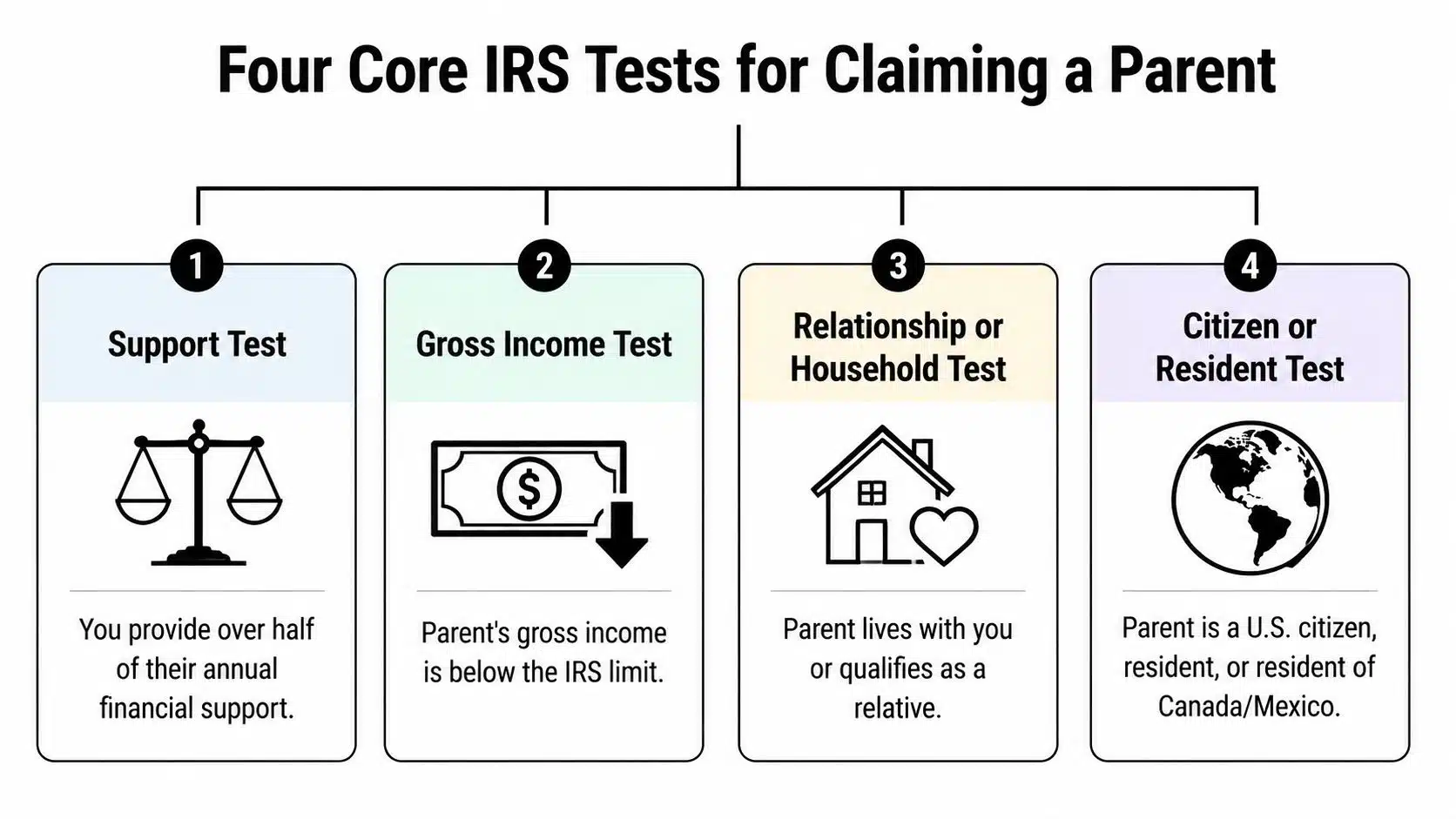
The quick checklist
| Test | What it means in plain language |
|---|---|
| Not a qualifying child | Your parent can't be claimed under the IRS rules that apply to children. |
| Gross income test | Your parent's taxable gross income must stay under the IRS limit. |
| Support test | You must provide more than half of their total support, unless a multiple support agreement applies. |
| Relationship or household test | A parent usually qualifies by relationship, even if they don't live with you. |
Most confusion comes from the middle two. People often assume that if they're helping “a lot,” that's enough. It isn't. The IRS wants you to look at income and support separately.
How these tests work together
A practical way to think about it is this:
- The relationship test asks who the person is to you.
- The income test asks what taxable money your parent had.
- The support test asks who paid for daily living.
- The qualifying child test makes sure your parent doesn't fall into a different category.
Practical rule: A dependency claim usually works or fails on paperwork, not intention. Families often know who helped most, but the IRS wants proof.
Here's a common example. Your mother lives in an assisted living setting near Mission Valley. You pay for medications and some monthly costs. Your brother pays for transportation and food. Your mother also has her own taxable pension income. In that situation, you can't answer the tax question with one sentence. You have to walk through each test in order.
The good news is that not every part is equally difficult. Relationship is usually easy for a parent. The hard part is the math. That's where most tax returns get tripped up.
Calculating the Critical 50 Percent Support Test
A lot of families lose this test for one simple reason. They total up what they paid and forget to total up everything that supported the parent for the year.
The IRS question is narrow. Did you pay more than half of your parent's total support for the year? TurboTax explains that the support test is based on whether you provided more than 50% of total annual support, and that support can also involve multiple contributors in some cases, such as under a multiple support agreement, in its discussion of claiming a parent as a dependent and support rules.

A good way to approach this is to treat support like a household budget worksheet. First find the full annual cost of your parent's living expenses. Then identify who paid each part. Your percentage only makes sense after both numbers are on the page.
What counts as support
Support usually includes the ordinary costs of living, plus medical care and other day-to-day needs.
- Housing costs: Rent, a fair value for lodging in your home, utilities, and other home costs tied to living there
- Food and household basics: Groceries, meals, pantry items, paper products, and cleaning supplies
- Medical care: Insurance premiums you paid, co-pays, prescriptions, medical equipment, and other out-of-pocket costs. If you also want to know which of those payments may help on your own return, see Allied Tax Advisors' guide to when medical expenses are tax deductible.
- Transportation and personal needs: Gas, rides to appointments, transit, clothing, and similar daily expenses
- Personal care and recreation: Haircuts, hygiene items, activities, and other ordinary living costs
One point trips people up all the time. Your parent's total support is not limited to money you paid. It also includes amounts your parent paid from their own funds, amounts siblings paid, and support provided through government benefits if those benefits covered living costs.
A worksheet-style way to run the math
Use a spreadsheet, notebook, or notes app. The format matters less than the order.
List every support category for the full year
Include housing, food, medical, transportation, and other regular living costs.Fill in the total annual cost for each category
Start with the whole cost, not your share. If your parent lived with you, estimate the fair value of the lodging and meals you provided.Assign each payment to the right person or source
Separate amounts paid by you, by your parent, by siblings or other relatives, and by public assistance programs.Add your column
This is your personal contribution for the year.Add the full support column
This is the parent's total annual support from all sources combined.Compare the two numbers
If your amount is more than half of the total, you meet the support test. If your amount is below that level, the test usually fails unless a multiple support agreement applies.
Start with the full pie, then measure your slice. Families often reverse that process and get the wrong answer.
Here is a simple worksheet format:
| Support category | Total annual support | Paid by you | Paid by parent | Paid by others |
|---|---|---|---|---|
| Housing | [fill in] | [fill in] | [fill in] | [fill in] |
| Food | [fill in] | [fill in] | [fill in] | [fill in] |
| Medical | [fill in] | [fill in] | [fill in] | [fill in] |
| Transportation | [fill in] | [fill in] | [fill in] | [fill in] |
| Other support | [fill in] | [fill in] | [fill in] | [fill in] |
A San Diego example
Suppose your mother lives with you in Clairemont. You do not charge rent. She uses one bedroom, shares utilities, eats most meals at home, and you pay for her prescriptions. Your brother covers occasional rides to medical appointments, and your mother uses some of her own money for clothing and personal items.
In that situation, the largest support number may be lodging. That matters in San Diego because housing costs are often much higher than families expect when they estimate support informally. If you leave out the fair value of the room, utilities, and meals, your worksheet can be off by a wide margin.
Now change the facts. Your father lives in his own apartment in North Park or El Cajon, and you send money each month to help with rent, groceries, and medications. The calculation is still the same, but the proof looks different. Instead of valuing room and board in your home, you would track the portion of his actual rent, food, prescriptions, transit, and other bills that you paid.
That is why I tell San Diego clients to build the worksheet category by category, almost like reconciling a bank statement. Housing first. Food next. Medical after that. Then transportation and personal expenses. Once those numbers are complete, the support test usually becomes much clearer.
Understanding the Gross Income and Residency Rules
A lot of families reach this point feeling confident because the support worksheet looks good, then run into two quieter rules that can still stop the claim. The first is the parent's gross income. The second is whether living with you is even required.

The gross income line is strict
For the 2026 tax year, a parent's gross income must be less than $5,300, and tax-exempt Social Security benefits do not count toward that amount, according to ElderLawAnswers on claiming a parent as a dependent.
Treat this like a gate with a hard limit. If your parent's taxable gross income goes over that number, the dependency claim does not work, even if you covered more than half of their support. That can also affect related tax breaks, such as the Credit for Other Dependents and certain medical expense strategies, as noted earlier.
One point causes confusion over and over. Cash received is not always the same as gross income for this test. A parent may have money coming in from Social Security, a pension, part-time work, interest, or retirement distributions, but each item can be treated differently for tax purposes. If you need a plain-English refresher on how income is measured on a return, see Allied Tax Advisors' guide to adjusted gross income and how it works.
Do not start with bank deposits. Start with whether each source is taxable.
That distinction matters in San Diego, where retired parents often piece together income from several places. A parent in La Mesa might receive Social Security, small IRA withdrawals, and interest from savings. A parent in Chula Vista might have pension income plus a few months of part-time wages. Before you assume the gross income test is met or failed, sort each income source by its tax treatment.
Residency is usually simpler than families expect
Parents are different from many other dependents because the relationship test often removes the need for them to live with you all year. In plain terms, your mother or father can still qualify even if they live in their own apartment, in senior housing, or with another relative for part of the year.
That surprises many new clients. They hear “dependent” and picture someone who must share the same address. For a parent, the IRS usually cares much more about the relationship, the income limit, and the support calculation than about sleeping under your roof.
Use this quick check:
- Parent lives with you: review gross income and support as usual.
- Parent lives in their own place: the claim may still be allowed if the other dependency tests are met.
- Parent moves during the year: track who paid for housing, food, medical costs, and other support during each period.
This comes up often across San Diego County. A parent may spend spring in your home in Clairemont, summer with a sibling in Poway, then return to a senior apartment in Escondido. The living arrangement may look complicated on the surface. The tax question is more mechanical. Confirm the relationship. Check the parent's taxable gross income. Then match your support worksheet to the months and expenses you covered.
Special Cases Multiple Support Agreements and Tie Breakers
Some families don't have one clear caregiver. Instead, several people cover different pieces of a parent's life. One sibling pays for medication. Another buys groceries. A third handles transportation and utility bills.
That doesn't automatically prevent a dependency claim.
When siblings split the bills
Under the support rule described earlier, a taxpayer who contributes only 10% to 50% of a parent's support may still be able to claim the parent through a multiple support agreement if the group collectively contributes more than half and the contributors keep documentation of their shares. That approach is described in the TurboTax material already cited above.
This arrangement helps families avoid losing the claim just because support is fragmented. It's especially useful when caregiving is shared across households.
Use this checklist if your family is in that situation:
- Track each person's share: Don't rely on memory. Pull bank records, pharmacy receipts, rent checks, and reimbursement logs.
- Choose one claimant: Families need to decide who will claim the parent for that year.
- Keep signed documentation: The agreement only works if the paperwork supports the arrangement.
- Stay consistent: If siblings rotate who claims the parent in different years, keep notes showing why that year's choice made sense.
When more than one person could claim the same parent
Sometimes the issue isn't split support. It's competing eligibility. Two people may both think they have the better claim.
That can happen when a parent lived part of the year with one child and part with another, or when one child paid direct bills while another provided housing. In those cases, tie-breaker analysis becomes more technical because the return has to match the facts and the supporting records.
A clean way to avoid disputes is to decide early, before anyone files. Compare the support worksheet, verify the parent's taxable income, and save the records in one shared folder. If there's still disagreement, that's usually a sign the family should get tax advice before submitting a return.
The Payoff Claiming Benefits and Keeping Records
A dependency analysis takes work, so it's fair to ask what you gain by doing it right.
What you may gain
The clearest direct benefit named in the verified guidance is the $500 Credit for Other Dependents, referenced in the ElderLawAnswers material cited earlier. For some families, the other meaningful tax benefit is the ability to include qualifying medical costs paid for a parent, depending on the rest of the return and whether the taxpayer itemizes.
That's why this topic matters. If you're already carrying a parent's financial burden, proper tax treatment can provide some relief.
Benefits often become more valuable when you've paid many scattered expenses over the year, such as prescriptions, specialist visits, medical devices, and transportation related to care. If you're sorting through account records to identify those payments, a practical companion resource is this investors' guide to brokerage statements, which can help readers understand how to review statements and trace transactions when support funds came from investment accounts.
Records that make the claim defensible
Good records matter as much as the math. If the IRS ever asks questions, you want a file that tells the story quickly.
Keep a folder with items like these:
- Support records: Grocery receipts, pharmacy records, utility payments, rent checks, and insurance statements.
- Housing backup: Lease records, mortgage-related payment history, and notes showing how you estimated your parent's lodging value if they lived with you.
- Medical documentation: Bills, explanation of benefits forms, prescription receipts, and provider statements.
- Shared support proof: Written notes showing what siblings or other relatives paid during the year.
- Income documents for the parent: Tax forms, pension statements, and any records needed to sort taxable from non-taxable income.
A well-organized support file often answers the question faster than memory ever can.
If you want this claim to hold up, think like an auditor for a few minutes. Could someone else review your folder and understand why the dependency claim was valid? If the answer is yes, you're in much better shape.
When to Get Professional Tax Help in San Diego
Some returns are simple. This topic often isn't.
If you're trying to assign a fair lodging value in your San Diego home, separate taxable income from non-taxable income, or sort out a multiple support agreement among siblings, it's easy to make an honest mistake. The rules look simple at a distance, but the details matter once you apply them to real life.

Professional help also makes sense when family care overlaps with estate issues, end-of-life costs, or questions that don't belong on an income tax return. For example, many families ask whether burial-related costs create a deduction. A plain-language reference on that separate topic is are funeral costs tax deductible.
For readers who want local guidance, working with a CPA in San Diego, CA can help you evaluate the dependency claim before filing, rather than trying to fix it after the IRS sends a notice. That's often the better route when multiple family members are involved or the records are incomplete.
The right answer isn't always the answer you hoped for. But getting a precise answer, backed by records, is far better than guessing on a signed return.
If you're caring for a parent and want a clear answer before you file, Allied Tax Advisors can help you review support, income, and documentation so you can claim every credit and deduction you're entitled to with confidence.