
If there’s just one thing you need to remember about capital gains tax in California, it's this: the state doesn't give you a special, lower tax rate for these profits. It's a common misconception. Unlike the federal system, California taxes the money you make from selling an asset—like stocks, crypto, or real estate—just like it taxes your regular paycheck.
How California's Approach to Capital Gains is Different
Many taxpayers get tripped up because they assume California mirrors the federal rules, which make a big distinction between short-term gains (from assets held less than a year) and long-term gains (held more than a year).
At the federal level, holding an asset for the long term gets you a reward: preferential tax rates of 0%, 15%, or 20%.
California throws that entire concept out the window.
Think of your annual income as a big bucket. Your salary, bonuses, and other earnings fill it up throughout the year. When you sell an asset for a profit, California just dumps that capital gain right on top of everything else in the bucket. There's no separate, smaller bucket for your investment profits.
This means your capital gain is taxed as ordinary income, plain and simple. It’s subject to California’s progressive tax brackets, so the more total income you have (including the gain), the higher your marginal tax rate climbs.
To give you a clearer picture, here’s a quick comparison of the two systems.
Federal vs California Capital Gains Tax At a Glance
This table breaks down the fundamental differences between how the IRS and the California Franchise Tax Board (FTB) handle your investment profits. It's a handy way to see why you can't apply federal logic to your state tax planning.
| Tax Aspect | Federal Rules | California Rules |
|---|---|---|
| Long-Term vs. Short-Term | Crucial distinction. Long-term gains (held >1 year) get lower tax rates. | No distinction. Holding period is irrelevant for state tax calculations. |
| Tax Rate | Preferential rates of 0%, 15%, or 20% for long-term gains. | Taxed as ordinary income at progressive rates from 1% to 13.3%. |
| How It's Taxed | Gains are calculated separately from ordinary income. | Gains are added directly to your other income (wages, salary, etc.). |
| Tax Planning Focus | Holding assets for at least a year and a day is a key strategy. | Planning focuses on managing total taxable income and the timing of the sale. |
As you can see, what works for your federal return won't necessarily help you on your California 540.
The Impact of California's Tax Brackets
Because capital gains are treated as regular income, a large one-time profit can easily push you into a much higher tax bracket than you’re used to. This is a critical detail that catches many people by surprise.
For example, selling a successful business, a rental property, or a valuable stock portfolio could launch your income into the state's highest tax tiers for that year. You can get a full breakdown of how these progressive rates work in our guide to the 2024 California tax brackets.
Key Takeaway: In California, how long you hold an asset doesn't matter for state taxes. A gain is a gain, whether you owned the investment for two months or two decades. It will be taxed at your personal income tax rate.
This unique approach puts California among the states with the highest effective capital gains taxes in the nation. For high-income earners, the state's top marginal rate can hit 13.3%. That’s why proactive tax planning isn't just a good idea here—it's essential for anyone selling assets in the Golden State.
Calculating Your California Capital Gains Tax Step by Step
Figuring out your capital gains tax in California boils down to some pretty straightforward math. Once you know the key pieces of the puzzle, the process is less about navigating dense tax code and more about simple arithmetic.
Let's walk through it together, starting with the single most important number in any capital gains equation: your cost basis.
Think of your cost basis as your total, all-in investment in an asset. For a stock, that’s not just what you paid per share—it also includes any brokerage commissions or fees. For real estate, it’s the original purchase price plus certain closing costs and any major improvements you’ve made, like a new roof or a kitchen remodel.
Step 1: Determine Your Adjusted Cost Basis
The initial price you paid for an asset is just the starting point. The real goal is to find your adjusted basis, which reflects the true total of what you've put into it over time.
Here are a couple of common examples:
- For Stocks: Say you bought 100 shares of a company at $50 per share and paid a $10 commission. Your initial basis isn't just $5,000; it's ($50 x 100) + $10 = $5,010.
- For Real Estate: Imagine you purchased a rental property for $400,000. You also paid $8,000 in closing costs (the non-deductible kind) and later spent $50,000 on a full kitchen renovation. Your adjusted basis becomes $400,000 + $8,000 + $50,000 = $458,000.
Pro Tip: Keep meticulous records of everything. Every receipt for an improvement or a transaction fee is gold. Each dollar you can legitimately add to your cost basis is a dollar that won't get taxed as a gain down the road.
For a deeper dive into the nuances here, our guide on how to calculate capital gains breaks down more complex scenarios that might apply to you.
Step 2: Calculate Your Realized Gain
Got your adjusted basis? Great, the next part is easy subtraction.
Your realized gain is simply the sale price of your asset minus your adjusted basis. You only "realize" this gain—and trigger a taxable event—the moment you sell.
Formula: Sale Price – Adjusted Basis = Realized Gain
Let’s stick with our real estate example. You eventually sell that rental property for $650,000.
- Sale Price: $650,000
- Adjusted Basis: $458,000
- Realized Gain: $650,000 – $458,000 = $192,000
This $192,000 is your taxable profit. It's the number that you’ll be adding to your income for the year.
Step 3: Add the Gain to Your Total Income
This final step is where California’s tax system really shows its unique character. As we've mentioned, the state doesn’t give you a special, lower tax rate for capital gains. That $192,000 profit is treated just like a year-end bonus or any other form of ordinary income.
You simply add that realized gain to all your other income sources for the year—your salary, business profits, you name it. This new, higher total is what determines which of California’s progressive tax brackets you land in.
This chart shows how that gain gets lumped in with your regular paycheck to create your total taxable income.
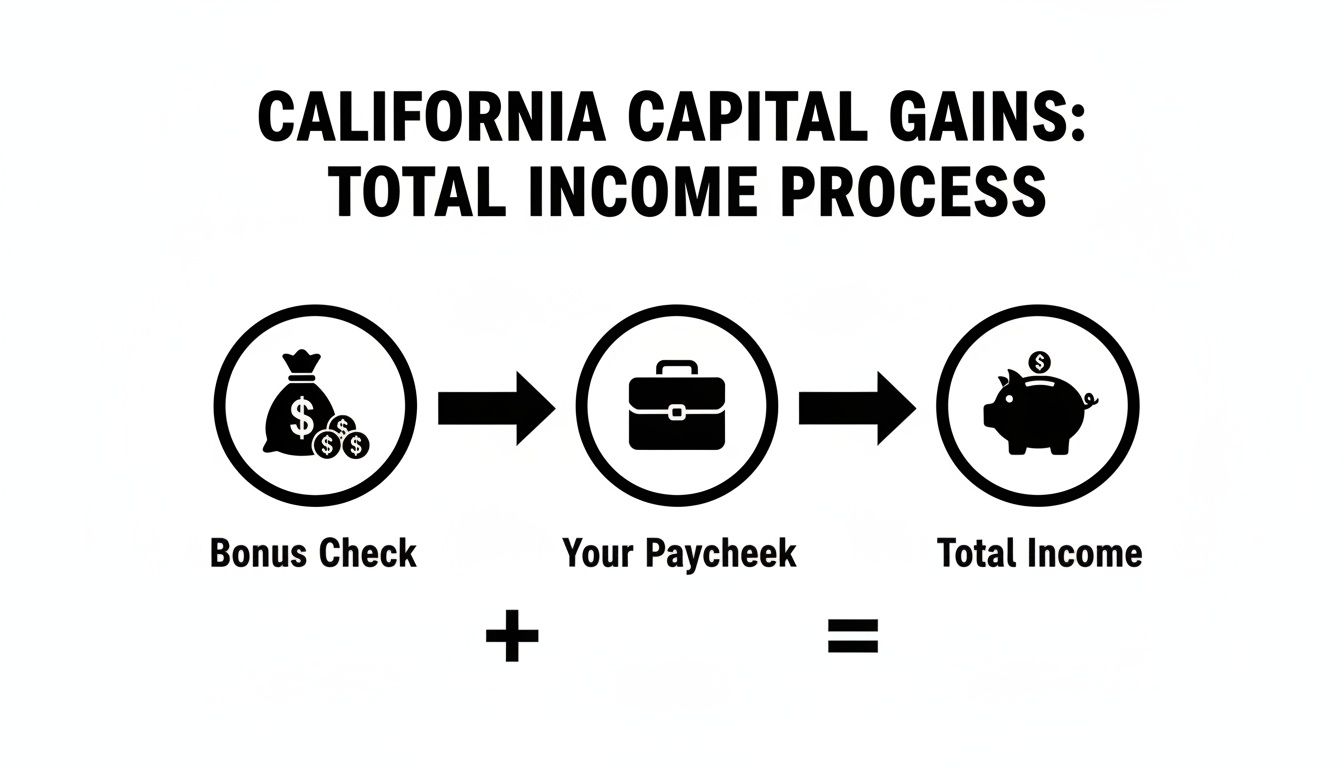
The big takeaway here? A large capital gain can easily inflate your total income for the year, potentially bumping you into a higher tax bracket. That means you could end up paying a higher tax rate on those last dollars you earned, including the gain itself.
Why Capital Gains Are a Big Deal for California's Economy
Getting a handle on capital gains tax in California is obviously important for your own wallet, but it also gives you a fascinating look into the state's entire economic engine. Your personal tax situation doesn't happen in a bubble—it's tied directly to California's famously volatile budget, which rides the stock market's highs and lows like a rollercoaster.
Unlike states with more diversified revenue streams, California relies heavily on income from its highest earners. A huge chunk of that income comes from capital gains—the profits from selling stocks, businesses, and other major assets. When the market is hot, the state is flush with cash. When it cools off, that revenue stream can slow to a trickle, creating massive budget headaches.
The Boom-and-Bust Budget Cycle
This dependency fuels a dramatic boom-and-bust cycle that has real-world consequences for state services and policy decisions. The numbers really tell the story here.
California's capital gains tax revenue has swung wildly over the past two decades. In 2009, in the wake of the Great Recession, these gains brought in a relatively paltry $2.3 billion for the state's General Fund. But fast forward to the market highs of 2021, and that number exploded to an incredible $25 billion.
This massive swing underscores why market cycles are so critical for anyone paying taxes in California. The state's financial health is directly linked to the performance of investment portfolios, especially those concentrated in tech and crypto.
Key Insight: California's heavy reliance on capital gains means that major market shifts hit the state budget much harder than they would elsewhere. This reality often shapes tax policy and makes the timing of your asset sales even more important.
How This Affects Your Tax Strategy
Understanding the state's reliance on investment income gives you powerful context for your own tax planning. It helps explain why California’s tax laws are written the way they are and reinforces why you need to be proactive. When state revenue is so closely tied to market performance, timing when you sell an asset becomes a crucial strategic move.
For example, cashing in on a large gain during a bull market might feel great, but you're also paying a bigger tax bill in a year when the state is already collecting record revenue. On the flip side, carefully planning your transactions around your own income needs and potential market shifts can give you a real strategic advantage.
For anyone dealing with digital assets, knowing the tax rules is absolutely essential. You can find a great deep-dive in this guide: A Beginners Guide to Cryptocurrency Trading and Tax Reporting.
Ultimately, by aligning your personal financial decisions with these broader economic currents, you can make smarter choices that help minimize what you owe in a system that is, by its very nature, unpredictable. This is the kind of strategic thinking that defines effective wealth management in the Golden State.
Navigating Special Rules for Real Estate and Crypto

While the general capital gains rules cover most assets, some of the biggest investments for Californians—real estate and cryptocurrency—play by their own set of rules. These assets are often where people build significant wealth, but they also come with complex tax treatments that can catch you by surprise.
Let's walk through the special considerations for homeowners, real estate investors, and crypto traders. Each has unique opportunities and potential pitfalls you need to know about.
The Home Sale Exclusion for Your Primary Residence
For most Californians, their home isn't just a place to live; it's their most valuable asset. Thankfully, both the IRS and California offer a huge tax break for homeowners called the primary residence exclusion (also known as the Section 121 exclusion).
This powerful rule lets you exclude a massive chunk of the profit from the sale of your main home, so you don't pay any tax on it.
To get this benefit, you have to pass two simple tests:
- The Ownership Test: You must have owned the home for at least two of the last five years before you sell it.
- The Use Test: You must have lived in the home as your main residence for at least two of those five years.
If you meet these tests, you can exclude up to $250,000 of your gain if you're a single filer. For married couples filing a joint return, that number doubles to a whopping $500,000. For many long-time homeowners, this exclusion can completely eliminate their tax bill from the sale.
Deferring Gains with a 1031 Exchange for Investment Properties
The game changes entirely when you sell a property that isn't your primary home, like a rental property or a commercial building. For real estate investors, the 1031 exchange is one of the most essential tools for building wealth and managing taxes.
Think of it like a strategic "swap." A 1031 exchange lets you sell one investment property and roll all the proceeds directly into a new, "like-kind" property. When done correctly, you get to defer paying any capital gains tax on the profit from the sale. The tax isn't forgiven, but it gets kicked down the road, allowing you to keep all of your capital working for you.
Important Note: A 1031 exchange is a highly technical process with very strict timelines and rules. It’s only for business or investment properties—you can't use it for your personal home.
This strategy is a cornerstone of savvy real estate investing in California. You can learn more about 1031 exchanges in our detailed guide.
The Taxable World of Cryptocurrency
When it comes to digital assets, California and the IRS are on the same page: crypto is treated as property, not as currency. That simple classification has enormous consequences for anyone buying, selling, or even using crypto.
Because it's property, nearly every crypto transaction you make is a taxable event. The moment you dispose of a cryptocurrency, you trigger a potential capital gain or loss. This isn't just about selling for U.S. dollars.
Here are a few common situations that trigger a tax bill:
- Trading one crypto for another: Swapping your Bitcoin for Ethereum is a taxable event.
- Paying for goods or services: Using crypto to buy a cup of coffee is treated as if you sold the crypto for cash and then used that cash for your purchase.
- Earning crypto: If you get paid in crypto for work or from mining, it's taxed as ordinary income based on its value the day you receive it.
The complexity explodes if you're an active trader, as every single trade requires its own cost basis calculation. Likewise, for those developing NFT projects, it's crucial to understand how California capital gains tax applies to their creation, sale, and exchange.
For crypto investors, meticulous record-keeping is absolutely non-negotiable. You have to track the date, U.S. dollar value, and purpose of every transaction to accurately calculate your gains and stay compliant with both federal and California tax law.
Actionable Strategies to Minimize Your Tax Burden
Knowing how capital gains tax in California works is one thing, but putting that knowledge into action is what actually saves you money. This is where you get to go on offense. With a few proven, completely legal strategies, you can actively shrink what you owe and keep more of your hard-earned profits.
These aren't secret loopholes; they’re just smart planning techniques built right into the tax code. From balancing out your portfolio's winners and losers to being strategic about when you sell, each approach gives you more control over your financial outcome.
Master Tax-Loss Harvesting
One of the most powerful tools in any investor's kit is tax-loss harvesting. The idea is simple but incredibly effective: you deliberately sell investments that have dropped in value to generate a capital loss. You can then use that loss to cancel out your capital gains.
Think of it like balancing a scale. On one side, you have your profitable sales (gains). On the other, you place your underperforming sales (losses). The goal is to get the sides as even as possible, which brings your net taxable gain down—sometimes to zero.
Here's how it works:
- Step 1: Pinpoint assets in your portfolio that are currently worth less than what you paid for them.
- Step 2: Sell those assets to "harvest" or realize the capital loss on paper.
- Step 3: Apply those losses against gains you've locked in from selling other assets for a profit.
For instance, say you realized a $15,000 gain from selling Stock A, but you're sitting on a $12,000 paper loss on Stock B. You could sell Stock B. That $12,000 loss wipes out most of your gain, leaving you with just $3,000 in taxable profit. And if your losses are greater than your gains, you can even use up to $3,000 per year to lower your ordinary income.
Strategically Time Your Sales
Because California lumps capital gains in with your regular income, the timing of a sale can have a massive impact on your tax bill. A big gain can easily bump you into a higher tax bracket, meaning more of your total income gets hit with a steeper rate.
This is where the calendar becomes your best friend. If you know your income will be lower next year—maybe you're retiring, changing careers, or taking a sabbatical—it might be smart to hold off on selling.
By simply waiting to sell an appreciated asset until January 1st, you push the entire tax event into the next tax year. If you expect to be in a lower California tax bracket that year, this simple act of patience could save you thousands.
This strategy requires a bit of foresight. You'll want to look at your projected income for this year and next year to make a smart call. The difference between selling on December 31st and January 1st can be surprisingly significant.
Explore Advanced Gifting and Donation Tactics
For those with significant appreciated assets, more advanced strategies like gifting or donating can open up some powerful tax-saving avenues. These methods let you move an asset out of your name without actually selling it, often sidestepping the capital gains tax entirely.
Two common approaches are:
- Gifting to Family: You can gift appreciated assets, like stocks or a piece of property, to a family member in a lower tax bracket. When they eventually sell it, the gain is taxed at their lower rate, not your higher one. This just requires a little planning to stay within the annual gift tax exclusion limits.
- Donating to Charity: Donating appreciated assets directly to a qualified charity is a classic win-win. First, you generally avoid paying any capital gains tax on the asset's growth. Second, you can usually take a charitable deduction for the asset's full fair market value at the time you donate it.
Let's say you want to give $50,000 to a cause you care about. Instead of selling a stock worth $50,000 (that has a $20,000 gain), paying the tax, and donating the leftover cash, you could just donate the stock itself. You avoid the capital gains tax on that $20,000 profit and still get the full $50,000 deduction.
These strategies are more complex, and a misstep can be costly. It’s often a good idea to get professional guidance. Partnering with a tax advisor at Allied Tax Advisors can help you execute them correctly to maximize your savings.
When to Partner with a California Tax Professional
Let's be honest, DIY tax software is great for simple returns. But the moment a capital gain enters the picture, things can get complicated—fast. Certain situations add layers of complexity that off-the-shelf software just isn't built to handle, leaving you exposed to costly mistakes and missed savings.
Knowing when to call in a professional is the first step toward protecting your assets. It’s not just about getting your taxes filed correctly; it’s a strategic move. A seasoned tax advisor goes beyond mere compliance to build a forward-looking plan that minimizes your tax bill and supports your long-term financial goals. This is especially true here in California, where investment profits get hit hard.
Red Flags That Signal You Need an Expert
If any of the following scenarios sound familiar, it's a strong sign that you could benefit from professional guidance. Each one comes with its own set of tricky rules that require a careful hand to navigate.
- You're doing a 1031 Exchange: The rules for deferring capital gains on investment real estate are notoriously strict. You're up against tight deadlines and rigid procedures. One small slip-up can disqualify the entire exchange, leaving you with a massive, unexpected tax bill.
- You inherited assets: Figuring out the "step-up" in basis for an inherited property or stock portfolio isn't always straightforward, but it's absolutely essential for calculating your gains correctly down the road. Get this wrong, and you could be overpaying taxes for years.
- You have multi-state tax issues: Did you move to or from California this year? Or sell property located in another state? You could easily get tangled in the tax laws of multiple states. An expert can make sure you're not getting double-taxed and are filing properly in all jurisdictions.
- You actively trade crypto: A busy year of crypto trading can mean wading through hundreds, if not thousands, of taxable events. Manually tracking the cost basis for every single trade is a nightmare, and this is where professional-grade software and expertise become indispensable.
For high-net-worth individuals in California, the stakes are even higher. A great tax advisor doesn’t just fill out forms—they build a defensive strategy to shield your wealth from the state’s aggressive tax policies.
This isn’t just talk; the numbers back it up. In 2018 alone, Californians paid a whopping $15.17 billion in capital gains taxes. A staggering 85.8% of that came from taxpayers with incomes over $1 million. As you can see, professional tax planning isn't a luxury—it's a necessity for managing this significant financial burden. You can read more about how capital gains impact California's top earners to see the full picture.
At Allied Tax Advisors, we specialize in turning these complex challenges into opportunities. We'll help you navigate your capital gains tax in California with confidence, ensuring you keep more of what you've earned.
Answering Your Top Questions
When it comes to capital gains tax in California, the details can get tricky. Let's tackle some of the most common questions we hear from clients to give you some clarity.
What’s the California Capital Gains Tax Rate for 2024?
This is a bit of a trick question, because California doesn't actually have a separate, special rate for capital gains. Instead, the profit you make from selling an asset is simply treated as regular income.
It gets added to your other earnings and taxed at the state's ordinary income tax rates, which run from 1% all the way up to 13.3%. A big gain can easily bump you into a much higher tax bracket for the year.
Do I Owe Capital Gains Tax on a Property I Inherited?
When you first inherit a property, you typically don't owe any tax. The tax event happens when you decide to sell it down the road.
But there's a huge advantage here called the "step-up in basis." The property's cost basis gets adjusted—or "stepped up"—to whatever its fair market value was on the date the original owner passed away. This is a game-changer, because it means you're only on the hook for taxes on the appreciation that happens after you inherit it, not on a lifetime of gains.
Are There States That Don't Tax Capital Gains at All?
Yes, there are. A handful of states don't have a state-level capital gains tax, which usually goes hand-in-hand with having no state income tax in general.
These states include:
- Alaska
- Florida
- Nevada
- New Hampshire
- South Dakota
- Tennessee
- Texas
- Wyoming
This is a major reason some people with highly appreciated assets think about moving before they sell.
A Word of Caution: If you're considering a move to avoid California taxes, tread carefully. You have to establish legitimate, bona fide residency in the new state before the sale. California is famously aggressive about auditing former residents it suspects haven't truly cut ties.
How Can I Avoid Paying Capital Gains Tax on My Real Estate?
While completely eliminating the tax is tough, there are powerful strategies to dramatically reduce or postpone it. If you're selling your primary home, the Section 121 exclusion is your best friend. It lets you exclude up to $250,000 of the gain from your income, or $500,000 if you're married and file jointly.
For investment properties, the go-to strategy is often a 1031 exchange. This lets you sell one property and roll the full proceeds into a similar new one, kicking the tax can down the road. Just be aware that both of these strategies come with very specific rules you have to follow to the letter.
Figuring out California's tax landscape is more than just compliance; it’s about having a smart, forward-looking strategy. The team at Allied Tax Advisors lives and breathes this stuff, and we’re here to help you build a plan that keeps you on the right side of the law while keeping more of your hard-earned money. Get in touch with us today to start securing your financial future.