
Let's be honest, the words "IRS audit" can send a shiver down anyone's spine. But what are the real odds of it happening to you? Statistically, they're quite low. Only a tiny fraction of individual tax returns get a second look from the IRS each year.
Your personal risk, however, isn't just a game of chance. It's heavily influenced by your income level and how you file.
Understanding Your Real Chances of an IRS Audit
While the thought of an audit is intimidating, the reality is that very few taxpayers actually go through one. Instead of a random lightning strike, think of the IRS selection process more like a sophisticated security system. It's programmed to flag returns that look unusual or deviate from the norm.
For the average person with a simple W-2 income, the odds are comfortably on your side. But as your financial picture gets more complex, those odds start to shift. The IRS focuses its limited resources where it's most likely to find errors and recover unpaid taxes. This means higher income is, by far, the biggest single factor that raises your audit risk. It's a simple return on investment for the agency.
Audit Rates By Income Bracket
Taxpayers who report less than $200,000 in income face an extremely low probability of an audit. As your income climbs into the high six-figures and beyond, the likelihood of scrutiny goes right up with it.
This infographic paints a clear picture of how audit rates scale with income.
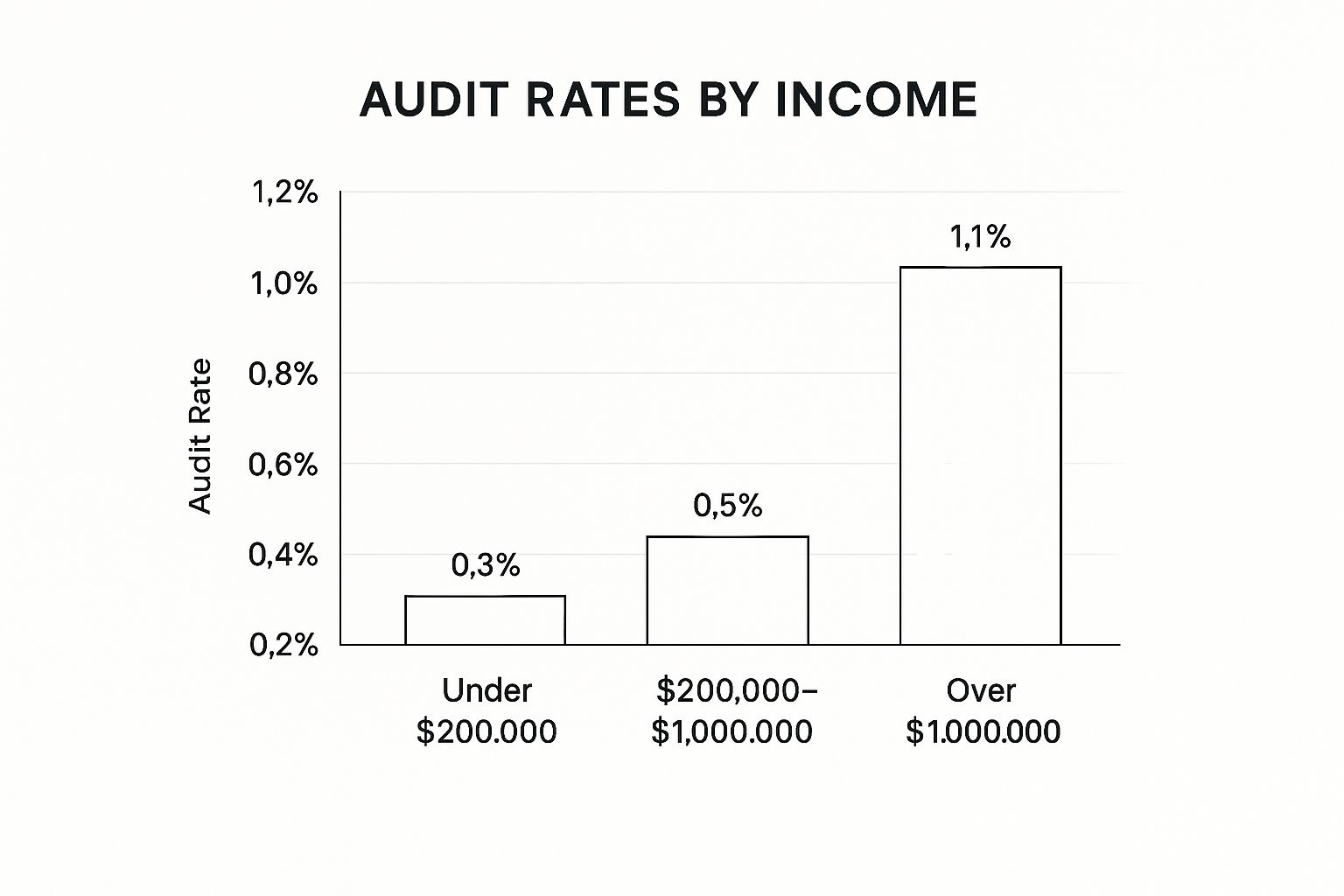
As you can see, the data is pretty stark. Crossing that million-dollar income threshold more than doubles your audit risk compared to someone earning between $200,000 and $1,000,000.
The Focus On High Earners
A closer look at the IRS's own data reveals a clear enforcement strategy. The agency is intensely focused on high-income filers.
The table below breaks down the audit rates by Total Positive Income (TPI) from a recent tax year, showing just how much the odds change as income rises.
IRS Audit Rates by Income Level
| Income Bracket (Total Positive Income) | Audit Coverage Rate (%) |
|---|---|
| $25,000 to $200,000 | 0.1% |
| $200,000 to $500,000 | 0.2% |
| $500,000 to $1,000,000 | 0.4% |
| $1,000,000 to $5,000,000 | 1.6% |
| $5,000,000 to $10,000,000 | 4.6% |
| $10,000,000 or more | 11.0% |
The trend is undeniable. While the audit rate for those with TPI between $1 million and $5 million was 1.6%, it skyrockets to a staggering 11.0% for taxpayers reporting $10 million or more. You can dig deeper into these figures by reviewing the compliance statistics published by the IRS.
The bottom line is simple: The more you earn, the more likely the IRS is to double-check your numbers. This isn't a reason to panic, but it's a powerful reminder of why meticulous record-keeping and professional tax advice become absolutely essential as your income grows.
The Biggest Red Flags That Can Trigger an IRS Audit

It helps to think of the IRS as a giant data-crunching machine. Its main job is to run algorithms that hunt for anomalies—tax returns that just don't fit the established patterns. While your overall chances of getting audited by the IRS are pretty slim, certain things can make your return stick out like a sore thumb.
The system isn't personal; it's all about the math. It’s constantly comparing your income, deductions, and credits against millions of other returns to spot the outliers. Knowing what trips those digital wires is your first line of defense in filing a return that blends in for all the right reasons.
Discrepancies Between Reported Income and Third-Party Forms
This is probably the most common and easily avoidable red flag out there. The IRS gets a copy of every W-2, 1099-NEC, 1099-K, and 1099-INT you receive. Its automated system then plays a simple game of matching—checking those forms against the income you reported.
If the numbers don't line up, your return gets flagged. Instantly. Even a tiny, forgotten 1099 from a small freelance gig can trigger an IRS notice. It's not an accusation of fraud, just a computer flagging a mismatch that needs to be sorted out.
Claiming Unusually Large Deductions
Taking big deductions isn't automatically a problem, but it definitely invites a closer look. The IRS has a mountain of data on what’s considered a "normal" amount for things like charitable donations, medical bills, or business expenses for someone at your income level.
For example, if you make $80,000 a year and claim $40,000 in charitable giving, the system is going to notice. That's a huge outlier that begs for verification. The same goes for claiming 100% business use of your car or exceptionally high home office expenses.
The key thing to remember is that your deductions need to be both legitimate and proportional. The IRS isn’t saying you can’t claim them; it's saying extraordinary claims require extraordinary proof.
For a deeper dive into the most common triggers, check out our guide on https://alliedtax.com/irs-tax-audits-what-triggers-an-audit-and-how-to-prepare/. This resource can give you more specific insights to help keep your tax filings clean.
Reporting Consistent Business Losses
Running a business is hard, and losses are part of the game. But when you report a loss on your Schedule C for several years in a row, the IRS starts to get suspicious. They might begin to wonder if your "business" is actually just a hobby.
A real business is run with the goal of making a profit. If your venture consistently bleeds money, the IRS may question whether you're just writing off personal expenses from a hobby, like photography or raising horses.
Other major red flags that will almost certainly increase scrutiny include:
- Misclassifying Employees as Independent Contractors: The IRS is always on the lookout for businesses trying to dodge payroll taxes by misclassifying their workers.
- Dealing in Cryptocurrency: With the IRS still getting its arms around crypto, any mistakes or omissions in reporting your transactions are high-risk.
- High Cash Transactions: Businesses that handle a lot of cash, like restaurants, car washes, or laundromats, are naturally watched more closely because of the temptation to underreport income.
On top of all this, having financial ties to jurisdictions associated with tax avoidance can dramatically increase your audit risk. These international dealings add a whole other layer of complexity and potential scrutiny from the tax man.
Why High Income Dramatically Increases Your Audit Risk
It's easy to assume that a bigger income just means a bigger tax bill. But in reality, it fundamentally changes your relationship with the IRS. As your earnings climb, you’re no longer just another face in the crowd of millions of filers; you become a strategic priority. This isn't personal—it's pure economics.
Think about it from the IRS's perspective. They have a limited budget and a limited number of agents. Auditing a straightforward W-2 return might, at best, claw back a few hundred dollars. But auditing a complex, high-income return? One with investments, business interests, and a maze of deductions? That could potentially uncover tens, or even hundreds, of thousands of dollars in unpaid taxes. The choice is obvious: go where the money is.
A Matter of Strategic Focus
This focus on high-earners isn't random; it's a deliberate and calculated strategy. The sheer complexity of their finances creates more room for honest mistakes, aggressive tax planning, or even outright evasion. For the IRS, assigning an agent to a multi-million-dollar return is simply a much better use of their time than sifting through thousands of simpler ones.
This strategic shift is only getting more intense. While overall audit rates have been historically low, the IRS is now doubling down on its scrutiny of wealthy individuals and large corporations. To give you an idea, people earning over $10 million had an audit rate of about 11% in 2019. That number is projected to jump to around 16.5% by 2026. You can get more details on this enforcement trend and see who is likely to be targeted by the IRS.
The Different Levels of Scrutiny
As your income grows, the type of audit you might face gets more serious, too. The higher the financial stakes, the more thorough the examination.
- Correspondence Audits: These are the most common and least intimidating. It’s usually just a letter asking for proof to back up a specific deduction or credit you claimed.
- Office Audits: This is a step up. You'll have to go to an IRS office and sit down with an agent to go over your records in person.
- Field Audits: This is the big one. An IRS agent comes to your home or business to conduct a full-blown, deep-dive examination of your financial records.
High-income returns are far more likely to be flagged for the more intensive office or field audits. The IRS knows these complex financial situations often have issues that a simple letter can't resolve.
At the end of the day, as your income grows, your chances of getting audited by the IRS go up because your financial profile is a much more valuable target. This reality highlights a crucial point: for high-earners, meticulous record-keeping and professional tax help aren't just good habits—they're your essential lines of defense. The more complex your finances become, the stronger your documentation needs to be to stand up to that potential scrutiny.
What an IRS Audit Actually Looks Like

The word "audit" is enough to make anyone nervous, often conjuring images of stern-faced agents knocking on your door. But in reality, an IRS audit is rarely that dramatic. Most are far less intimidating than you might think.
Let’s be clear: your overall chances of getting audited by the IRS are pretty slim. The odds of a stressful, in-person examination are even lower. The vast majority of audits are simple inquiries handled entirely through the mail, often just to double-check a single item on your return. Knowing the three main types can help turn that fear into preparedness.
Correspondence Audits: The Mail Inquiry
This is by far the most common type of audit, making up over 70% of all IRS examinations. A correspondence audit is exactly what it sounds like—an audit handled entirely through the mail. It's the least invasive form of review.
Think of it as the IRS sending you a "please explain" note. You'll get an official letter asking for documents to verify a specific line item, like proof of a large charitable donation you claimed or receipts for medical expenses.
The scope is laser-focused on one or two things, not your entire financial life. All you need to do is mail back clear, organized copies of the requested documents by the deadline.
Office Audits: The In-Person Meeting
One step up from a mail inquiry is the office audit. This is where you, or more often your tax pro, will need to visit a local IRS office to sit down with an auditor. While it feels more serious, it’s still a very structured and targeted process.
Office audits usually happen when the issues are a bit too complex for a simple letter but don't require a full-blown investigation.
What might trigger an office audit?
- Small business income and expenses that need a more detailed explanation.
- Rental property finances that have some gray areas.
- Potential unreported income from freelance gigs or investments.
The auditor will stick to specific items they want to discuss. The key here is organization. Show up with all your documentation neatly arranged, and you’ll make the process much smoother.
An IRS notice doesn’t automatically mean you’ve done something wrong. Often, it's just the system flagging a discrepancy or a random selection. The best approach is to respond calmly, professionally, and with well-organized records.
Field Audits: The Comprehensive Review
Finally, we have the field audit. This is the most comprehensive and serious type of examination—and the one that matches the Hollywood stereotype. An IRS agent will come to your home, business, or accountant's office to conduct a deep dive into your books.
Field audits are quite rare. They're typically reserved for complex tax situations, usually involving businesses or high-income individuals with intricate financial dealings. Unlike the other types, a field audit is broad. The agent can look into just about any aspect of your return, and the process can stretch on for a while.
For this kind of audit, having professional representation isn't just a good idea; it's essential.
Practical Steps to Lower Your Audit Risk
Knowing what flags an audit is half the battle. The other half is taking practical steps to stay off the IRS's radar. Think of it less as a stressful chore and more like preventative maintenance for your financial life. A few solid habits can make tax time feel routine instead of risky.
The most powerful habit you can build? Meticulous record-keeping. Every single deduction you claim, especially for things like business meals, travel, or your home office, absolutely needs a paper trail. If you claim a $500 deduction for business supplies, you better have the receipts to back it up. Without proof, a deduction is just a guess.
Maintain Spotless and Organized Records
Good records are your best defense in an audit. This doesn't mean stuffing a year's worth of receipts into a shoebox and hoping for the best. It means having a system that's organized and easy to navigate when you need it.
- Go Digital: Use software like QuickBooks or even simple receipt-scanning apps. They can help categorize your expenses as you go, creating a clean digital trail that's easy to search.
- Separate Business and Personal: This is non-negotiable. Open a dedicated bank account and get a separate credit card for all your business income and spending. This one move makes tracking your business finances infinitely simpler.
- Document the Details: For big-ticket deductions like the business use of your car, you need a detailed mileage log. For charitable giving, make sure you have the official acknowledgment letters from the non-profits.
Keeping your records straight not only prepares you for a potential audit but often helps you find more legitimate deductions you might have missed. It’s a true win-win.
Double-Check Your Income Reporting
One of the quickest ways to trigger an IRS letter is to report income that doesn't match the W-2s and 1099s they already have on file for you. Their computer systems are designed specifically to catch these mismatches, and they do it almost instantly.
Before you even think about filing, make sure you have every single income document in hand—including that small 1099-NEC from a one-off freelance gig you did last spring. Carefully compare the totals on those forms to what you've entered on your tax return. If there's a discrepancy, you're raising a red flag for no reason.
Think of it like this: The IRS has a master list with all your reported income. Your job is to submit a tax return that is an exact mirror of that list. Any difference is going to raise questions.
Part of this process also involves keeping your personal information safe from fraudsters who could file a return in your name. You can learn more about protecting your data by reading our guide on how to secure your identity with the IRS Identity Protection PIN.
Leverage Professional Help
DIY tax software is fantastic for straightforward returns, but as your finances get more complicated, its value starts to drop. A seasoned tax professional isn't just a form-filler; they're a critical second set of eyes on your entire financial picture.
An expert can spot deductions you didn't know you could take, flag claims that look unusually high for your industry, and make sure your return tells a consistent, logical story. They live and breathe the tax code and can often suggest strategies to avoid a tax audit you wouldn't have considered. Investing in professional guidance is often the smartest money you can spend to lower your audit risk.
How Long Does the IRS Have to Audit Your Tax Return?

One of the biggest anxieties after hitting "submit" on your taxes is that lingering question: how long do I have to worry about this? Thankfully, the IRS doesn't have forever to decide if they want to take a closer look at your return. This time limit is called the statute of limitations.
For the vast majority of people, the rule is pretty simple. The IRS generally has three years to initiate an audit, starting from the date you filed or the official tax deadline, whichever came later. Once those three years are up for a specific tax year, you can usually consider that file closed.
This is why it’s so critical to keep your tax records organized for at least three years after filing. It's also good to know that if you find a mistake, there's a related timeline for making corrections. You can learn more about how far back you can amend taxes here.
When the Audit Clock Ticks a Little Longer
But that three-year window isn't set in stone. Certain red flags can give the IRS a lot more time to dig into your finances. The biggest one is what the tax code calls a "substantial understatement of income."
What does that mean in plain English? It means you left off more than 25% of your gross income from your return.
If the IRS determines you substantially understated your income, the statute of limitations doubles. That gives them six years to audit you, not three. This much longer look-back period means more potential for back taxes, interest, and steep penalties.
The IRS takes this seriously. In FY 2024 alone, the agency's audits resulted in billions of dollars in additional tax assessments. This highlights just how important it is to stay off their radar by reporting everything correctly.
And in a few cases, the clock never stops ticking at all. The statute of limitations disappears entirely under a couple of circumstances:
- Filing a Fraudulent Return: If the IRS can prove you filed with the intent to cheat on your taxes, there is no time limit. They can come knocking anytime.
- Failure to File: If you simply don't file a return for a given year, the audit window for that year stays open forever.
Understanding these timelines is key. It’s not just about filing on time; it's about filing an accurate, honest return to keep your chances of getting audited by the IRS as low as possible and having the records to back it up for years to come.
Answering Your Top IRS Audit Questions
Let's clear the air. When it comes to IRS audits, a few persistent myths and nagging questions seem to cause the most stress. Getting straight answers to these common worries can make a world of difference, helping you file your taxes with a lot more confidence.
Does Filing An Extension Make an Audit More Likely?
This is probably one of the biggest misconceptions out there. The short answer is no, not at all.
Filing an extension is a completely normal part of the tax process. The IRS sees it as you taking the necessary time to get your return right. Think about it from their perspective: they’d much rather receive an accurate, well-prepared return in October than a sloppy, error-riddled one rushed to meet the April deadline. Those rushed mistakes are what actually get you noticed, not the extension itself.
Will Hiring a Tax Pro Help Me Avoid an Audit?
Hiring a professional isn't a magic shield, but it absolutely lowers your risk in a big way. A good CPA or enrolled agent lives and breathes the tax code. They know precisely what raises red flags and what’s considered normal for someone in your financial situation or industry.
Their real value is in making sure your return tells a coherent story. They check that your deductions are reasonable for your stated income and that you haven't made any of the simple math or data entry errors that often trigger an initial review.
The best thing a pro does is ensure your return just makes sense. It aligns your income with deductions that are logical for your line of work, which is something the IRS computers are specifically looking for.
And what if you do get audited and find out you owe money you can't pay right away? Don't panic. The IRS is surprisingly flexible and has programs like installment agreements to help you manage the debt over time.
Navigating the complexities of the IRS can feel overwhelming, but it's not a journey you have to take by yourself. The team at Allied Tax Advisors provides expert guidance on everything from your yearly tax filings to representing you in an audit, making sure your financial path is as smooth as possible. You can learn more about how we can help at https://alliedtax.com.