
The claim of right doctrine is one of those tax rules that can feel incredibly unfair at first glance. It dictates that if you receive income and have unrestricted access to it, you owe tax on it for that year. This is true even if there's a chance you might have to give the money back later.
What the Claim of Right Doctrine Means for You
Imagine this: you get a fantastic $25,000 year-end bonus. You deposit the check, maybe pay down some debt or put it toward a down payment, and you dutifully report it on your tax return. Then, months later, your employer calls—there was a payroll error, and you need to repay $5,000.

This is the claim of right doctrine in a nutshell. Because you received that $25,000 without any strings attached at the time, the IRS sees it as your income for that year. The fact that you had to repay part of it later is a separate tax event.
The key word here is control. If money hits your bank account and you're free to do what you want with it, it's taxable income. Any future dispute or obligation to repay doesn't change what happened in that initial year.
The "Pay Now, Fix It Later" Rule
You can think of this as a "pay now, fix it later" system for taxes. It's built on a foundational principle that keeps the U.S. tax system running predictably from year to year. The rule prevents a situation where taxpayers could delay paying taxes by simply claiming that some of their income might be contested in the future.
This isn't some new-fangled regulation. The concept was cemented in the 1932 Supreme Court case North American Oil Consolidated v. Burnet. The court decided that when a taxpayer receives money under a "claim of right" and without restriction, it's income for that year, period. Any later repayment is a problem for a future tax return.
Who Does This Affect?
While the bonus example is common, this doctrine can catch all sorts of people by surprise. It creates a timing issue where you pay tax on money you don't ultimately get to keep.
This isn't just about W-2 employees. Consider these real-world scenarios:
- Business Owners who receive a hefty advance for a project, only for the client to cancel it months later.
- Landlords who collect a large lease termination fee that gets tied up in a lawsuit the following year.
- Freelancers who get paid for a big gig, but the client disputes the work and claws back part of the payment after the tax year has closed.
The immediate headache is paying tax on phantom income. It might seem unfair, but don't worry—the tax code does offer a way to make things right. We'll get into the solution, but first, you have to understand this core rule.
How Disputed Income Impacts Your Tax Bill
The real headache with the claim of right doctrine isn't just the legal theory—it's the very real, and often painful, hit to your bank account. When you receive money that’s later disputed, the IRS essentially says, "You had it, you pay tax on it." This "pay now, figure it out later" approach can create a major tax bill and serious cash flow problems, all for money you didn't even get to keep.
Imagine you're a salesperson who landed a huge deal and earned a $20,000 commission in December. You report it on your tax return and pay what you owe. But in April of the next year, the client backs out, and your company claws back the entire commission. Under the claim of right doctrine, you still owed tax on that $20,000 for the year you received it, even though it was later yanked away.

Paying tax on phantom income feels incredibly unfair, and the financial strain is immediate. The fundamental problem is a timing mismatch: your tax liability is locked in for the year you got the cash, but your chance to get that tax money back doesn't come until a future year.
It's Not Just About Employee Bonuses
This tax trap isn't limited to commissions. It can pop up in all sorts of situations for small businesses and investors, too. The principle is always the same: if you receive funds and have an unrestricted right to use them, the IRS considers it taxable income right then and there.
Here are a few other ways this can play out:
- A Business Retainer: Your marketing agency gets a $50,000 upfront retainer for a new year-long project. Six months in, the client cancels and the contract requires you to refund $25,000. Unfortunately, you still have to report the full $50,000 as income in the year you received it.
- An Investor Clawback: You invest in a private equity fund and receive a $100,000 profit distribution. A year later, the fund discovers a valuation error and issues a "clawback," forcing you to return $30,000. The entire initial $100,000 distribution is taxable in the year you got it.
In both of these scenarios, you're left holding a tax bill for income that vaporized. This can throw a major wrench in your business operations, personal budget, or investment strategy. Worse, a large one-time payment can easily push you into a higher tax bracket, making the tax bite even more severe.
The core idea of the claim of right doctrine is that if you have unrestricted access to funds, you must pay tax on them in the year of receipt. Relief for having to repay that money only comes in a later tax year.
This can be especially frustrating if the first time you learn about the discrepancy is from an official IRS notice. If you find yourself in that boat, our guide on what to do if you receive an IRS CP2000 notice can help you figure out the next steps.
So, the problem is clear: you've paid tax on money you had to give back. Now, let’s look at how the tax code provides a way to make things right.
Where the Claim of Right Doctrine Shows Up in Real Life
Theory is one thing, but this tax rule really hits home when you see it in action. The claim of right doctrine isn't some obscure corner of the tax code; it pops up in surprisingly common situations for employees, business owners, and investors.
Let's walk through a few real-world examples. In each case, you'll see the same pattern: someone gets paid, believes the money is theirs, pays tax on it, and then later finds out they have to give it back.
Scenario 1: The Clawed-Back Sales Commission
A classic situation we see all the time involves sales commissions. Imagine Sarah, a star salesperson at a software firm. In November of Year 1, she lands a huge deal and gets a $40,000 commission. The money hits her bank account, and she reports it on her Year 1 tax return like any other income.
Fast forward to March of Year 2. The client she signed goes out of business and defaults on their contract. Sarah's employment agreement has a clawback clause, and her employer demands she repay the full $40,000.
So what happens now? Sarah can't just amend her Year 1 tax return. As far as the IRS is concerned, she had unrestricted access to that money in Year 1, so it was correctly taxed then. Her only option is to address the repayment on her Year 2 tax return, either as a deduction or a special tax credit.
Scenario 2: The Upfront Payment for a Canceled Project
Now let's look at a small business owner. Mark runs a web design agency. A client pays him a $75,000 upfront fee in December of Year 1 for a major project. Mark's business is on the accrual basis, but even for cash-basis businesses, this fee is recorded as revenue for Year 1.
The project kicks off, but in February of Year 2, the client gets new management and abruptly cancels everything. Their contract requires Mark to refund $50,000.
This is a crucial takeaway for any business: when a client pays you upfront, that money is generally considered income in the year you receive it, even if you haven't done all the work yet. A later refund is a brand-new tax event.
Just like Sarah, Mark's agency can't go back and edit its Year 1 return. The $75,000 was income under a claim of right. The $50,000 repayment becomes a deductible business expense (or gets special tax treatment) on the business's Year 2 return.
Scenario 3: The Real Estate Investor's Returned Fee
This doctrine isn't just for W-2 employees or service businesses. Consider Maria, a real estate investor who owns a commercial building. In Year 1, a tenant pays her a $25,000 fee to terminate their lease early. She receives the cash and reports it as rental income.
The story doesn't end there. In Year 2, the ex-tenant sues her, arguing the fee was excessive. After a legal battle, a court orders Maria to refund $15,000.
It's the same story, different context:
- Year 1: She received $25,000 without any strings attached and paid tax on it.
- Year 2: She was legally forced to repay $15,000 of that money.
- Tax Solution: Her tax relief for the repayment has to be claimed on her Year 2 return.
Scenario 4: The Reversed Crypto Airdrop
Even the fast-moving world of digital assets isn't immune. Alex, a crypto investor, receives an airdrop of 1,000 new tokens in his wallet during Year 1. At that moment, they're worth $5 each, giving him $5,000 in taxable income, which he properly reports.
A few months into Year 2, the project's developers find a critical bug. To fix it, they execute a "network rollback" that reverses the initial airdrop transaction. The 1,000 tokens simply vanish from Alex's wallet.
Even though the transaction was undone, Alex had control over those tokens in Year 1. The $5,000 was income under the claim of right doctrine. His tax remedy for the loss of those assets must be handled on his Year 2 return, most likely using the special repayment rules we'll cover next.
These examples illustrate just how broad the doctrine's reach can be. To help you visualize this, the table below breaks down how these scenarios play out for different types of taxpayers.
Claim of Right Scenarios Across Different Taxpayers
| Taxpayer Type | Income Scenario | Year 1 Action (Receipt) | Potential Future Event |
|---|---|---|---|
| Employee | Receives a year-end bonus or commission. | Reports the full amount as wages on their Form W-2. | Company has a bad year; bonus is clawed back. |
| Business Owner | Receives an advance payment for services. | Reports the payment as revenue on their Schedule C. | Client disputes the work and demands a partial refund. |
| Investor | Sells stock and receives proceeds. | Reports capital gains on their Schedule D. | A lawsuit reveals the sale was based on fraud; must return proceeds. |
| Landlord | Collects a non-refundable security deposit or fee. | Reports the amount as rental income on Schedule E. | A court later rules the fee was illegal and orders a refund. |
| Crypto User | Receives staked rewards or airdropped tokens. | Reports the value as "Other Income" on their return. | The protocol is exploited; rewards are reversed or lost. |
As you can see, the core issue remains the same regardless of the taxpayer or the source of income. The key is recognizing that the initial receipt and the subsequent repayment are two separate tax events that happen in two different years.
How Section 1341 Provides Tax Relief
After seeing how the claim of right doctrine can create a real financial sting, you’re probably wondering if there’s any way to make things right. Thankfully, there is. The IRS isn't completely heartless; they created a specific remedy for this exact situation called Internal Revenue Code (IRC) Section 1341.
This rule is the government's official answer to the unfairness of paying tax on money you later had to return. It essentially acknowledges the timing mismatch and gives you a way to recover the taxes you overpaid.
Do You Qualify for This Special Relief?
Before you can use this powerful tool, you have to meet a key requirement. This special relief isn't for small amounts. To qualify for a Section 1341 claim, the amount of income you repaid in a single tax year must be more than $3,000.
If your repayment is $3,000 or less, Section 1341 is off the table. You simply take a miscellaneous itemized deduction on Schedule A for the amount you gave back. Depending on your other deductions and income level, this might not provide much of a tax benefit.
But if your repayment crosses that $3,000 threshold, a much better strategic opportunity opens up.
The Two Powerful Choices Under Section 1341
Once you confirm your repayment was over $3,000, Section 1341 gives you two distinct options for getting your money back. The best part? You get to calculate your tax both ways and choose whichever method saves you more money. This turns a tax headache into a strategic decision.
Here are the two methods:
Deduct the Repayment in the Current Year: The first, more straightforward option is to deduct the amount you repaid on the tax return for the year you made the repayment. For example, if you repaid $10,000 in 2026 that you had originally received in 2024, you would claim a $10,000 deduction on your 2026 tax return.
Claim a Tax Credit Based on the Prior Year's Tax: The second option is more complex but often far more valuable. You recalculate your tax liability for the year you received the income, but this time you exclude the amount you later repaid. The difference between the tax you actually paid and this new, lower tax amount becomes a credit on your current-year return.
Let's break that second option down. Using our example, you’d pull out your 2024 tax return. You'd figure out how much tax you would have paid if you had never received that $10,000 in the first place. The difference—the amount of tax you overpaid back in 2024—can be claimed as a direct dollar-for-dollar credit on your 2026 return.
The choice is yours: You are not locked into one method. The law explicitly allows you to compute your tax under both scenarios and pick the one that results in a lower tax bill for the current year.
This is a critical point. A deduction reduces your taxable income, while a credit directly reduces your tax bill. Depending on your tax bracket in both years, one method could be significantly better. If your tax rate was higher in the year you received the income, the credit method is almost always the winner.
The process can get complicated and may require a careful review of your tax history. Sometimes, an unwelcome Notice of Deficiency from the IRS is the very event that brings this issue to light.
Claiming Your Credit or Deduction Step by Step
Alright, let's get down to brass tacks. You understand the theory behind Section 1341 relief, but how do you actually put that money back in your pocket? Filing the right forms can seem daunting, but it's a straightforward process once you know the steps. Think of this as your game plan for getting back the tax you overpaid under the claim of right doctrine.
First things first, remember the magic number: your repayment must be more than $3,000. If it’s less, your only option is a standard itemized deduction on Schedule A. But if you've repaid more than that, you now have a strategic choice to make, one that could significantly impact your refund.
Deciding Between the Deduction and the Credit
Your first job is to run the numbers both ways to see which path saves you the most money. This is the single most important step. The tax code actually gives you the power to pick the better outcome for your situation.
- Calculate Your Tax with the Deduction: Start by preparing a draft of your current-year tax return. Include the full repayment amount as a deduction. If the money you paid back was originally wages, it's usually an itemized deduction on Schedule A. If it was from your business, it’s a business expense on Schedule C. See what your final tax bill looks like.
- Calculate Your Tax with the Credit: Now, start over with a fresh draft of your current-year return, but this time, don't take the deduction. Instead, find your tax return from the year you originally reported the income. Rework the math on that old return as if you never received the income you just paid back. The difference in tax is your credit for this year.
Compare the results from both scenarios. Which one leaves you owing less tax for the current year? That's the one you go with. It's as simple as that.
This flowchart lays out the decision-making process for getting relief under Section 1341.
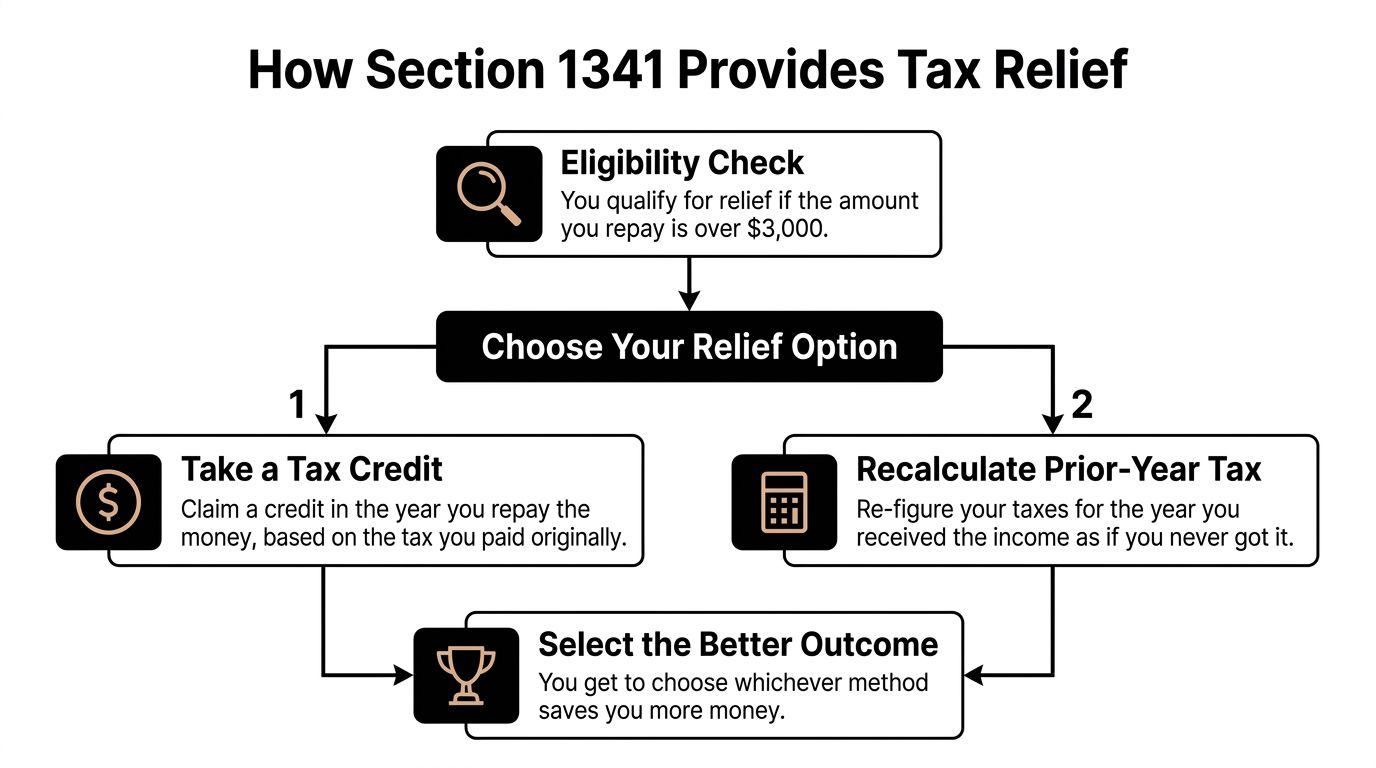
The real takeaway here is that you get to choose. The IRS gives you the flexibility to select the method that maximizes your financial recovery.
Where to Report on Your Tax Forms
Knowing which option is better is half the battle; the other is putting the numbers in the right boxes on your Form 1040. Here’s a quick guide:
- The Deduction Method: If the income you repaid wasn't from a business (like a salary or bonus), you'll claim it as a miscellaneous itemized deduction. This goes on Schedule A (Form 1040), Line 16, for Other Itemized Deductions. Be sure to write "Claim of Right" or "IRC 1341" in the space provided.
- The Credit Method: If the credit gives you a better result, you report it on Schedule 3 (Form 1040), Line 13d, under "Other Credits and Payments." You have to write "IRC 1341" on the dotted line next to the box.
One crucial point: you do all of this on the tax return for the year you repaid the money. You never go back to change a past return for this. If you need a refresher on the difference, check out our guide on how to file an amended tax return.
Last but not least, your records are everything. You absolutely must keep proof of both the original income and the repayment. This means holding onto pay stubs, W-2s, bank statements, legal agreements, and canceled checks. Having your documentation in order will make any potential questions from the IRS a quick and painless affair.
Proactive Planning to Minimize Tax Headaches
You can't always avoid the claim of right doctrine, but with some smart planning, you can definitely take the sting out of it. The idea is to get ahead of potential problems instead of just reacting to them. This turns a confusing tax rule into a manageable part of your financial life.
It's all about anticipating disputes before they happen and structuring your agreements to protect your cash flow. If you know a repayment might be on the horizon, you'll be in a much better position to handle it without a major financial shock.
Strategies for Businesses and Individuals
For small business owners, this starts with the contracts you write and the payment terms you offer. For individuals, it's about paying close attention to the fine print in employment agreements, especially when large bonuses or commissions are involved.
Structure Your Contracts Carefully: If your business gets big payments upfront, try to break them down. Tying payments to specific project milestones means you receive less income under a claim of right before the work is fully signed off on.
Clarify Bonus and Commission Terms: As an employee, make sure you understand exactly when and why a bonus could be clawed back. If the terms in your compensation plan are fuzzy, get clarification in writing. It’s that simple.
Establish a "Repayment Fund": When you receive a large sum that feels even a little uncertain, it's a good practice to set aside some of the after-tax money in a separate savings account. Think of it as your own personal buffer, ensuring you can cover a repayment without having to scramble for cash.
A little forethought can save you a massive tax surprise down the road.
Know When to Get Professional Help
Good planning also means knowing your limits. The second you're asked to repay more than $3,000, it's time to call a tax professional. They can run the numbers to figure out whether taking a deduction or claiming a Section 1341 credit will save you more money.
A tax advisor can analyze your complete tax picture—from the year you got the money to the year you paid it back—to lock in the best strategy. You don't want to leave money on the table.
This is especially critical in complex situations involving business revenue or investment gains. For instance, to properly handle repayments on rental income, you need to be familiar with all the relevant landlord tax write-offs and other specific rules. A professional will make sure your claim is not only maximized but also audit-proof.
Ultimately, navigating the claim of right doctrine is about control. You can’t control a client who backs out of a project or an employer who miscalculates your bonus. But you can absolutely control how you prepare for those possibilities. With clear documentation, smart planning, and expert help when you need it, you can protect your finances and turn a potential tax nightmare into a non-issue.
Frequently Asked Questions
When you have to repay income you've already paid taxes on, a lot of questions come up. Let's walk through some of the most common ones we hear from clients navigating the claim of right doctrine and its solution, Section 1341.
Can I Just Amend My Prior Year Tax Return?
That’s a great question, and it's probably the most common point of confusion. The short answer is no, you can't.
Think of it this way: the IRS views receiving the income and later repaying it as two distinct events in separate tax years. When you first received the money, you had an unrestricted right to it, so reporting it then was correct. The repayment is a brand-new tax event that you deal with on the tax return for the year you actually gave the money back.
What if I Repay the Money Over Several Years?
If you're repaying a large sum in installments over a few years, you'll need to handle the tax implications for each payment in the year it's made.
For example, say you repay $10,000 in 2026 and another $10,000 in 2027. You would address the first repayment on your 2026 tax return and the second on your 2027 return. Each year stands on its own.
It's crucial to remember the $3,000 threshold applies to the total amount repaid within a single tax year. A repayment of $2,500 in one year and $2,500 the next wouldn't qualify for Section 1341 relief in either year, even though the total adds up to $5,000.
Is the Section 1341 Credit Always the Better Option?
It's a common assumption, but no, not always—though it often is. The credit is usually the winner if your tax rate was higher in the year you originally received the income. A higher tax bracket back then means you get a bigger dollar-for-dollar credit now.
On the other hand, if your income (and tax bracket) is much higher in the current repayment year, taking the deduction might save you more. The only way to know for sure is to run the numbers both ways. Calculate your total tax liability with the deduction and then with the credit, and go with whichever one results in a lower tax bill.
Do I Have to Repay the Exact Item of Income?
Yes, absolutely. For Section 1341 to apply, there has to be a direct, traceable link between the income you received and the amount you're now repaying.
A recent Tax Court case, Smith v. Commissioner, really drives this home. A taxpayer had received Social Security disability benefits, but it was later determined he wasn't entitled to them and had to pay them back. The court confirmed that his relief was only available in the year he made the repayment, highlighting two key principles:
- You must have had an "apparent" and unrestricted right to the money when you got it.
- You are later obligated to repay those same funds because it turned out you didn't have a final right to them after all.
That direct connection is the foundation of a valid claim.