
A San Diego landowner usually doesn't wake up thinking about conservation easement tax benefits. Then a broker, a land trust, or a neighboring owner starts talking about permanent restrictions, charitable deductions, estate planning, and maybe a property-tax break, and suddenly the question gets real. If you own coastal acreage, inland agricultural land, or a parcel that's been in the family for years, the decision is rarely about ideology. It's about whether the tax result is strong enough to justify giving up future development value and living with the paperwork that comes with it.
That's the part most glossy explainers skip. The headline deduction gets all the attention, but the effective planning happens in the gap between the appraisal, the AGI cap, the carryforward, and the state and county rules that can make the economics better or worse than you expected. If you're sitting on land in or around San Diego and trying to decide whether an easement is a smart move, the first question isn't whether conservation is good in the abstract. It's whether the tax structure fits your income, your entity setup, and your long-term family goals.
Table of Contents
- A Landowner at a Crossroads in San Diego
- What Makes an Easement a Qualified Conservation Contribution
- Appraisals and IRS Form 8283 Done Right
- How the Deduction Amount Is Calculated
- Common Pitfalls and IRS Audit Triggers
- California Tax Credits and San Diego Property-Tax Effects
- A Worked Example for a San Diego Landowner
- Practical Next Steps With Allied Tax Advisors
A Landowner at a Crossroads in San Diego
A ranch owner in East County gets a call. A land trust is interested in a conservation easement, and the pitch sounds appealing, preserve the land, get a tax deduction, maybe trim the estate-tax burden for the kids. That's the conversation point where most owners nod politely and then start asking the same four questions in private.
How much can I deduct? When does the benefit show up? What will the IRS want to see if I'm audited? And if I'm in California, does the state or county layer anything on top of the federal rules?
Those questions are the right ones. The federal system gives you a real tax tool, but it doesn't give you a free pass. A qualified conservation easement can reduce estate-tax exposure by letting heirs exclude up to 40% of the encumbered land's value from the taxable estate, subject to a $500,000 cap, with a lower cap if the easement reduced land value by less than 30% when donated, according to the Land Trust Alliance's summary of the federal estate-tax incentive (Land Trust Alliance). On the income-tax side, the deduction can be large, but it's still governed by AGI limits and documentation rules that catch sloppy planning fast.
Practical rule: if the easement only works on paper because someone assumed the tax deduction would cover everything, the deal is probably not ready.
That's why the rest of the decision turns on more than the land itself. The deed has to be drafted right, the appraisal has to survive scrutiny, and the owner's income profile has to match the deduction timing. For some families, the easement is a clean fit. For others, the restriction makes sense, but the tax timing is wrong, which means the deal is expensive to force.
If you're a San Diego owner looking at this for the first time, treat the tax benefit as part of the price, not a bonus. That mindset saves people from signing documents they don't fully understand.
What Makes an Easement a Qualified Conservation Contribution
A generic land-use restriction is not enough. Federal law only rewards a transfer that meets the requirements of a qualified conservation contribution under IRC §170(h), and each piece matters. If any one of the statutory tests fails, the deduction is at risk.
The four tests that matter
First, the easement has to be given to a qualified organization, usually a land trust or a governmental body that can hold and enforce the restriction. Second, the donor has to give up a qualified real property interest, which is the easement interest itself or another eligible property interest. Third, the restriction has to be perpetual, meaning the land keeps the promise forever, not just for a few decades. Fourth, the donation has to serve a recognized conservation purpose, such as protecting open space, preserving habitat, or conserving land for certain public benefits.
That checklist sounds technical, but the logic is simple. The IRS wants to see that the landowner gave away a real property right, permanently, for a real conservation purpose, and handed enforcement to a body that can effectively police it. If the deed leaves too much flexibility for the donor, or if the organization lacks enforcement authority, the tax benefit gets shaky.
For owners comparing easements with other charitable land restrictions, the distinction matters. A historic façade easement is not the same thing as a conservation easement. The tax rules overlap in the broad charitable-contribution framework, but the conservation rules are tied to land, permanence, and conservation purpose. A ranch, farm, coastal bluff, watershed parcel, or open-space tract is the classic candidate, not a property where the restriction is really just cosmetic.
A useful outside reference is Unitism's guide to habitat conservation plans, which helps readers separate land protection goals from the tax mechanics. That distinction is important because the IRS cares about both the conservation story and the legal form of the transfer.
The easement is a promise the land keeps forever. If the deed doesn't say that in substance, the deduction usually won't last either.
For a practical planning lens, the owner should ask one blunt question. Would this property still qualify if nobody cared about the tax deduction? If the conservation facts are weak without the tax angle, the deal deserves a hard second look.
For donors trying to coordinate the timing of the deduction with future income, the carryforward discussion in Allied Tax Advisors' charitable contributions carryover guide is worth reading after the legal basics are clear.
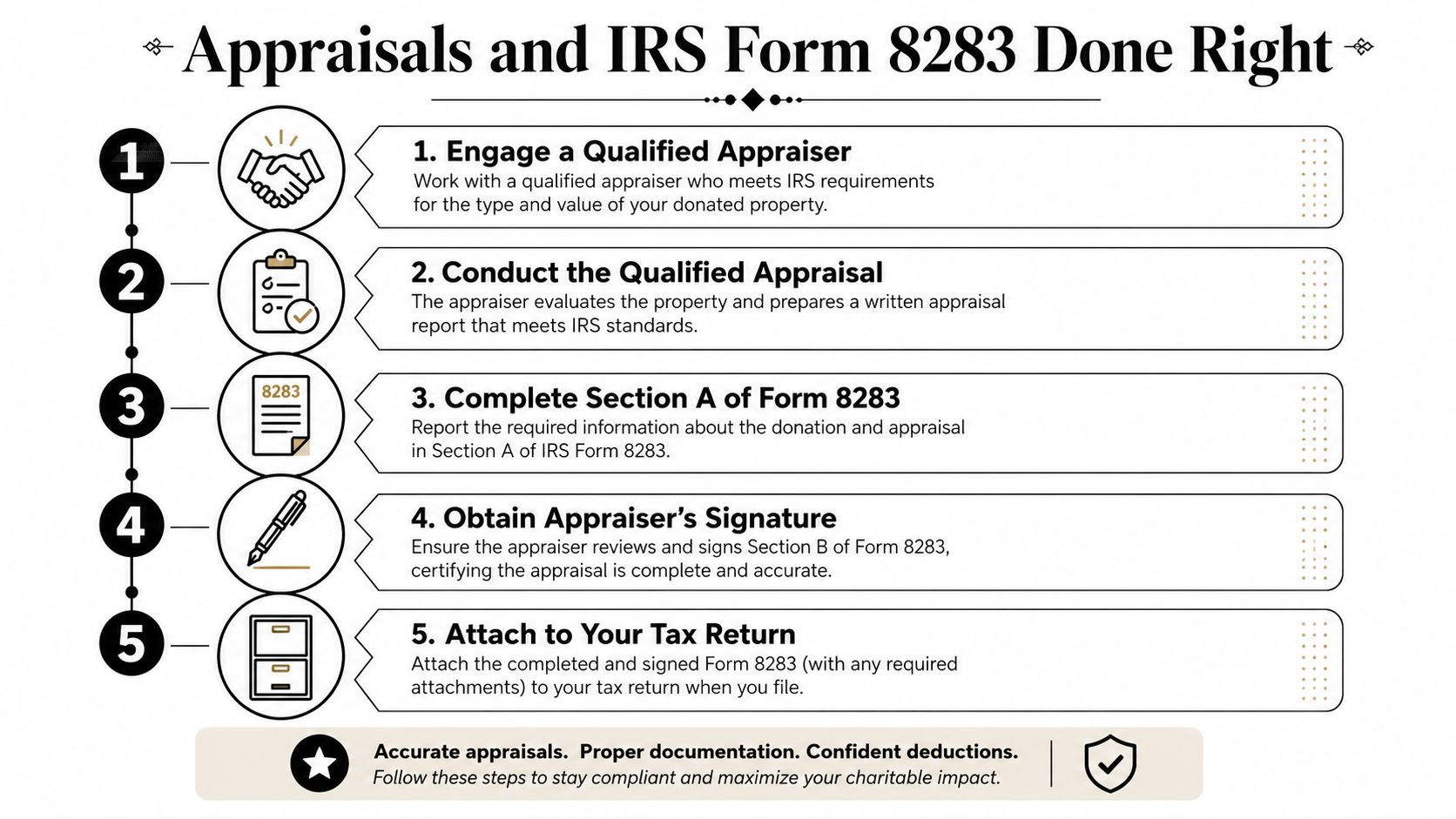
Appraisals and IRS Form 8283 Done Right
The deduction lives or dies on valuation. If the appraisal is weak, the tax return is weak too, and the IRS will notice.
Why the appraisal is the backbone
For a non-cash charitable contribution, a qualified appraisal from a qualified appraiser sits at the center of the file. Conservation easements usually belong in the higher-documentation lane because the value comes from the difference between the property's before and after fair market value, not from a simple receipt or a fixed donation amount. The appraisal has to explain the before-and-after method, lay out the highest and best use analysis, and use a contemporaneous date so the value matches the actual donation moment.
The question is not just what the land is zoned for. It is what a buyer would pay for it. Weak appraisals fall apart there. A parcel may allow development on paper, but if the market would not support that use, the IRS can push back hard on speculative valuation.
Form 8283 is not a clerical afterthought
The return package matters just as much. Form 8283 is where the donor tells the IRS what was contributed and how it was valued. Easements generally belong in the documentation-heavy lane, and larger appraised gifts may also require deeper supporting schedules and signatures. If the appraiser's certification is missing, or if the form does not match the appraisal, you have given an examiner an easy opening.
Keep the file aligned: deed, appraisal, baseline documentation, and tax return entries should tell the same story. If one piece wanders, the whole return looks unreliable.
The appraisal team should also understand donor disclosure obligations, especially when the easement value is large enough to draw attention. That does not mean the taxpayer should panic. It means the return needs to be prepared as if someone will read every line under a microscope, because that is a realistic possibility.
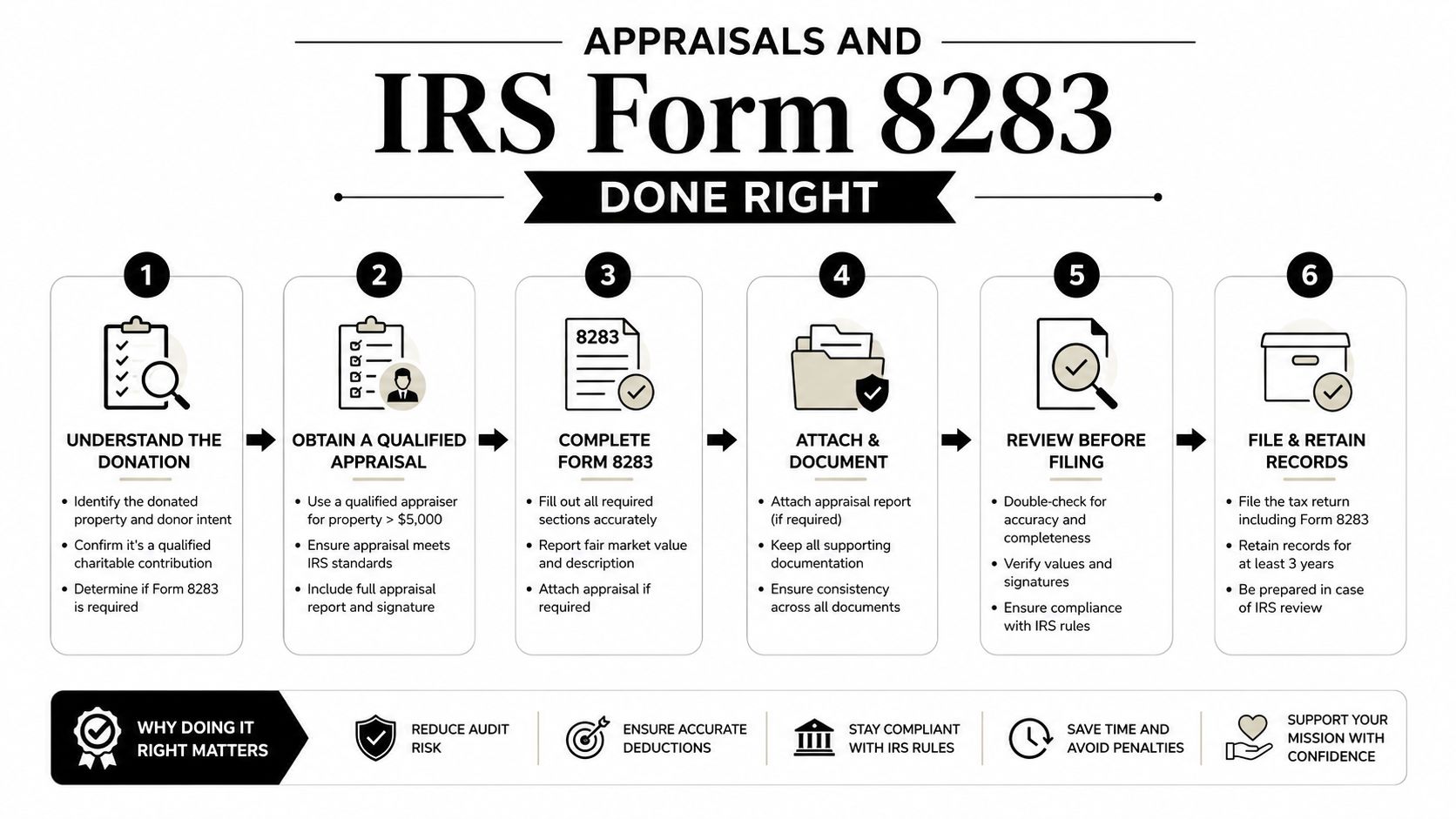
A landowner who wants the deduction to survive an exam should insist on a fully documented appraisal packet before the return is filed. If the preparer starts filling gaps later, the problem has already started.
For farm and ranch owners who keep property records alongside operating books, SteadStack's recommended farm accounting tools can help keep transaction records, entity data, and tax support from drifting apart during the year.
How the Deduction Amount Is Calculated
The deduction is not mysterious, but people treat it like one. Start with the easement value, apply the AGI limitation, then carry forward anything left. That is the order that matters.
The basic calculation
For federal tax purposes, the charitable deduction generally follows the appraised value of the development rights surrendered. In plain terms, that value is usually the property's worth before the easement minus its worth after the easement. Once that number is set, the AGI cap determines how much can be used in the current year.
Under the federal rules summarized in conservation-tax guidance, most donors can deduct up to 50% of adjusted gross income (AGI) in the year of the gift, while qualified farmers and ranchers can generally deduct up to 100% of AGI. Any unused amount can be carried forward for up to 15 years (Land Trust Alliance brochure).
| AGI Limits and Carryforward Rules at a Glance | |||
|---|---|---|---|
| Donor Type | Annual AGI Cap | Carryforward Period | Key Requirement |
| Most donors | 50% of AGI | 15 years | Must track unused deduction year by year |
| Qualified farmers and ranchers | 100% of AGI | 15 years | Must meet the farmer or rancher rules |
That carryforward is where many owners misjudge the benefit. A deduction that cannot be used this year does not vanish. It becomes a future-year deduction stream, which changes the timing decision for owners with uneven income, sale proceeds, or a retirement transition.
What the cap really does to planning
The cap is a planning tool as much as a limitation. If your current-year income is low, the deduction may sit unused and wait for stronger tax years. For a pass-through owner, the timing gets more delicate because entity-level reporting and owner-level AGI do not always line up cleanly.
That is why bookkeeping matters. SteadStack's recommended farm accounting tools can help keep transaction records, entity data, and tax support from drifting apart during the year.
The carryforward is not automatic in practice. It has to be elected, tracked, and defended over time, or the paper benefit can outrun the usable tax benefit.
A clean way to look at it is this. The appraisal sets the size of the deduction. The AGI cap sets the annual speed limit. The carryforward decides whether the unused value is still available later.
That planning discipline also matters if the return is likely to draw attention. For a close look at common IRS audit triggers, review how Allied Tax Advisors approaches IRS audit risk and preparation.
Common Pitfalls and IRS Audit Triggers
The IRS does not care that a deal sounded complex at closing. It cares whether the deduction was real, supportable, and valued conservatively enough to survive review. That's where a lot of easement files break.
The red flags that draw heat
The first red flag is an inflated appraisal built on fantasy development assumptions. The IRS has been especially focused on syndicated conservation easements and overstated valuations, because those structures tend to package aggressive appraisals with investor tax expectations. A recent Tax Court memo discussed in the current federal tax developments literature shows how quickly a case can fall apart when the highest-and-best-use story becomes too speculative and the comparable sales are too far removed from the actual market.
The second red flag is weak documentation. If the baseline report is thin, the easement deed is sloppy, or the appraiser's credentials don't match the task, the file looks improvised. The third is pass-through complexity. Partnerships and LLCs can make the reporting messier, and poor entity-level coordination often creates mismatches between the conservation story and the owner-level tax return.
The fourth red flag is failing one of the §170(h) tests. A beautiful appraisal does not rescue a bad conservation structure. If the recipient isn't qualified, the restriction isn't perpetual, or the conservation purpose is shaky, the deduction is exposed.
For taxpayers who want a sense of why the enforcement environment is sharper now, Eccleston Law's discussion of the IRS crackdown on syndicated conservation easements explains the broader audit and enforcement risk environment (Eccleston Law). For anyone already under audit or considering a deal that feels more financial than conservation-driven, Allied Tax Advisors' audit preparation resource is a practical place to start.
If the return depends on a valuation everyone in the room secretly knows is aggressive, the audit risk is not theoretical.
The safest approach is boring on purpose. Use a qualified appraiser, make the baseline documentation airtight, and avoid deals where the pitch leans too heavily on tax savings instead of land facts. That discipline is what separates a legitimate conservation contribution from an audit file.
California Tax Credits and San Diego Property-Tax Effects
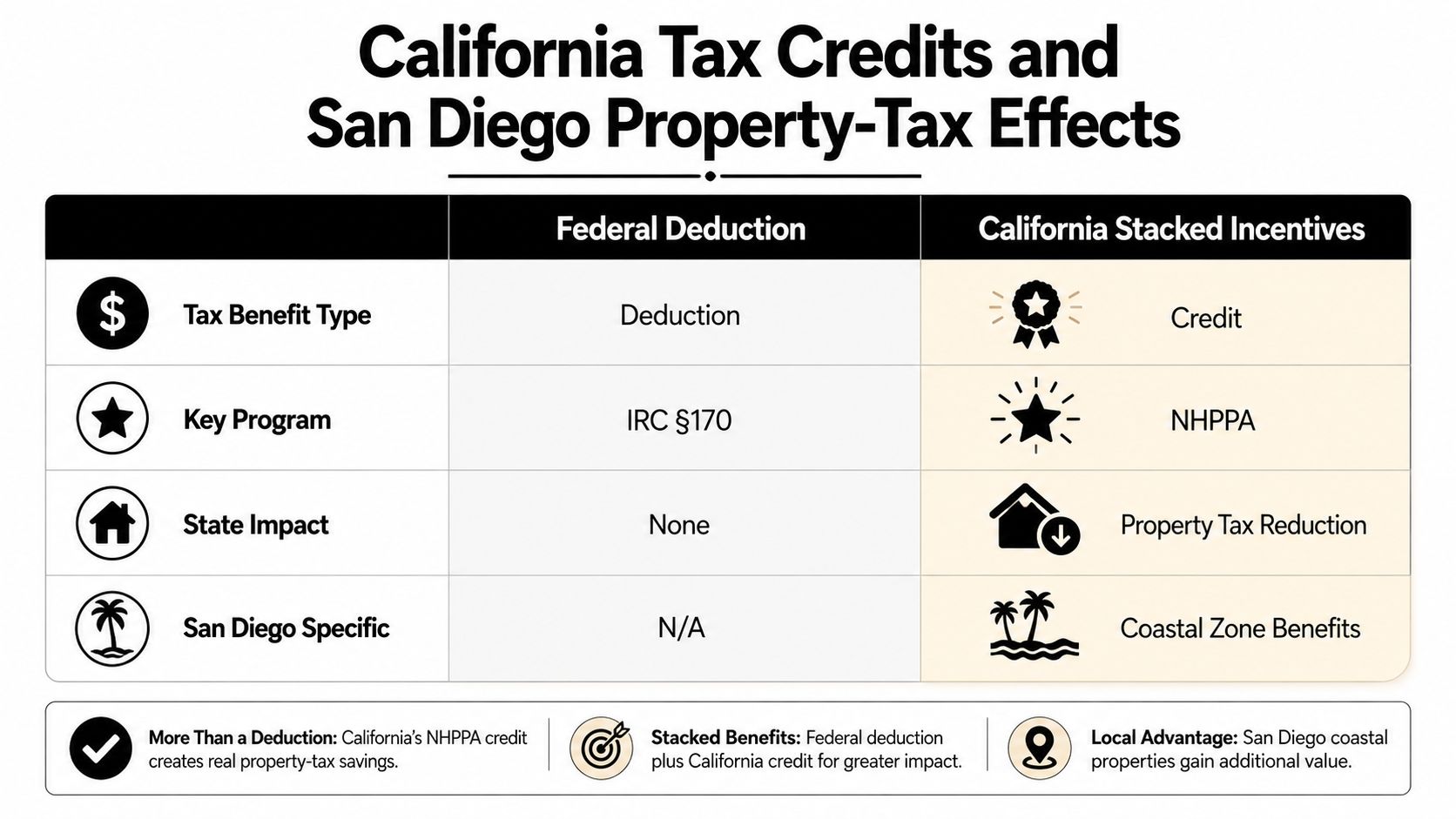
Federal deduction is only half the story for a California owner. In this state, you also have to think about whether the restricted land changes its property-tax profile, and whether any California-level credit or program applies alongside the federal benefit.
Federal and state benefits are not the same thing
The federal deduction is an income-tax matter. It reduces taxable income if the appraisal and AGI rules are satisfied. California and local property-tax treatment are different animals, because they depend on how the parcel is classified and assessed under state and county rules.
For San Diego owners, that means the county's treatment of restricted land can matter just as much as the federal deduction. Parcels enrolled under open-space or agricultural programs may be assessed differently from unrestricted developable land, and that can affect the annual carrying cost. If the land is already in a program like the Williamson Act, the easement may interact with existing assessment rules rather than create a brand-new property-tax result.
The California Natural Heritage Preservation Tax Credit is often discussed in easement conversations, but owners should treat it as a separate state-level issue rather than assume it automatically tracks the federal deduction. The same is true for California Forest Legacy provisions. They may help in the right fact pattern, but they are not substitutes for understanding the federal charitable rules.
For owners juggling more than one property, understanding second home taxes is also useful because not every parcel in a family portfolio should be treated the same way when you're looking at deductions, basis, and annual carrying costs.
What San Diego owners should focus on
The practical question is whether the easement reduces the annual tax burden in a way that compounds the federal benefit. If the property is already constrained, the state and county effect may be modest. If the parcel has been carrying a development-level assessment, the easement can shift the economics more meaningfully.
You should also keep the deduction and the property-tax result mentally separate. A federal income-tax benefit does not automatically lower the county bill, and a lower county bill does not create a federal deduction. Those are distinct systems, and mixing them up causes bad planning.
For property owners trying to understand how the county side works in more general terms, Allied Tax Advisors' property tax guide is a useful companion read.
Treat California and San Diego property-tax effects as a second layer, not a bonus you assume will show up later.
If you're buying, holding, or donating land in San Diego County, the smart move is to model the easement as a combined income-tax, property-tax, and estate-planning decision. That's the only way to know whether the restriction improves the family balance sheet.
A Worked Example for a San Diego Landowner
Take a landowner who donates a conservation easement appraised at $2 million. The owner's AGI for the year is $250,000, and they're in a 24% marginal bracket. The easement creates a large deduction, but the annual limit controls how much gets used right away.
Under the 50% of AGI rule, the donor can use up to $125,000 of the deduction in the year of the gift. The remaining amount rolls forward and can be used over future years, assuming the taxpayer continues to have enough AGI and the filing positions stay clean. If the donor qualifies as a farmer or rancher and can use the 100% AGI rule, the current-year deduction capacity rises to the full $250,000, which makes the carryforward shorter and the tax benefit more immediate.
That difference matters because timing changes the economics. A taxpayer expecting a sale, business exit, or unusually high income in future years may care more about the carryforward than the current-year benefit. A taxpayer with stable, low income may care more about the conservation outcome and the estate-tax angle than about getting the whole deduction quickly.
The same math also explains why a donor can't casually assume the easement will wipe out this year's income. The deduction is only as useful as the AGI limit allows. If the return is prepared without tracking the carryforward carefully, a big chunk of the tax benefit can sit unused on the shelf.
Practical Next Steps With Allied Tax Advisors
Start with three documents, the deed draft, the appraisal draft, and the latest tax return. If those three don't tell the same story, stop and fix the mismatch before closing. Then line up the recipient organization, confirm the conservation purpose, and make sure the valuation approach is defensible on raw land, not on wishful development math.
Allied Tax Advisors' workflow is built around coordination, not guesswork. The team reviews the donor's income pattern, entity structure, and long-term estate goals, then works with the appraiser and the recipient so Form 8283, the appraisal, and the return all match. For San Diego owners, that usually means a first meeting in Clairemont, a document review, a filing checklist, and a carryforward plan that's monitored over time.
If you're thinking about a conservation easement, don't wait until the deed is signed to ask whether the tax result works. Schedule a planning conversation with Allied Tax Advisors, bring the land documents you already have, and get a clear opinion on whether the deduction, the carryforward, and the California property-tax effects line up with your goals.
If you're weighing a conservation easement on San Diego land, Allied Tax Advisors can help you pressure-test the deduction, the carryforward, and the filing risk before you sign anything. Visit Allied Tax Advisors to start a planning conversation and get the numbers reviewed against your actual income, entity structure, and long-term estate goals.