
You're a San Diego homeowner with a side rental, a weekend freelance business, and a stack of tax documents that doesn't fit neatly into one envelope. A seasonal preparer may be able to enter the information, but the question is whether they can correctly handle depreciation, business deductions, estimated payments, and the consequences of an IRS notice.
That's the practical issue behind CPA vs tax preparer. The right choice depends on the moving parts in your return, not on which professional quotes the lowest starting fee. A simple wage-earner return may not justify a full-service accounting relationship. A rental property, LLC, investment activity, or audit notice usually does.
Table of Contents
- Why This Decision Matters for San Diego Taxpayers
- What a CPA and a Tax Preparer Are
- Side by Side Qualifications, Services and Liability
- Pricing Models and the True Cost of Each Option
- Which One Fits Your Situation
- When a Full-Service CPA Firm Is the Better Choice
- How to Choose and What to Ask
- Frequently Asked Questions Before You Hire
Why This Decision Matters for San Diego Taxpayers
San Diego taxpayers often have income from more than one source. A person may own a Clairemont home, rent out a property in North County, receive freelance income from a technology client, and hold investments through a brokerage account. Each item creates a separate reporting question, and the answers can affect deductions, records, estimated payments, and future returns.
A preparer who focuses on straightforward filings may be perfectly suitable for a single W-2 and standard investment forms. That same person may not be the right choice for a return involving rental depreciation, business expenses, pass-through activity, or a property transaction. The issue isn't whether the preparer can type numbers into tax software. It's whether the preparer can recognize which numbers require professional judgment.

Complexity changes the decision
Consider a freelance designer in Pacific Beach who also rents out a detached unit. The designer must separate personal and business expenses, document income, and report the rental activity consistently. The rental property may require schedules that continue from one year to the next, rather than a one-time data entry exercise.
A CPA brings a state-regulated credential and broader accounting training. A general tax preparer may be capable and careful, but the title alone doesn't tell you how much education, experience, or review is behind the work. The IRS explains the distinction between tax return preparer credentials and qualifications: a paid preparer needs a PTIN, while a CPA must satisfy state licensing requirements.
San Diego decision rule: Choose the least expensive professional who clearly understands your return, not the least expensive person who promises to file it.
For local taxpayers, the consequences of a mismatch can include missed deductions, inconsistent treatment of property activity, preventable notices, and a second professional fee to repair the first return. Allied Tax Advisors describes its San Diego tax services around individual, business, rental-property, and tax-resolution needs. That broader service model matters when your tax return is connected to the rest of your financial life.
What a CPA and a Tax Preparer Are
Your filing situation should determine whom you hire. A Certified Public Accountant, or CPA, is a state-licensed accounting professional. The CPA path includes the Uniform CPA Examination, college or university accounting study, experience and good-character requirements, continuing education, and ethical compliance. The license comes from state regulation, not from preparing tax returns.
A tax preparer is a broader category. The individual may have substantial experience, formal training, or a narrow seasonal practice. A paid preparer generally needs an IRS Preparer Tax Identification Number, or PTIN, to prepare federal returns. Federal rules do not set a minimum education, examination, or experience requirement for every paid preparer comparable to the licensing rules for CPAs. Review the IRS explanation of preparer credentials if a professional's title or qualifications are unclear.
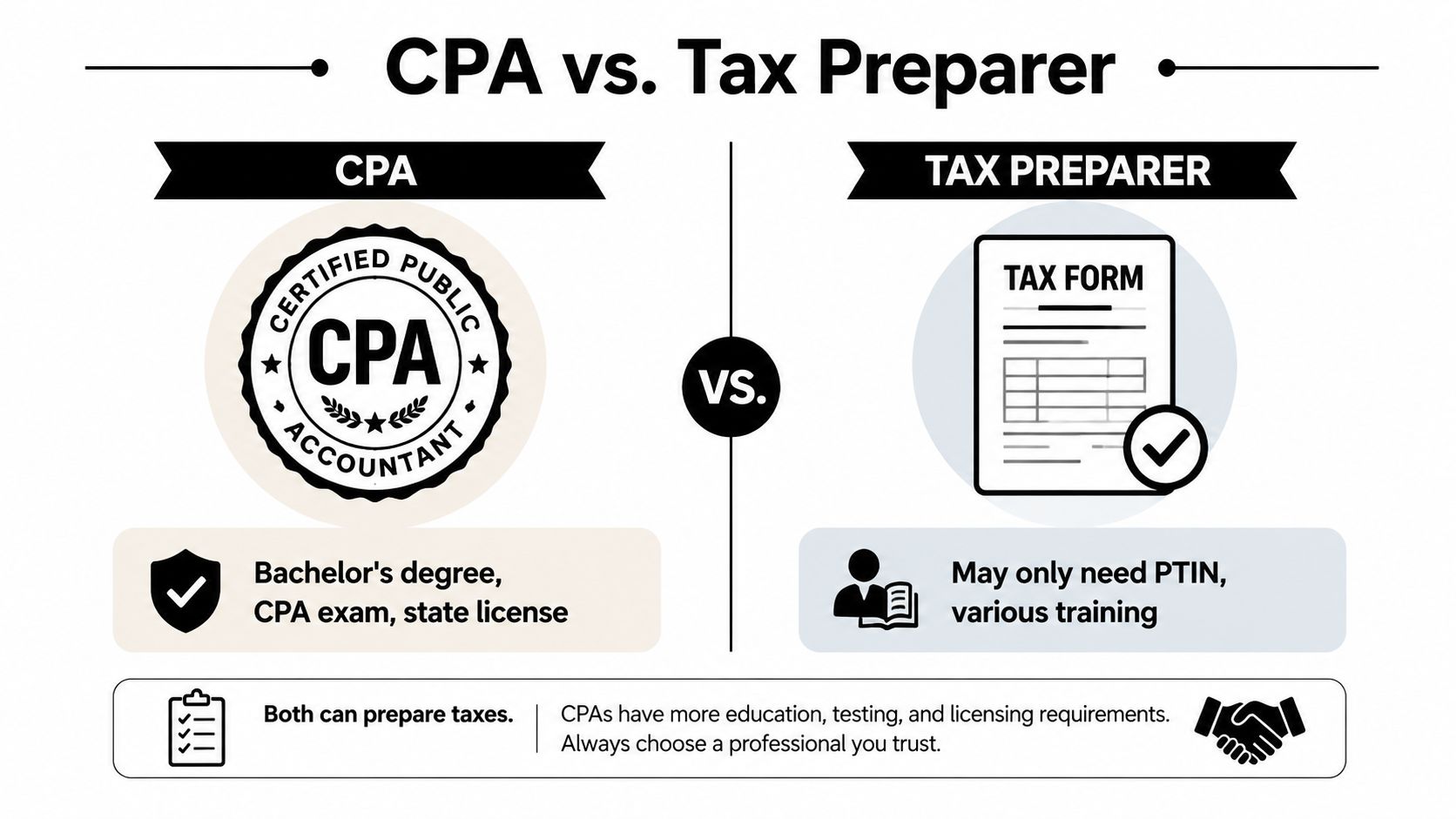
Read the credential, then examine the scope
The IRS reported 864,569 individuals with current PTINs for 2026, including 207,405 CPAs among credentialed preparers. Those figures appear in the IRS tax professional statistics. PTIN status covers paid preparers broadly, while CPA status identifies a smaller, state-regulated group.
The same IRS statistics list 2,300,089 cumulative PTINs issued since September 28, 2010. That total shows the size of the paid preparation market, not the quality of any particular professional. For a straightforward W-2 return, a capable seasonal preparer may be enough. A San Diego owner with rental income, a business entity, real estate activity, or higher audit exposure should choose a firm that can connect tax preparation with accounting, planning, and follow-up support.
That broader scope is where a full-service firm such as Allied Tax Advisor can handle related work in-house. Before sharing sensitive records, ask what the professional will review, which schedules they routinely prepare, and whether they can address issues beyond data entry. Business owners can also use these practical accounting support tips to organize records before tax work begins.
Representation is a separate question
An IRS notice creates a second decision. Preparing a return and representing you before the IRS are different services. CPAs, enrolled agents, and tax attorneys can represent taxpayers within the scope of their authorization. A general tax preparer may not have that authority, even if they prepared the original return.
Ask who will respond if the IRS questions your return, who will sign correspondence, and how that work will be billed. If your return involves a business, rental property, or records that need ongoing accounting support, select the CPA firm. Use a seasonal preparer when the filing is simple and you only need accurate preparation.
Side by Side Qualifications, Services and Liability
The difference becomes clearer when you compare what each professional is built to handle. A seasonal preparer usually sells return preparation. A CPA firm can combine preparation with accounting, planning, business advisory, and support when a tax issue develops into a larger financial problem.
| Criteria | CPA | Tax Preparer |
|---|---|---|
| Qualifications | State license, Uniform CPA Examination, education, experience, continuing education, and ethical obligations | PTIN required for paid federal return preparation, with training and experience varying by individual |
| Typical scope | Tax preparation, accounting, planning, business advisory, and qualified IRS representation | Often focused on preparing returns, especially straightforward filings |
| Business support | Can connect tax work with bookkeeping, payroll, entity reporting, and financial analysis | May offer limited or separate business services |
| Audit and notice support | CPAs may represent taxpayers before the IRS | Representation depends on the preparer's separate credentials and authority |
| Liability and oversight | State-regulated credential and professional obligations | Oversight and professional protections vary |
| Technology and access | Often includes document portals, accounting integrations, and year-round communication | Tools and availability vary, with some practices operating mainly during filing season |
Qualifications are only useful when they match the work
The CPA credential signals a formal licensing process, but it doesn't guarantee that every CPA specializes in rental property or small business tax. Ask about actual experience with your situation. A CPA whose practice centers on audits may not be the most suitable choice for a complex real estate portfolio, just as a tax specialist may be a better fit than a general accountant for a narrow IRS controversy.
The label “tax preparer” also shouldn't be treated as an automatic warning. For a clean individual return, a careful preparer with transparent fees may deliver exactly what you need. The problem begins when the professional accepts work outside their competence without explaining the limits.
Services and liability affect the real outcome
A full-service CPA relationship can include tax planning before year-end, bookkeeping review, payroll coordination, entity analysis, and representation if a notice arrives. Those services cost more because they require more professional time and broader systems.
Liability protections also vary. A CPA is subject to state accountancy rules and professional obligations, while a general preparer's insurance, review process, and accountability structure require direct questions. Never assume that a low-cost quote includes error correction, amended returns, or audit assistance.
Ask one uncomfortable question: “If the IRS challenges this return, who handles the response, and what will I pay for that service?”
For a rental owner, business operator, or taxpayer with several income sources, that answer can matter more than the initial preparation fee. A return is not finished because it was electronically filed. It's finished when the records, positions, and follow-up responsibilities are clear.
Pricing Models and the True Cost of Each Option
A seasonal preparer may quote an appealing starting fee, then add charges for each rental property, business form, investment transaction, amended return, or multi-state filing. The base price often applies only to a basic federal and state return. Ask for the fee after the preparer reviews your complete document set, not before.
CPA firms usually bill hourly, offer a flat-fee engagement, or set up an ongoing advisory arrangement. The best structure depends on the work. A flat fee makes budgeting easier when the agreement identifies the deliverables. Hourly billing fits planning or notice work whose scope cannot be predicted in advance.
| Pricing Factor | Seasonal Tax Preparer | CPA Firm |
|---|---|---|
| Basic preparation | Usually priced around a defined return or form set | Often priced by complexity and service scope |
| Additional schedules | Frequently added individually | May be included in a package or priced by project |
| Planning | Often limited or unavailable outside filing work | Commonly available as a separate or bundled service |
| IRS notices | May require a new engagement or referral | Can be handled when the firm offers representation |
| Business support | May be separate from preparation | Can connect bookkeeping, payroll, and tax services |
| Year-round access | Often limited outside tax season | More likely to include ongoing communication and planning |
Compare the engagement, not the headline price
Before comparing quotes, ask what each fee includes. A rental schedule, K-1, amended return, digital-asset reporting, or multi-state issue can expand the engagement. Poor records, missing basis information, and prior filings that need reconstruction can also create additional work.
The higher-priced professional is not always the more expensive choice. A preparer who files quickly but leaves you to answer an IRS notice, correct an omission, or find separate planning help may create costs after filing. A CPA firm is not the right expense for every taxpayer, especially when the return is simple. For connected decisions involving entities, properties, or business income, coordinated work from a firm such as Allied Tax Advisor can justify the broader fee.
Use a practical budget test
List your income sources, properties, entities, states, investment accounts, and unresolved notices. Then decide whether you need filing compliance alone or advice before filing as well.
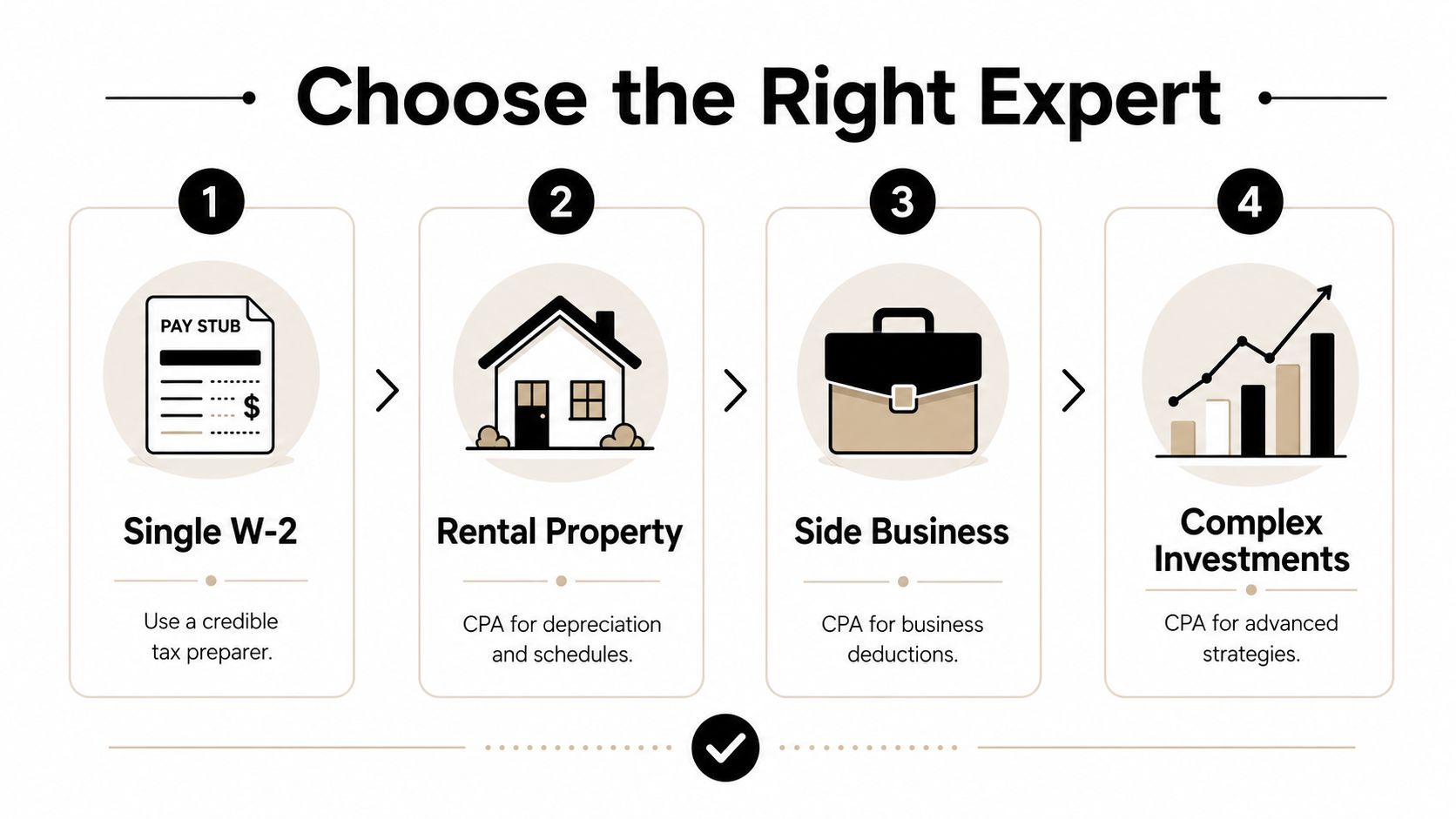
A single wage statement and ordinary investment reporting may fit a careful seasonal preparer. San Diego real estate, multiple rentals, an operating business, or several related tax decisions point toward a CPA engagement. Request a written scope, identify possible add-on work, and ask who handles corrections or notices, and what that service costs.
The right price is the one that accounts for everything your return requires.
Which One Fits Your Situation
Your filing profile should decide the professional you hire. A simple wage return needs a different level of support than a business, rental portfolio, or IRS notice.
A straightforward individual return
You work one W-2 job, claim uncomplicated deductions, and receive ordinary brokerage reporting. You do not own a rental, operate a business, or face an IRS notice. A credible seasonal tax preparer is a practical choice. Confirm that the preparer reviews your documents, signs the return, gives you a copy, and explains what was filed.
Verify the preparer's PTIN before hiring. Ask who will handle a corrected brokerage statement or an IRS letter after filing. Paying for year-round accounting or business advice makes little sense if your return does not require it.
A Pacific Beach business owner
You operate an LLC, run payroll, collect client revenue, and need organized business records. Choose a CPA firm, particularly one that can coordinate bookkeeping, payroll, estimated payments, entity reporting, and business deductions in-house. Treating those items as separate tasks can leave gaps between providers.
A CPA can also review whether your business structure matches your goals. The benefit is coordinated advice, not the completion of more forms. For a broader comparison of tax-focused and accounting-focused help, review this guide to tax consultants versus tax advisors.
A North County real estate investor
You hold short-term rentals, have a property exchange, and receive passive investment reporting. Choose a CPA or enrolled agent with demonstrated real estate and tax controversy experience. Depreciation schedules, basis, passive-activity rules, and exchange documents require consistent records and careful review.
Ask who prepared similar returns, how the firm tracks carryforwards, and whether someone can advise you before a purchase or sale. A general preparer who advertises rental services may not provide that depth of review.
A Chula Vista taxpayer with an IRS notice
You receive a CP2000 notice or audit letter. Hire a CPA, enrolled agent, or tax attorney who handles representation. A preparer can help gather documents, but preparation alone does not establish authority to advocate for you before the IRS.
Quick decision test: Count your moving parts. One uncomplicated income source points toward a qualified preparer. Property, business, entity, investment, or notice issues point toward a credentialed advisor with broader support.
When a Full-Service CPA Firm Is the Better Choice
A full-service CPA firm becomes the better choice when tax preparation is only one part of the problem. That usually happens when your return depends on decisions made months before filing, records maintained throughout the year, or responses required after filing.
For a San Diego startup, that may mean coordinating bookkeeping, payroll, business deductions, and entity reporting. For a real estate owner, it may mean maintaining depreciation records, reviewing a proposed transaction, and planning for the tax effects before signing a contract. For a taxpayer with an IRS or California notice, it means having someone who can interpret the issue and communicate with the agency.
Match capabilities to local pressure points
California business owners face state compliance obligations and operating costs that deserve advance planning. Sales-tax questions can also arise for businesses whose transactions involve the California Department of Tax and Fee Administration. Real estate investors must account for property records, financing, repairs, improvements, and transaction timing.
A CPA team can connect those concerns instead of treating each form as an isolated task. Business owners who are still evaluating their structure may also benefit from this guide for California business owners as they consider the legal and financial consequences of operating and investing in the state.
Know when seasonal preparation has reached its limit
A seasonal preparer may be enough while your finances remain simple. Move to a full-service firm when you need year-round tax planning, entity analysis, bookkeeping oversight, payroll coordination, rental-property compliance, or notice representation.
Allied Tax Advisors is a Clairemont, San Diego–based CPA firm that provides individual and business tax preparation, rental-property support, bookkeeping, payroll, business filings, and IRS and state resolution services. That combination is relevant for clients whose tax return can't be separated from their property, business, or compliance decisions.
How to Choose and What to Ask
Choose based on the return you need, not the title on the business card. Verify a CPA through the California Board of Accountancy and confirm that any paid preparer has a current PTIN. Ask about experience with your return type, disciplinary history, and professional liability insurance.
Before signing, ask:
- Confirm who prepares the return: Will the person you meet prepare, review, or only sign it?
- Define the fee: Request a written breakdown of what the base fee covers and what creates additional charges.
- Discuss notices: Ask whether IRS or California notices are included, referred out, or billed as representation work.
- Test practical experience: Explain your rental, LLC, investments, or freelance activity. Ask how the firm would organize and review those records.
- Set communication expectations: Confirm who answers questions after filing season and how documents are exchanged and protected.
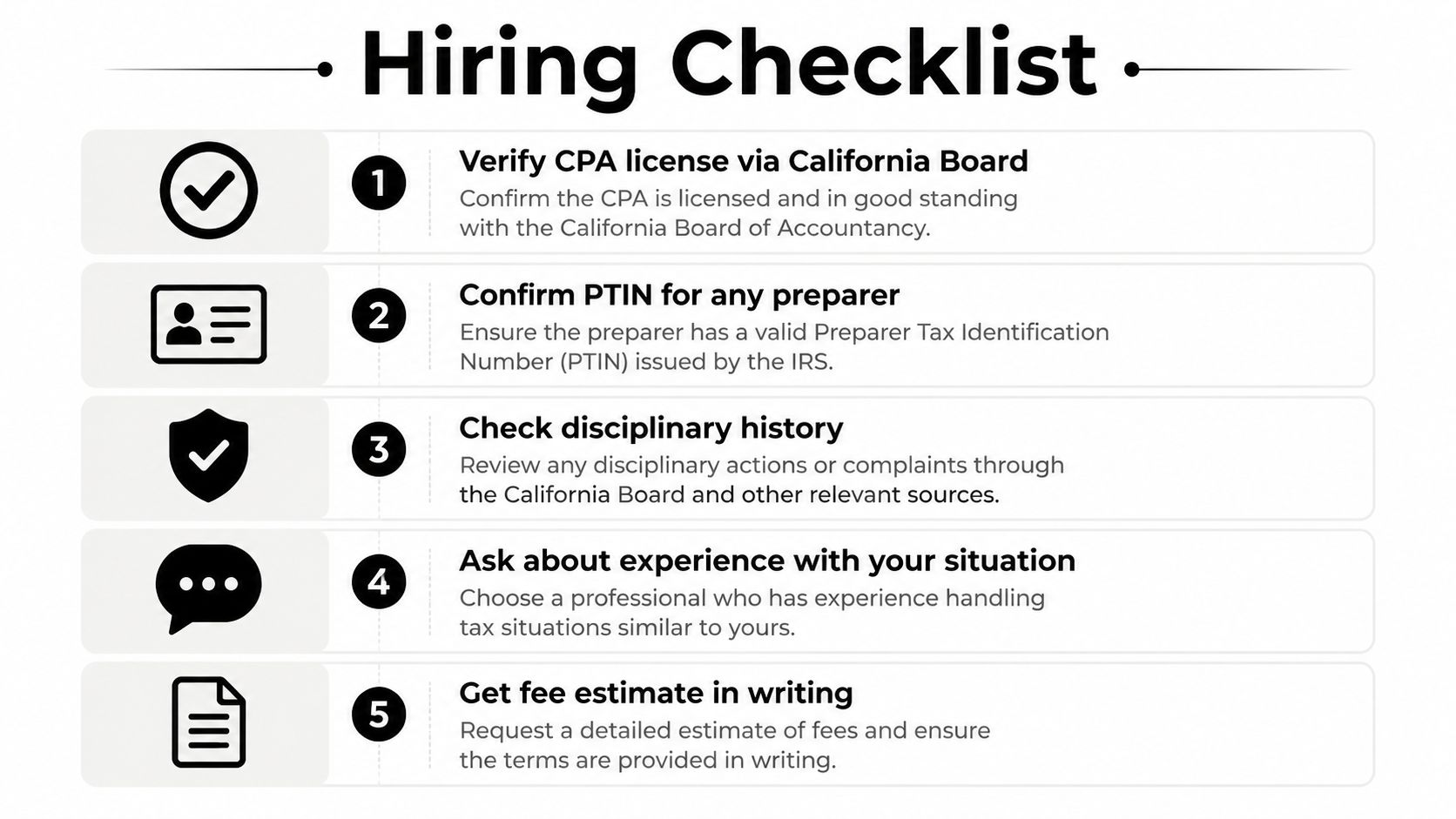
A seasonal preparer fits a straightforward wage-only return with limited investments and no rental or business activity. Choose a full-service CPA firm when San Diego rentals, an LLC, multiple income sources, or audit exposure require records, planning, and follow-through beyond filing. Allied Tax Advisors can keep preparation, bookkeeping, payroll, business filings, rental-property work, and notice representation with one team.
Walk away if the preparer bases fees on your refund, refuses to sign the return, cannot explain responsibility for the filing, or promises results without reviewing your records. A remote or home-based practice can work, but you should know how to reach the preparer and how documents are secured.
Bring prior returns, current income forms, rental and business records, investment statements, and a list of major life changes. Use these materials with the guide to finding a good CPA so you can compare the firm's process, communication, and fit instead of choosing on vague promises of savings.
Frequently Asked Questions Before You Hire
Can I switch preparers during the year?
Yes. Ask the new professional which records they need, whether they will review the prior filing, and how they will coordinate with the former preparer. Request your complete file and supporting schedules. You may still owe the former preparer for work already completed.
What makes a filed return problematic?
Question unexplained deductions, missing income, inconsistent rental records, unsupported business expenses, or a preparer who will not provide a complete copy. Before signing, you should understand every position taken on the return.
Can a preparer handle cryptocurrency or NFT activity?
Hire someone who understands digital-asset reporting and basis records. Provide transaction histories, transfers, sales, and income information. A software import may miss taxable events, especially across multiple wallets or platforms.
Should I choose an LLC or an S corporation?
Base the decision on your business facts, payroll, administration, tax objectives, and compliance responsibilities. A CPA can model the tax results and coordinate bookkeeping, payroll, and required filings. Do not make the election from a generic internet rule.
What should I do after an IRS notice?
Send the notice and filed return promptly to a CPA, enrolled agent, or tax attorney who handles representation. Follow the response deadline. A seasonal preparer may have prepared the return without offering notice or resolution work.
Can any tax preparer represent me in an audit?
No. IRS representation may require a power of attorney, commonly Form 2848, signed by you and the authorized professional. State tax agencies can use separate authorization procedures, so an IRS authorization does not automatically cover a California matter. Confirm both the credential and the agency involved before relying on representation.
Complexity and follow-through determine the right choice. A qualified seasonal preparer can handle ordinary wage and investment reporting. Choose a full-service CPA firm when San Diego rentals, business activity, entity decisions, multiple income sources, or unresolved notices require preparation, bookkeeping, payroll, planning, and representation from one team. Allied Tax Advisors provides those services for individuals, landlords, and business owners.
Allied Tax Advisors helps San Diego taxpayers with coordinated tax preparation, planning, bookkeeping, payroll, and IRS or state notice support. Visit Allied Tax Advisors to request a consultation and match your filing needs with the appropriate professional help.