
If you’re self-employed or run a small business, writing off your vehicle expenses is one of the most significant tax breaks you can get. But it all starts with a big decision: Should you use the simple Standard Mileage Rate or the more detailed Actual Expense Method?
These are the two paths the IRS gives you, and the one you pick can make a real difference to your bottom line.
Your Guide to Deducting Vehicle Expenses

Anytime you use your personal car, van, or truck for your business, you’re racking up deductible expenses. This is a huge opportunity to lower your taxable income. The main rule of thumb is that if you use your vehicle for business activities more than 50% of the time, you’re generally in the clear to claim these deductions.
But here’s something a lot of people miss: the method you choose in the very first year you put a car into business service can lock you in for future years. So, it pays to get this right from the start.
The Two Core Deduction Methods
Let’s break down your options.
First up is the Standard Mileage Rate. This is the “set it and forget it” approach. The IRS gives us a flat rate per mile each year—for instance, if the rate was 70 cents per mile for 2025, you’d simply multiply that by your total business miles. Easy. This single rate is meant to account for all the variable costs like gas, insurance, depreciation, and general upkeep.
On the other hand, you have the Actual Expense Method. This one requires you to be a bit of a bookkeeper. You’ll track every single penny you spend on the business use of your vehicle. This includes things like:
- Gas and oil
- Repairs and routine maintenance
- Car insurance premiums
- Registration fees and taxes
- Depreciation or lease payments
This method is almost always a bigger administrative lift, but it can often lead to a much larger deduction, especially if you drive a newer, more expensive vehicle or one that requires a lot of maintenance. I’ve seen clients save thousands more this way, but only because they were diligent about keeping their receipts.
The real choice isn’t just about saving money. It’s about how much time you’re willing to commit to paperwork. You have to weigh the potential tax savings against the very real effort of tracking every expense.
A Quick Comparison
So, how do you decide? It really comes down to your personal situation. If you drive a ton of miles in a reliable, paid-off car, the Standard Mileage Rate is often a no-brainer. But if you have a high car payment or your vehicle seems to live at the repair shop, the Actual Expense Method might be your best bet.
| Method | Pros | Cons |
|---|---|---|
| Standard Mileage | Incredibly simple to calculate. Less paperwork. | Often leaves money on the table; deduction might be smaller. |
| Actual Expense | Usually results in a larger tax deduction. | Demands meticulous, year-round record-keeping. |
Getting a handle on how both of these methods work is the first real step. From there, you can build a tax strategy that truly fits the way you do business.
How the Standard Mileage Rate Works

If you’re after the most straightforward way to claim your vehicle expenses, look no further than the standard mileage rate. I often tell my clients to think of it as the IRS’s “all-inclusive” option, designed to make your life a whole lot easier come tax time.
Instead of meticulously tracking every single fill-up, oil change, tire rotation, and insurance payment, you focus on one core metric: your business mileage. The IRS sets a specific rate per mile that’s meant to cover all those operational costs, including wear and tear (depreciation).
This rate isn’t static; the IRS reviews it and often adjusts it to keep pace with the economy. For instance, looking ahead to the 2025 tax year, the rate has been set at 70 cents per mile. That’s a nice bump from the 67 cents in 2024, reflecting the real-world costs we’re all facing.
Calculating Your Deduction
The math here is refreshingly simple. You just multiply your total business miles for the year by the official rate. That’s it.
Let’s walk through a quick, real-world scenario. Say you’re a freelance photographer and you drove 12,000 miles last year for work—that’s for client visits, location scouting, and trips to the print shop.
- 12,000 business miles
- x $0.70 (2025 standard mileage rate)
- = $8,400 total vehicle deduction
That $8,400 is what you get to write off. It directly reduces your taxable income, which means less money owed to Uncle Sam, all without a shoebox full of crumpled receipts.
Pro Tip: Even when using the standard mileage rate, you can still separately deduct business-related parking fees and tolls. The per-mile rate doesn’t cover these, so be sure to hang onto those specific receipts!
The Non-Negotiable Record-Keeping
Just because the calculation is simple doesn’t mean you can slack on your records. This is where people get into trouble. The IRS is a stickler for proof, and for mileage, that means keeping a contemporaneous mileage log.
“Contemporaneous” is IRS-speak for recording your trips as they happen, or at least very close to when they happen. Trying to reconstruct a year’s worth of driving from memory in April is a recipe for disaster and a major red flag.
Whether you use a dedicated app or a simple notebook in your glovebox, your log must include:
- The date of each trip.
- Your destination and the business purpose (e.g., “Meet with XYZ Corp” or “Pick up supplies at Staples”).
- The starting and ending odometer readings.
- The total miles driven for that trip.
This log is your shield in an audit. Without it, the IRS has every right to deny your entire vehicle deduction, a mistake that could cost you thousands.
While getting your vehicle deduction right is a huge win, don’t forget it’s just one part of a bigger puzzle. Make sure you’re maximizing your savings everywhere by checking out our complete guide to small business tax deductions. A smart, organized approach to all your write-offs is what truly protects your bottom line.
Using the Actual Expense Method

If you’re the kind of person who doesn’t mind a bit of detailed record-keeping to maximize your tax write-off, the actual expense method might be perfect for you. While the standard mileage rate is certainly simpler, this approach often leads to a much bigger deduction. I’ve seen it make a huge difference, especially for people with vehicles that have high operating costs or for businesses just getting off the ground.
At its core, this method involves tracking and adding up every single cost that goes into running your vehicle for business. We’re not just talking about gas money here—it’s about capturing the full picture of what it really costs to keep your car or truck on the road for work.
What You Can Actually Deduct
When you choose this route, the list of what you can claim is surprisingly long. You have to think beyond the pump to really make it worthwhile. Here’s a rundown of the most common expenses people claim:
- Fuel and Oil: This one’s obvious, but every fill-up and oil change counts.
- Repairs and Maintenance: Think new tires, brake jobs, or even just routine tune-ups. All of these are deductible based on your business use.
- Insurance Premiums: The business portion of your monthly or annual insurance bill.
- Registration Fees and Taxes: Those yearly fees you pay to the state or local government are part of the calculation.
- Lease Payments: If you lease your work vehicle, you can deduct the business-use percentage of your payments.
- Depreciation: This is a big one. It’s a non-cash deduction that accounts for your vehicle’s decline in value over time.
My Two Cents: From my experience, the actual expense method really pays off when your vehicle’s costs are high. If you drive a newer, more expensive car, a leased luxury vehicle, or a work truck that’s always in the shop, you’ll almost certainly get a larger deduction this way than you would with the standard mileage rate.
Calculating Your Business Use Percentage
The golden rule here is that you can only deduct the portion of these expenses that directly relates to your business activities. To figure this out, you need to calculate your business-use percentage. It’s a straightforward formula: divide your total business miles by the total miles you drove all year.
Let’s look at a real-world example. Say you’re a contractor with a heavy-duty truck. You drove a total of 25,000 miles this year. After looking through your detailed mileage log, you see that 20,000 of those miles were for driving to job sites, meeting with clients, and picking up supplies.
Your business-use percentage would be 80% (20,000 business miles / 25,000 total miles).
If your total vehicle expenses for the year—gas, insurance, repairs, the whole shebang—came to $15,000, you could legally deduct $12,000 on your taxes ($15,000 x 0.80).
Understanding Vehicle Depreciation
Depreciation is usually the heaviest hitter in the actual expense calculation. It’s the official way you write off the cost of your vehicle over what the tax authorities consider its “useful life.” For most business vehicles put into service after 1986, you’ll use what’s called the Modified Accelerated Cost Recovery System (MACRS). This system is designed to give you bigger deductions in the first few years you own the vehicle.
Now, there’s a catch. Tax agencies put limits on how much depreciation you can claim, especially for passenger cars. For example, in Canada, the government sets specific rates that can change from year to year. In 2025, the capital cost allowance ceiling for Class 10.1 passenger vehicles was bumped up to $38,000. Interestingly, the limit for zero-emission vehicles stayed put at $61,000, which clearly shows a policy push toward EVs. It’s always a good idea to check the latest Canadian government updates for businesses to stay on top of these numbers.
If there’s one thing to take away about the actual expense method, it’s this: documentation is everything. Every receipt, every invoice, and every bank statement is your proof. Without a solid paper trail, you’ll have a tough time backing up your claims if the IRS comes knocking.
Choosing the Right Method for Your Business
This is where the rubber meets the road, both literally and financially. Deciding between the standard mileage and actual expense methods isn’t just a box to check on a form—it’s a strategic choice that can significantly impact your tax bill. There’s no single “best” answer; the right path really depends on your business, the vehicle you drive, and how much time you spend behind the wheel.
Let’s look at a couple of real-world examples to see how this plays out.
Imagine a consultant who crisscrosses the state for client meetings in her reliable, paid-off sedan. She racks up a ton of miles every year. For her, the standard mileage rate is a no-brainer. It’s straightforward, the paperwork is minimal, and her deduction grows with every trip she takes.
Now, picture a local contractor with a heavy-duty work van. That van guzzles gas, needs frequent oil changes, and required a hefty down payment. For this business owner, adding up the actual costs—gas, insurance, repairs, and especially depreciation on that expensive van—will almost certainly lead to a much larger deduction than the standard mileage rate could provide.
At its core, the decision boils down to a trade-off: simplicity versus maximization.
Scenarios and Special Cases
Things can get a little more nuanced depending on your specific situation.
What if you drive an electric vehicle (EV)? You won’t have gas receipts, but that doesn’t mean you don’t have costs. Think about the installation of a home charging station or the electricity itself. You can claim these under the actual expense method, which often makes it a very appealing choice for EV owners, particularly when you factor in the vehicle’s depreciation.
Leasing a vehicle throws another wrinkle into the mix. If you go with the actual expense method on a leased car, you can deduct the business-use portion of your monthly lease payments. But here’s the catch: you are locked into that choice for the entire life of the lease. This makes it absolutely critical to run the numbers and project your mileage and costs before you commit.
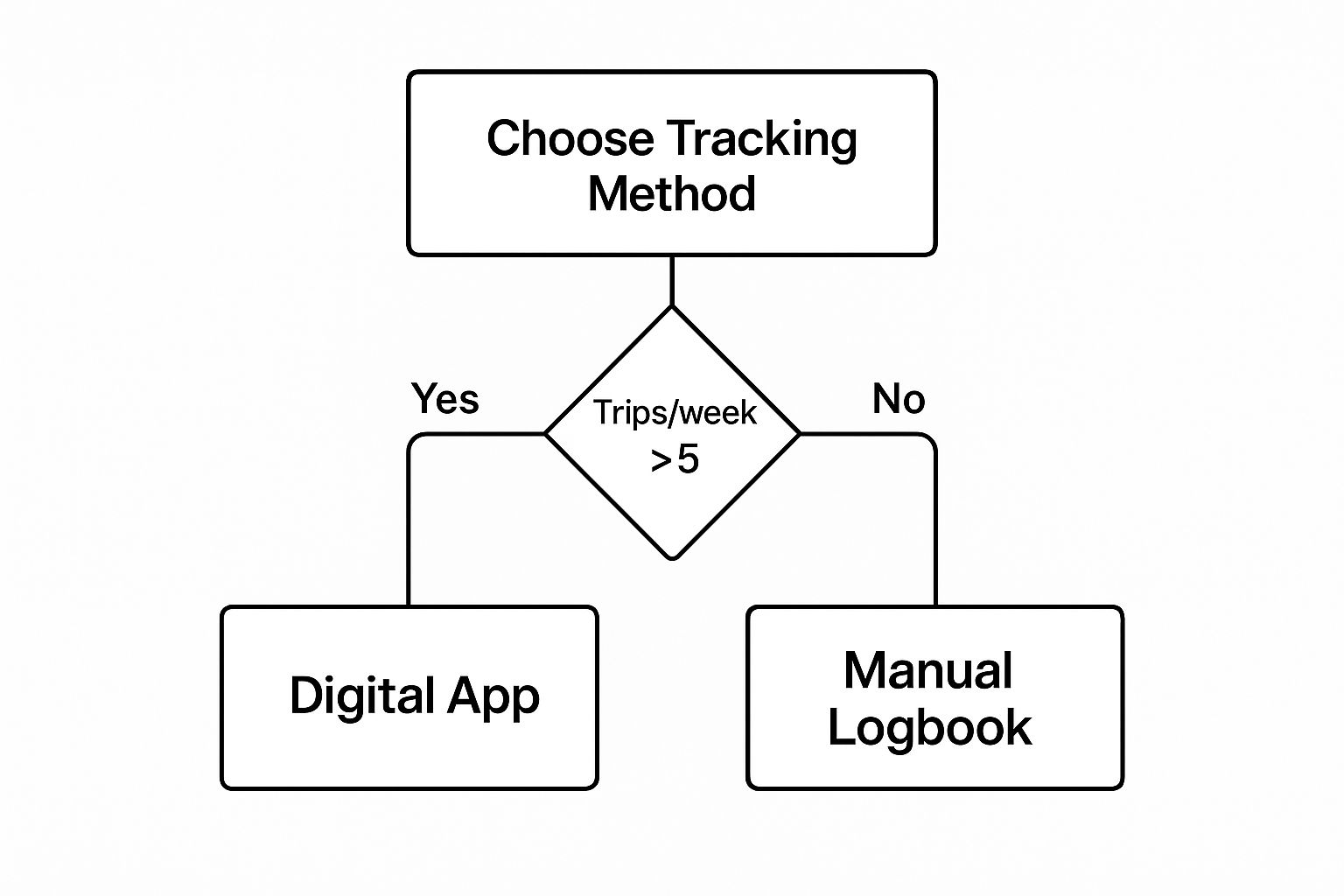
As the chart illustrates, your trip frequency can guide your tracking style. If you’re constantly on the road for work, a digital app is your best friend. For more sporadic business travel, a simple manual logbook might be all you need.
Standard Mileage vs. Actual Expense Method at a Glance
So, how do you make the final call? The choice comes down to running the numbers and understanding the trade-offs. To help you visualize the decision, here’s a direct comparison of the two methods.
| Factor | Standard Mileage Method | Actual Expense Method |
|---|---|---|
| Vehicle Cost | Great for older, less expensive, or paid-off cars. | Better for new, expensive, or luxury vehicles. |
| Annual Mileage | Excellent for anyone who drives a lot of business miles. | Often better for those with lower mileage but high running costs. |
| Repair & Maintenance | Not a direct factor since repairs are baked into the flat rate. | Crucial. High repair and maintenance bills strongly favor this method. |
| Record-Keeping | Simpler. You just need a well-kept mileage log. | Demands meticulous tracking of every single receipt and expense. |
Ultimately, it comes down to a simple calculation. Add up all your actual vehicle costs for the year (including depreciation), and compare that total to what your deduction would be using the standard mileage rate.
The Bottom Line: If your actual running costs are higher than the standard mileage deduction, the actual expense method will save you more money. If they aren’t, the simplicity of the standard rate is probably the smarter, more efficient choice.
Picking the right vehicle deduction method is a fantastic start, but it’s just one part of a solid tax strategy. To make sure you’re not leaving any money on the table, it’s worth exploring how to reduce your tax bill with other deductions and credits. A little time spent analyzing your unique situation now can lead to significant savings later.
Mastering Your Record-Keeping
Let’s be blunt: claiming vehicle expenses is a fantastic way to lower your tax bill, but it’s not a free-for-all. An unclaimed deduction is money left on the table, and a poorly documented one is a flashing red light for an audit. Your records aren’t just a suggestion; they are your entire defense.
Whether you’re taking the standard mileage rate or tracking every single penny with the actual expense method, your system for keeping records is what will make or break your deduction.
Finding the Right Tool for the Job
For those of us using the standard mileage rate, the choice usually boils down to a modern app or a classic paper log.
Mileage tracking apps are a game-changer for many. They use your phone’s GPS to automatically log trips, so you never forget to record that quick run to the post office or a client meeting. On the other hand, there’s nothing wrong with a simple notebook tucked into your glove compartment. If your business driving is pretty straightforward and you’re disciplined enough to write it down every time, it works just as well.
How to Organize Your Actual Expenses
If you’ve opted for the actual expense method, getting organized from day one is non-negotiable. Trust me, you don’t want to be digging through a shoebox full of crumpled receipts next April.
A simple digital system can be a lifesaver. Create folders on your computer for each month and toss in scans of your receipts, invoices, and bank statements as they come in. If you prefer a more hands-on approach, a physical accordion file with tabs for “Gas,” “Repairs,” “Insurance,” and other categories is just as effective.
The secret ingredient here is consistency. Spend just five minutes each week filing new receipts. This tiny habit will save you from a massive, frantic search for documents months down the road. It’s one of many small habits that build a strong financial foundation. For more tips like this, check out our guide on tax-saving strategies for freelancers and small business owners.
Your Essential Documentation Checklist
No matter which method you use, your records need to be thorough. Here’s what you absolutely must have on hand to back up your claim:
- A Detailed Mileage Log: This is the big one. Your log needs the date, the business purpose of the trip, your start and end odometer readings, and the total miles driven. This is required for both methods.
- Receipts for All Expenses: If you’re using the actual expense method, you need proof for everything—gas, oil changes, new tires, repairs, insurance premiums, and registration fees.
- Proof of Parking and Tolls: Keep these receipts separate! You can deduct these costs in addition to the standard mileage rate, so don’t miss out.
- Vehicle Purchase or Lease Documents: These are essential for calculating depreciation if you own the car or for deducting lease payments.
The most common mistake I see is people trying to guesstimate their mileage at the end of the year. The IRS requires contemporaneous records, which is just a fancy way of saying you have to log your trips as they happen, not months later. An accurate, timely log is your single best defense if you’re ever questioned.
Answering Your Top Questions About Vehicle Deductions
Even after you get a handle on the standard mileage and actual expense methods, you’ll inevitably run into specific situations that aren’t so clear-cut. It happens to everyone. Let’s walk through some of the most common questions I hear from business owners trying to apply these rules to their real-world operations.
Getting these details sorted out is crucial for claiming every dollar you’re entitled to while keeping your records clean for the IRS.
Can I Switch Between the Standard Mileage and Actual Expense Methods?
This is probably the most frequent question I get, and the answer is a classic “it depends.” Your flexibility really hinges on whether you own or lease the vehicle and, critically, what you did in that very first year.
If you own your car, you can choose the standard mileage rate for the first year and then switch over to the actual expense method in a later year. No problem there.
But—and this is a big one—you can’t go the other way. If you start with the actual expense method and claim depreciation on that vehicle, you are locked into that method for as long as you own that car. It’s a one-way street.
For leased vehicles, it’s even more straightforward: the method you pick in year one is the method you must use for the entire lease period. Period. This makes that initial choice incredibly important.
Think about a new business owner who just bought a new car. They might be tempted by the high first-year depreciation under the actual expense method. But what if their business takes off in year three and they start driving a ton? They’ve lost the chance to switch to the simpler (and now more valuable) standard mileage rate.
What Really Counts as a Business Mile?
The IRS is very clear on one thing: driving from your house to your main office or workplace is a personal commute. It’s never deductible.
So, what travel is deductible? A business mile is a mile driven between two business locations. Simple as that.
- Driving from your office to a client’s site.
- Going from one job site to another.
- Making a trip to the bank or post office for your business.
- Heading to a supplier to pick up materials.
The rules change significantly if you have a home office that qualifies as your principal place of business. If that’s the case, your home is your office. That means the drive from your front door to your first client meeting of the day is now a deductible business trip.
Are Parking Fees and Tolls Deductible?
Yes, absolutely. And here’s the best part: parking fees and tolls you pay for business-related travel are 100% deductible no matter which primary method you choose.
If you use the standard mileage rate, you deduct these costs separately, in addition to your mileage deduction. If you use the actual expense method, you just add them to your list of other vehicle costs like gas, oil, and insurance. Just make sure you keep the receipts to prove it.
I know that navigating the maze of tax deductions can feel overwhelming, but you don’t have to figure it all out on your own. The team at Allied Tax Advisors has spent decades helping business owners get their finances in order and stay compliant. For advice that’s specific to your business, I’d recommend checking them out. You can get personalized guidance by visiting Allied Tax Advisors.