
As a landlord, you can recover the cost of your investment property over time through a powerful tax deduction known as depreciation. It's essentially an annual allowance the IRS gives you for the wear and tear your property experiences, and it's a game-changer for reducing your taxable income without touching your actual cash flow.
Unlocking Your Biggest Tax Advantage

Many real estate investors get laser-focused on monthly rental income and long-term appreciation. While those are critical, they often miss one of the most significant financial perks of owning a rental property: depreciation.
It's a "non-cash" expense, which is just a fancy way of saying you get to deduct it on your tax return even though no money actually leaves your bank account. This "paper loss" directly shrinks your tax bill, leaving more cash in your pocket.
Think of your rental property like a new work truck. The moment you drive it off the lot, it starts to lose value through use, mileage, and general wear. The IRS gets this. They recognize that buildings and their components don't last forever, so they let you write off that gradual decline as a business expense. The best part? You can claim this deduction even if your property's market value is going through the roof.
Why Depreciation Is a Non-Negotiable Strategy
Let's be clear: claiming depreciation isn't just a good idea for savvy investors—it's essential. The IRS has a rule they call "allowed or allowable," which is their way of saying they assume you're taking the deduction, whether you actually do or not. If you skip it and then sell the property down the road, you could get hit with a bigger tax bill for a benefit you never even took.
Here’s why depreciation should be at the core of your financial strategy:
- It Slashes Your Taxable Income: This is the big one. Depreciation directly reduces the net profit from your rental, which means you pay less in taxes every single year.
- It Boosts Your Cash Flow: By lowering your tax payment, you keep more of your hard-earned money. That's capital you can use for repairs, upgrades, or saving for your next investment.
- It’s a Long-Term Play: For residential rental properties, this tax benefit stretches out over 27.5 years, giving you a consistent and predictable tax shield for decades.
This annual deduction is one of the main reasons real estate is considered such a tax-advantaged investment. It legally minimizes what you owe the government, making a profitable investment on paper even more profitable in your bank account.
Properly handling this deduction is key to maximizing your returns. It's a foundational part of your financial toolkit, right alongside other important write-offs. To really get the most out of your investment, it pays to explore every angle, like those covered in a comprehensive guide to rental property tax deductions.
Ultimately, depreciation is the mechanism that helps you better manage the overall https://alliedtax.com/taxes-on-rental-income/. By accounting for the slow, steady aging of your building, you create a powerful financial tool that helps you build long-term wealth as a property owner. This guide will walk you through the rules and the math so you can claim this valuable deduction with confidence.
Qualifying Your Property for Depreciation

Before you can start slashing your tax bill with depreciation, your property has to pass a few tests from the IRS. Think of it as a pre-flight checklist to unlock this powerful tax deduction. Not every property you own is automatically eligible, so getting these rules straight is the first step toward smart, compliant tax planning.
Of course, ownership is the very first hurdle. And if you're just getting started, it helps to understand the different rental property financing options that get you in the door in the first place. You can only depreciate what you own.
The Four Essential IRS Tests
The IRS has four main criteria your property must meet. If you can check all these boxes, you're clear to start claiming depreciation as a valuable annual expense.
-
You Must Own the Property: This one sounds simple, but it’s critical. You have to be the legal owner. You can’t depreciate a property you’re just managing for someone else or leasing yourself.
-
It Must Be Used for Business or Income-Producing Activity: Here’s the big one. This is what separates your rental from your personal home. When you rent out a property to tenants, you're using it to produce income. Your own family home, on the other hand, doesn't qualify because it's not generating rent checks.
-
It Must Have a Determinable Useful Life: This just means the property is something that will eventually wear out, deteriorate, or lose value over a predictable timeframe. Buildings, appliances, and fences all fit this description.
-
It Must Be Expected to Last More Than One Year: Depreciation is for the long haul. Small repairs or items that last less than a year are handled differently—they’re usually treated as immediate expenses, not depreciable assets.
Why Land Is Never Depreciable
One of the most fundamental rules in the world of real estate investing is this: you can depreciate the building, but never the land it sits on. This distinction is non-negotiable and impacts every calculation you make.
The IRS considers land to have an indefinite useful life. Since it doesn’t wear out, get used up, or become obsolete, you can never claim a depreciation deduction for the value of the land itself.
What this means in practice is that after buying a rental, your first job is to split the total purchase price between the physical structure and the land. Only the portion of your cost assigned to the building can be depreciated. It’s a critical step that ensures you're only writing off the part of the asset that actually degrades over time.
Global Perspectives on Depreciation Periods
It's also interesting to see how depreciation timelines shift depending on where you are in the world. In the United States, residential rental property is depreciated over a standard 27.5 years.
However, many other countries use different schedules. It's common to see a 30-year depreciation life for foreign residential properties. This longer period spreads the deduction out more, which slightly reduces the annual tax benefit but extends it over a greater number of years.
How to Calculate Depreciation Using MACRS
So, how do you actually turn the idea of depreciation into real tax savings? The IRS has a specific system for this, and for any residential rental property you've put into service since 1986, it's called the Modified Accelerated Cost Recovery System (MACRS).
Don't let the long name intimidate you. MACRS is basically a rulebook that lets you deduct the cost of your property in a structured way over a set number of years. For residential rentals, it boils down to a simple, predictable straight-line calculation.
Step 1: Figure Out Your Property's Basis
Before you can calculate anything, you need a starting number. This is your property's basis. Think of it as your total investment to get the property up and running.
For most investors, the basis is simply what you paid for the property, plus some of the extra costs you paid at closing.
Your basis will typically include:
- The contract price you paid the seller.
- Certain legal fees, title insurance, and recording fees.
- Costs for surveys or transfer taxes.
Here's the most critical part of this step: you have to separate the value of the building from the value of the land it sits on. Why? Because the IRS says land never depreciates. You can only claim depreciation on the structure itself. A common and easy way to do this is to look at your local property tax assessment, which usually breaks down the value between land and improvements (the building).
Step 2: Know the Recovery Period
Once you've isolated the basis for just the building, the IRS gives you a fixed timeline to depreciate it. This is called the recovery period. For any residential rental property in the U.S., that magic number is 27.5 years.
This 27.5-year timeline is non-negotiable. It's the "useful life" the IRS assigns to your rental building, no matter if it's brand new or a century old. This consistency is what makes depreciation a reliable tool for tax planning.
This whole process is actually pretty straightforward. You find your building's cost, apply the standard timeline, and calculate your yearly deduction.
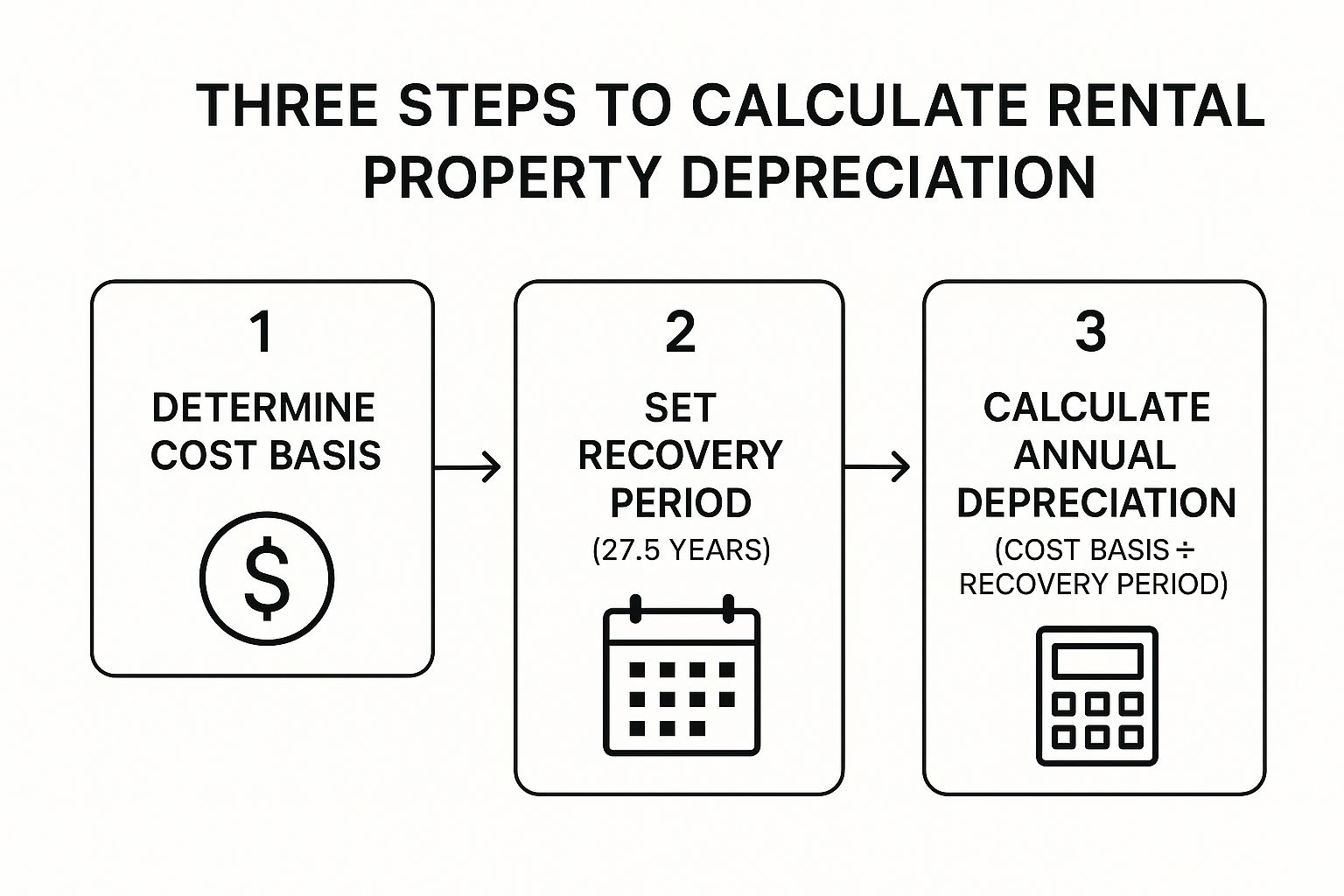
As you can see, once you've done the initial legwork to find your cost basis, the rest is just simple math.
Step 3: Calculate Your Annual Deduction
With your building's basis and the 27.5-year recovery period, the final calculation is a breeze. You just divide the depreciable basis by 27.5. That's it. This gives you the amount you can deduct from your rental income every single year.
Let's say your rental property's building (not including land) has a basis of $300,000. The math would be $300,000 ÷ 27.5 years, which comes out to about $10,909 per year. That's nearly $11,000 you can write off your taxable income annually.
Here’s a full example to tie it all together:
- Purchase Price: You buy a rental home for $400,000.
- Separate Land Value: The tax assessor says the land is worth $80,000.
- Determine Building's Basis: Subtract the land value from the purchase price: $400,000 – $80,000 = $320,000. This is your depreciable basis.
- Calculate Annual Depreciation: Divide the basis by the recovery period: $320,000 ÷ 27.5 = $11,636.
Under this scenario, you get to deduct $11,636 from your income every year for the next 27.5 years. For investors looking to get even more out of their deductions, it's worth exploring the benefits of a cost segregation study, a strategy that can help you write off parts of your property much faster.
To give you a clearer picture of how this plays out over time, here is a table showing the first five years of depreciation for a sample property.
MACRS Depreciation Schedule for a Sample Property
This table shows the annual depreciation for a hypothetical residential rental property with a $250,000 depreciable basis (the value of the building alone) over its first five years.
| Year in Service | Depreciable Basis | Annual Depreciation Rate (%) | Annual Deduction | Accumulated Depreciation |
|---|---|---|---|---|
| 1 | $250,000 | 3.636% | $9,090 | $9,090 |
| 2 | $250,000 | 3.636% | $9,090 | $18,180 |
| 3 | $250,000 | 3.636% | $9,090 | $27,270 |
| 4 | $250,000 | 3.636% | $9,090 | $36,360 |
| 5 | $250,000 | 3.636% | $9,090 | $45,450 |
As you can see, the annual deduction remains constant, providing a consistent, predictable tax benefit each year you own and operate the rental property.
Don't Forget the Mid-Month Convention
There’s one last little wrinkle to be aware of, especially in your first and last years of ownership: the mid-month convention.
The IRS rulebook says that no matter what day of the month you officially put your property in service (i.e., ready it for rent), you have to treat it as if you did so on the 15th. This means for the month you start, you only get to claim half a month's worth of depreciation.
For example, if you close on your rental and have it ready for tenants on October 1st, you don't get depreciation for all of October. You'll get it for half of October, all of November, and all of December—a total of 2.5 months for that first tax year. Your accountant or tax software will automatically handle this, but it’s good to know why your first year's deduction is a bit smaller than the ones that follow.
What Happens to Depreciation When You Sell?
The annual tax deductions you get from depreciation of rental property are a fantastic perk while you own the asset. Think of it as a series of small tax breaks you get every single year. But there's a catch. The IRS essentially considers those deductions a loan against your future tax bill, and when you sell the property, that loan comes due. This process is called depreciation recapture.
Understanding this concept is absolutely vital to avoid a nasty surprise when you close the sale. It’s the final chapter in the depreciation story, and preparing for it is just as important as taking the deduction in the first place.
So, What Exactly Is Depreciation Recapture?
Simply put, depreciation recapture is how the IRS claws back the tax benefits you've enjoyed from your depreciation deductions over the years. Since those deductions reduced your taxable income along the way, the government wants its share when you finally cash out.
It's important not to confuse this with capital gains. Capital gains tax is on the profit you make from the property's increase in value. Recapture, on the other hand, is a tax specifically on the total depreciation you've claimed (or were allowed to claim) during your ownership.
Depreciation recapture is taxed at your ordinary income rate, but the IRS caps it at a maximum of 25%. This is a critical detail because that 25% cap is often higher than the long-term capital gains rates of 0%, 15%, or 20%.
This means that when you sell, your tax bill will likely be a mix of two different rates: one for the appreciation gain and a separate, potentially higher one for all that depreciation you've taken. For a deeper dive into this, check out our guide on understanding rental property depreciation recapture.
Calculating Your Recapture Tax Bill
Let's walk through an example to see how this plays out in the real world. Imagine you bought a rental property and, over a decade, you claimed a total of $100,000 in depreciation deductions. When you sell, that entire $100,000 is now subject to recapture.
Here’s the simple math:
- Total Depreciation Claimed: $100,000
- Maximum Recapture Tax Rate: 25%
- Potential Recapture Tax Bill: $100,000 x 0.25 = $25,000
This $25,000 is the tax you owe just on the depreciation benefit you received. Any extra profit from the sale (the selling price minus your adjusted cost basis) is taxed separately as a capital gain. Forgetting about this recapture tax is one of the most common—and painful—financial shocks for new real estate investors.
A Powerful Strategy to Kick the Tax Can Down the Road
The thought of a big recapture tax bill can be intimidating. Luckily, real estate investors have a powerful tool at their disposal to postpone it almost indefinitely: the 1031 exchange.
Named after Section 1031 of the Internal Revenue Code, this rule allows you to sell an investment property and defer paying taxes on both capital gains and depreciation recapture, as long as you play by the rules. The core requirement? You must reinvest the proceeds from the sale into a similar "like-kind" property.
Here's the basic process:
- Sell Your Property: You sell your current rental through a special third-party known as a qualified intermediary.
- Identify a Replacement: You have a strict 45-day window from the sale date to formally identify the new investment property (or properties) you plan to buy.
- Complete the Purchase: You must close on the new property within 180 days of selling the old one.
By rolling your investment from one property into the next, a 1031 exchange lets your money keep growing for you without taking a massive tax hit. It’s a cornerstone strategy for serious investors looking to build their portfolios and manage the long-term tax consequences of the depreciation of rental property.
Common Depreciation Mistakes and How to Avoid Them

Let's be honest, navigating the IRS rules for depreciation of rental property can be a minefield. One wrong step, and you could find yourself facing an audit or leaving thousands of dollars on the table. Knowing where other investors typically trip up is the best way to keep your own tax filings clean and maximize your returns.
One of the biggest—and most common—mistakes I see is trying to depreciate the value of the land. The IRS is firm on this: land doesn’t wear out or become obsolete, so you can't claim depreciation on it. You can only depreciate the building itself and any other improvements.
If you don't separate the land value from the building value, you'll inflate your cost basis. This leads to an artificially high depreciation deduction, which is a major red flag for the IRS that can trigger an audit and lead to penalties.
Getting the Numbers Right
Another classic blunder is using the wrong recovery period. It’s an easy mistake to make, but the IRS has specific timelines you absolutely must follow.
- Residential Rental Property: This always gets depreciated over 27.5 years. Don't be tempted to use a shorter commercial timeline; it’s incorrect and will overstate your deductions.
- Commercial Property: This follows a longer recovery period of 39 years.
- Property Improvements: Big-ticket upgrades like a new roof or a complete HVAC replacement are depreciated separately. For a residential property, these also fall under the 27.5-year schedule.
Always double-check that you're using the correct 27.5-year recovery period for your residential rentals. Using the wrong timeline is one of the quickest ways to attract unwanted attention from the IRS.
Repairs vs. Improvements: A Critical Distinction
This is where things can get a bit tricky. Misclassifying a capital improvement as a simple repair is probably the most nuanced mistake investors make, and it has big tax implications.
Think of a repair as something that keeps the property in good operating condition. Fixing a leaky pipe or replacing a single broken window pane falls into this category. The great thing about repairs is that you can deduct the entire cost in the year you pay for them.
An improvement, however, is a much bigger deal. It's an investment that substantially adds value to your property, prolongs its life, or adapts it for a new use. We're talking about a full kitchen gut and remodel, adding a deck, or replacing the entire roof.
These major expenses must be capitalized. This just means you add their cost to your property's basis and then depreciate that cost over 27.5 years. You can't write off a $20,000 kitchen remodel in one go. Mixing these up can lead to underpaying your taxes and facing penalties down the road. Keep meticulous records and, when in doubt, talk to a tax pro to make sure you're getting it right.
Common Questions on Rental Depreciation Answered
When you start digging into rental property depreciation, a few common questions always seem to pop up. Let's tackle some of the most frequent ones I hear from property investors to help you get the details right.
What If I Forgot to Claim Depreciation in Past Years?
It happens. The good news is yes, you can recover those missed depreciation deductions. The bad news is you can't just go back and amend your old tax returns.
Here's the catch: the IRS follows a rule they call "allowed or allowable." This means they consider you to have taken the deduction each year, whether you actually did or not. It's not optional in their eyes.
To fix this, you need to file Form 3115, which is an Application for Change in Accounting Method. This form lets you make a "catch-up" adjustment for all the depreciation you missed, all in a single tax year. This can be a tricky process, so I always recommend working with a tax pro to make sure it’s handled correctly.
The bottom line is the IRS assumes you’re taking your depreciation deduction every year. Because of this, it’s always in your best interest to actually claim it.
What's the Difference Between a Repair and an Improvement?
Getting this right is absolutely crucial for your bookkeeping and tax filings. The core difference really comes down to whether you're maintaining the property or enhancing it.
-
A repair is all about keeping the property in its current working condition. Think of it as routine maintenance—fixing a leaky pipe, patching some drywall, or replacing a single cracked tile. These are everyday expenses that you can deduct in full the year you pay for them.
-
An improvement, on the other hand, makes the property better, extends its life, or adapts it for a new purpose. We're talking about big projects like a full kitchen renovation, putting on a brand-new roof, or adding a deck. These are considered capital investments and must be depreciated over 27.5 years, just like the original property.
What Happens If I Move Back Into My Rental?
If you decide to convert your rental property back into your primary home, you have to stop claiming depreciation right away. The moment it's no longer used to produce income, it's no longer depreciable.
But the depreciation you already took doesn't just disappear. All those deductions have permanently lowered your property's cost basis. This means that when you eventually sell the home, your taxable capital gain will be higher. You'll also still be on the hook to pay depreciation recapture tax on all the deductions you claimed while it was a rental.
Getting a handle on the finer points of the depreciation of rental property is a game-changer for maximizing your returns and staying on the right side of the IRS. The expert team at Allied Tax Advisors can walk you through every step, from your first calculation to crafting a long-term tax strategy. Visit us at https://alliedtax.com to see how we can help you hit your financial targets.