
When you flip a house, your profit is going to get taxed one of two ways. It's either a long-term capital gain (taxed at favorable rates of 0%, 15%, or 20%) or it's ordinary income (taxed at your regular bracket, which can be as high as 37%).
What determines that outcome? It all boils down to how the IRS sees you: are you an investor or a dealer? This single distinction can make a huge difference in how much cash you actually keep from a flip.
Your Tax Identity: Investor vs. Dealer
Before you even think about deductions or tax forms, you have to get this first part right. The IRS doesn't treat every house flipper the same. They sort you into one of two buckets—investor or dealer—and that classification dictates how every dollar of profit is handled. This isn't just a label; it’s the cornerstone of your entire tax strategy.
Here's a simple way to think about it. An investor is like a hobbyist who buys a classic car, spends time restoring it, and then sells it for a nice profit. It's not their day job. A dealer, however, is the person running the full-time used car lot. Their entire business model is buying and selling cars to earn a living. The IRS applies that same kind of logic to real estate.
How the IRS Classifies House Flippers
There isn't a single, clear-cut rule here. The IRS looks at the whole picture—your "facts and circumstances"—to figure out what you're doing. They're trying to understand the nature of your business.
Some of the key questions they'll consider are:
- Frequency and Volume: How many properties are you turning over each year? Flipping one or two might keep you in the investor camp. Consistently flipping multiple properties starts to look a lot more like a dealership.
- Your Intent: Why did you buy the property? Was the plan to hold it and let it appreciate over time, or was it to sell it as quickly as possible for a profit? Your original intent matters.
- Business Operations: Do you operate like a formal business? Having a dedicated office, advertising properties for sale, and using a business entity all point toward dealer status.
- Time and Effort: Is this a side hustle or your full-time job? If most of your working hours are spent on flipping activities, you're likely a dealer in the eyes of the IRS.
This infographic lays out how one of the biggest factors—frequency—can push you from one category to the other.
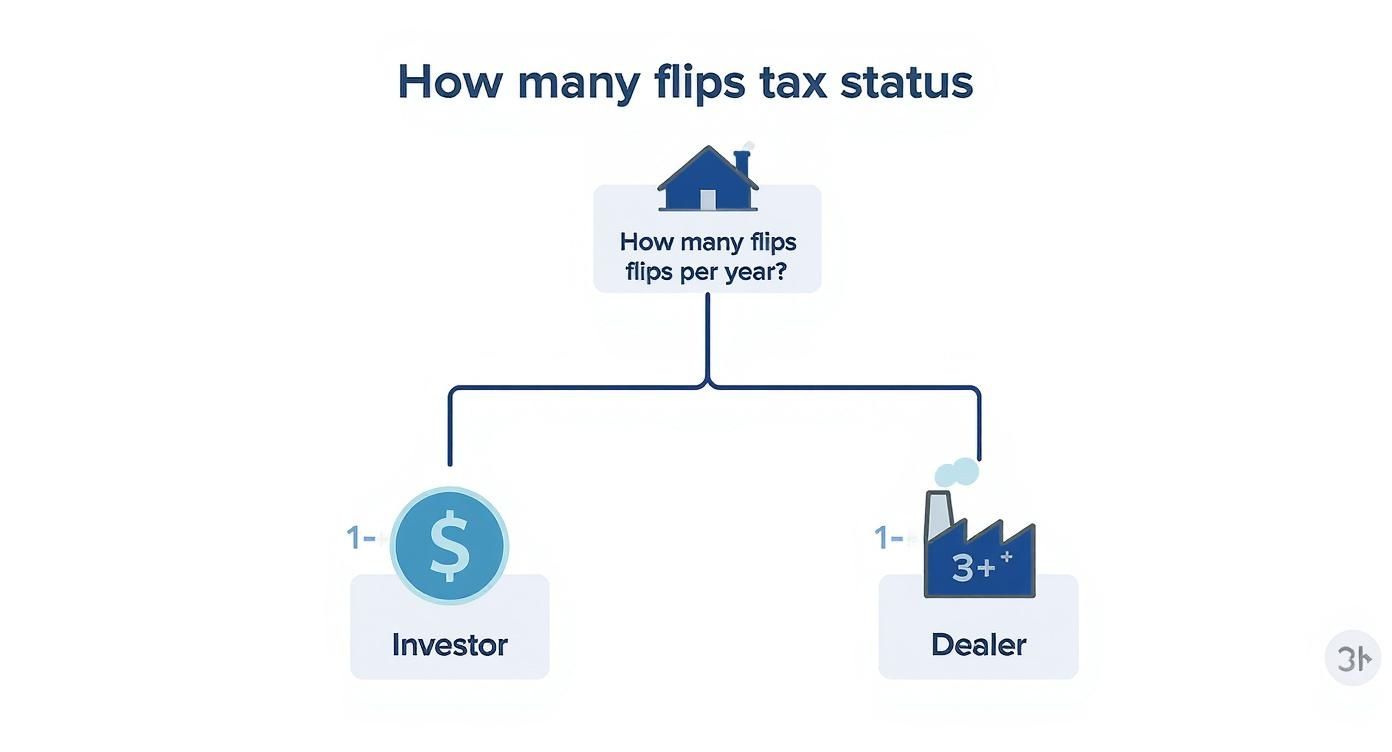
As you can see, flipping just a couple more houses a year can completely change the game, shifting you from a lower-taxed investor to a higher-taxed dealer.
Why This Distinction Matters So Much
The investor vs. dealer classification is a game-changer for your tax bill and what you can deduct.
As an investor, if you hold a property for more than a year, your profits are taxed at the much lower long-term capital gains rates. But as a dealer, all your profits are treated as ordinary income. That means you'll pay your regular income tax rate plus self-employment taxes (for Social Security and Medicare), no matter how long you held the property.
To give you an idea of the scale, in a recent quarter, flips made up about 7.4% of all single-family home and condo sales in the country. That's a huge number of people trying to figure out these complex rules. You can find more data on real estate market trends at ATTOM Data Solutions.
Getting this classification right from the start is absolutely critical to protecting your profits on every single project.
Investor vs. Dealer Tax Status At a Glance
To make it even clearer, here’s a quick rundown of the main differences between being taxed as an investor versus a dealer. This table simplifies the key tax implications of each status.
| Factor | Investor Status | Dealer Status |
|---|---|---|
| Primary Tax Type | Capital Gains | Ordinary Income |
| Tax Rate | 0%, 15%, or 20% (if held >1 year) | Up to 37% + Self-Employment Tax |
| Self-Employment Tax | Not Applicable | 15.3% on net earnings |
| Deducting Expenses | Costs capitalized into basis; some investment expenses may be deductible | Business expenses are fully deductible |
| Loss Treatment | Capital losses (limits apply) | Ordinary business losses (fully deductible against other income) |
As you can see, there are pros and cons to each. While dealer status means higher taxes on profits, it also offers more flexibility for deducting expenses and losses. It’s all about understanding which one applies to you and planning accordingly.
Navigating Capital Gains and Ordinary Income Taxes

Once you've figured out whether the IRS sees you as an investor or a dealer, the next big question is how they'll tax your profits. This is where the rubber meets the road on your flipping houses taxes. Every dollar you make from a flip will be treated as either a capital gain or ordinary income.
Don't let the terminology fool you—this isn't just a matter of semantics. The difference between the two can mean thousands of dollars staying in your pocket instead of going to Uncle Sam.
Think of ordinary income as your regular salary; it's taxed at standard, progressive rates. Capital gains, on the other hand, are more like a bonus from a successful long-term venture. If you play your cards right, they're taxed at a much friendlier rate.
Which tax treatment you get boils down almost entirely to your investor/dealer status and, crucially, how long you hold the property. That holding period is the key to unlocking major tax savings.
The Critical One-Year Mark for Investors
If you're operating as an investor, the calendar is your most powerful tax-planning tool. The amount of time you own a property before selling it directly impacts the tax rate on your profit.
- Short-Term Capital Gains: Sell a property in one year or less, and your profit is a short-term capital gain. This gets taxed at your regular income tax rate, which can be as high as 37%.
- Long-Term Capital Gains: Hold onto that same property for more than one year, and the profit becomes a long-term capital gain. These are taxed at much lower rates: 0%, 15%, or 20%, depending on your income.
This one-year threshold is a game-changer. Simply by timing a sale to push it past that 365-day mark, an investor can slash their tax bill on the exact same profit. To get a better handle on this, you can learn more about short-term vs long-term capital gains and see how the rules apply.
The Dealer's Path: Ordinary Income and Self-Employment Tax
Things look very different if your flipping activity gets you classified as a dealer. For a dealer, flipping isn't just an investment; it's your full-time business. As a result, your profits are treated just like any other business income.
For a dealer, all net profit from a flip is considered ordinary business income, regardless of the holding period. This income is taxed at your standard rate and is also hit with self-employment taxes.
That's a painful one-two punch. First, you pay your regular income tax on the profit. On top of that, you have to pay the 15.3% self-employment tax for Social Security and Medicare. This extra tax is precisely why being a dealer often leads to a much higher tax bill than being an investor who can qualify for long-term capital gains.
Putting It All Together: A Real-World Example
Let's make this tangible. Say you clear a $50,000 net profit on a flip and your regular federal income tax bracket is 24%.
| Your Flipper Status | Holding Period | Applicable Taxes | Estimated Tax Bill |
|---|---|---|---|
| Investor | 11 months | 24% Short-Term Capital Gains | $12,000 |
| Investor | 13 months | 15% Long-Term Capital Gains | $7,500 |
| Dealer | Any Period | 24% Ordinary Income + 15.3% SE Tax | $18,800 (approx.) |
Look at those numbers. By waiting just two more months to sell, the investor saves $4,500. Meanwhile, the dealer pays over $11,000 more in tax than the long-term investor on the exact same $50,000 profit.
This simple comparison drives home why understanding your classification and holding period is absolutely critical. For a deeper look, check out this excellent Taxes for Flipping Houses: A Beginner's Guide which breaks these concepts down even further.
Maximizing Deductions to Lower Your Taxable Profit
While your tax status and holding period dictate how your profit is taxed, maximizing your deductions is where you get to actively slash that final tax bill. Every single dollar you put into buying, fixing up, and selling a property is a potential deduction that lowers your taxable profit. The secret weapon here is your property's cost basis.
Think of your cost basis as the running tally of your total investment. It starts with what you paid for the house and grows with every qualified expense you add along the way. The higher you build this basis, the smaller your taxable gain is when you finally sell. This is why obsessive record-keeping isn't just a good habit—it's your most powerful tax-saving tool.
Understanding Your Cost Basis
Your property's cost basis is simply the total capital you have tied up in the project. It starts with the purchase price, of course, but it’s so much more than that. It also includes a whole host of fees and other costs you paid just to get the keys.
These are what the IRS calls "capital expenditures"—costs that permanently add value, extend the property's life, or adapt it for a new use. Instead of being written off immediately, they get added to your basis.
Here are the big ones that increase your basis:
- Settlement Fees and Closing Costs: This covers things like abstract fees, legal services, recording fees, property surveys, and title insurance.
- Real Estate Taxes: Did you have to pay back taxes the seller owed? That counts.
- Capital Improvements: This is where the real money is. We're talking about major upgrades like a new roof, a full kitchen remodel, adding a bathroom, or finishing the basement—things that are clearly different from routine repairs.
Every improvement you make not only boosts the sale price but also fortifies your financial position when tax time rolls around.
The Power of Deductible Expenses
Beyond the costs that beef up your basis, there's a whole other world of expenses you can deduct directly from your income in the year you pay them. If you're classified as a dealer, these are simply your day-to-day costs of doing business.
These expenses are crucial for chipping away at your taxable profit, especially when you're juggling multiple projects.
Meticulous tracking of every single expense is non-negotiable. An organized system for your receipts and invoices is the only way to prove to the IRS that your deductions are legitimate. It’s what ensures you don't hand over a penny more in tax than you legally have to.
The average gross profit on a flip hovers around $66,000, and with costs on the rise, every deduction is vital to protecting that margin. While profits have remained fairly steady, the actual percentage returns have gotten tighter because of higher purchase prices and renovation expenses. You can see more data on house flipping profitability on fairfigure.com.
Your Comprehensive Deduction Checklist
To make sure nothing slips through the cracks, it’s best to categorize your expenses from day one. Below is a checklist of the essential deductible expenses every house flipper should be tracking.
Essential Deductible Expenses for House Flippers
| Expense Category | Examples of Deductible Items |
|---|---|
| Acquisition Costs | Appraisal fees, home inspection costs, legal and accounting fees related to the purchase. |
| Holding Costs | Utilities (water, electricity, gas), insurance premiums, property taxes, loan interest and financing fees. |
| Renovation & Repair Costs | Building materials (lumber, paint, flooring), labor for contractors, permit fees. |
| Selling Costs | Real estate agent commissions, advertising and marketing, staging costs, legal fees for closing. |
Properly documenting every item on this list can make a massive difference in your tax outcome.
For flippers who operate as a full-fledged business, there may be even more advanced strategies available. Our guide on achieving real estate professional tax status dives into these opportunities. At the end of the day, the best practice is simple: keep every receipt and invoice, organized by property. It’s your best preparation for tax time and your best defense in an audit.
Choosing the Right Business Structure

Figuring out how to legally set up your house-flipping business is one of the biggest decisions you'll make. It’s far more than just paperwork; it directly shapes your personal liability, how complicated your taxes are, and ultimately, how much you pay in flipping houses taxes. Think of it as the financial foundation for your entire operation.
A lot of flippers just dive in without a formal structure, but as the business takes off, that initial setup might not offer the best protection or tax benefits. Getting it right from the start—or knowing when it's time to upgrade—can save you from a world of legal trouble and a boatload of unnecessary taxes.
Let's walk through the three most common paths flippers take: operating as a sole proprietor, forming an LLC, or setting up an S Corporation. Each has its own set of pros and cons, and the right one for you depends on how big you're planning to go and how much risk you're comfortable with.
The Sole Proprietorship
This is the default starting line for most new flippers. If you’re doing business on your own and haven’t filed any special paperwork, you’re a sole proprietor. It’s simple, but there's a catch: there's absolutely no legal separation between you and the business.
- Pros: It costs nothing to get started, and it's incredibly simple. All your profits and losses flow right onto your personal tax return (Schedule C), so the paperwork is minimal.
- Cons: The huge downside is unlimited personal liability. If a contractor gets hurt on site or a buyer sues you, your personal assets—your house, your car, your savings—are fair game.
This structure might be fine for your very first project, but it gets real risky, real fast, once you start doing more deals.
The Limited Liability Company (LLC)
An LLC is a massive step up from being a sole proprietor. It creates a legal wall between your personal life and your business finances, which is a huge source of peace of mind for any serious entrepreneur.
From a tax perspective, a single-member LLC is usually a "disregarded entity," which is a fancy way of saying you file your taxes the same way a sole proprietor does. The magic is that you get the liability protection of a corporation without the complex tax filings.
Forming an LLC is the fundamental move to protect your personal wealth from business risks. It draws a clear line in the sand, ensuring that if a deal goes bad, your family’s assets aren’t on the hook for business debts.
The LLC is a popular choice for a reason—it strikes a great balance between protection and simplicity. You can dive deeper into the specifics of different setups by learning about business structure types to see how they fit your unique situation.
The S Corporation (S Corp)
For flippers who are doing this full-time and are classified as dealers, the S Corp can be a game-changer for saving on taxes. While an LLC protects your assets from lawsuits, an S Corp can also shield your profits from self-employment taxes.
Here's the strategy: As an S Corp owner, you're officially an employee. You pay yourself a "reasonable salary," and that salary is subject to normal payroll taxes (Social Security and Medicare). But here's the key—any profit left over can be taken as a distribution, which is not subject to those pesky 15.3% self-employment taxes.
Let's put it all together in a quick comparison to see what makes the most sense.
Comparing Business Structures for House Flippers
| Feature | Sole Proprietor | LLC | S Corporation |
|---|---|---|---|
| Liability Protection | None | Strong | Strong |
| Tax Filing | Schedule C | Schedule C (default) | Form 1120-S, K-1 |
| SE Tax Savings | No | No (default) | Yes, on profits beyond salary |
| Setup Complexity | Very Low | Low | Moderate |
| Best For | First-time, low-risk flippers | Most flippers seeking protection | Active dealers aiming to reduce taxes |
Picking the right structure comes down to your deal volume, your appetite for risk, and where you see your business going. A sole proprietorship is an easy way to dip your toes in, but the liability shield of an LLC is a must-have for anyone serious about this business. And once your profits start climbing, the potential tax savings from an S Corp become too good to ignore for an established dealer. Your best bet is always to chat with a tax pro who can run the numbers and help you make the smartest call for your business.
Putting Tax Strategy into Action on Your Flips
Knowing the tax rules for flipping houses is one thing. Actually using them to pocket more profit is a whole different ballgame. This isn't about finding secret loopholes; it's about being smart and proactive. A good tax strategy means making deliberate choices from day one that legally lower your tax bill and boost your real return on each project.
This goes way beyond just keeping good receipts. It's about thinking ahead—timing your sales, using powerful tax-deferral tools when they make sense, and staying on top of your payments to avoid nasty surprises from the IRS. Let's dig into some of the most effective strategies you can use.
Timing is Everything: Playing the Calendar Game
For any flipper who can genuinely claim investor status, the calendar is your best friend. Seriously. Holding onto a property for just one day longer can literally cut your tax bill in half.
- The Magic Number is 365: Make it your mission to hold investment properties for more than 365 days before you sell. That one extra day is what separates a high-taxed short-term capital gain from a much more favorable long-term capital gain.
- Paper Trail is Proof: If a project’s timeline is cutting it close to that one-year mark, your documentation is critical. Make sure everything—from emails to internal notes—backs up your intent to hold the property for investment, not just for a quick flip. This is how you solidify your investor classification if the IRS ever comes knocking.
The 1031 Exchange: Your Tax Deferral Power Tool
The 1031 exchange, often called a like-kind exchange, is one of the most powerful wealth-building tools in real estate. It allows you to sell an investment property, take all the profit, and roll it directly into a new, "like-kind" property without paying a dime in capital gains tax at that moment.
Think of it like this: a 1031 exchange hits the pause button on your tax liability. You're not getting out of the tax forever, but you're kicking the can way down the road, letting your full pre-tax profit work for you in the next deal.
But this isn't a free-for-all. The 1031 exchange has very strict rules and is only for investors, not dealers. You have just 45 days to identify a replacement property and a total of 180 days to close on it. For a deeper dive into the specifics, exploring resources on managing investment property tax effectively can really pay off.
Get Ahead of the IRS with Estimated Tax Payments
One of the rudest awakenings for new flippers is getting slapped with a massive tax bill in April—plus penalties for not paying sooner. When you're self-employed, Uncle Sam expects his cut as you earn, not just once a year.
You do this by making quarterly estimated tax payments. If you skip them, you're setting yourself up for some painful penalties and interest charges.
- Do the Math: Sit down with your CPA to forecast your income for the year and figure out what you'll likely owe.
- Save the Dates: These payments are generally due on April 15, June 15, September 15, and January 15 of the next year. Don't miss them!
Paying your estimated taxes on time not only keeps the IRS happy but also makes managing your own cash flow so much easier. No one wants a five-figure surprise that drains their bank account right when they need capital for the next project.
Keep Your Flips and Rentals in Separate Sandboxes
Here's a more advanced move: if you both flip houses and hold long-term rentals, you need to draw a very clear line between them. Treating them as totally separate operations is crucial for protecting the tax benefits of your rental portfolio.
This means you can operate your flipping business as a dealer while still maintaining investor status—and all the perks that come with it, like long-term capital gains and depreciation—on your buy-and-hold properties. This often requires setting up separate business entities, like two different LLCs, and keeping immaculate, separate records.
This kind of structuring is becoming even more important as governments get wise to flipping. For instance, British Columbia recently rolled out a new tax that hits flippers with up to a 20% tax on profits if they sell a property within a year. You can read more about how tax policy is being used to curb house flipping. It’s a perfect example of why getting your business structure right from the very beginning is non-negotiable.
Common Questions on Flipping Houses Taxes

Even after you've got the basics down, the world of flipping houses taxes is full of "what if" scenarios. It's one thing to understand the theory, but it's another to apply it when you're in the thick of a project.
This section is all about tackling those nagging questions that pop up in real-world situations. Think of it as a quick reference guide for some of the most common points of confusion we see flippers run into.
Can I Live in the House I'm Flipping to Avoid Taxes?
This is easily one of the most popular questions, and for good reason—the potential savings are huge. The idea is to use the Section 121 exclusion, which lets you pocket up to $250,000 in gains tax-free ($500,000 if you're married). But here's the catch.
To qualify, the house has to be your primary residence for at least two of the five years before you sell it. For most flippers, that timeline just doesn't work. The IRS is also very focused on your intent. If all the evidence points to you buying the property with the primary goal of renovating and selling it for a profit, they’ll almost certainly deny the exclusion, even if you did live there for a bit.
Key Takeaway: The primary residence exclusion is built for homeowners, not for business ventures. Trying to fit a classic flip into this box is a major audit risk. The facts and circumstances surrounding the deal matter far more than just the time you spent living there.
What if I Lose Money on a Flip?
Let's face it, not every project goes according to plan. Sometimes, a flip results in a loss. The good news is that a financial loss can become a tax advantage, but how you use it boils down to whether you're classified as a dealer or an investor.
- If you're a dealer: The loss is considered an ordinary business loss. This is the best-case scenario because you can use it to offset any other income you have, whether it’s from your day job or another profitable flip.
- If you're an investor: The loss is a capital loss. You can use this to wipe out capital gains from other investments, like selling stocks. If you have more losses than gains, you can deduct up to $3,000 per year against your regular income and carry the rest forward to future years.
Knowing where you stand is crucial for turning a disappointing outcome into a legitimate tax-saving opportunity.
How Should I Pay Contractors to Maximize Deductions?
Getting this right is non-negotiable for both legal and tax reasons. In almost every flip, the tradespeople you hire—plumbers, electricians, painters—are independent contractors, not your employees.
Here’s the rule: if you pay any single contractor $600 or more during the year, you have to send them a Form 1099-NEC. To do that, you first need to have them fill out a Form W-9. This process creates the clean paper trail you need to prove your labor costs are valid business expenses. Paying "under the table" in cash is a massive red flag for the IRS and a surefire way to get your deductions thrown out in an audit.
Can I Deduct the Cost of My Own Labor?
This one's a hard no, and it's a tough pill to swallow for flippers who put in countless hours of "sweat equity." You simply cannot deduct the value of your own time and effort.
Why? Because a tax deduction requires an actual out-of-pocket expense. You didn't write a check to yourself for your labor. Your reward for all that hard work comes in the form of profit when you sell the house. While your time isn't deductible, every single dollar you do spend on materials, tools, permits, and hired help absolutely is.
Meticulous record-keeping of these real costs is how you legally and effectively lower your taxable income.
At Allied Tax Advisors, we specialize in simplifying the complexities of real estate taxation. From choosing the right business structure to maximizing every available deduction, our team provides the expert guidance you need to keep more of your hard-earned profit. Visit us at https://alliedtax.com to learn how we can help you build a smarter tax strategy for your house-flipping business.