
You review your tax return, see a higher bill than expected, and realize the frustrating part isn't just what you owe. It's the feeling that you probably could've done something about it months earlier. That reaction is common, especially for families with kids, professionals with bonuses, and business owners whose income drifted just high enough to lose deductions or credits they expected to claim.
In practice, the biggest missed opportunity usually isn't an obscure write-off. It's Adjusted Gross Income, or AGI. If you want to understand how to lower your AGI, the actual goal isn't just shaving taxable income. It's controlling the number that determines whether you qualify for key tax breaks in the first place.
Table of Contents
- Why Your AGI Is the Most Important Number on Your Tax Return
- Maximize Your Pre-Tax Retirement and Health Savings
- Use Investment Strategies to Lower Your Tax Bill
- Deductions for Business Owners and Real Estate Investors
- Lowering AGI to Unlock Valuable Tax Credits
- Common Mistakes and When to Partner with a Tax Pro
Why Your AGI Is the Most Important Number on Your Tax Return
A lot of taxpayers focus on the final refund or balance due. That's understandable, but it hides the number doing most of the work behind the scenes. AGI is your gross income minus certain adjustments, and that number becomes the starting point for a surprising amount of tax math.
Think of AGI as the gatekeeper. It affects how much of your income is exposed to tax, but it also controls access to benefits that phase out as income rises. That's why two taxpayers with similar earnings can end up with very different outcomes. One reduced AGI early through payroll elections and planned contributions. The other waited until filing season and had fewer options left.
If you're fuzzy on the basics, this overview of adjusted gross income and how it works is a good starting point.
Why AGI matters more than many deductions
Chasing deductions after year-end often isn't enough. Many deductions happen below the line, after AGI is already set. The stronger strategies happen earlier and reduce income before AGI is calculated.
Practical rule: If a move lowers AGI above the line, it usually has broader value than a deduction that only affects taxable income later.
That distinction matters for families trying to keep access to education credits, parents balancing child-related tax benefits, and retirees managing income from multiple sources. In my experience, taxpayers often don't miss tax savings because they forgot a receipt. They miss them because AGI ended up slightly too high.
The missed-opportunity problem
AGI planning isn't only about paying less on your last dollar earned. It's also about preserving options. Once AGI crosses certain thresholds, some tax breaks shrink or disappear, and fixing that after December is much harder.
That's why the best AGI strategy is usually proactive, not reactive. Fund the right accounts. Time investment moves carefully. Coordinate business deductions and retirement contributions before year-end, not after the return is drafted.
Maximize Your Pre-Tax Retirement and Health Savings
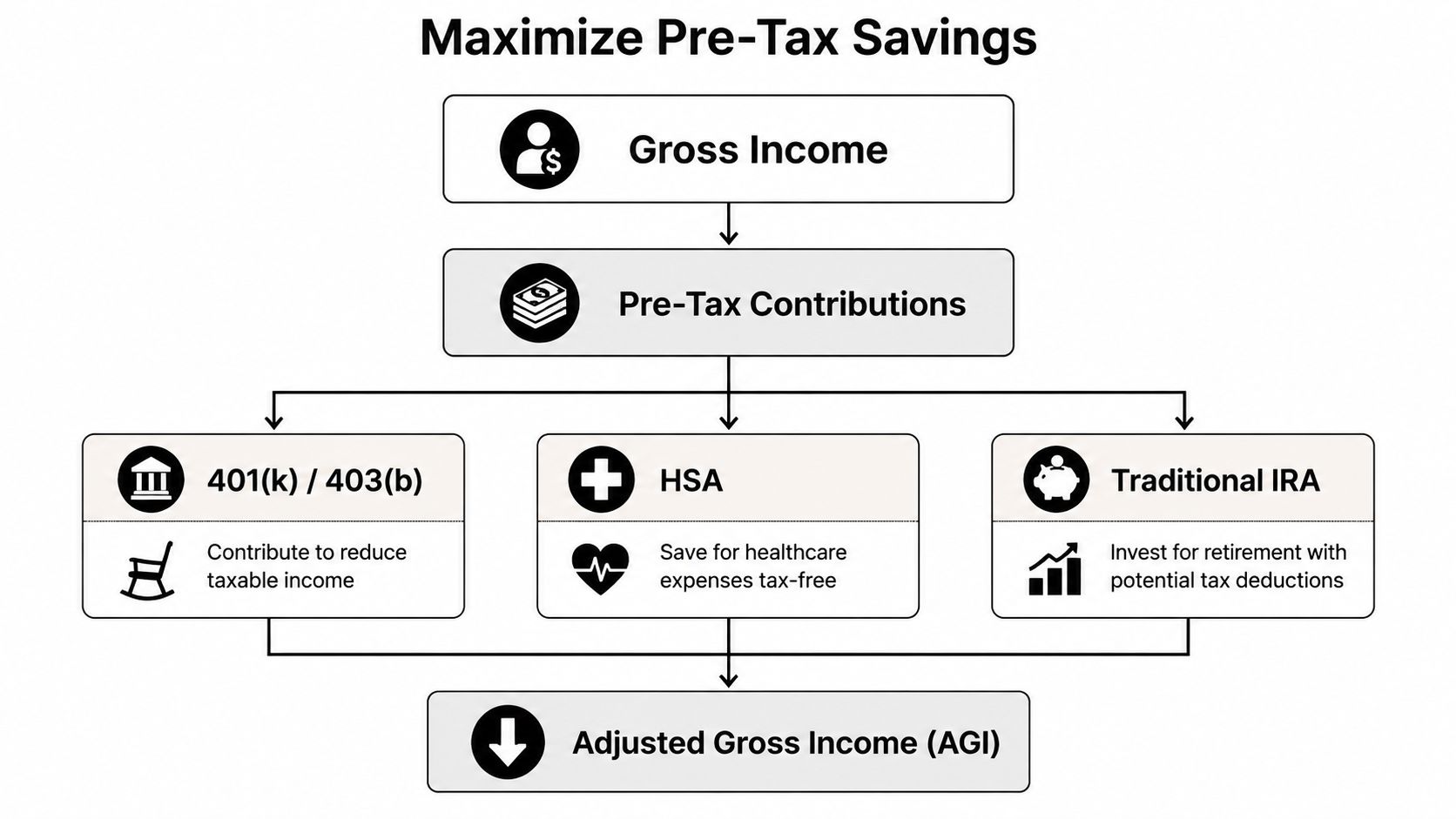
If you want the most direct answer to how to lower your AGI, start here. Pre-tax contributions are the cleanest, most reliable tools because they reduce income before AGI is calculated.
The IRS states that for tax year 2026, the 401(k) contribution limit is $24,500, and individuals ages 60 to 63 can contribute an extra $11,250. Using those limits, a taxpayer earning $100,000 could reduce AGI to as low as $68,500 through maximum contributions to these tax-advantaged accounts, according to the IRS guidance on lowering AGI for the next filing season.
Start with payroll deductions
For employees, payroll is where AGI planning usually succeeds or fails. If you wait until year-end and hope to patch things together, you may run out of time or cash flow.
A practical sequence looks like this:
- Increase your 401(k) or similar workplace plan contribution first. This is the most visible dollar-for-dollar AGI reduction available to many wage earners.
- Check whether your employer offers a 403(b) or TSP instead. The concept is the same. Pre-tax salary deferrals lower current taxable income.
- Review your final pay periods early. If you've had a raise, bonus, or uneven income during the year, your withholding and contribution pattern may not be where you think it is.
The taxpayers who benefit most from retirement contributions aren't always the ones with the highest income. They're the ones who make the election early enough for payroll to do the work.
Traditional IRAs can also fit into the plan, depending on your situation and eligibility. Timing matters, and many people confuse the contribution window with the filing deadline. If you're trying to coordinate year-end planning, this guide on the IRA contribution deadline and tax timing helps avoid an easy mistake.
For taxpayers looking beyond standard employer plans, alternative retirement assets can raise separate compliance questions. If you're exploring precious metals inside a retirement structure, it's worth reviewing the rules before acting. This overview of understanding gold and silver IRA regulations is useful because the custody and asset rules are stricter than many people expect.
Use HSAs and IRA timing carefully
Health Savings Accounts deserve more attention than they get. They lower AGI and support future medical spending, which makes them one of the more efficient tools available to eligible taxpayers.
Porter Brown notes that for 2026, HSA contributions are $4,400 for individuals and $8,750 for families, and those contributions are pre-tax and directly reduce AGI in its discussion of year-end AGI reduction strategies.
A few practical points matter here:
- Confirm plan eligibility first. An HSA only works if you're covered by a qualifying high-deductible health plan.
- Don't confuse HSA and FSA rules. They don't operate the same way, and mixing them up can create compliance issues.
- Use the deduction as part of a broader plan. HSA contributions are most effective when they support both tax planning and a real healthcare funding strategy.
A common mistake is treating every retirement contribution as equally helpful for AGI. They aren't. Pre-tax contributions reduce current AGI. Roth contributions generally don't. That doesn't make Roth accounts bad. It just means they solve a different problem.
Use Investment Strategies to Lower Your Tax Bill
Once retirement and health accounts are in good shape, taxable investments become the next planning area. With these investments, careful moves can reduce current tax friction, but sloppy execution can create disappointment fast.

Harvest losses with intent
Tax-loss harvesting sounds simple. In principle, it is. You sell investments that are down in value in a taxable account and use those losses to offset gains.
The key phrase is in a taxable account. Selling a losing position inside an IRA or 401(k) doesn't create the same tax result. I still see taxpayers assume all losses are interchangeable. They aren't.
A disciplined process looks like this:
- Review holdings with unrealized losses before year-end. Focus on positions that no longer fit your investment plan, not just anything showing red.
- Match the sale to actual gains if possible. Harvesting works best when it offsets realized capital gains you've already created elsewhere.
- Document the transaction trail. Your brokerage statement helps, but your tax file should also show why the sale happened and what you bought next.
If you want a plain-English explanation of how harvested losses are treated, this resource on the capital loss deduction and its limits is helpful.
The trap here is emotional investing. Taxpayers sell solely for the tax benefit, then rush back into the same or substantially similar position without understanding the wash-sale issue. Good tax planning still has to respect the investment rules.
Donate appreciated shares instead of cash
There is a better charitable strategy for many investors than writing a check. If you own appreciated securities in a taxable account and have held them for more than one year, donating those shares directly to a qualified charity can produce a stronger tax outcome than selling first and donating cash.
Porter Brown explains that donating appreciated securities held for more than one year to IRS-approved charities can provide a deduction for the full fair market value without triggering gain taxation, in the same discussion of AGI reduction methods through investing and giving.
That gives you two potential advantages at once:
| Strategy | Tax friction | Potential deduction treatment |
|---|---|---|
| Sell appreciated stock, then donate cash | Gain may be recognized | Cash donation rules apply |
| Donate appreciated stock directly | Gain may be avoided | Fair market value may be deductible if requirements are met |
Give the asset with the embedded gain, not the cash you would've had left after tax. That's often the cleaner move.
This doesn't mean every appreciated holding should be donated. Some assets are better retained, some charities aren't equipped to accept securities smoothly, and timing can matter. But for charitably inclined taxpayers with brokerage gains, it deserves a close look.
Deductions for Business Owners and Real Estate Investors
Employees usually have a shorter list of AGI tools. Business owners and real estate investors have more levers, but also more ways to get the planning wrong.
Business owners need coordinated planning
If you're self-employed, your AGI strategy shouldn't start with random expense hunting in March. It should start with entity structure, bookkeeping quality, and retirement plan selection.
U.S. Bank notes that self-employed individuals can use SEP or SIMPLE IRAs to deduct up to 25% of net earnings, offering a flexible AGI reduction path, in its overview of ways to reduce taxable income.
That matters because the retirement plan menu for self-employed taxpayers is different from what a W-2 employee sees. A freelancer, consultant, or sole proprietor may have room to make meaningful deductions if records are current and net earnings are measured correctly.
Here are the practical pressure points I watch most closely:
- Bookkeeping first: If income and expenses aren't clean, retirement contribution calculations will be unreliable.
- Entity fit: S corporation owners need to coordinate payroll, distributions, and retirement planning together. Looking at only one piece usually creates distortion.
- Documentation: Business deductions are strongest when they tie back to a clear business purpose and consistent recordkeeping.
For self-employed buyers trying to line up tax planning with mortgage readiness, lending documentation can become part of the conversation. A review of New American Funding, LLC. programs for self-employed mortgage borrowers can help you see how lenders may view business income and documentation differently from the IRS.
Real estate deductions work differently
Rental property can create meaningful deductions, but taxpayers often misunderstand what those deductions can and can't do. Depreciation is powerful. So are properly tracked rental expenses. But passive activity rules and professional status rules affect how much benefit you can use against other income.
Real estate investors should pay attention to three issues:
- Depreciation isn't optional in practice. If a property is placed in service, the tax treatment gets technical quickly.
- Repairs and improvements aren't the same. Misclassifying them can distort the return.
- Material participation matters. The ability to use losses against other income often turns on facts and records, not intention.
A rental property can look profitable in cash terms and still show a tax loss. That can be useful, but only if the return reflects the activity correctly.
This is also where taxpayers tend to overestimate what software can do without context. A program can place numbers on forms. It can't tell you whether your level of participation, grouping approach, or expense classification will hold up.
Lowering AGI to Unlock Valuable Tax Credits
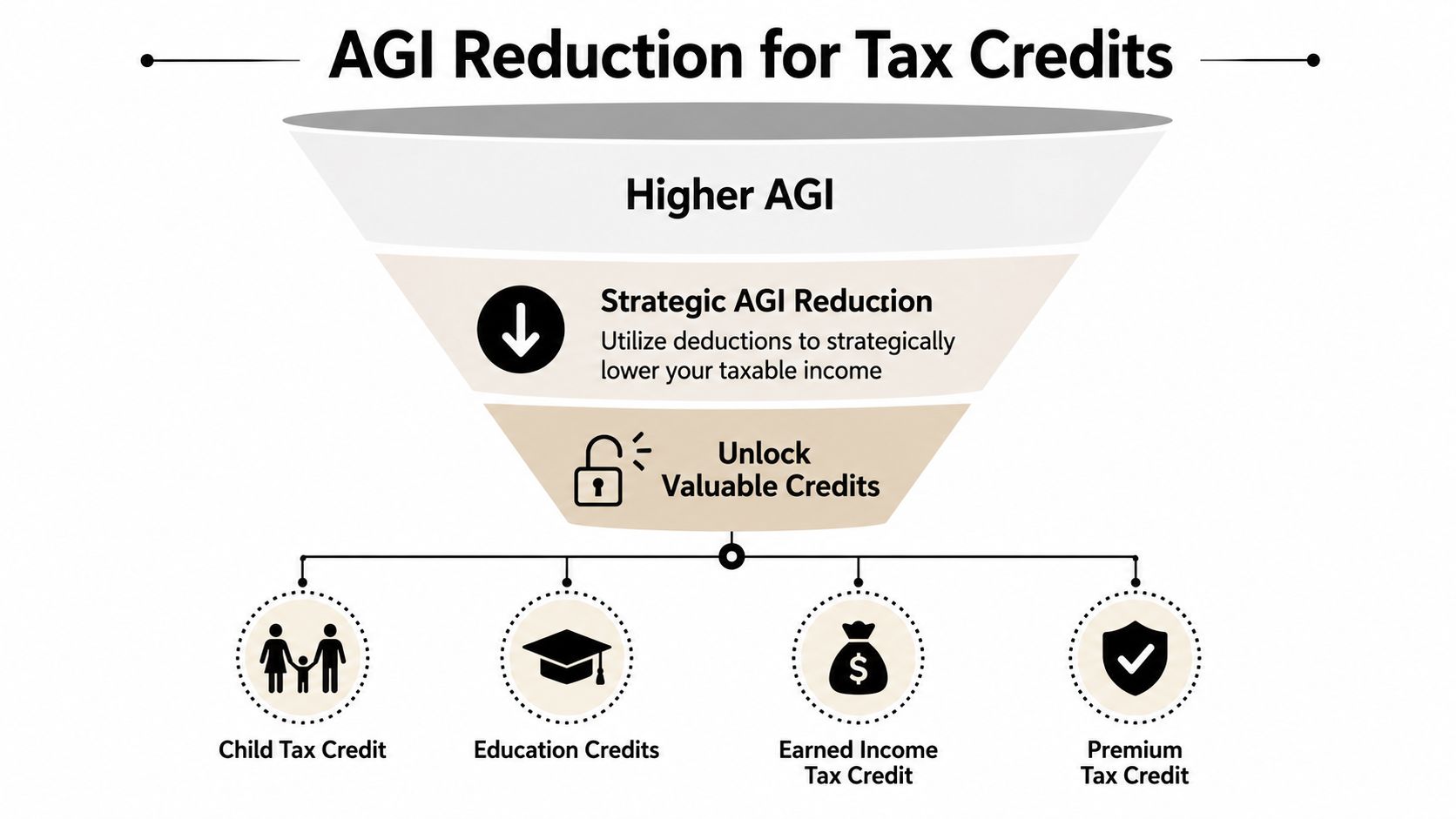
AGI reduction is commonly perceived as a way to lower tax on income already earned. That's only half the story. The more valuable perspective is this: AGI is often the gate that determines whether you receive a credit at all.
The real payoff is often outside the tax bracket
Verified tax planning data shows that over 40% of income-based tax credits are directly phased out as AGI rises, and nearly 28 million households missed eligible credits due to AGI mismanagement, leaving a potential $1,200 to $3,500 in credits annually on the table.
That changes the conversation. A taxpayer doesn't always need a dramatic income drop to improve the result. Sometimes they need a narrow, intentional AGI reduction that keeps a credit from shrinking or disappearing.
The credits that commonly enter this discussion include child-related credits, education credits, and retirement savings incentives. Each has its own rules, but they share the same practical reality. If AGI lands too high, the value starts to erode.
A small AGI change can change the outcome
Many do-it-yourself tax plans often miss the mark. They ask, "Will this contribution save me tax?" The better question is, "Will this move preserve a credit I was about to lose?"
Consider the difference between these two approaches:
- Tax-only thinking: You look at a retirement contribution solely for its current deduction.
- Credit-access thinking: You ask whether that same contribution also keeps education or family-related tax benefits available.
That second mindset is usually stronger because it measures the full effect. Lower AGI can improve multiple parts of the return at once.
A useful way to think about it is this:
| AGI planning mindset | What the taxpayer focuses on | What often gets missed |
|---|---|---|
| Narrow view | Tax bracket only | Credit eligibility |
| Strategic view | AGI plus phaseouts | Combined tax outcome |
When AGI is close to a phaseout line, a modest contribution can do more than reduce tax. It can restore benefits that felt "mysteriously" unavailable.
This is why year-end tax planning meetings matter so much for families. A household with tuition payments, dependents, investment income, and retirement contributions isn't dealing with one tax issue. It's managing a chain reaction. If AGI comes down in the right way, the return can improve from more than one angle.
Common Mistakes and When to Partner with a Tax Pro
The right AGI strategy is rarely flashy. It's usually a set of ordinary decisions made on time and documented well. The mistakes happen when taxpayers mix good ideas with poor timing or incomplete facts.

Mistakes that undo good planning
One common problem is assuming every retirement move lowers AGI. It doesn't. A Roth conversion, for example, can increase current-year taxable income and change the rest of the return in ways taxpayers didn't anticipate.
Another is treating state tax rules as if they follow the federal return exactly. Verified planning data notes that 32 states now have unique AGI calculations, and a 2025 study found that 19% of multi-state taxpayers filed incorrectly because of AGI discrepancies, with average penalties of $1,450.
That matters in real life for remote workers, military families, business owners with activity in more than one state, and anyone who moved during the year. A federal strategy can still be sound while the state treatment changes.
A short checklist helps catch the biggest issues:
- Wrong account type: Pre-tax and Roth dollars don't affect AGI the same way.
- Bad timing: Waiting until filing season closes off options that required payroll or year-end action.
- Incomplete state review: Multi-state returns can break from federal AGI treatment in important ways.
- Investment sloppiness: A tax-motivated sale still has to respect the underlying tax rules and holding requirements.
When DIY tax planning stops working
Some returns are still straightforward enough for basic software and a careful taxpayer. Others aren't. If your return includes a business, rentals, large investment activity, income from more than one state, or a year with major life changes, AGI planning usually becomes a coordination problem rather than a form-entry problem.
A practitioner earns their fee not by reciting deduction categories, but by seeing how one move affects the whole return. Increase a retirement contribution, and that may affect credits. Harvest a loss, and that may change gain planning. Shift states midyear, and now the federal answer may not finish the job.
Allied Tax Advisors is one option for taxpayers who need coordinated planning, especially when the return involves individual taxes, business income, rental property, capital gains, or state compliance issues.
If you're asking whether a move lowers AGI, that's a tax preparation question. If you're asking which move lowers AGI without creating a new problem somewhere else, that's tax planning.
The best time to ask for help is before the deadline pressure sets in. That's when there are still choices to make.
If you'd like a second set of eyes on your AGI strategy, Allied Tax Advisors works with individuals, families, business owners, and real estate investors who need practical tax planning before filing season locks in the outcome.