
Let's get straight to the point: if you owe the IRS, your federal income tax payment is due on April 15th. This date is the anchor for the entire U.S. tax system, serving as the deadline for both filing your return and paying what you owe. Think of it as a firm, non-negotiable date circled on the national calendar.
Understanding the April 15 Tax Payment Deadline

The question "if I owe taxes when are they due" has one primary answer, but the distinction between filing and paying is where many people get into trouble. It's best to view these as two separate obligations that just happen to share the same initial due date.
Imagine you have a final project for school. You might get an extension to hand in the paper late, but the professor is still going to grade you based on the work that was supposed to be done by the original deadline. Tax payments work the same way. You can request an extension to file your paperwork, but your tax payment is still due on April 15th.
The History and Scope of Tax Day
This date is a cornerstone of the American financial system. Since being moved from March 15 back in 1954 to give taxpayers more time, April 15 has become synonymous with taxes. It's a huge deadline for millions; the IRS expects over 160 million individual returns each year, and a good chunk of those filers will have a balance due.
In fact, some projections show that roughly 40% of filers owe taxes, which means about 64 million people are writing a check to the government. If you want to see how this compares to other countries, you can find some great insights about global tax deadlines on Omnipresent.com.
Key Takeaway: The single most important thing to remember is this: filing an extension for your tax return does not grant you an extension to pay the taxes you owe. The payment deadline is fixed.
Understanding this fundamental rule is the first step in avoiding unnecessary—and often costly—penalties and interest. The IRS is crystal clear on this: your payment must be postmarked or electronically submitted by that critical date. Any delay, even by a single day, can trigger financial consequences.
The rest of this guide will break down what happens when you miss the deadline and, more importantly, what you can do about it.
The Truth About Filing an Extension
Let’s clear up one of the most common—and most expensive—misconceptions in the tax world: the filing extension. A lot of people assume that getting more time to file your return also means you get more time to pay what you owe. That’s a critical misunderstanding that can land you in a world of hurt with penalties and interest.
Think of it like this: your property tax bill is due on a specific date. You might get an extension to submit some paperwork related to your property assessment, but the county still wants its money by the original due date. The deadline for payment is firm.
A tax extension works the same way. When you file Form 4868, Application for Automatic Extension of Time To File U.S. Individual Income Tax Return, the IRS grants you an automatic six-month grace period to get your paperwork in order. This pushes your filing deadline from April 15th to October 15th.
Crucial Distinction: An extension to file is not an extension to pay. Your tax payment is still due on the original April 15th deadline, no matter what.
This means that even with an approved extension, the clock on penalties and interest for any unpaid balance starts ticking on April 16th. So, how do you handle this the right way?
How to Properly File an Extension and Pay
The trick is to make a solid estimate of what you'll owe. You don't need every last document to do this. Grab your recent pay stubs, look at your bank statements, and use last year’s tax return as a guide to project your tax liability for the current year.
Once you have a reasonable number, you need to pay that amount by the April deadline.
Here’s the simple, correct way to do it:
- Estimate Your Tax Liability: Do a "back-of-the-napkin" calculation of your income and deductions to get a close approximation of your total tax bill.
- Submit Your Payment: Send what you estimate you owe to the IRS by April 15th. You can easily do this online when you e-file Form 4868 or use one of the other IRS payment methods.
- File Your Return by October 15th: With your payment in, you've bought yourself time. Now you can finalize everything and file your accurate return by the extended deadline.
By paying your estimated tax by the original deadline, you stop the nasty Failure to Pay penalty and interest charges from piling up. If it turns out you owe a little more when you finally file, you’ll only face penalties on that small remaining balance, not the entire amount. This is the key to separating the act of filing from the non-negotiable act of paying.
The Four Seasons of Estimated Tax Payments
For anyone who isn't a traditional W-2 employee—think freelancers, gig workers, and small business owners—that big April 15th tax deadline is only one piece of a much larger puzzle. The IRS doesn't want you to wait a full year to settle up if you're earning income without automatic tax withholding. They expect you to pay into the system as you earn.
Welcome to the world of estimated tax payments. It's essentially a pay-as-you-go system designed to keep you on track and prevent a shocking tax bill when you finally file your return. Think of it less like a single annual event and more like a quarterly subscription service for your tax obligations. You're making four smaller, more manageable payments throughout the year instead of one giant one.
This system is a win-win. It helps you avoid the sticker shock of a huge lump-sum payment, and it provides the government with the steady revenue stream it needs to operate.
Who Needs to Pay Estimated Taxes?
So, who needs to get on this quarterly schedule? As a rule of thumb, if you expect to owe at least $1,000 in tax for the year (after factoring in any withholding from other jobs and your refundable credits), you'll likely need to make estimated payments.
This typically applies to a few key groups:
- Self-employed individuals: This is the big one—freelancers, independent contractors, and sole proprietors.
- Small business owners: This includes partners and S corporation shareholders.
- Investors: If you have significant income from dividends, interest, or capital gains.
- Landlords: Anyone earning income from rental properties.
Figuring out how much to pay involves a bit of forecasting. You'll need to project your annual income, deductions, and credits. If your income is complex—say, from a rental property—digging into resources on rental property tax deductions can make a real difference in what you owe. For a deeper dive, our guide on quarterly estimated tax payments breaks down the whole calculation process.
The core idea is simple: if you're earning it now, the IRS wants you to pay tax on it now. Staying on top of these payments is the single best way to avoid the dreaded underpayment penalty.
The payment schedule is broken down into four distinct periods, each with its own non-negotiable deadline. Missing these dates is one of the most common—and easily avoidable—mistakes that can lead to penalties. Getting this cycle down is fundamental to managing your tax life like a pro.
The Real Cost of Paying Your Taxes Late
Missing the tax payment deadline is more than just a simple slip-up; it's a financial mistake that can quickly snowball. The IRS has a system of penalties and interest designed to collect what's owed, and it can inflate your original tax bill into something much more daunting. Getting a handle on how this system works is the first step in protecting your wallet.
The two main penalties to be aware of are the Failure to File and the Failure to Pay penalties. They sound similar, but one is far more punishing than the other.
Failure to Pay vs. Failure to File
The Failure to Pay penalty is relatively straightforward. The IRS charges 0.5% of the unpaid taxes for each month (or even part of a month) that your bill remains outstanding. This penalty keeps adding up until it hits a cap of 25% of your unpaid tax liability. It's a slow and steady drain on your finances.
But the Failure to File penalty is the one you really need to watch out for. This one is a whopping 5% of your unpaid taxes for each month your return is late. That's ten times more severe than the failure-to-pay penalty. It also caps out at 25%, but it gets you there much, much faster.
This is exactly why you should always file on time, even if you don’t have the money to pay. You can learn more about how to sidestep these expensive IRS penalties for late tax filing.
The Golden Rule of Tax Debt: Always file your tax return by the deadline, even if you cannot afford to pay what you owe. Filing on time avoids the much larger Failure to File penalty.
And it doesn't stop there. On top of these penalties, the IRS charges interest on everything you owe—the original tax, plus the penalties. The rate can change every few months and, critically, it compounds daily. This mix of penalties and compounding interest is the perfect recipe for turning a small tax debt into a major financial headache.
For anyone who is self-employed or has other income not subject to withholding, this is where estimated taxes come in. The system is designed to keep you on track throughout the year to avoid a nasty surprise in April.
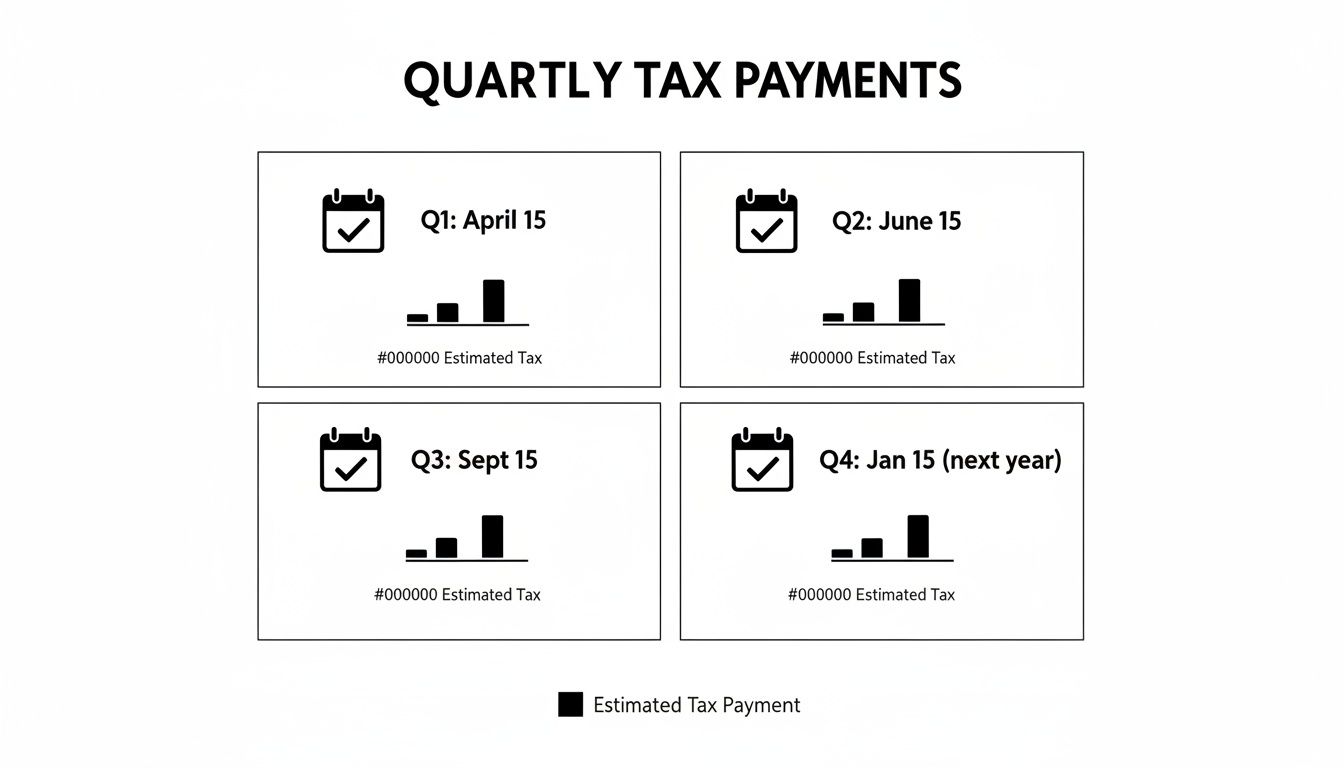
This just goes to show that for many people, staying on top of taxes is a year-round job, not just a once-a-year event.
A Real-World Example
Let's see how this plays out with some real numbers. Imagine you owe $5,000 in taxes and you completely miss the April 15 deadline—no filing, no paying—for three full months.
Here’s what the damage would look like:
- Failure to File Penalty: At 5% per month, three months costs you 15%. (15% of $5,000 = $750)
- Failure to Pay Penalty: At 0.5% per month, three months costs you 1.5%. (1.5% of $5,000 = $75)
- Total Penalties: $750 + $75 = $825
That's an extra $825 tacked onto your bill, and this calculation doesn't even factor in the daily compounding interest. In just 90 days, your original debt has ballooned by over 16%.
This is a powerful argument for implementing effective budgeting strategies that plan for your tax obligations ahead of time. Knowing the true cost of being late is the best motivation to stay on schedule.
You’ve wrestled with your federal return and figured out what you owe the IRS. That’s a huge hurdle cleared, but don’t close your laptop just yet—you’re only halfway there. Now it's time to deal with your state's department of revenue, and this is where things can get tricky.
It’s one of the most common—and costly—assumptions taxpayers make: that state tax deadlines are always the same as the federal ones. While most states do piggyback on the federal April 15th deadline for the sake of simplicity, "most" isn't "all." Banking on that assumption without checking can land you in hot water with a surprise penalty notice.
Some states, for instance, have their own quirky deadlines later in April or even in a different month entirely. Think of it as a patchwork quilt of rules, and you need to know exactly which square you live in.
Why You Can't Ignore Your State's Tax Rules
Beyond just the main filing deadline, states play by their own rulebook on almost everything tax-related. You can't just assume a federal extension gives you a pass with the state, or that the penalty for being a few days late will be the same.
Here are a few key areas where state rules often go their own way:
- Filing Extensions: Some states are easygoing and will automatically grant you an extension if you filed for one with the IRS. Others demand you fill out their own separate state-specific form.
- Estimated Tax Payments: If you're self-employed or have other income without withholding, your quarterly estimated tax due dates might not line up perfectly with the federal schedule.
- Penalties and Interest: The sting of paying late is determined by state law. Some states are more forgiving than the IRS, while others can be much harsher.
This isn't just an American phenomenon. Tax deadlines are all over the map globally. For example, corporate tax due dates in Europe vary wildly, from January in the UK to July in Germany, as each country sets its own fiscal calendar. You can see a great breakdown of these corporate income tax due dates on PWC.com.
Crucial Reminder: Think of your state and federal taxes as two completely separate obligations. Always, always double-check the specific deadlines for filing, payment, and extensions directly on your state's official department of revenue website.
And don't forget, a handful of states don't even have a personal income tax, which changes the game entirely for their residents. This just goes to show how critical it is to treat your state taxes as a unique task. A few minutes of verification now can save you a world of financial headaches later.
What to Do When You Owe but Cannot Pay

It’s a gut-wrenching moment: you’ve finished your taxes, and the amount you owe is far more than you can afford right now. That kind of stress can be overwhelming, but you do have options.
The single worst thing you can do is stick your head in the sand and hope the problem disappears. It won't. In fact, being proactive and communicating with the IRS is your most powerful move.
The IRS has several programs designed specifically for people who can't pay their tax bill in full by the deadline. Think of them less as a last resort and more as established pathways to get yourself back on solid financial footing. Ignoring the debt just lets penalties and interest pile up, turning a manageable issue into a much bigger one.
Instead of panicking, it’s time to take action. Understanding the relief options available is the first step toward resolving your tax debt without derailing your entire financial life. Believe it or not, the IRS is much more willing to work with taxpayers who face the problem head-on.
Explore Short-Term and Long-Term Payment Plans
If you just need a little more breathing room, the IRS offers a short-term payment plan. This can give you up to 180 additional days to pay your balance in full. It’s a great solution for a temporary cash-flow crunch, but keep in mind that interest and penalties still apply until the balance is zero.
For a larger debt that will take longer to tackle, a long-term installment agreement is the most common path. This is a formal arrangement that lets you make manageable monthly payments for up to 72 months. For many people, setting one up is a simple process you can do right on the IRS website, as long as your total debt is below a certain threshold. It provides a predictable way to chip away at what you owe.
Key Insight: At the end of the day, the IRS would rather receive smaller, consistent payments over time than nothing at all. Setting up a payment plan shows you’re trying to comply and can stop more aggressive collection actions in their tracks.
Other IRS Relief Programs
What if your financial hardship is more severe? In that case, other options might be on the table. These programs are more complex and have stricter eligibility rules, but they can offer life-changing relief for those who qualify. Digging into how to negotiate with the IRS can give you a much clearer picture of these advanced strategies.
Here are two major programs designed for taxpayers in significant financial distress:
- Offer in Compromise (OIC): This program allows certain taxpayers to settle their tax debt with the IRS for a lower amount than what they originally owed. An OIC is usually only considered when there’s serious doubt that the taxpayer could ever pay the full amount.
- Penalty Abatement: Sometimes, you can get certain penalties removed. This is often granted if you can show a reasonable cause for failing to pay on time, like a serious illness, a death in the family, or a natural disaster.
So, while the answer to "if I owe taxes when are they due" is always the original deadline, the IRS provides multiple ways to manage the payment if you can’t meet it. Taking the initiative to explore these plans is absolutely the best way forward.
Got Questions About Tax Deadlines? We’ve Got Answers.
When it comes to taxes, a few common questions pop up year after year. Let’s clear up some of the confusion around payment deadlines.
What if the Tax Deadline Falls on a Weekend or Holiday?
It happens more often than you'd think. If the usual April 15th deadline lands on a Saturday, Sunday, or a legal holiday (like Emancipation Day in Washington, D.C.), you get a little extra time.
The deadline automatically bumps to the next business day. This applies to both filing your return and, crucially, paying what you owe. I always tell my clients to double-check the IRS calendar at the start of the year just to be safe.
Can I Pay My Taxes with a Credit Card?
Yes, you absolutely can. The IRS lets you pay through a few approved third-party payment processors using a credit or debit card. It can be a real lifesaver if you're a bit short on cash when the bill comes due.
Just be mindful of the trade-off. These services charge a convenience fee, usually a percentage of your tax bill. Before you swipe, make sure you account for that extra cost.
A Quick Word on Amended Returns: Filing a Form 1040-X to amend your return doesn't give you a new payment deadline. If you discover you owe more, the IRS considers that extra tax to have been due back on the original April 15th. Pay it as soon as you can to keep penalties and interest from piling up.
At Allied Tax Advisors, our job is to provide clear, straightforward answers to simplify your tax journey. If you're facing a complex tax situation, our team is here to help you understand your obligations and find the best path forward. Visit us at https://alliedtax.com to learn more.