
You open the envelope after a long day and see the words Notice of Intent to Levy. Your first thought is usually that the IRS is about to empty your bank account or take your next paycheck. Don't panic, but don't put the letter aside either. An IRS levy notice is serious because it signals that the IRS intends to seize wages, bank funds, or other property, yet it also gives you a procedural opportunity to act before that happens.
The most important mistake is treating the notice as another routine balance-due letter. The issue is timing. The notice may arrive before any seizure, while the IRS's deadline is already running from the date printed on the document. Your response should begin today, with verification, deadline control, and a properly prepared request for relief.
Table of Contents
- Understanding What an IRS Levy Notice Means
- How to Verify and Interpret Your Notice
- Immediate Steps You Should Take After Receiving a Notice
- Relief Options That Can Stop or Delay the Levy
- Practical Tips for Dealing with the IRS During a Levy
- When to Hire a Tax Professional and Get Local Help
Understanding What an IRS Levy Notice Means
An IRS levy notice is a formal warning that the IRS intends to use its legal collection power against property or rights to property. That can include wages, bank accounts, certain refunds, and other assets. The notice generally gives you 30 days to pay, arrange a payment plan, or request a Collection Due Process hearing before levy action begins, as described in the IRS guidance on understanding a CP90 notice.
That makes the letter different from an ordinary tax bill. Earlier collection notices may tell you that the IRS believes you owe money and ask you to pay. A final levy notice adds an enforcement warning and explains your hearing rights. In practice, taxpayers may see final collection letters such as CP90 or CP297, and the notice may follow earlier correspondence that the taxpayer overlooked or never resolved.
Why the notice matters
The 30-day period is the central safeguard in the levy process. It isn't a courtesy extension that you can safely ignore. It gives you a defined opportunity to challenge the collection process, propose a payment arrangement, or present financial information showing why immediate collection would be inappropriate.
The IRS states that the notice informs you of both its intent to levy and your right to a hearing. The Taxpayer Advocate Service explanation of a Notice of Intent to Levy also emphasizes that the notice is sent when taxes remain unpaid and the IRS is pursuing collection if the debt isn't resolved.
Practical rule: Treat the date on the notice as the controlling date, not the day you finally opened the envelope.
Warning versus seizure
Receiving the notice doesn't necessarily mean your bank account has already been frozen or your wages have already been garnished. It does mean the IRS may move toward those actions after the applicable period, unless you resolve the debt or successfully invoke a remedy.
The distinction between a lien and a levy also matters. A lien is a legal claim securing a tax debt. A levy is the actual taking of money or property. If you need a plain-English explanation of the difference and the broader collection process, review what a tax levy means. Your immediate objective is to determine where your case stands and protect the rights that are still available.
How to Verify and Interpret Your Notice
A levy notice can sit unopened while the response clock runs. Before taking action, identify exactly what the IRS sent, whether it sets a hearing deadline, warns of future enforcement, or shows that a levy has already reached a bank or employer. The gap between notice and seizure is your opportunity to act, not permission to wait.
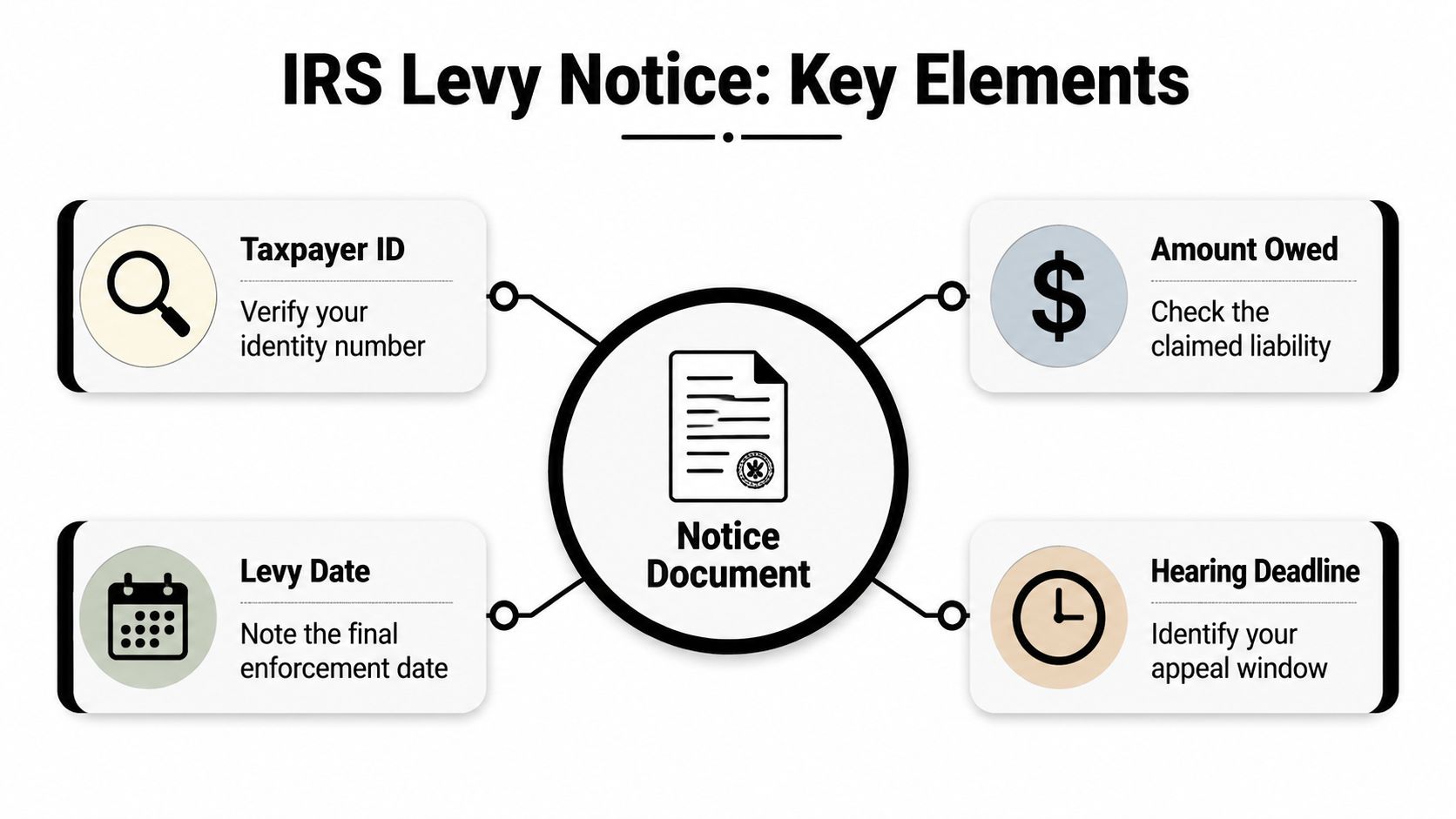
Read the upper portion of the letter first. Record the notice or letter number, notice date, tax periods, claimed balance, and response deadline. CP90 and CP297 commonly identify final collection warnings. An LT11 or L-1058 may identify a final Notice of Intent to Levy and Notice of Your Right to a Hearing. Base your response on the wording in your letter, not on another taxpayer's experience.
Check the liability before choosing a remedy
Compare the IRS balance with your records. Verify the taxpayer identification information, tax year, assessment, credited payments, penalties, and interest. If the amount does not match, obtain account and return transcripts through the IRS or follow this guide to get an IRS transcript online. Do this before selecting a payment arrangement or challenging collection.
Read the rights section line by line. Find the instructions for Form 12153, the Collection Due Process hearing, the filing deadline, and the address or submission method listed by the IRS. A correctly completed form sent to the wrong location can still create a preventable procedural problem.
Understand the timing gap
The notice normally arrives before the actual seizure, but the available time may be short. Once the response window closes, the IRS can pursue third-party collection. A bank or employer may receive levy instructions before you understand what occurred, restricting funds or reducing a paycheck without the appearance of a traditional IRS seizure.
The Taxpayer Advocate Service describes this notice as the final reminder before the IRS can seize wages, bank accounts, a state tax refund, or other property. It reports that third-party levy activity reached 339,137 in FY2025, the highest level since FY2020, and rose 8.1% from FY2024. Those figures appear in its Taxpayer Advocate Service notice guidance.
The practical rule is simple: confirm the deadline immediately and treat the 30-day window as a deadline for action. “Nothing has been seized yet” does not mean the case is inactive.
Immediate Steps You Should Take After Receiving a Notice
A levy notice can arrive while your bank account and paycheck still look normal. That timing gap is your opportunity to act, not a reason to wait. Work in a fixed order so the IRS does not reach a third party before you have chosen a response.
Follow this response sequence
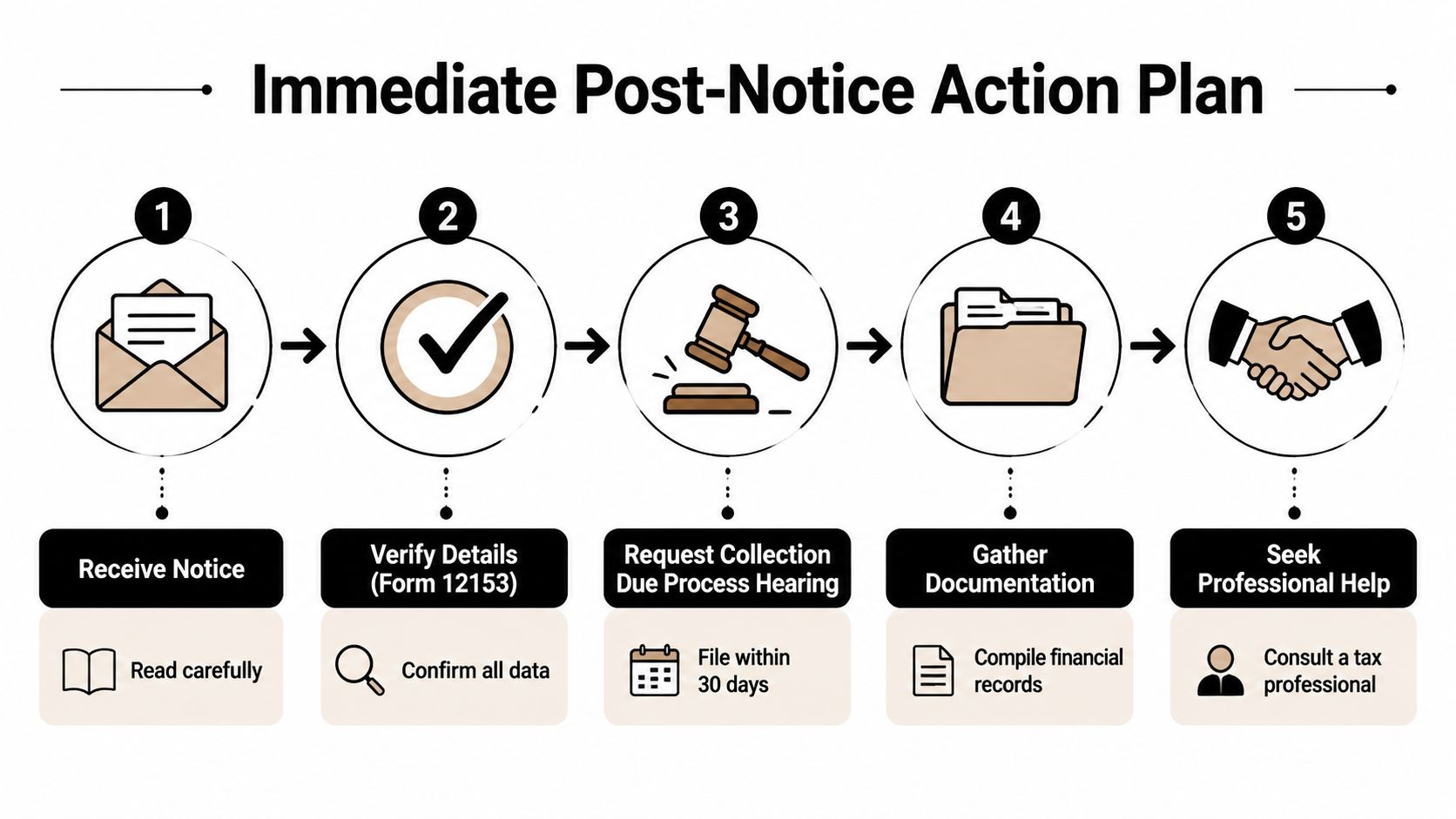
Calendar the deadline immediately. Find the date printed on the Notice of Intent to Levy and set reminders well before it. The response period for a timely CDP request is generally 30 calendar days. Treat that window as an action deadline.
Prepare Form 12153. Use Form 12153 to request a Collection Due Process hearing. List each relevant tax period, identify the collection alternative or issue you want considered, sign the form, and follow the instructions on your notice.
Send it to the correct address. Use the filing address printed on the notice, not a generic IRS address found online. Keep a complete copy and proof of delivery. A properly completed form sent to the wrong location can still create a preventable problem.
Gather financial records. Assemble income records, bank statements, housing costs, ordinary living expenses, business records, loan obligations, asset information, and proof of payments or disputed credits. The IRS needs a credible financial picture, supported by documents.
Choose a resolution track. Depending on the facts, you may pursue an installment agreement, an offer in compromise, currently not collectible status, full payment, or another appropriate collection position. Set the payment amount from your actual budget. An arrangement that you cannot maintain may default and lead to renewed enforcement.
Request levy protection through the proper process. A valid, timely CDP request generally moves the levy issue into Appeals review. The IRS Internal Revenue Manual explains the procedures for Collection Due Process cases and levy actions.
Do not assume that no seizure means no action is occurring. After the response window closes, the IRS may send levy instructions to an employer, bank, or another third party. Those instructions can restrict funds or reduce a paycheck before you see a traditional seizure.
A late request is not equivalent to a timely one. If you miss the 30-day period, you may generally request an Equivalent Hearing for up to 1 year, but the case can lose the full CDP protections and Tax Court review available with a timely filing. The Treasury Inspector General for Tax Administration explains the deadline issue and late-filing consequences in its review of Collection Due Process requests.
Critical Forms and Deadlines for Levy Response
| Form or Action | Deadline Window | Consequence of Missing It |
|---|---|---|
| Form 12153 for a CDP hearing | Generally 30 calendar days from the notice date | You may lose full CDP rights and Tax Court review of the levy action |
| Equivalent Hearing request | Generally available for up to 1 year after the CDP deadline | The IRS may review the matter, but the case has narrower protections |
| Appeals determination review | 30 days to petition Tax Court after the determination | You may lose the opportunity for Tax Court review |
If you prefer a payment arrangement, calculate an affordable amount before contacting the IRS. Use reliable guidance on setting up an IRS payment plan, then propose a plan you can maintain. Acting during the 30-day window gives you a better chance to protect your position before levy activity reaches your employer or bank.
Relief Options That Can Stop or Delay the Levy
Stopping a levy requires a credible resolution, not merely a request for more time. The right option depends on whether the liability is accurate, whether you can pay over time, and whether your current income and assets support collection.
An installment agreement fits taxpayers who can pay the balance through scheduled payments while staying current with new filing and payment obligations. It can be appropriate when cash flow is reliable but immediate full payment isn't realistic. The danger is agreeing to an amount that looks acceptable during a stressful phone call but exceeds your sustainable monthly capacity.
An offer in compromise may fit a taxpayer whose financial circumstances make full payment unlikely and whose income, assets, and ability to pay support a reduced settlement. The IRS evaluates the complete financial picture. This isn't a discount that anyone can obtain by asking, and a weak financial submission can waste time while enforcement pressure continues.
Match the remedy to the facts
Currently not collectible status is designed for situations where collection would prevent the taxpayer from meeting basic living expenses. It can delay active collection, but it doesn't erase the tax debt. The IRS may later review the taxpayer's financial condition, so current compliance and accurate documentation remain important.
A Collection Due Process hearing is different from those financial resolutions. It is a procedural opportunity to challenge the proposed collection action and present alternatives. You can use the hearing to raise appropriate issues, dispute certain collection defects, or propose an installment agreement, offer in compromise, or currently not collectible position.
The strongest levy response addresses two questions: Is the balance correct, and what specific action gives the IRS a workable path to collect?
Watch for exceptions
Standard pre-levy hearing expectations don't apply identically in every situation. IRS and Taxpayer Advocate Service materials identify exceptions involving state tax refunds, certain employment tax levies, federal contractors, and jeopardy situations. In those cases, the timing, remedy, or enforcement sequence can change materially.
Small-business owners deserve particular caution. A levy may involve payroll obligations, customers who owe the business money, or a third-party payer rather than a personal bank account. Landlords and independent contractors can also face collection complications when income moves through business relationships. If the notice involves a third party or says the IRS considers collection at risk, get professional review before assuming the ordinary 30-day process tells the whole story.
Practical Tips for Dealing with the IRS During a Levy
Your communication should be short, accurate, and supported by documents. IRS representatives need to know what you dispute, what you can offer, and what action you want taken. They don't need a long emotional history, and an unplanned call can produce statements that complicate later negotiations.
Use a written case summary with the notice number, tax periods, balance, deadline, payments made, filing status, and requested outcome. Keep copies of every form and letter. If you call, write down the representative's name or identifying information, the date, the substance of the discussion, and any promised follow-up.
Use plain, specific language
A useful opening is:
“I received a final Notice of Intent to Levy for the tax periods listed in the letter. I am reviewing the balance and requesting the appropriate collection process. I need confirmation of the filing instructions and the actions required to prevent levy activity while my request is considered.”
If hardship is part of the case, be concrete:
“The proposed levy would prevent me from paying necessary household or business expenses. I can provide income, expense, bank, and liability records supporting a collection alternative.”
Don't promise a payment you can't maintain. Don't transfer assets, close accounts, liquidate retirement funds, or take on expensive debt just because the letter frightened you. Those decisions can create new tax and financial problems without solving the underlying liability.

When to Hire a Tax Professional and Get Local Help
Self-guidance may be reasonable when the balance is clearly correct, your records are organized, and you can pay or maintain a straightforward arrangement. It becomes risky when the notice involves a third-party levy, business payroll, several tax years, disputed assessments, uncertain filing history, or a deadline that is close.
Bring in a CPA, enrolled agent, or tax attorney when you need someone to verify transcripts, prepare Form 12153, build a financial statement, communicate with IRS Appeals, or evaluate whether an exception changes your rights. Professional representation is especially valuable when a levy threatens wages, operating cash, customer payments, or funds needed for basic expenses.
A local firm can also coordinate federal and state problems rather than treating the IRS notice in isolation. Allied Tax Advisors, based in Clairemont, San Diego, provides IRS and state resolution services, including guidance with notices, levy matters, collection alternatives, and related tax compliance. Its team includes CPAs and enrolled agents who can review the notice and financial records before recommending a path.
Allied Tax Advisors is one option, not a substitute for reviewing your specific facts. The important decision is to act before the deadline, not after a bank or employer has already restricted access to your money.
Allied Tax Advisors can review your IRS levy notice, verify the response deadline, and help prepare a practical resolution strategy for your financial situation. Visit Allied Tax Advisors today to request help before the 30-day window closes.