
A roofing estimate lands in your inbox, and your first reaction probably isn’t about shingles or underlayment. It’s about taxes. If you’re staring at a major bill for a roof replacement, the question becomes very practical: is replacing a roof tax deductible?
The honest CPA answer is, it depends on the property and the type of work.
If the roof is on your personal home, the answer is usually no for an immediate deduction. If the roof is on a rental or business property, the answer is often yes, but not in the simple way many expect. And if you’re a landlord replacing an old roof, there’s one overlooked rule that can create a much bigger current-year write-off than many owners realize.
That’s where people get tripped up. They hear “home improvement,” “repair,” “credit,” “basis,” and “depreciation” as if those words all mean the same thing. They don’t. The IRS treats them very differently.
I’m going to walk through this the same way I would with a client in a tax planning meeting. We’ll separate personal-home rules from rental-property rules, use plain English, and keep the focus on what you can do with the cost of a new roof. If you own your home, you need to know when a roof helps your tax return through an energy credit or through your home’s basis. If you own rentals, you need to know how a roof becomes a depreciable asset and why the old roof may matter just as much as the new one.
Introduction A Costly Project with Tax Questions
Questions about roof deductions often arise when one is under pressure. A contractor says the roof can’t wait. A leak turns into structural damage. An insurer asks for documents. A landlord needs to turn a unit quickly. The tax question usually comes after the spending decision has already started.
That’s understandable. Roof replacement is one of those projects that feels like maintenance because you have to do it, but tax law often treats it as an improvement instead.
That distinction changes everything.
A homeowner replacing the roof on a primary residence usually can’t deduct that cost as a current home expense. A landlord replacing a roof on a rental usually can’t call it a repair either, but the landlord may recover the cost over time through depreciation and, in some cases, write off the remaining value of the old roof right away. Those are two very different outcomes from the same contractor invoice.
Practical rule: Before asking whether a roof is deductible, ask two earlier questions. Is this a personal residence or an income-producing property? And is this a repair or a full replacement?
People also confuse a deduction with a credit. They’re not the same. A deduction reduces taxable income. A credit reduces tax liability directly. That difference matters if you’re installing a qualifying energy-efficient roof on your primary home.
The tax treatment also changes based on documentation. The invoice wording, the date placed in service, whether the roof is on a duplex you partly occupy, and whether insurance reimbursed part of the work can all affect the answer. Good records don’t create deductions, but they often determine whether you can defend them.
The Critical Distinction Repair vs Improvement
A roof invoice can describe two jobs that sound similar but get very different tax treatment. The IRS looks past the contractor’s shorthand and asks what the work did to the property.
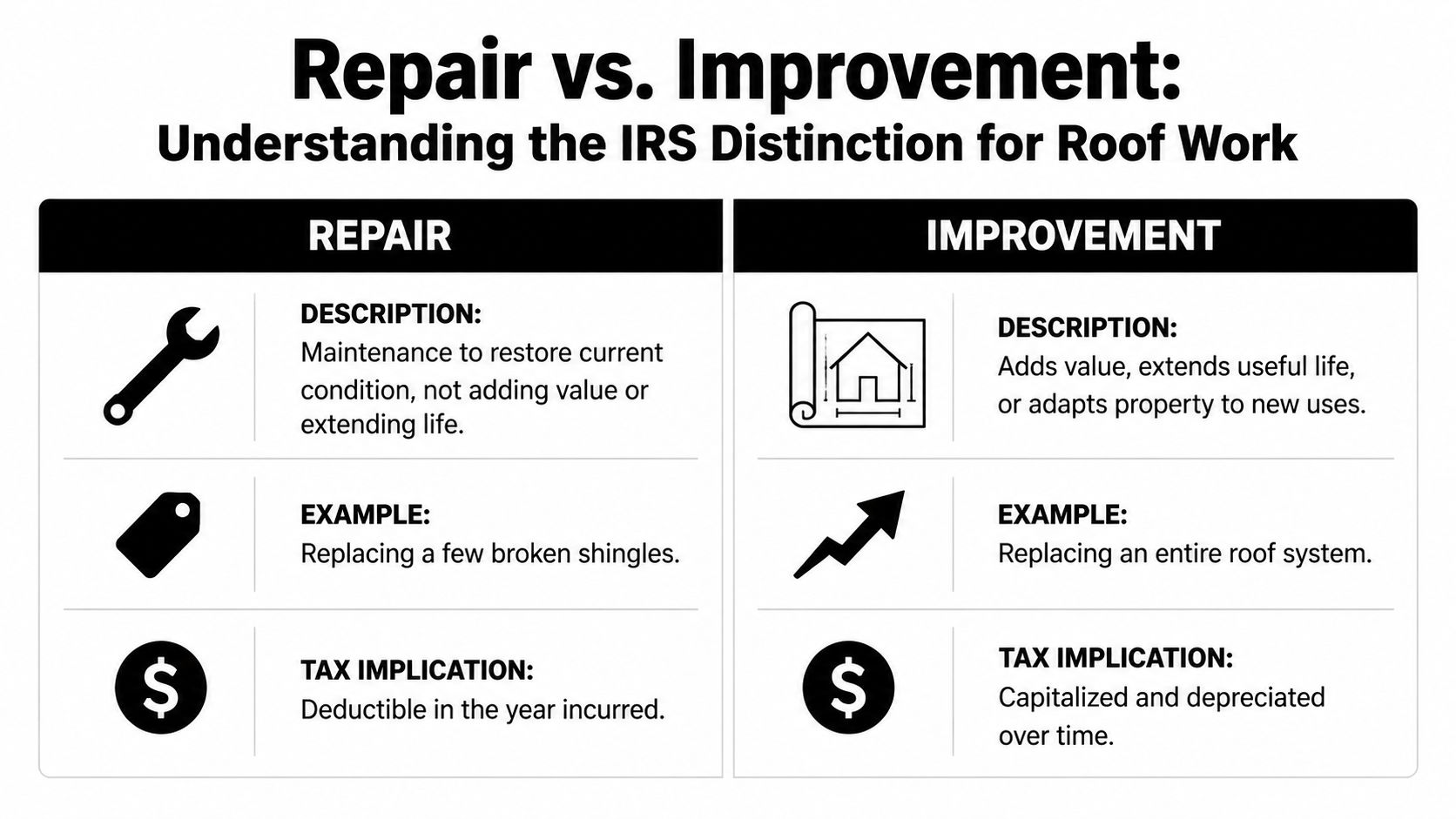
The clearest way to separate the two is this. A repair keeps the roof doing its existing job. An improvement gives the property a restored major component or extends how long it can serve you. For tax purposes, patching a problem area and replacing an entire roof system are usually not in the same category.
A good comparison is routine car maintenance versus installing a new engine. Replacing worn brake pads keeps the car running as expected. Installing a new engine changes the car’s useful life in a much bigger way. A roof works similarly. Replacing a few shingles usually maintains. Replacing the whole roof usually improves.
What the IRS usually treats as a repair
Repairs are narrower jobs. They correct a defect, stop deterioration, or return the roof to ordinary operating condition without replacing a major part of the structure.
For landlords, that matters because a true repair is generally deductible in the year paid or incurred, assuming the usual tax rules are met. That is the simpler outcome, and it is why classification matters so much.
Examples that often fall on the repair side include:
- Leak patching: Correcting a localized issue without rebuilding the full roof system.
- Limited shingle replacement: Replacing damaged shingles in one section after wear or minor storm exposure.
- Minor flashing work: Fixing a specific failure point around vents, chimneys, or edges.
What the IRS usually treats as an improvement
A full roof replacement usually crosses into improvement territory because it restores a major component of the building. Once that happens, the cost is typically capitalized instead of deducted right away.
Capitalized means the cost goes onto the property’s tax record and is recovered over time. For residential rental property, that usually means depreciation as part of the building over 27.5 years. Homeowners often get tripped up here because “had to replace it” feels like a repair in everyday life. Tax law cares less about urgency and more about the scale of the work.
Here is a practical comparison:
| Work performed | Typical tax treatment |
|---|---|
| Patching a leak | Usually current repair treatment |
| Replacing a small section | Depends on the scope and facts |
| Replacing the entire roof | Usually capital improvement treatment |
The personal-versus-rental difference starts to matter right here. On a primary residence, classifying a roof as an improvement generally means no current deduction. On a rental, the same classification usually means depreciation, and sometimes something more valuable that many articles miss. If the old roof was retired, a landlord may be able to write off the old roof’s remaining basis, subject to the rules and records. Allied Tax Advisors often sees this missed because owners save the invoice for the new roof but never identify the tax value still sitting in the old one.
If you’re also evaluating solar-related options, it helps to review the suitability for Florida solar roofs before the work begins, because roof design and material choices can affect both installation decisions and how the project is documented for tax purposes.
A contractor may label everything as “roof work.” Your tax treatment depends on whether the work maintained the existing roof or replaced a major component.
Good invoices make this much easier. The description should show whether the job was a patch, a partial replacement, or a complete tear-off and new system.
Tax Rules for Your Primary Residence
You replace the roof on the home you live in, write a large check, and then ask the question every homeowner asks at tax time. Can I deduct this? In most cases, the answer is no. A standard roof replacement on a primary residence is usually treated as a personal home improvement, not a current tax deduction, as summarized in this explanation of residential roof tax treatment.

For a homeowner, that usually means the cost does not reduce this year’s taxable income.
Instead, the cost is added to your home’s basis. Basis is the running total of what you have invested in the property for tax purposes, including the purchase price and certain improvements. A full roof replacement usually goes into that bucket. The tax benefit is delayed, not lost, because a higher basis can reduce taxable gain when you eventually sell.
A simple way to separate this from everyday spending is to compare it to car work. An oil change is routine upkeep. A new engine changes the value and useful life of the vehicle. A new roof is usually closer to the new-engine category than the oil-change category.
That personal-use rule is the big dividing line between homeowners and landlords. Homeowners generally add the cost to basis and keep good records. Landlords often recover the cost through depreciation, and in some cases may also deduct the remaining basis of the old roof if it was retired. That missed landlord deduction matters, but it belongs under rental property rules, not your personal residence return.
What to keep in your records
Good records matter here because the roof may affect your taxes years later when you sell the home.
Keep these items with your permanent home file:
- Final contractor invoice: It should show that the project was a full roof replacement and describe the materials and scope.
- Proof of payment: Canceled checks, credit card statements, financing papers, or bank records.
- Permits and final inspection documents: These help establish when the improvement was completed.
- Manufacturer paperwork: Save this if the project included any product marketed as eligible for an energy-related tax credit.
The exception homeowners should check closely
A roof replacement on a primary residence usually is not deductible, but part of the project may qualify for a tax credit if it includes eligible energy property.
This is the part that causes confusion. Homeowners often hear that an “energy-efficient roof” gets a tax break. Usually, that is too broad. A roof that helps with insulation or lowers attic temperatures does not automatically qualify. Eligibility depends on the specific product and the specific credit rules.
Qualifying solar roofing tiles or shingles that generate electricity may be treated differently from a conventional asphalt or metal roof. If your project included those components, review the manufacturer certification and the credit requirements before filing.
Deduction and credit are not the same
A deduction lowers the income that gets taxed. A credit lowers the tax you owe directly.
| Tax term | What it does |
|---|---|
| Deduction | Reduces taxable income |
| Credit | Reduces tax owed directly |
That distinction matters. A homeowner who cannot deduct a standard roof replacement may still have a credit opportunity if the installation included qualifying energy-generating materials.
One more point trips people up. Residency and use rules matter for these credits. A property that is used mainly as a vacation home may not get the same treatment as the house you live in for most of the year.
For most homeowners, the practical answer is straightforward. A regular roof replacement on your primary residence usually does not create an immediate deduction. Keep the paperwork anyway, because the cost generally increases basis, and check carefully for any qualifying energy credit if the project included eligible solar roofing components.
Deductions for Rental and Business Properties
A landlord replaces a leaking roof on a duplex and asks the same question a homeowner asks: “Can I write this off?” The answer changes because the property is producing income. For tax purposes, that roof is usually part of the building’s long-term cost, not a personal household expense.
For a residential rental, a full roof replacement is generally a capital improvement. That means the cost is added to the property’s basis and recovered over time through depreciation, rather than deducted all at once in the year you pay for it.

How depreciation works in plain English
Basis works like your tax investment in the property. If repairs are like changing the oil on a car, a full roof replacement is closer to putting in a new engine. You expect value from it for years, so the tax benefit is spread across years too.
For residential rental real estate, a new roof is generally depreciated over 27.5 years under MACRS. If a landlord spends $50,000 on a roof, the yearly straight-line deduction is about $1,818.
That slower write-off can still matter a great deal. Each year, depreciation reduces taxable rental income. Over time, the roof becomes a tax asset on your depreciation schedule instead of a cost that disappears.
The practical mistake landlords make is treating the whole invoice as one thing. Often, it is not. A roofing project may include patch work, deck repair, gutter work, flashing, or interior fixes from a leak. Some items may be current repairs, while the roof replacement itself is a capital improvement. Clear invoice wording matters. If you need help sorting that line, our guide to rental property repair deductions explains how to separate repair costs from improvement costs before you file.
A second point gets missed often. Landlords do not just focus on the new roof. They should also keep enough detail to identify the old roof that came off, because that can affect a later deduction if the prior component is disposed of properly. Many articles stop at “depreciate the new roof.” That is only part of the picture.
Keep these records with the property file:
- The full contractor invoice, with itemized labor and materials if possible
- The date the new roof was ready for service
- Any insurance reimbursement information
- Prior depreciation schedules and purchase records that may help identify the retired roof component
Business properties follow the same broad idea, but the recovery period and related rules can differ from residential rentals. The key practical difference is simple. A homeowner usually gets basis only. A landlord or business owner usually gets depreciation, and sometimes more if the removed roof component is tracked correctly.
Advanced Strategies for Real Estate Investors
A landlord replaces a rental roof, capitalizes the new cost, and starts depreciating it. That part is familiar. The bigger tax opportunity often sits in what came off the building.
If you can identify the old roof as a separate building component, the remaining undepreciated basis of that retired roof may be deductible under the partial disposition rules. For real estate investors, that can change the year-one tax result in a meaningful way.
The tax move many investors miss
Basis works like your tax investment in a property component. Depreciation is how the tax law lets you recover that investment over time. A roof replacement can create two separate tax events. You place the new roof into service as a new capital asset, and you may also write off the tax value still left in the old roof.
A car analogy helps here. If you replace windshield wipers, that is usually a repair. If you replace the entire engine, you now have a new major component. For tax purposes, a rental roof is much closer to the engine example. And if you can show the old engine still had unrecovered cost attached to it, you do not want that cost stranded on your books after the part is gone.
As explained in Bradford Tax Institute's discussion of the old-roof write-off, the partial disposition rules can allow a landlord to deduct the remaining basis of the removed roof, rather than continue depreciating an asset that no longer exists: https://bradfordtaxinstitute.com/Content/Rental-Property-Often-Missed-Add-New-Roof-Deduct-the-Old-One.aspx
Why this works differently for rentals than for your home
Therefore, investors need to separate homeowner rules from rental rules very carefully.
For a personal residence, a new roof usually increases basis. That helps later when you sell, but it rarely creates a current deduction. For a rental property, the new roof is generally depreciated over time, and the removed roof may produce a current deduction if you have enough records to support a partial disposition. That is the practical difference. Homeowners usually get future tax benefit through basis. Landlords may get both current depreciation on the new roof and a write-off tied to the old one.
That second piece is the one many general tax articles skip.
Good records turn theory into a deduction
The hard part is rarely the rule itself. The hard part is proving the numbers.
Many investors bought property years ago with one combined building basis on the depreciation schedule. The roof was never broken out separately. In that case, your CPA may need to reconstruct the old roof's cost using closing statements, appraisals, prior returns, contractor records, cost segregation workpapers, or a reasonable allocation method based on the facts.
The best time to do that work is before the tear-off. Once the old roof is gone and the paperwork is thin, the deduction becomes harder to support.
If you are still sorting out how building components are depreciated after placement in service, our guide to depreciation on rental property explains the mechanics in plain English.
Section 179 and bonus depreciation are not the same answer for every property
Investors also get tripped up by accelerated write-off rules.
A roof on residential rental property does not automatically qualify for the same treatment as a roof on nonresidential business property. Section 179 can apply in some business settings, but not in the same broad way many online summaries suggest. Bonus depreciation questions also depend on what the property is, how the improvement is classified, and which tax year applies.
In other words, "new roof equals immediate write-off" is too simple to trust.
At Allied Tax Advisors, we usually explain this as two separate questions. First, what happens to the old roof that came off. Second, how must the new roof be recovered under the rules for that specific property type. Real estate investors who answer both questions often do better than those who only focus on the new invoice.
Navigating Casualty Loss and Insurance Claims
Sometimes a roof isn’t replaced because it wore out. A storm rips shingles away. A fire damages the structure. A falling tree destroys a section of the home. When that happens, owners often assume the roof cost is “deductible because it was a disaster.”
It’s not that automatic.
The tax treatment depends on the type of property, whether insurance reimbursed the loss, and how the repair or replacement is characterized afterward. Insurance proceeds matter because you generally don’t deduct the part of the loss that insurance covered.
Start with the insurance file, not the tax return
Before you think about tax reporting, organize the claim.
Your adjuster’s estimate, contractor scope, settlement statement, photos, and proof of reimbursement all help establish what happened and what was paid out of pocket. If you’re in the middle of that process, a practical guide to home insurance claims for homeowners can help you think through the paperwork and communication issues before the tax side even starts.
How the tax analysis usually works
For rental or business property, casualty-related damage and restoration often flow through business or rental tax rules. Insurance reimbursement reduces the amount of unreimbursed loss. The replacement itself may still need to be capitalized if it results in a new roof or another major improvement.
For a personal residence, casualty-loss treatment is more limited and fact-specific. Insurance reimbursement still matters, and personal-loss deductions are subject to extra restrictions. In many homeowner cases, the tax question turns into a basis and reimbursement analysis rather than a straightforward deduction.
Use this sequence when thinking through a storm-related roof replacement:
Identify the event clearly
Keep insurer reports, weather documentation, and contractor statements that show the damage came from a sudden event rather than ordinary wear and tear.Separate reimbursement from out-of-pocket cost
If insurance paid part of the claim, that paid amount generally doesn’t become your deduction.Classify the actual work done
A temporary patch may be one thing. A complete tear-off and replacement may be another.
Insurance language and tax language often describe the same roof job differently. Don’t rely only on the insurance summary when preparing the return.
A storm claim can also affect future basis records. If insurance proceeds, owner-paid improvements, and code-required upgrades all appear in the same project, the final tax treatment may involve more than one category. That’s why cleanup work, full replacement work, and insurer reimbursements should each be documented separately.
The Essential Guide to Documentation and Tax Forms
A roof deduction often succeeds or fails in the file cabinet, not on the roof.
If a landlord replaces a roof and later wants to depreciate the new one, or write off the old roof’s remaining basis, the IRS will ask a basic question first: what records prove the numbers? Homeowners face a different issue. They usually are not claiming a current deduction, so their records matter later, when basis affects gain on sale or supports a credit.

What to keep in your roof file
Keep more than the invoice. Keep a paper trail that explains what happened.
Basis works a lot like your running investment in the property. Depreciation works like recovering that investment over time. For a landlord, replacing a few shingles is closer to a car repair. Replacing the whole roof is closer to installing a new engine. The tax treatment changes, and your documents need to show why.
A solid roof file usually includes:
- Signed contract: Shows the original scope and whether the job was patching, restoration, or full replacement.
- Detailed final invoice: Itemized charges help separate repair work from capital improvement costs.
- Proof of payment: Bank statements, canceled checks, financing records, and card receipts.
- Permits and inspection sign-offs: These help establish what was done and when the project was completed.
- Before-and-after photos: Useful if you need to support the extent of the work.
- Insurance paperwork: Important when reimbursement reduced your out-of-pocket cost.
- Product specifications or manufacturer certifications: Helpful if any part of the project could relate to an energy credit.
- Prior depreciation records for rentals: This is the often-missed piece. If you are removing an old roof from a rental or business property, your CPA may need prior-year depreciation schedules to calculate any remaining basis that can be written off.
If you want a broader organizing system for filing season, this tax document checklist for homeowners and landlords is a useful place to start.
Which forms usually come into play
The right form depends on how you use the property.
| Situation | Common tax form or schedule |
|---|---|
| Energy-related credit on a primary residence | Form 5695 |
| Depreciating a roof improvement on rental or business property | Form 4562 |
| Reporting rental income and expenses | Schedule E |
| Tracking added basis for a personal residence | Usually kept in permanent records until sale |
Form 4562 matters most for rental and business owners. It is the form commonly used to report depreciation on the new roof. In some cases, the old roof also matters. If the records are good enough to identify the retired component and its remaining basis, that undepreciated amount may be deductible. Many property owners miss this because they save the new invoice but not the older cost records.
The filing mistake that causes trouble later
Trouble usually starts with one combined invoice.
A roofer may bill tear-off, decking repair, full replacement, gutter work, and storm-related extras on the same document. That is convenient for construction. It is less convenient for tax reporting. If you treat the whole amount as one category without reviewing the line items, you can miss a repair deduction, understate basis, or lose support for a partial-disposition write-off on a rental.
A one-page summary can save hours later. At Allied Tax Advisors, we often ask clients to list four facts in plain English: what was done, when it was completed, how much they paid, and whether the property was personal, rental, or mixed use.
That summary gives your CPA a starting map. The source documents do the proving.
Common Questions on Roof Replacement Deductions
Some roof situations don’t fit neatly into “home” or “rental.” Here are the questions I hear most often.
What if I have a home office
A home office doesn’t automatically turn your personal roof into a fully deductible business asset. Usually, the roof remains a personal-home improvement first, and only the business-use portion may affect the analysis if you otherwise qualify for home office treatment. In practice, this gets technical quickly because the roof affects the whole home, not just one room.
The key is not to assume that business use changes the entire roof cost into a current deduction. It usually doesn’t.
I live in one half of a duplex and rent the other half
This is a mixed-use property, which means you generally allocate costs between personal and rental use. The rental portion follows rental rules. The personal portion follows personal-residence rules.
That allocation should be consistent with how the property is used and documented. If the invoice covers one roof over the whole structure, your tax preparer will usually need a reasonable method to divide the cost.
Does the roof warranty affect deductions or depreciation
The warranty itself usually doesn’t create a deduction. What matters is the nature of the work and the property use. A long warranty may support the idea that the project was a major capital improvement, but the tax result still comes from the underlying rules, not the warranty brochure.
My HOA required the roof replacement. Does that make it deductible
No. HOA approval or HOA requirements don’t convert a personal roof replacement into a tax deduction by themselves. For a primary residence, that usually remains a nondeductible personal improvement unless a specific energy credit rule applies. For rental property, the HOA requirement may explain why you did the work, but it doesn’t usually change capitalization rules.
What records should I keep if I’m unsure how the roof will be treated
Keep everything. If you need a practical year-round system for that, this 2026 guide for tax planning offers useful ideas on organizing receipts and support documents.
The biggest mistake I see isn’t claiming the wrong thing on purpose. It’s failing to preserve enough documentation to support the right thing later.
If you’re dealing with a roof replacement on a home, rental, or mixed-use property, Allied Tax Advisors can help you sort the repair-versus-improvement question, track basis correctly, and identify whether depreciation, an energy credit, or an old-roof write-off may apply to your facts.