
Understanding Your Tax Structure Foundation

Before analyzing the specific LLC vs S Corp tax benefits, it’s crucial to understand the concept that underpins both: pass-through taxation. This method is a cornerstone for many small and medium-sized businesses because it sidesteps the “double taxation” C Corporations often encounter. In a pass-through model, business profits are not taxed at the corporate level. Instead, profits and losses are reported directly on the owners’ personal tax returns.
While this shared principle is a starting point, the paths of an LLC and S Corp diverge quickly. A Limited Liability Company (LLC) is a legal entity formed under state law, offering liability protection. In contrast, an S Corporation is a tax classification granted by the IRS. This distinction is critical—an LLC can elect to be taxed as an S Corp while legally remaining an LLC. This dual nature is where significant tax savings can be found, but it also introduces compliance requirements.
The Default Tax Positions
The IRS treats these entities differently by default, which has an immediate effect on your tax liabilities.
- LLC Taxation: A single-member LLC defaults to a sole proprietorship for tax purposes. This means all net profits are subject to both regular income tax and the full 15.3% self-employment tax. A multi-member LLC is taxed as a partnership, where each partner pays income and self-employment taxes on their respective share of the profits.
- S Corp Taxation: An S Corp framework allows owner-employees to receive a “reasonable salary,” which is subject to standard payroll taxes. Any additional profits can be disbursed as distributions, which are exempt from self-employment taxes. This separation of salary and distributions is the core mechanism behind the tax savings an S Corp can offer.
Historical Context and Modern Implications
The history of these business structures provides insight into current tax planning strategies. The S Corp was created in the 1950s to give small businesses a way to avoid double taxation. Much later, the creation of the LLC introduced a more flexible legal structure. The ability for an LLC to elect S Corp status combined legal adaptability with tax optimization.
This flexibility is not without rules. S Corps have stringent eligibility criteria, including a limit of 100 or fewer shareholders who must be U.S. citizens or residents. LLCs have far fewer ownership restrictions. Understanding this history is essential for any business owner weighing the LLC vs S Corp tax benefits. For a deeper dive into their tax histories, you can explore a detailed comparison in this LLC vs S Corp tax landscape on LawInc.com. This foundational knowledge is necessary to determine which structure aligns with your company’s financial objectives and operational scale.
The Self-Employment Tax Reality Check
The fundamental difference in the LLC vs. S Corp tax benefits discussion centers on a single, impactful factor: self-employment tax. For an owner of a standard LLC, every dollar of profit is subject to the full 15.3% self-employment tax rate. This tax covers both the employer and employee shares of Social Security and Medicare, significantly cutting into take-home pay before federal and state income taxes are even considered.
Choosing to be taxed as an S Corp, however, creates a strategic alternative. This structure lets you divide your earnings into a reasonable salary and shareholder distributions. While your salary is subject to payroll taxes (FICA), the distributions are not. This is the key to unlocking substantial tax savings. The visual below shows how the tax rate applies differently to an LLC owner’s total profit versus an S Corp owner’s salary.
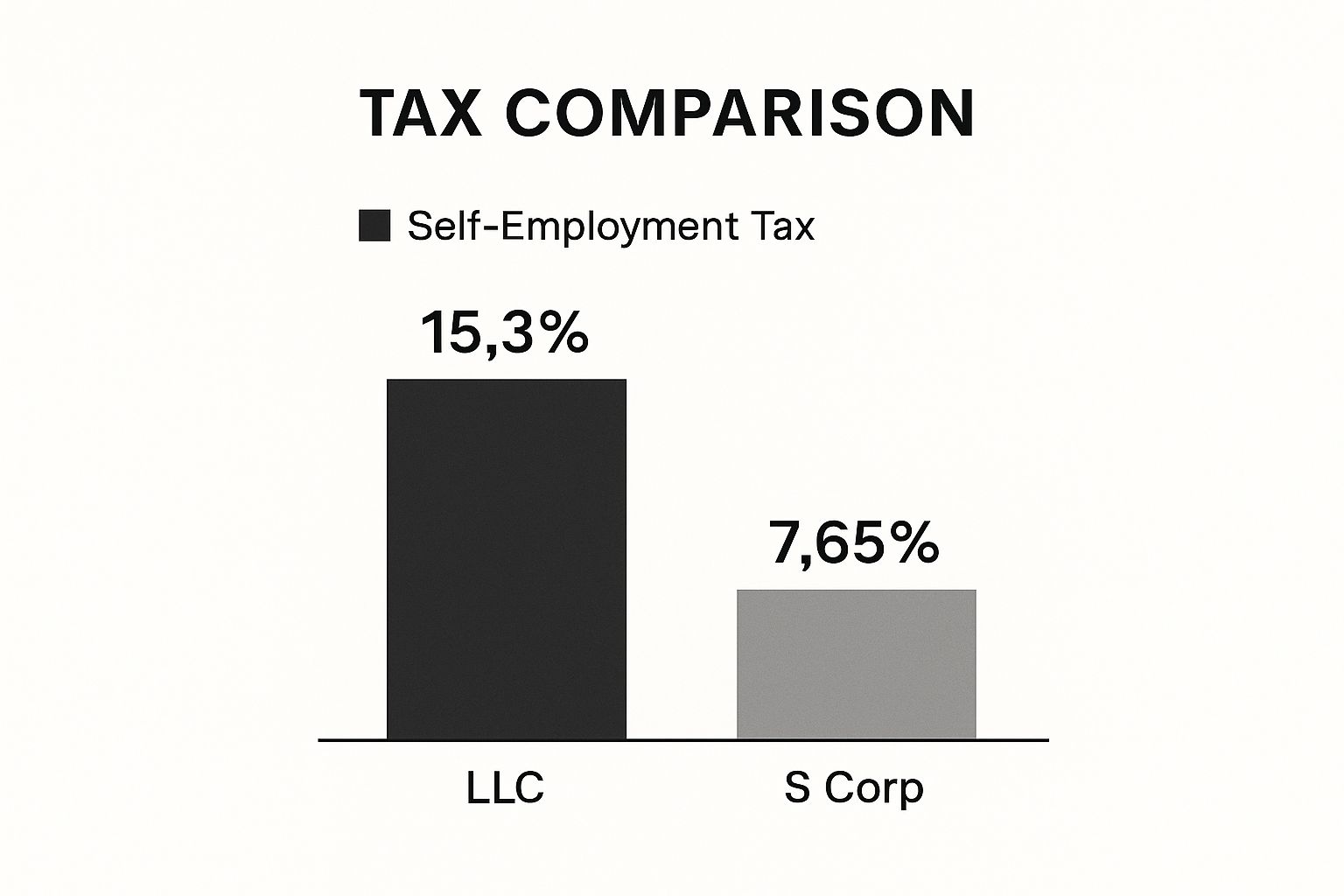
This chart clearly illustrates that S Corp owners can avoid paying the full self-employment tax on all profits by separating their compensation into a salary and distributions.
Reasonable Compensation: The IRS Watchdog
This tax-saving strategy comes with a critical rule. The IRS requires S Corp owner-employees to pay themselves a reasonable salary before taking any tax-free distributions. This regulation prevents owners from setting an artificially low salary just to dodge payroll taxes. The term “reasonable” isn’t a fixed number; it’s determined by several factors:
- Your role and duties within the business
- Industry averages for similar positions
- Your experience and qualifications
- The company’s financial health
Failure to pay a reasonable salary is a major red flag for the IRS and can trigger an audit, resulting in back taxes, penalties, and interest. This compliance step is non-negotiable for correctly managing an S Corp.
Income Scenarios: Where the Savings Kick In
To illustrate when the S Corp election becomes financially beneficial, let’s analyze the tax burden at different profit levels. This comparison shows how your entity choice directly affects your annual take-home income.
| Self-Employment Tax Impact Analysis |
|---|
| Real-world tax burden comparison showing how entity choice affects your take-home income |
| Business Profit |
| $100,000 |
| $150,000 |
| $200,000 |
As the table demonstrates, the savings become more significant as business profits increase. For a business with $100,000 in net profit, an S Corp owner could pay themselves a $60,000 salary and take the other $40,000 as a distribution. Payroll taxes would only apply to the salary, not the entire profit. This approach is a widely used tactic among small business owners to lower their tax liability, as detailed in this breakdown of LLC vs. S Corp tax strategies on Collective.com.
However, it’s important to weigh these savings against the added complexity. For businesses with lower or fluctuating profits, the administrative costs of an S Corp, such as payroll processing and separate tax filings, might cancel out the tax benefits. In those cases, the simplicity of a default LLC structure often makes more sense.
Your Actual Tax Savings Breakdown
While comparing the theoretical LLC vs S Corp tax benefits is a good starting point, the right choice for your business comes down to real numbers. To understand the actual financial impact, you must look beyond potential tax savings and account for the costs required to get there.
The main draw of an S Corp election is reducing self-employment taxes. However, this benefit is only meaningful if the savings are greater than the new administrative expenses you’ll take on. These costs, which include payroll services, extra tax preparation, and more detailed bookkeeping, typically range from $1,500 to over $4,000 each year.
The Break-Even Point: When Does an S Corp Make Sense?
The break-even point is the profit level where the tax savings from an S Corp finally surpass its administrative costs. This point varies depending on your specific expenses and what the IRS considers a “reasonable salary,” but a general guideline is around $40,000 to $60,000 in net income. If your profit is below this threshold, the costs often wipe out any savings, making a standard LLC the more sensible option.
Let’s run a scenario with a graphic designer who has $80,000 in net profit:
- As a default LLC, the entire profit is subject to self-employment tax. They would owe $12,240 (15.3% of $80,000).
- As an S Corp, they could set a reasonable salary of $50,000 and take a $30,000 distribution. The payroll tax on the salary is $7,650. This initially saves $4,590 in taxes.
- After subtracting administrative costs (let’s say $2,500), their net savings become $2,090.
In this situation, the S Corp election provides a tangible financial advantage. But if that same designer’s profit was only $40,000, the tax savings would likely be minimal or even turn negative once administrative fees are factored in. Every business owner must run this calculation for their own unique financial picture.
Tax Savings Reality Check by Income Level
To give you a clearer picture of the potential returns, the table below offers an honest breakdown of net savings after factoring in all costs. This analysis assumes an average annual administrative expense of $2,500 for maintaining S Corp status and a reasonable salary set at 60-65% of profits.
| Annual Profit | LLC Total Cost | S Corp Total Cost | Net Savings | ROI Analysis |
|---|---|---|---|---|
| $75,000 | $11,475 (SE Tax) | $9,385 ($6,885 Payroll Tax + $2,500 Admin) | $2,090 | Positive but requires active management. |
| $120,000 | $18,360 (SE Tax) | $12,445 ($9,945 Payroll Tax + $2,500 Admin) | $5,915 | Significant savings; clear benefit. |
| $180,000 | $27,540 (SE Tax) | $14,740 ($12,240 Payroll Tax + $2,500 Admin) | $12,800 | Substantial return; highly recommended. |
As you can see, the S Corp advantage grows significantly as profits increase. The net savings are what matter, not just the gross tax reduction. At higher income levels, the compliance costs become a smaller fraction of the overall savings, making the S Corp a powerful tool for tax efficiency. You can find more detailed discussions on tax savings potential on CBH.com.
Beyond these core numbers, remember to factor in other financial elements. To truly maximize your financial position, you might be interested in our guide on how to reduce your tax bill with overlooked deductions and credits.
When Each Structure Actually Makes Sense
The choice between an LLC and an S Corp isn’t just about chasing tax savings; it’s about matching your legal structure to your operational reality. Not every profitable business should immediately elect S Corp status, and sticking with default LLC taxation isn’t always a misstep. The optimal path depends on specific factors like your income stability, investor profile, and long-term business goals.
Why Sticking with an LLC Can Be the Smarter Move
While the potential for self-employment tax savings is a major draw for S Corps, there are several compelling scenarios where the simplicity and flexibility of a default LLC structure are superior. Business owners in these situations often find that the administrative load and costs of an S Corp election outweigh the potential tax advantages.
Consider these common situations where an LLC is the better fit:
- Businesses with Irregular Income: If your profits are unpredictable, swinging significantly from month to month, the S Corp’s mandate to pay a “reasonable salary” becomes a major headache. Running payroll consistently is challenging when cash flow is uncertain. For a consultant who lands large, infrequent contracts, the LLC structure allows them to simply take owner’s draws when funds are available without the pressure of payroll compliance.
- Passive Ownership Structures: LLCs provide excellent flexibility in how profits are distributed. You can allocate profits disproportionately to ownership percentages, which is perfect for arrangements where some members contribute capital while others contribute labor. An S Corp requires that all distributions be strictly proportional to stock ownership, complicating partnerships with passive investors or members with varying levels of involvement.
- Anticipating Business Losses: In the early years, many businesses operate at a loss. Under a standard LLC structure, these losses can often be deducted against the owner’s other personal income, offering a direct tax benefit. While S Corp losses also pass through, they are subject to more complex basis limitations that can prevent you from deducting them right away.
- Simple Reinvestment Strategy: If your primary strategy is to reinvest the majority of your profits back into the business to fuel growth, the tax savings from an S Corp election may be minimal. Since you aren’t taking large distributions, the main benefit of the S Corp is neutralized. This makes the added administrative costs an unnecessary financial drain.
The Ideal Candidate for an S Corp Election
On the other hand, the S Corp structure becomes a powerful financial tool under the right conditions. This isn’t just about reaching a specific profit threshold; it’s about the stability and nature of your business operations. A business becomes a prime candidate for an S Corp election when it aligns with several key criteria.
Here is a profile of a business that would maximize the LLC vs S Corp tax benefits by making the S Corp election:
- Consistent and Substantial Profits: Your business reliably generates net profits well above what’s needed to cover administrative costs—typically over $60,000 annually. This ensures the savings on self-employment tax are significant enough to justify the expenses of payroll and compliance.
- Owner as an Active Employee: As the owner, you actively work in the business and can justify drawing a regular, reasonable salary for the duties you perform. This is the fundamental requirement of the S Corp strategy.
- Stable Cash Flow: The business has predictable revenue that can comfortably support a consistent payroll schedule for its owner-employees without causing financial strain.
- Desire for Regular Distributions: You intend to regularly take profits out of the business for personal use. The ability to receive these profits as tax-advantaged distributions is the core incentive for electing S Corp status.
For business owners who fit this profile, making the S Corp election is a logical step toward financial optimization. If you are considering this path, you may find our detailed guide on S Corporations a valuable resource for next steps. This decision signifies a maturing business that is ready to implement a more formal and advantageous financial strategy.
Advanced Strategies Beyond Basic Structure Choice

True financial optimization goes well beyond the initial decision between an LLC and an S Corp. After you select your entity, the real strategic work begins. Astute business owners use advanced tactics to maximize the LLC vs S Corp tax benefits, transforming a basic legal structure into a powerful financial instrument. This involves careful timing, deliberate operational structuring, and forward-looking planning to protect profits and encourage growth.
One of the most effective strategies is the timing of your S Corp election. Filing Form 2553 to elect S Corp status is governed by strict deadlines. Generally, you must file within the first two months and 15 days of the tax year for the election to take effect. Missing this deadline can cost you an entire year of potential payroll tax savings. Proactive entrepreneurs plan this transition meticulously, ensuring their profitability and cash flow can support a reasonable salary before they make the change.
Optimizing Your Salary-to-Distribution Ratio
The foundation of S Corp tax savings is the balance between what you pay yourself in salary versus what you take in distributions. While the IRS mandates a “reasonable salary,” this figure is not set in stone. Smart owners consistently review and document their compensation, aligning it with their job duties, the company’s performance, and industry benchmarks. This approach not only solidifies their standing in an audit but also allows them to legally maximize the amount paid out as tax-advantaged distributions.
This ratio must be reassessed as your profits increase. A salary that was reasonable when the business made $100,000 in profit may attract IRS scrutiny at $300,000. A common compliance error is failing to adjust compensation upward as the business grows, which can undermine your tax savings.
Integrating Retirement and State-Level Tax Planning
An S Corp structure can substantially boost your retirement savings. As an owner-employee, you can set up a Solo 401(k) or a SEP IRA, contributing as both the “employee” and the “employer.” This opens the door to much higher contribution limits than a traditional IRA. For instance, in 2024, an owner can make an employee contribution and also have the corporation make a profit-sharing contribution, which can shelter a significant amount of income from current taxes while building personal wealth.
State tax laws introduce another layer of analysis. Some states, such as Tennessee and New Hampshire, tax distributions but not salaries, effectively inverting the federal tax incentive. Other states do not recognize the S Corp election at all and tax the entity as a C Corp. Structuring your operations to minimize state-level tax burdens is a key part of a thorough strategy.
For more complex businesses, multi-entity structures can also be beneficial. You might run your primary business as an S Corp to reduce payroll taxes on operating income while holding real estate or other assets in a separate LLC for liability protection and more flexible estate planning. For business owners considering these multifaceted approaches, our guide to proactive business tax planning offers deeper insights into structuring your finances for sustainable success.
These advanced strategies demand careful management and often professional advice. By looking beyond the initial entity choice, you can convert your business structure from a simple legal formality into a dynamic tool for financial efficiency and long-term growth.
Your Implementation Game Plan
Understanding the theoretical differences between an LLC and an S Corp is the first step. The next is to put that knowledge into practice. A successful transition or initial setup depends on careful planning and precise execution. This roadmap will guide you through the critical steps, from filing the right documents to managing ongoing compliance, to make sure you capture the LLC vs S Corp tax benefits you’re after.
The Paperwork and Critical Timing
Switching from a default LLC to an S Corp for tax purposes doesn’t happen automatically. It requires a formal request to the IRS, and timing is everything.
- The Key Document: The central element of this process is IRS Form 2553, “Election by a Small Business Corporation.” This document must be filled out with complete accuracy and submitted on schedule.
- The Critical Deadline: For an S Corp election to cover the entire current tax year, you must file Form 2553 within the first two months and 15 days of that year. For businesses on a calendar year, this deadline is March 15th. Missing this window can postpone your potential tax savings for an entire year.
- Late Election Relief: The IRS does have a provision for late election relief if you miss the deadline, but you’ll need to provide a reasonable cause for the delay. Relying on this is a risky strategy; timely filing is always the better approach.
Building Your Compliance Foundation
Choosing S Corp status brings new administrative duties that are essential for keeping your tax benefits. If you don’t adhere to these requirements, the IRS could revoke your S Corp status and issue significant penalties.
The most important new responsibility is running payroll. As an owner-employee, you are required to pay yourself a reasonable salary, which means establishing a formal payroll system. This includes:
- Withholding federal and state income taxes.
- Paying and remitting FICA taxes (Social Security and Medicare).
- Filing quarterly and annual payroll tax reports, such as Form 941.
Many business owners use a payroll service to manage these tasks. The cost, typically between $40 to $100+ per month, is a necessary expense to consider. This investment helps ensure accuracy and prevents expensive payroll mistakes, a common issue for new S Corps.
First-Year Expectations and Measuring Success
Your first year as an S Corp will operate differently. Instead of taking irregular owner’s draws from profits, you will receive a consistent paycheck. The remaining business profits accumulate in your company bank account, available for you to take as distributions.
To determine if the change was worthwhile, perform an annual review. Compare your total tax liability (income tax plus payroll tax) as an S Corp to what you would have paid in self-employment tax as a standard LLC. Then, subtract your new administrative costs, like payroll services and any extra accounting fees. The resulting figure represents your true net savings. This concrete number, not just the potential benefit, is the ultimate measure of a successful implementation.
Your Decision Framework And Next Steps
Translating complex tax details into a clear decision requires a structured approach. The choice between an LLC and an S Corp extends beyond potential tax savings; it’s about aligning your business structure with your specific operational and financial circumstances. This framework offers actionable steps to guide your choice, helping you move from analysis to a confident decision.
Your Personal Decision Checklist
Before making a final selection, measure your business against these critical criteria. Your answers will clarify which structure provides the most practical benefits for your situation.
- Profit Consistency: Does your business generate stable, predictable profits capable of supporting a regular payroll? If your income is inconsistent, the S Corp’s reasonable salary requirement could create a cash flow challenge.
- Annual Net Profit Threshold: Is your annual net profit consistently above $60,000? This is a widely accepted benchmark where the self-employment tax savings from an S Corp election often start to outweigh the associated administrative costs.
- Owner’s Role: Are you an active owner-operator who performs the daily work of the business? The primary benefit of an S Corp is tied to paying yourself a salary for your labor. A passive investor role does not align with this model.
- Reinvestment Strategy: Do you intend to reinvest the majority of profits back into growing the business? If so, you will not be taking large distributions, which neutralizes the main tax advantage of an S Corp.
- Future Ownership Plans: Do you foresee bringing on foreign investors or other corporations as partners? An LLC provides greater flexibility for complex ownership arrangements, whereas S Corps are bound by strict limitations on who can be a shareholder.
Key Milestones for Implementation and Review
Once you have chosen a path, a clear timeline is vital for proper execution and sustained success. This applies whether you are forming a new business or electing a different tax status for an existing one.
| Timeline & Action Plan | Key Action Items & Deadlines |
|---|---|
| Decision & Setup (0-30 Days) | Consult with a tax professional. If selecting an S Corp, file Form 2553 before the March 15 deadline for the current tax year. Open business bank accounts and set up a bookkeeping system, such as QuickBooks. |
| Initial Operation (31-90 Days) | For an S Corp, establish a payroll system and define a reasonable salary. Begin running regular payroll and withholding taxes. For an LLC, create a clear method for tracking owner’s draws and making estimated tax payments. |
| Mid-Year Review (6 Months) | Evaluate cash flow and profitability against your initial forecasts. S Corp owners should confirm their salary remains reasonable in relation to profits. Adjust estimated tax payments to prevent underpayment penalties. |
| Annual Review (12 Months) | Calculate your actual net savings by comparing your total tax liability to what it would have been under the alternative structure, after subtracting administrative costs. This is your core performance indicator. Re-evaluate if your business has undergone significant changes. |
When to Re-evaluate Your Choice
Your business structure is not a permanent decision. As your company grows and its needs change, the most effective choice may also shift. Be ready to reconsider your entity if you encounter:
- Rapid Profit Growth: A sudden and sustained increase in profitability could make an S Corp election significantly more beneficial than it was previously.
- Shift in Business Model: Transitioning from a service-based to a product-based business (or the reverse) can impact your cash flow patterns and profit margins, altering the tax equation.
- Bringing on New Partners: Any changes to ownership may require a re-evaluation, particularly if new partners have different financial needs or residency statuses that conflict with S Corp rules.
This decision framework gives you the tools to assess your current standing and prepare for the future. The conversation about LLC vs S Corp tax benefits is dynamic, and the correct answer depends on your commitment to active financial management.
Navigating these complexities often requires professional guidance. The dedicated CPAs and enrolled agents at Allied Tax Advisors specialize in helping business owners optimize their tax strategy. From initial entity selection to ongoing compliance and advisory services, we offer the personalized support necessary to achieve your financial objectives. Discover how our team can simplify your business taxes and maximize your savings.