
You made sales, the payouts hit your bank account, and now the uncomfortable part shows up. Nothing was withheld. Your ecommerce platform has reports that don't match your bank deposits exactly. You sold into states you've never visited. Maybe you imported inventory, fulfilled through a marketplace, or sold digital offers on the side. The business feels real now, and so do the tax consequences.
That's the moment most online owners start searching for answers about paying taxes for an online business. They usually ask the wrong first question. It's not “How much will I owe?” It's “Which taxes apply to me, who gets paid, and when?”
I've seen this play out with Amazon sellers, Shopify store owners, course creators, consultants, and service businesses in San Diego. They spend months learning fulfillment, ad platforms, and inventory flow, then hit tax season and realize the backend was neglected. If you're sourcing product overseas, operational guides like Online Brand Growth's FBA shipping guide help you understand the logistics side. Tax compliance has to keep pace with that same growth.
This is the practical version. No fluff. No vague “talk to your accountant” cop-out. If you're new to online business, you need a working system for income tax, sales tax, estimated payments, and records.
Table of Contents
- The Online Entrepreneur's Tax Wake-Up Call
- Income and Self-Employment Tax Essentials
- The Sales Tax Maze Demystifying Nexus
- The Rhythm of Compliance Estimated Taxes and Key Deadlines
- Smart Recordkeeping and The New 1099-K Rules
- Common Tax Pitfalls and How to Avoid Them
- Your Next Steps and When to Partner with an Advisor
The Online Entrepreneur's Tax Wake-Up Call
The typical tax wake-up call doesn't happen in April. It happens on a random weekday when you finally total your revenue and realize nobody has been withholding anything for you.
A new seller in San Diego launches a Shopify store, adds a marketplace channel, and starts seeing consistent deposits. At first, the owner treats each payout like spendable cash. Then come the questions. Which deposits are taxable income? What about refunds? Do fees reduce income? Do sales to other states create sales tax exposure? Was the LLC enough, or was some other election supposed to happen?
That confusion is normal. It's also dangerous.
Online businesses create tax complexity faster than traditional local businesses because money moves through multiple systems. Your payment processor tracks gross receipts. Your bank sees net deposits. Your platform logs returns, fees, shipping, and discounts separately. If you sell products, services, subscriptions, or bundles, the tax treatment gets even more layered.
Good tax compliance starts before filing season. It starts the day you accept payment.
The owners who stay in control usually do three things early. They separate business finances, build a tax reserve, and treat compliance like an operating function instead of an afterthought.
The owners who get burned usually make the same mistake. They assume no tax form means no tax problem. That's false. Reporting thresholds, filing deadlines, and sales tax rules don't determine whether income is taxable. They only affect how and when government agencies see what you did.
If you want paying taxes for an online business to feel manageable, stop viewing it as one annual event. It's a year-round system with four moving parts: income tax, self-employment or entity tax treatment, sales tax, and records. Once those pieces are organized, the stress drops quickly.
Income and Self-Employment Tax Essentials
Your first federal tax issue isn't sales tax. It's how your profit gets taxed.
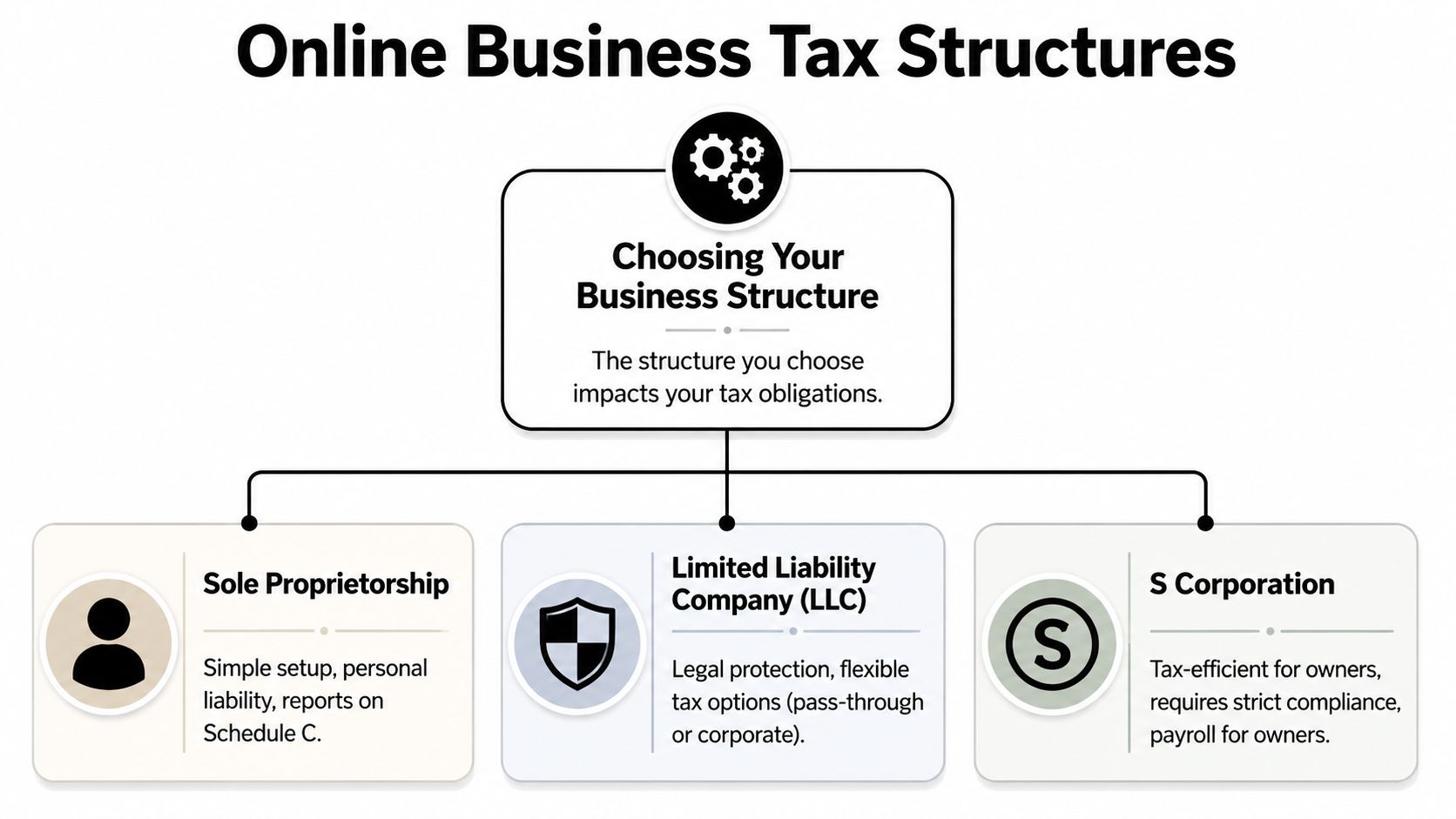
How your business structure changes the tax result
Most new online owners begin as a sole proprietorship by default, even if they never intended to. If you start selling and haven't elected corporate treatment, that's often where you are for tax purposes. Your business profit typically passes through to your personal return.
An LLC gives legal structure, but it does not automatically create a different federal tax result. Many single-member LLCs still report like sole proprietors unless they choose another tax treatment. That's the point many owners miss. The legal entity and the tax classification are related, but they aren't the same thing.
An S corporation can change how owner compensation and profit are handled, but it comes with stricter compliance. Payroll, filings, and ongoing maintenance matter. The IRS filing side is not casual. Pass-through income also has to be reported correctly under the federal rules described in this practical guide to self-employment tax calculation.
Here's the part that surprises people most. Sole proprietors don't just deal with income tax. They also deal with self-employment tax, which covers Social Security and Medicare obligations that a W-2 job would normally split with an employer.
The reserve rule that keeps you out of trouble
The cleanest habit for a new online owner is this: save for taxes every time money comes in.
According to Nationwide's small business tax overview, the average effective tax rate for sole proprietorships is 13.3%, and experts recommend online business owners set aside approximately 30% of post-deduction income to cover federal obligations once self-employment tax is considered. That reserve rule is simple, conservative, and useful.
Practical rule: If you wait until year-end to figure out your tax reserve, you waited too long.
I tell new owners to build this into their workflow:
- Open a separate tax savings account. Move your reserve there after each payout cycle.
- Work from net income, not gross sales. Fees, refunds, and ordinary business deductions matter.
- Revisit your structure as profit grows. An LLC may help with liability, but tax efficiency depends on election and compliance, not just formation paperwork.
- Watch health insurance deductions. If you're self-employed, strategies like those explained in this piece on unlocking tax savings with health insurance can affect planning.
A short comparison helps:
| Structure | General tax treatment | What owners usually miss |
|---|---|---|
| Sole proprietorship | Business profit typically goes on the owner's personal return | Self-employment tax hits hard if you didn't reserve cash |
| Single-member LLC | Often taxed similarly unless another election is made | Legal setup doesn't automatically reduce taxes |
| S corporation | Pass-through treatment with added compliance requirements | Payroll, filings, and discipline are mandatory |
If you're still early, keep it simple. Know your structure, reserve cash, and don't guess at owner pay or deductions. Complexity grows fast online, especially once multiple platforms and states are involved.
The Sales Tax Maze Demystifying Nexus
Sales tax is where many online businesses get blindsided. Income tax is about your profit. Sales tax is different. You collect it from customers when required, then remit it to the state. It is not your money.

What nexus actually means
Your obligation usually starts when you have nexus with a state. Historically, owners thought nexus meant a store, office, warehouse, or employee. That's incomplete now. States can impose collection duties based on economic nexus, which often means crossing a sales or transaction threshold.
The common trap is assuming “I'm based in California, so I only worry about California.” That's wrong for many online sellers.
Verified compliance guidance states that triggering economic nexus by exceeding state-specific thresholds, often $100,000 in sales or 200 transactions, is a major pitfall. It also states that 85% of online businesses fail to comply with multi-state sales tax laws and may face penalties averaging $15,000 per jurisdiction if audited. Those figures are the reason this area deserves attention, not procrastination.
California businesses need to be especially careful because local operators often sell nationwide early. A San Diego brand can trigger obligations outside California long before it leases a second space or hires out-of-state staff.
A workable sales tax process
Most owners overcomplicate the theory and underbuild the process. Use this sequence instead.
- Identify where you may have nexus. Review where you have customers, inventory, contractors, and consistent economic activity.
- Register before collecting tax. Don't start charging customers in a state until your registration is handled.
- Track transaction detail by destination. State, city, and county differences matter.
- File every required return, even zero returns. Missing a period can create penalties and account problems.
- Remit collected amounts on time. Treat collections as a liability sitting in trust.
Sales tax money should never sit in your operating mindset as revenue. It belongs on your books as a pass-through obligation.
That distinction matters in practice. If your platform deposits a lump sum and you spend it all, the state still expects its share later.
A few judgment calls matter for digital businesses too:
- Digital products aren't automatically simple. Bundled offers that combine downloads, subscriptions, and live services can create classification questions.
- Service providers can still have exposure. Online coaching, consulting, and memberships aren't exempt from analysis just because there's no physical shipment.
- Manual tracking breaks quickly. The moment you sell across several states, spreadsheets become fragile.
For owners who need a deeper operational framework, this resource on sales tax compliance for growing businesses is a good next step.
If you're in California, don't assume local familiarity solves multistate issues. California compliance is only one part of the map. The primary challenge is knowing when your online activity created duties elsewhere and fixing it before a notice arrives.
The Rhythm of Compliance Estimated Taxes and Key Deadlines
Most online owners aren't employees. Nobody withholds taxes from marketplace payouts, Stripe receipts, or consulting invoices for them. That means you're responsible for paying as you go.
Why quarterly payments matter
Estimated taxes are the federal system's way of keeping you current during the year. If your business generates profit and you wait until filing season to pay everything, you can create a cash crunch and invite penalties.
The practical habit is simple. Every quarter, estimate your taxable business profit, review what you've already paid, and send in what's needed. If your income is uneven, the process takes more attention. That's normal for ecommerce, seasonal businesses, and launch-based digital offers.
A few rules keep this manageable:
- Use current books, not rough memory. Pull clean profit numbers from your accounting system.
- Separate tax reserve from tax payment. Saving money is step one. Remitting it is step two.
- Put deadlines on your calendar now. Don't rely on inbox reminders from software platforms.
- Adjust when profit changes. Stronger quarters usually require stronger payments.
For owners who want a reference point on timing and process, this page on estimated tax payment dates is worth bookmarking.
2026 online business federal tax calendar
Use this as your baseline federal rhythm.
| Deadline | Task |
|---|---|
| January | Close prior-year books, reconcile bank and payment processor activity, gather deduction support |
| April | File your annual federal return or extension, and make the first estimated payment for the current year if required |
| June | Review year-to-date profit and make the next estimated payment if required |
| September | Recalculate based on actual results and make the next estimated payment if required |
| January of the following year | Make the final estimated payment for the tax year if required, then prepare for annual filing |
Discipline beats intensity. You do not need to think about taxes every day. You do need a repeatable operating rhythm.
The owners who stay calm in tax season usually handled the work in small pieces long before tax season arrived.
If your income jumps, your payment plan has to jump with it. If sales dip, revise. The point is not perfection. The point is staying current enough that filing the annual return becomes a reporting exercise, not a financial emergency.
Online businesses that sell, advertise, and fulfill in real time need tax habits that work the same way. Quarterly review is not optional. It's basic maintenance.
Smart Recordkeeping and The New 1099-K Rules
Bad records create bad tax returns. Most online tax stress comes from one core problem: the owner can't clearly prove what they earned, what they spent, and what part of each deposit was actual income.

Records you need all year
If you sell online, create separation immediately. One business bank account. One bookkeeping system. One place to store receipts, invoices, payout statements, and vendor records.
Your books should reconcile across four sources:
- Platform reports
- Payment processor reports
- Bank activity
- Your accounting file
That sounds basic, but it's where many owners fail. Gross sales on a platform often won't match net deposits because fees, refunds, chargebacks, and shipping adjustments sit in the middle. If you only use the bank feed, your numbers will be incomplete.
For merchants on Shopify, practical setup matters. This guide on Shopify accounting software integration shows why syncing commerce data into your bookkeeping stack matters. Tools like QuickBooks can help, and some firms also support cleanup and monthly categorization when the books are already behind.
What the new 1099-K threshold changes
The 1099-K rules changed in a way that matters to small sellers. According to H&R Block's explanation of online selling tax rules, for the 2025 tax year, third-party processors issue Form 1099-K only when a person receives over $20,000 in gross payments and more than 200 transactions. That is a 300% increase from the prior $5,000 reporting threshold described for 2024.
That change reduces automatic reporting for many casual sellers. It does not remove the duty to report taxable business income.
No 1099-K does not mean no taxable income.
That single sentence would solve a lot of future notices.
If you operate below the reporting threshold, your own records become even more important because the IRS may not receive the same automatic form from the processor. If you operate above it, don't assume the form alone gives you your taxable income. A 1099-K generally reflects gross payments, not your net profit after returns, fees, and deductible expenses.
Your annual file should be boring. That's the goal. Clean reconciliations, categorized expenses, saved support, and year-end numbers that tie together. Tax preparation gets easier when your recordkeeping tells a coherent story.
Common Tax Pitfalls and How to Avoid Them
Most online business tax problems aren't exotic. They're repetitive, avoidable, and expensive.
The mistakes that cost online owners money
The first problem is underreporting digital income. Owners rely on one dashboard, miss another platform, or forget direct invoices that bypassed their main store. Verified guidance warns that underreporting income from digital transactions can lead to an IRS underpayment penalty of 0.5% per month on unpaid tax. That penalty grows because the original bookkeeping failure usually isn't discovered quickly.
The second problem is commingling funds. If your groceries, software subscription, owner draws, ad spend, and inventory purchases all run through the same account with no discipline, your books become an argument instead of a record.
A third issue is sales tax neglect after nexus is triggered. Owners often learn the rule late, then freeze because the fix feels messy. Delay usually makes it worse.
Then there's DIY entity management without follow-through. Forming an LLC or electing S corporation treatment without maintaining the filings, payroll, or reporting creates false confidence. Paperwork alone doesn't create compliance.
How to tighten your system fast
You don't need a complete financial overhaul in one weekend. You need triage.
- Clean up income capture first. Make sure every payment source flows into your books.
- Stop using one account for everything. Separate business and personal activity now, even if prior months need cleanup.
- Review state exposure before the state reviews you. If you sell broadly, check where you may already have obligations.
- Create a monthly close routine. Reconcile platforms, processors, and bank data on a repeating schedule.
A short diagnostic helps:
| Pitfall | What it leads to | Immediate fix |
|---|---|---|
| Incomplete income tracking | Underreported revenue and penalties | Reconcile every sales channel monthly |
| Mixed personal and business spending | Weak books and missed deductions | Use dedicated accounts and cards |
| Ignored sales tax obligations | Notices, assessments, and cleanup work | Review nexus and filing status |
| Skipped estimated payments | Cash shock at filing time | Build quarterly review into your calendar |
The biggest mindset problem is thinking you can improvise indefinitely. You can bootstrap marketing. You can test offers cheaply. You should not freestyle tax compliance once real money is moving.
Your Next Steps and When to Partner with an Advisor
If you want a clear path forward, do these things this week.
Open a dedicated tax savings account. Get your bookkeeping current. Identify every place money enters the business. Confirm your entity tax treatment. Review whether you've created sales tax obligations outside your home state. Put quarterly tax checkpoints on your calendar.
If you're in California or specifically in San Diego, add one more step. Make sure your local business operations and your multistate online activity are being reviewed together, not in isolation. That's where many small businesses drift into mismatch problems.
Professional help becomes necessary when any of these are true:
- You sell into multiple states and aren't sure where nexus exists.
- You received an IRS or state notice and don't want to respond blindly.
- You're considering an S corporation election and need the tax result modeled before filing.
- Your books don't tie out between platform reports, processor statements, and bank deposits.
- You want to focus on growth instead of spending nights reverse-engineering your own compliance.
At that point, using a structured service is more efficient than guessing. Firms such as Allied Tax Advisors can handle tax preparation, bookkeeping support, sales tax management, payroll-related compliance for S corporations, and secure document collection through an online client portal. That's useful when the issue is no longer knowledge, but execution.
Tax isn't the side quest. For an online business, it's part of the operating system.
If you want help building that system, Allied Tax Advisors can help you sort out income tax, sales tax, recordkeeping, and filing obligations before they become expensive cleanup work.