
You own a San Diego rental. Maybe two. One is a long-term condo near Clairemont Mesa. The other might be an ADU, a duplex unit, or a short-term rental that started as a side project and turned into real income.
Tax season arrives, and the same pile shows up on the table. Settlement statements. Mortgage interest forms. Repair invoices. Property tax records. A spreadsheet that made sense in July and looks less convincing in March. Then Schedule E starts asking questions your bookkeeping cannot answer cleanly.
That is the point where many landlords realize they do not need “someone who does taxes.” They need a rental property tax accountant who understands how real estate income is tracked, defended, and planned for. In San Diego, that matters even more because landlords often juggle higher-value properties, remodels, ADUs, mixed personal and rental use, and local quirks like Mello-Roos, HOA assessments, and shifting short-term rental rules.
Effective work involves more than just finding a name online. It is hiring the right specialist, asking the right questions, and building a working relationship that saves money instead of creating clean-looking but weak returns.
The True Cost of DIY Rental Property Taxes
The DIY version usually looks harmless at first.
A landlord logs rent in one column, expenses in another, and drops receipts into a folder. If the numbers roughly tie to the bank account, that feels good enough. It usually is not.

Where landlords lose money
The tax cost of informal records is not small. Landlords who maintain organized rental property accounting records typically deduct $12,000–$25,000 more per property annually, and properly maintained books save an average of $3,000–$8,000 annually in missed deductions. The same source notes that most landlords without professional guidance overpay taxes by 15–30% due to incomplete expense documentation (Madras Accountancy rental property accounting guide).
That gap shows up in ordinary places:
- Depreciation never gets set up correctly. The landlord knows the property is depreciable, but never establishes the right basis.
- Repairs and improvements get mixed together. A patch job, appliance replacement, and major renovation all get thrown into the same bucket.
- Personal and rental spending overlap. One Home Depot run covers both the rental and the primary residence.
- Security deposits are handled casually. They get treated like income when they should not be, or the opposite.
- Property-by-property tracking disappears. That becomes a problem because each property needs its own clean story.
In San Diego, this gets more expensive fast. Clairemont owners often have older homes with periodic upgrades, sewer line work, electrical updates, and ADU-related spending. Those are exactly the kinds of facts that require careful classification.
What DIY gets wrong
A spreadsheet is not the issue by itself. A weak process is the issue.
A proper rental accounting file has to answer three tax questions clearly: how much rent came in, what expenses were incurred, and what the net taxable result is after deductions. If your records cannot answer those quickly, you are not ready for filing, and you are definitely not ready for an IRS notice.
Practical rule: If a transaction would require a long verbal explanation, your records are not doing their job.
A specialist earns their fee in the gray areas. They know when a “simple repair” is not simple, when a partial-year rental needs careful handling, and when your closing statement contains tax items that should not be ignored.
Why a specialist pays for itself
A general tax preparer can enter numbers. A rental property tax accountant builds a defensible tax position.
That includes:
- Separating each property’s activity
- Tracking deductible categories consistently
- Capturing depreciation
- Preparing support for audit questions
- Turning tax data into investment decisions
For a landlord, that is the difference between filing a return and running a rental business intelligently. The first lowers stress for a week. The second changes your cash flow year after year.
How to Find and Vet a Specialist in San Diego
San Diego landlords should start locally, but not lazily. A referral from a friend is useful only if that friend owns similar property, has similar income complexity, and expects more than basic return prep.
A Clairemont landlord with one long-term rental and one ADU needs a different tax advisor than someone with a W-2 and a single inherited condo. A landlord running furnished rentals near the coast needs someone different again.
Where to look first
Three referral channels usually produce better candidates than a generic search result:
Property managers
Good property managers know which accountants ask smart operational questions, not just tax-season questions.
Real estate attorneys
Attorneys see where tax mistakes turn into legal and entity problems.
Local investor circles
Other landlords can tell you whether the accountant understands rentals or just says they do.
After that, verify the firm directly. Review service pages, not just the homepage. You want to see whether they handle rental income, bookkeeping, planning, notices, and representation together. A local example is this San Diego CPA resource, which shows the type of broader tax and accounting support landlords often need once the portfolio gets more complex.
Know the difference between CPA, EA, and bookkeeper
Not every professional plays the same role.
| Professional | What they usually do well | Where they fall short for landlords |
|---|---|---|
| Bookkeeper | Transaction entry, reconciliations, monthly records | Usually not the right person for complex tax strategy |
| Enrolled Agent | Tax preparation, IRS matters, representation | Skill level in real estate varies widely |
| CPA | Tax planning, return prep, financial analysis, broader advisory | Some CPAs are generalists and do not specialize in rentals |
The credential matters less than the specialization.
A strong rental property tax accountant should understand more than deductions. They should be able to discuss financial statements, profitability by property, and how records support decisions. That matters because landlords who consistently tracked key performance metrics earned average returns that were 23% higher in a 2024 survey, and accountants working with rentals often generate the balance sheets, income statements, and cash flow statements that make that possible (Azibo’s accountants for rental property overview).
What local San Diego knowledge looks like
You do not need someone to memorize every neighborhood. You do need someone who understands the kinds of tax questions San Diego landlords face:
- ADU conversions
- Mixed-use homes
- HOA-heavy condos
- Mello-Roos and supplemental property tax paperwork
- Renovations on older housing stock
- Coastal short-term rental compliance issues
- California sourcing and multi-state owner issues
A specialist should ask where the property is, how it is used, whether you ever stay there personally, how rent is collected, and whether any contractor work was paid outside normal payroll systems.
Good sign: They ask operational questions before they quote a fee.
Red flags during the search
Skip the candidate if they lead with any of these:
- “Rental properties are pretty straightforward.”
- “Just send me your totals.”
- “We can figure it out at filing time.”
- “An LLC solves the tax side.”
That is how landlords end up with a clean PDF and weak support underneath it.
10 Interview Questions That Reveal True Expertise
Most landlord interviews with accountants are too soft. They focus on fees, turnaround time, and whether the office answers the phone. Those matter, but they do not tell you whether the person can protect your deductions.
Use sharper questions. A real specialist will welcome them.
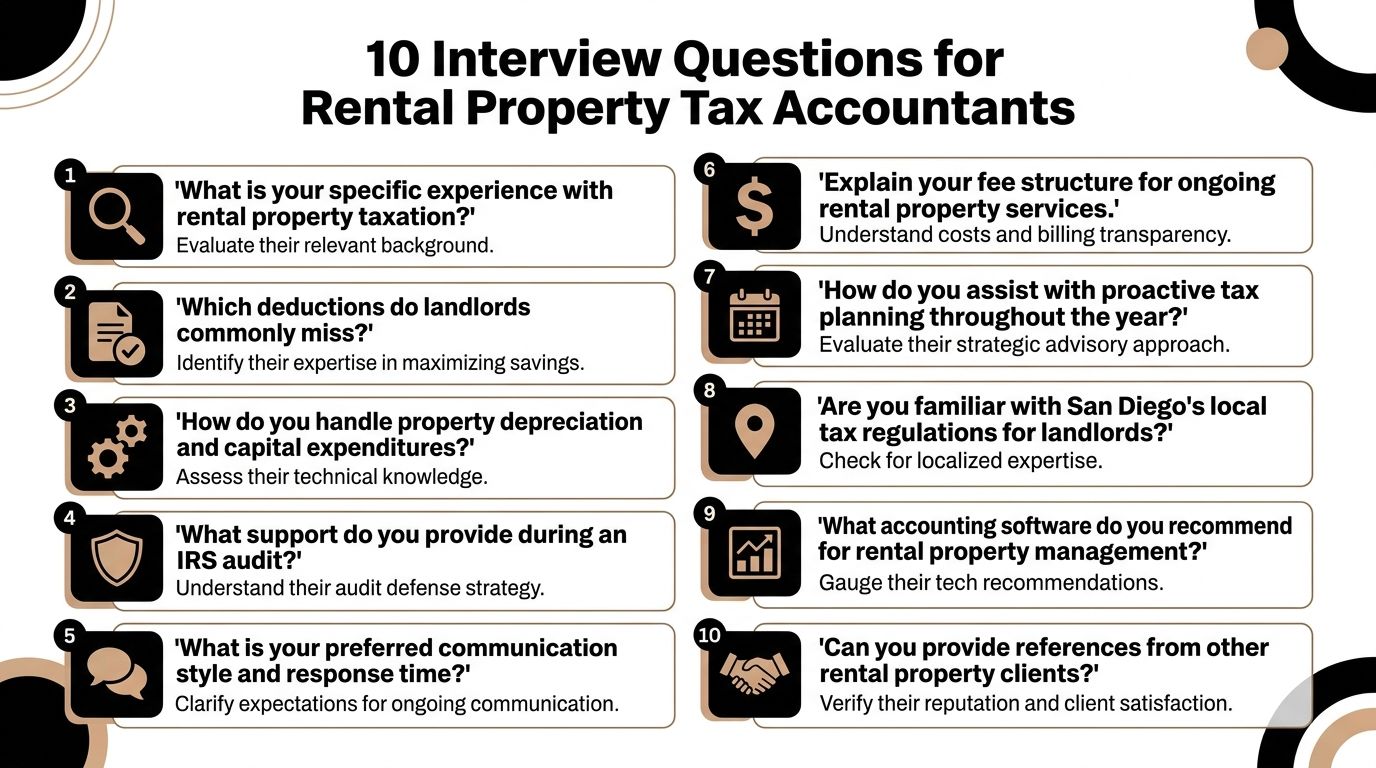
Ask these in the first meeting
What is your specific experience with rental property taxation?
Listen for actual scope. You want to hear about Schedule E work, depreciation, passive loss issues, mixed-use properties, and rental-specific bookkeeping. If the answer stays broad, keep digging.Which deductions do landlords commonly miss?
Strong candidates usually mention overlooked categories without hesitation. Weak candidates give you a generic list that sounds copied from basic tax software prompts.How do you handle depreciation and capital expenditures?
This question exposes whether they understand setup work or just annual prep. A good answer distinguishes routine repairs from improvements and explains how they establish the depreciable basis.What support do you provide during an IRS audit or notice response?
Not every question becomes a full audit. Many become correspondence problems first. You want to know who responds, what records they expect, and whether they represent clients directly.How do you prefer clients to deliver records during the year?
The answer tells you whether they run a real process. Secure portals, periodic review, and standardized document requests are all good signs.
Questions that separate planners from preparers
How do you approach year-round tax planning for landlords?
A preparer talks about deadlines. A planner talks about entity questions, timing of expenses, documentation habits, and upcoming law changes.How would you treat a property with some personal use?
This matters in San Diego because owners often use a coastal unit part of the year or test a long-term rental as a furnished stay. A good answer should immediately turn to allocation and documentation.What should I be tracking monthly for each property?
You want someone who thinks in systems. They should care about income, categorized expenses, reconciliations, and property-level performance.What software do you recommend, and why?
Good answers are specific. They may mention QuickBooks, Excel for very small portfolios, or landlord-focused platforms like Stessa, then explain which owner each fits.Can you provide references from rental property clients or examples of similar situations you handle?
You are not asking for confidential data. You are checking whether this is a real lane for them or a marketing line.
What a strong answer sounds like
A real specialist is comfortable with nuance. They do not rush to a yes-or-no answer when the facts matter.
For example, if you ask about personal use of a property, the wrong answer is “That’s fine, we can still write everything off.” The better answer is, “It depends on how many days of personal use there were, how the property was marketed, and how expenses were allocated.”
If you ask about audit help, a vague promise is not enough. You want to hear what records they expect you to maintain, who handles the response, and how they support the filing position.
How to score the interview
Use this simple screen after each call:
- Clear and specific: They answered directly.
- Rental-focused: Their examples came from landlord situations.
- Process-driven: They described how they work during the year.
- Cautious where needed: They did not improvise on gray areas.
- Local awareness: They understood the types of properties common in San Diego.
Quick test: If the accountant never asks how many properties you own, whether any are furnished, or whether you use one personally, they are not vetting your case seriously.
One question landlords forget
Ask this near the end: “What type of client is not a fit for your firm?”
That question does two things. It tells you whether the accountant knows their lane, and it tells you whether they are disciplined enough to say no. Both matter.
A rental property tax accountant who takes every kind of tax work often ends up acting like a generalist even when the website says otherwise.
Onboarding Your Accountant for a Successful Partnership
Hiring the right accountant is only half the job. The other half is giving them clean inputs and agreeing on a workflow that works in real life.
Most bad tax relationships fail in the first sixty days. Not because the accountant lacks skill, but because the landlord sends partial records, uses the wrong bank account, and expects strategic advice from year-end chaos.

Bring these documents first
The first meeting goes better when you show up with the full file, not just last year’s return.
Gather:
- Prior tax returns
- Closing statements for each property
- Loan documents and refinance records
- Property tax bills
- Insurance statements
- HOA statements
- Repair and contractor invoices
- Rent rolls or lease summaries
- Bank and credit card statements used for rentals
- A current list of each property with address, purchase date, and use
If the property is in San Diego, include anything unusual such as Mello-Roos bills, ADU construction records, permit-related expenses, and major improvement invoices.
Confirm the accounting method early
This is not a technical footnote. It affects how the books are built.
Small landlords with fewer than 5 units often use the cash basis method, chosen by 70% of landlords for simplicity, and a key onboarding step is confirming the method and setting up a separate bank account for each property. The same source says segregated accounts produce a 98% audit pass rate per CPA benchmarks (Irvine Bookkeeping guide to property manager accounting).
That means your accountant should ask, early:
- When do you record rent?
- How do you handle prepaid items?
- Do you have one account per property?
- Are any personal transactions flowing through the rental account?
If they do not ask, ask them.
Choose a fee structure that matches your portfolio
Different structures fit different landlords.
| Fee model | Best for | Watch out for |
|---|---|---|
| Flat fee | Stable portfolios with predictable work | Scope creep if planning or cleanup is extensive |
| Hourly | Messy records, one-time cleanup, audit issues | Harder to budget if records stay disorganized |
| Retainer | Ongoing planning and active investors | Make sure the service calendar is defined |
For a single clean long-term rental, a flat annual engagement often works. For a landlord adding properties, using contractors heavily, or converting units between long-term and short-term use, some form of ongoing advisory is usually more useful.
Set communication rules before problems arise
Do not leave communication vague.
Agree on:
- Who sends documents
- How often bookkeeping is reviewed
- What response time to expect
- When planning meetings happen
- What triggers an extra consultation
A secure portal is better than email chains full of attachments. Some firms, including Allied Tax Advisors, use an online client portal for document collection and ongoing communication. That matters when you need to upload closing statements, notices, and contractor records without hunting through old inboxes.
Best onboarding move: Open separate property bank accounts before the next rent cycle starts. That single change fixes a surprising amount of downstream tax friction.
Proactive Tax Strategies Your Accountant Should Discuss
A rental property tax accountant should do more than prepare last year’s return. If the conversation never leaves last year, you are paying for compliance only.
Landlords in San Diego often need planning around renovations, ADUs, changing use patterns, and future sales. Those are not side topics. They drive the tax result.
Strategy starts before year-end
A serious advisor should raise planning issues while the year is still open.
The list usually includes:
- Depreciation setup and review
- Capital improvement tracking
- Passive loss planning
- Real Estate Professional status documentation
- Disposition planning
- Short-term rental classification issues
- Timing of major work and large purchases
One area that needs attention now is the Tax Cuts and Jobs Act timeline. The excess business loss disallowance is set to expire after 2025, which may unlock significant deductions for multi-property owners, and IRS examiner guides target Real Estate Professional status claims, disallowing 60% of them without documented proof of 750+ hours of participation (Kirsch CPA on rental property loss angles).
That has two practical consequences. First, landlords with multiple properties should model future deduction opportunities rather than waiting for 2026 to arrive. Second, anyone discussing REP status needs documentation discipline, not optimism.
Cost segregation and front-loaded deductions
Not every property needs a cost segregation study. Some do.
A specialist should explain when front-loading depreciation may make sense and when it may not. Newer acquisitions, substantial improvements, and certain conversion projects deserve a closer look. If the accountant never raises the topic, that is a missed planning conversation.
For landlords who also operate furnished units or Airbnb-style properties, strategy gets more technical. A useful background resource on that niche is this guide on how to maximize your short term rental tax deductions, especially if you are comparing long-term and short-term use of the same asset.
Short-term rental loopholes and conversion planning
This is one of the biggest gaps between generalists and specialists.
A San Diego owner may convert a garage apartment or ADU into a short-term rental, then later convert it to a second home or long-term unit. Each shift changes the tax analysis. The accountant should ask:
- Was the unit originally placed in service as a rental?
- Was there any personal use?
- Were furnishings added?
- Did platform income reporting begin?
- Is the owner trying to treat the activity as passive or non-passive?
That conversation needs to happen before filing, not after a 1099 arrives.
What the best advisors do differently
They connect tax rules to operating decisions. They do not just say “keep receipts.” They tell you which receipts matter, how to categorize them, and what to document about the work performed.
They also build an annual planning rhythm. A firm handling broader real estate investment tax strategies can be one useful model for the kind of year-round discussion active landlords need.
Key takeaway: Good rental tax planning feels boring during the year. That is exactly why it works. The surprises happen when no one planned.
The Ultimate San Diego Landlord's Tax Checklist
A good checklist should fit how landlords operate. Save this one and review it before you hire, before year-end, and before filing.

Finding and vetting
Match the accountant to the property type
A Clairemont duplex, coastal condo, ADU, and Airbnb do not create the same tax issues.Ask who they already serve
Look for existing landlord clients, not just “real estate experience.”Screen for California and San Diego familiarity
Local ownership issues show up in records, classification, and planning.Test for strategy, not just preparation
Ask about depreciation, mixed-use property, contractor reporting, and future planning.
Hiring and onboarding
Open a separate bank account for each property
This makes bookkeeping cleaner and supports tax reporting.Deliver the full acquisition file
Closing statements, loan docs, and early repair records matter more than most landlords expect.Clarify fee scope in writing
Know whether notices, amended returns, planning calls, and bookkeeping review are included.Set a document rhythm
Monthly or quarterly beats annual scrambling.
Annual tax prep and strategy
Review property-by-property income and expenses
Every property needs its own clean numbers.Track local charges carefully
Property taxes, HOA dues, Mello-Roos, insurance, and contractor payments should be categorized consistently.Separate repairs from improvements
This is a common trouble spot, especially after turnovers and renovations.Flag changes in use immediately
Long-term to short-term, owner use, vacancy shifts, and ADU conversions all affect treatment.Prepare for contractor compliance
If you pay vendors directly, ask early about required tax forms.Hold a planning meeting before year-end
Filing season is too late for many useful decisions.
For landlords who want a ready-made list of deductible categories to compare against their records, this rental property tax deductions checklist is a practical companion to your own bookkeeping file.
One final operational check
If you cannot hand your accountant a clean packet for each property, the problem is not just taxes. It is management. Fix the operating system, and tax prep gets easier, faster, and safer.
Frequently Asked Questions
Do I need a rental property tax accountant if I only own one rental
Sometimes yes.
One rental can still involve depreciation, partial-year ownership, personal use questions, repairs versus improvements, or contractor compliance. If the property was inherited, refinanced, converted from a residence, or renovated, the file gets technical quickly.
If your records are clean and the activity is simple, you may only need limited help. If anything about the property is unusual, a specialist is usually worth it.
How is a short-term rental different from a regular rental for tax purposes
Short-term rentals create more moving parts. Income sources can include nightly rent, cleaning fees, pet fees, and platform payouts. Use patterns also matter more because owners often stay in the property personally.
Generalists often miss planning opportunities in these situations. Generalist CPAs often miss 20–30% of optimizations in short-term rental scenarios, and IRS audit guides show STR income being reclassified as non-passive in 40% of audits for non-professionals. Specialized knowledge also matters because of new Form 1099-K reporting rules for platforms like Airbnb effective in 2025 (TurboTenant webinar summary on rental taxes and accounting).
For San Diego owners running furnished units, beach-area stays, or ADUs, that is a strong reason to hire someone who handles STR work specifically.
What if I think my accountant made a mistake
Act quickly, but do not assume the issue is fraud or negligence. Start by asking for the workpapers, depreciation schedule, and explanation of the treatment used.
Then compare that answer to your records. Many “mistakes” are really missing facts the accountant never received. Some are actual filing errors and should be corrected with an amendment or formal response.
If you get a notice, do not ignore it while sorting out blame.
Should my accountant also do my bookkeeping
For many landlords, yes.
Bookkeeping and tax prep are separate functions, but they should connect tightly. If one person builds the books one way and another person files taxes another way, errors creep in. At minimum, your tax professional should review the bookkeeping structure and chart of accounts.
What records should I keep for my San Diego rental
Keep records that prove what you bought, what you spent, what you earned, and how the property was used.
That includes settlement statements, invoices, leases, bank statements, loan records, property tax bills, insurance records, contractor payments, and notes on any periods of personal use. If you operate a short-term rental, keep platform payout reports and occupancy records too.
Insurance documents also deserve more attention than many landlords give them. If you are reviewing your risk setup alongside tax records, this overview of Landlord and Rental Property Insurance is a useful starting point.
When is the right time to hire
Before there is a problem.
The best time is when you buy, convert, renovate, or add a second property. The next-best time is before year-end. The most expensive time is after a notice arrives and the records are weak.
If you want a second set of eyes on your rental bookkeeping, Schedule E reporting, or year-round planning, Allied Tax Advisors works with landlords and real estate investors on tax preparation, compliance, and strategic guidance specific to the facts of the property.