
When business owners start digging into the "S corp distribution tax rate," they're usually looking for a hard number, a specific percentage. The answer often comes as a surprise: for most S corp shareholders, that rate is zero.
That’s right. S corp distributions are typically tax-free, as long as you have enough stock basis to cover the amount you take out. The real tax hit comes when your business actually earns the profit, not when you decide to move that money into your personal bank account.
How the S Corp Distribution Tax Rate Actually Works

To really get why distributions are usually tax-free, you first have to understand what makes an S corp special: its "pass-through" tax status. Unlike other corporate structures, an S corporation doesn't pay its own income taxes. Instead, all the company's profits and losses are "passed through" directly to the shareholders to report on their personal tax returns.
Think of your S corp as a conduit. The profits it generates flow through the business and land directly on your personal Form 1040. It’s on your individual return where that income gets taxed at your personal income tax rates, which currently range from 10% to 37%.
Key Takeaway: You pay taxes on S corp profits in the year they're earned, whether you take a distribution or not. The distribution itself is just you accessing money that has already been taxed.
This approach is a world away from how traditional C corporations are handled, which get hit with what's famously known as "double taxation." A C corp first pays corporate tax on its profits. Then, if it distributes any of those after-tax profits to shareholders as dividends, the shareholders have to pay tax on that income all over again.
S Corp Pass-Through vs C Corp Double Taxation
Seeing the two structures side-by-side makes the S corp advantage crystal clear. The entire S corp election was created to give small businesses a way to escape this double-tax scenario.
Here's a simple breakdown of the two paths your money can take.
| Taxation Point | S Corporation Treatment | C Corporation Treatment |
|---|---|---|
| Tax on Business Profits | None at the corporate level. Profits "pass through" to owners. | Taxed at the 21% corporate rate. |
| Tax on Shareholder Income | Profits are taxed once at the shareholder's individual rate. | Dividends are taxed again at the shareholder's dividend rate. |
| Tax on Distributions | Generally tax-free, as long as basis exists. | Taxable to the shareholder as a dividend. |
| The Bottom Line | A single layer of taxation. | A double layer of taxation. |
Wrapping your head around this single layer of taxation is the first major step to mastering your S corp's finances. The profits are tallied and reported on your company’s annual tax return, and you can learn more about that by reading our guide on what Form 1120-S is. This form is what tells the IRS how much income passed through to you, which you then report on your personal return. It’s this simple, direct mechanism that makes the S corp distribution tax rate a non-issue in most situations.
Why S Corps Became a Small Business Game-Changer
It’s easy to think of the S corp as just another box to check on a form, but its creation was a genuine game-changer for American small businesses. To really grasp how S corp distributions work, you have to understand the problem it was designed to solve. This wasn't some loophole; it was a deliberate legislative rescue mission.
Picture this: it's 1958, and you're a successful entrepreneur. The tax environment is so punishing that nearly every dollar of profit could be devoured by taxes before it ever reaches your pocket. This historical backdrop is the key to understanding why the s corp distribution tax rate is structured the way it is.
The Problem of Double Taxation
Back then, a business owner was caught between a rock and a hard place. You could operate as a sole proprietorship or partnership and accept unlimited personal liability, or you could form a C corporation for protection but get hammered by a system known as "double taxation."
It was a brutal one-two punch. First, the C corporation's profits were taxed at the corporate level. Then, when the company paid out those already-taxed profits to you, the owner, you were taxed a second time on your personal return as a dividend.
Just how bad was it? In 1958, the top corporate tax rate was 52%, and the top individual rate was a staggering 91%.
When you combine those two, the results were toxic for anyone trying to grow a business. A high-income shareholder could see an effective federal tax rate on their profits climb as high as 96%. Even for a family with a median income, that effective rate often shot past 60%. You can dig deeper into this history by exploring this overview of S-Corp taxation.
This system trapped money inside corporations. Why would any owner distribute profits if the government was going to take nearly all of it? Congress saw that this was choking off small business growth and decided to create a better way.
A Legislative Lifeline for Small Business
The solution came in the form of Subchapter S of the Internal Revenue Code. This legislation created a new kind of business entity that offered the best of both worlds: the liability shield of a corporation and the tax-friendly nature of a partnership.
This new "S" corporation completely did away with the corporate-level income tax. Suddenly, the entire landscape shifted.
- Single Layer of Taxation: Profits were no longer taxed at the company level. Instead, they would "pass through" to the owners to be reported on their personal tax returns.
- Tax-Free Distributions: Because owners had already paid tax on their share of the profits, they could generally withdraw that money from the business as a distribution without paying any additional tax.
- Capital Unleashed: This simple change freed up massive amounts of capital. Owners could finally take home what they earned, reinvest in their businesses, and fuel their local economies.
By sidestepping double taxation, the S corp fundamentally changed the rules of the game. It gave entrepreneurs a real chance to build wealth without having it decimated by the tax code. When you understand this origin story, you see the S corp for what it is: not a tax gimmick, but a purpose-built tool designed to help small businesses thrive—a principle we at Allied Tax Advisors help our clients put into practice every single day.
Understanding the Three Tiers of S Corp Distributions
When it comes to S corp distributions, not all withdrawals are treated the same way by the IRS. While most are tax-free, there’s a strict order to how you can take money out of your business. This is especially true if your S corp ever operated as a C corp in a past life. Getting this wrong can lead to a nasty surprise come tax time.
A great way to visualize this is to think of your S corp's equity as three different buckets of water. You have to drain the first bucket completely before you can touch the second, and so on. The s corp distribution tax rate you’ll pay—if any—depends entirely on which bucket the money is coming from.
This flowchart gives you a peek into why the S corp was created in the first place—to solve a specific tax problem. That history is exactly why these distribution rules are so precise.
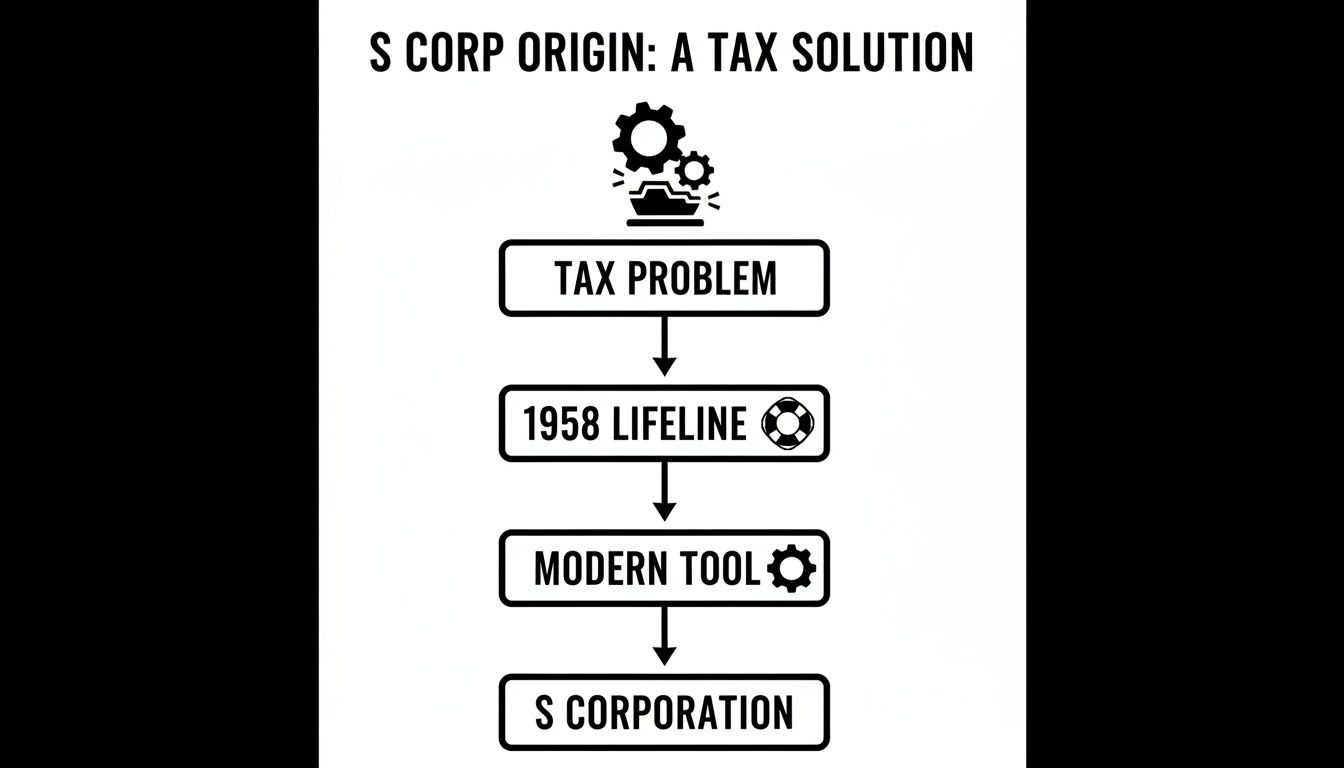
As you can see, the S corp was a deliberate fix, and understanding its rules is key to using it effectively.
Tier 1: The Accumulated Adjustments Account (AAA)
First up is the main bucket for nearly every S corp: the Accumulated Adjustments Account, or AAA. Think of this as the running total of all the profits your company has earned and that you've already paid personal income tax on since it became an S corp. It's reduced every time you take a distribution.
Because you’ve already been taxed on this income, you can pull money from the AAA bucket completely tax-free. For a company that has been an S corp from day one, this is often the only bucket that ever comes into play. As long as your distributions don’t exceed your stock basis, the money comes out of the AAA, and your tax rate on it is 0%.
Tier 2: Prior C Corporation Earnings and Profits (E&P)
Now, things get a bit more complicated if your S corp used to be a C corporation. The second bucket holds any profits the business earned and kept during its C corp days. This is known as Earnings and Profits (E&P). From a shareholder's viewpoint, this is old money that was never taxed at the individual level.
Critical Distinction: Because this E&P was never "passed through" to shareholders under the C corp structure, any distributions from this bucket are treated as taxable dividends.
Once your AAA bucket is empty, the IRS says any further distributions must come from this E&P bucket. These withdrawals are taxed at the qualified dividend rates, which are usually 0%, 15%, or 20%, based on your personal income. This is a common and costly trap for entrepreneurs who convert a C corp without solid tax advice.
Tier 3: Return of Capital and Capital Gains
What happens if you manage to empty both the AAA and the E&P buckets? At that point, you move to the third and final tier. Any distribution from this bucket is considered a return of capital—it’s essentially the company giving you back your initial investment or any additional funds you've put in.
This tier has two distinct steps:
- Tax-Free Return of Basis: First, these distributions are treated as a tax-free return of your investment, which reduces your stock basis.
- Taxable Capital Gain: Once your stock basis is reduced to zero, any distribution beyond that point is taxed as a capital gain. Whether it's short-term or long-term depends on how long you've held your stock.
Let's walk through a quick example.
Say your S corp was previously a C corp. Your books show:
- $100,000 in the AAA
- $30,000 in C corp E&P
- You have a personal stock basis of $50,000
You decide to take a $140,000 distribution. Here’s how the IRS would break it down:
- The first $100,000 is drawn from the AAA. This portion is tax-free.
- The next $30,000 must come from E&P. This is taxed as a dividend.
- The last $10,000 is a return of capital. It’s also tax-free and reduces your stock basis from $50,000 down to $40,000.
As you can see, these ordering rules aren't just suggestions—they have very real tax consequences. Keeping a close, accurate watch on your AAA, E&P, and stock basis isn't just good accounting; it's fundamental to managing your tax bill and making sure every distribution is as efficient as possible.
Finding the Sweet Spot Between Salary and Distributions

For S corp owners, mastering the interplay between your salary and distributions is everything. This is arguably the most powerful tool you have for managing your tax bill, but it's also the area the IRS watches like a hawk. Striking the right balance is absolutely critical.
The core difference is straightforward: salaries are hit with payroll taxes, while distributions are not. This simple fact creates a massive tax-saving opportunity and directly influences the effective s corp distribution tax rate you ultimately pay on your total compensation.
The Payroll Tax Dilemma
When you take a salary, your S corp treats you just like any other W-2 employee. That means both you and the company have to pay payroll taxes—Social Security and Medicare (FICA)—which add up to a significant 15.3% on wages up to the annual Social Security limit.
Distributions, however, are a different animal. They represent a withdrawal of the company’s profits. Since those profits have already "passed through" to you and been taxed on your personal income tax return, they aren’t subject to that 15.3% payroll tax.
The incentive here is obvious: the lower your salary and the higher your distribution, the less you pay in payroll tax. But before you decide to pay yourself a $1 salary, know that the IRS has a major rule to prevent exactly that.
The Compensation Balancing Act: Think of your total pay as a balancing act. Lean too heavily on the "salary" side, and you're handing over too much in payroll taxes. But if you tip the scales too far toward "distributions," you're waving a huge red flag for an IRS audit.
The law is crystal clear: every shareholder who works for their S corp must be paid a reasonable salary for the work they perform before taking a single dollar in distributions. This isn't a suggestion; it's a requirement.
What Is a Reasonable Salary?
"Reasonable" might sound vague, but the IRS has a pretty specific checklist it uses to determine if your salary holds up to scrutiny. You can't just pick a number that feels good; it needs to reflect what a similar business would pay for the same services.
Here’s what the IRS looks at:
- Your Role and Responsibilities: What do you actually do all day? Are you the CEO, the lead salesperson, the bookkeeper, or all three?
- Your Training and Experience: A seasoned expert with 20 years in the field naturally commands a higher salary than someone just starting out.
- Time and Effort Invested: How many hours are you putting in? A full-time, hands-on owner's salary should look very different from that of a part-time or passive shareholder.
- Industry Benchmarks: What are comparable companies in your area paying people for similar jobs? Data from the Bureau of Labor Statistics and other compensation studies are key here.
Nailing this number is one of your most important compliance duties. For a deeper dive, see our guide on setting a reasonable salary for an S Corp owner. Documenting how you arrived at your figure is your single best defense if you ever face an audit.
It's also worth noting how tax laws like the Tax Cuts and Jobs Act (TCJA) of 2017 have made this even more important. By creating things like the Qualified Business Income Deduction (QBID), the law enhanced the S corp advantage. As this in-depth economic report shows, smart owners know that optimizing the salary-to-distribution ratio is the key to unlocking these benefits, since the hefty 15.3% payroll tax only applies to the salary portion.
How the QBID Supercharges Your S Corp Tax Savings
When the Tax Cuts and Jobs Act of 2017 rolled out, it handed S corporation owners a game-changer: the Qualified Business Income Deduction (QBID). This isn't just another line item on your tax form; it’s one of the most significant tax breaks available to business owners today and a cornerstone of modern tax planning.
At its core, the QBID allows many S corp shareholders to deduct up to 20% of their qualified business income right off their personal tax return. This is the profit that flows from your business to you personally—the very same pool of money your distributions come from. Put simply, the government is letting you make a chunk of your business profit tax-free.
The savings can be dramatic. For a business owner in the highest 37% federal tax bracket, taking a 20% deduction on their business income effectively slashes their tax rate on those profits down to just 29.6%. That's a direct, powerful reduction that leaves more of your hard-earned money right where it belongs: with you.
Who Qualifies for the QBID
As potent as it is, the QBID doesn't apply to everyone automatically. The rules were written to benefit most pass-through businesses, but there are critical income limits and industry-specific restrictions to be aware of.
Generally, the deduction is on the table for owners of:
- S Corporations
- Partnerships
- Sole Proprietorships
- Certain trusts and estates
Things get trickier, however, once your personal taxable income climbs above the annual thresholds set by the IRS. The deduction can also be limited or even eliminated for owners in what's known as a "Specified Service Trade or Business" (SSTB). These are fields like health, law, accounting, or consulting, where the main asset is the owner's or employees' reputation and skill.
The creation of this deduction underscores just how vital pass-through businesses are to the U.S. economy. Consider that S corp owners paid a staggering $131 billion in individual income taxes on their pass-through profits in 2018 alone. You can dive deeper into the economic impact of S corporations to see just how central these structures have become.
A Clear Example of QBID in Action
Let's bring this down to earth with a real-world scenario. Imagine you're the sole owner of an S corp. You’ve paid yourself a reasonable salary, and after all expenses, the business has $100,000 in qualified business income that passes through to you.
Without the QBID, that entire $100,000 would be subject to your personal income tax rate. But with the deduction, you can subtract $20,000 (20% of $100,000) from your income. If you fall into the 24% tax bracket, that $20,000 deduction directly saves you $4,800 in taxes. It’s like getting a massive discount on your tax bill.
The QBID Bottom Line: This deduction makes the S corp structure more valuable than ever. It directly reduces the taxes you owe on business profits, which in turn increases the after-tax value of every distribution you take.
Getting the most out of this deduction while staying compliant takes careful planning. And remember, the QBID is just one piece of your overall tax strategy. You can find even more savings by exploring all the available small business tax deductions. To get a complete view of how all these moving parts affect your bottom line, take a look at our guide to the S corp tax rate.
Common Questions About S Corp Distributions
Even with the rules laid out, things can get tricky in the real world. As advisors, we find that the same practical questions come up time and time again from S corp owners. Let's walk through the most common concerns to help you apply these concepts with confidence.
Understanding the theory is one thing, but knowing what to do when your business faces a specific situation is another entirely. Here are the straightforward answers to the questions we hear most often.
What Happens If My Distribution Exceeds My Stock Basis?
This is where things can get sticky, and it's a common trap for S corp owners. The general rule is that your distributions are tax-free, but that only applies as long as you have enough stock basis to cover them.
Once you take out more than you have in your basis, that money isn't a tax-free distribution anymore. The IRS views that excess cash as a taxable capital gain.
Example: Let's say your stock basis is $20,000 at the beginning of the year. You decide to take a $25,000 distribution. The first $20,000 comes out completely tax-free. But that extra $5,000 you took? That's treated as a capital gain and will be taxed.
This is exactly why you must track your basis every single year. It’s not optional.
Can I Take Distributions If My S Corp Has a Loss?
Technically, yes, you can. But from a financial and tax standpoint, it's a really bad idea. Remember, a business loss reduces your stock basis, which makes it far more likely that any distribution you take will push you over your limit and trigger a tax bill.
Beyond the immediate tax hit, pulling money from a business that's losing money can raise red flags with the IRS. It might suggest the business isn't financially sound or even call into question whether your "reasonable salary" was appropriate in the first place. It's best to talk with a tax pro to understand the full picture before taking a distribution from a company in the red.
Do I Have to Pay All Shareholders Distributions Equally?
Yes. This is a non-negotiable rule of the S corp structure. All distributions have to be paid pro-rata, which is just a formal way of saying they must be proportional to each shareholder's ownership stake.
If you own 60% of the company and your business partner owns the other 40%, every distribution must be split 60/40. No exceptions.
If you don't follow this rule, you've created a "disproportionate distribution." This is a serious misstep that can lead the IRS to revoke your S corp status altogether. If that happens, your company gets reclassified as a C corporation, and you could be facing the nightmare of double taxation, possibly even retroactively.
How Is My Stock Basis Calculated?
Think of your stock basis as a running tally of your after-tax investment in the company. It’s not a static number—it changes every year based on the company's performance and your own financial activity.
Here’s the simple formula for tracking it:
- Start With: Your initial cash and property investment to get the company off the ground.
- Add to It: Your share of the company's profits and any new capital you contribute.
- Subtract From It: Your share of any company losses and, of course, any distributions you take out.
Keeping an accurate, up-to-date calculation of your basis isn't just a good idea; it's a fundamental part of your S corp's bookkeeping. It’s the only way to know for sure that your distributions are tax-free and to make smart financial plans for the future.
Navigating the complexities of S corp distributions, reasonable compensation, and tax planning requires a clear strategy and expert guidance. The team at Allied Tax Advisors has decades of experience helping business owners optimize their tax position and ensure full compliance. If you're ready to move forward with confidence, schedule a consultation with our team of experts today.