
If you're a freelancer, independent contractor, or run your own business, the self-employment tax rate of 15.3% is a number you'll get to know very well. It might seem intimidating at first, but understanding where this figure comes from is the key to managing your tax responsibilities confidently.
What Is the Self Employment Tax Rate?
Think back to when you were a W-2 employee. Your pay stub likely showed a deduction for "FICA" taxes, which fund Social Security and Medicare. The cost of those taxes was split right down the middle: your employer paid half (7.65%), and you paid the other half (7.65%).
Now that you're self-employed, you're wearing both hats—you are the business and the worker. That means you're responsible for covering both sides of the FICA contribution. This combined payment is what we call the self-employment tax.
The self-employment tax isn't a penalty for being your own boss. It’s simply how independent professionals pay into Social Security and Medicare, ensuring they can receive those same benefits down the road, just like anyone with a traditional job.
The Two Parts of the 15.3% Rate
That 15.3% rate isn't one giant tax; it's actually two separate components rolled into one. Here's a quick look at the two taxes that make up the self-employment tax, their rates, and the income they apply to.
Self Employment Tax Rate Components
| Tax Component | Tax Rate | Applicable Income Limit (2024) |
|---|---|---|
| Social Security | 12.4% | On the first $168,600 of earnings |
| Medicare | 2.9% | On all of your net earnings |
As you can see, the Social Security portion (at 12.4%) only applies up to a certain income cap each year. For 2024, that ceiling is $168,600. Once your self-employment earnings cross that line, you stop paying the Social Security tax for the rest of the year.
The Medicare portion, however, is different. You'll pay that 2.9% on every single dollar of your net self-employment earnings, with no income limit at all.
This system has changed a lot since it began. When it was first introduced back in 1951, the rate was a mere 2.25% on the first $3,600 of income and only covered Social Security. If you're curious, you can explore more about the history of the self-employment tax rate to see just how much it has evolved.
Applied to Net Earnings, Not Gross Revenue
Here's a crucial point that often trips people up: the self-employment tax isn't calculated on your gross revenue—the total amount of money your business brings in. It's calculated on your net earnings from self-employment.
First, you tally up your business income and subtract all your ordinary and necessary business expenses. But the calculation doesn't stop there. The IRS gives you a slight break by letting you multiply that net profit figure by 92.35% (100% – 7.65%).
This little adjustment accounts for the fact that W-2 employees don't have to pay FICA taxes on the half their employer pays for them. It's a small but important detail that lowers your taxable base before the 15.3% rate is even applied.
Calculating Your Self-Employment Tax Step by Step
Knowing the self-employment tax rate is one thing, but actually running your own numbers is where it all clicks. The good news is that this calculation isn't nearly as scary as it sounds. It’s a logical, step-by-step process that takes your raw business profit and turns it into your final tax figure.
Let's walk through it. The whole thing happens on a tax form called Schedule SE (Form 1040), which you’ll file along with your main tax return. Think of Schedule SE as the official worksheet for this calculation.
Step 1: Start with Your Net Earnings
Before any tax rates enter the picture, you have to figure out your business's profit for the year. This is the bedrock of the entire calculation.
First, add up all your business income—your gross revenue. Then, subtract all your ordinary and necessary business expenses. We're talking software subscriptions, office supplies, marketing costs, mileage… you name it. What's left is your net earnings from self-employment.
- Gross Income – Business Expenses = Net Earnings
Don't rush this step. Every single legitimate business expense you deduct directly lowers the profit that your self-employment tax is based on.
Step 2: Find Your Taxable Base
Here’s a twist that works in your favor. The IRS doesn't actually hit your entire net earnings with the 15.3% tax rate. Instead, you only pay tax on 92.35% of that amount.
Why the discount? It’s the IRS’s way of creating a little more parity between you and a W-2 employee. See, employees don't pay FICA taxes on the share their employer contributes. This 92.35% adjustment is a rough equivalent for self-employed folks.
- Net Earnings x 0.9235 = Taxable Self-Employment Income
This resulting number is the actual base figure that will be used to calculate what you owe for Social Security and Medicare.
Key Takeaway: You never pay self-employment tax on 100% of your business profit. You first get to multiply your net earnings by 92.35%, which gives you a small but important break right off the bat.
Step 3: Apply the Tax Rates with an Example
Okay, now we're ready to apply the tax rates to that taxable base. The best way to see this in action is with a real-world example.
Example 1: A Graphic Designer
Let's say a freelance graphic designer brought in $65,000 for the year and had $5,000 in legitimate business expenses.
- Calculate Net Earnings: $65,000 (Income) – $5,000 (Expenses) = $60,000
- Find Taxable Base: $60,000 (Net Earnings) x 0.9235 = $55,410
- Calculate the Tax: $55,410 (Taxable Base) x 0.153 (SE Tax Rate) = $8,477.73
Boom. The designer’s self-employment tax bill for the year is $8,477.73. Since their entire taxable base of $55,410 is well below the annual Social Security limit, the full 15.3% rate applies to the whole amount.
For a more detailed walkthrough, our guide on how to calculate self employment tax breaks this down with even more examples and scenarios.
How the Social Security Cap Affects High Earners
Things look a bit different for high earners because of the Social Security wage base limit, which is $168,600 for 2024. Once your taxable self-employment income blows past this number, the 12.4% Social Security tax simply stops. It's capped.
The 2.9% Medicare tax, however, keeps going. It applies to all of your earnings, no matter how high they are.
Example 2: A High-Earning Consultant
Let's imagine a successful business consultant who netted $180,000 after expenses.
- Find Taxable Base: $180,000 (Net Earnings) x 0.9235 = $166,230
- Calculate Social Security Tax: Even though their net earnings were higher, their taxable base of $166,230 is still just under the $168,600 cap. So, the 12.4% tax applies to the whole thing.
- $166,230 x 0.124 = $20,612.52
- Calculate Medicare Tax: The 2.9% Medicare tax hits the entire taxable base.
- $166,230 x 0.029 = $4,820.67
- Total Self-Employment Tax:
- $20,612.52 (Social Security) + $4,820.67 (Medicare) = $25,433.19
Now, if that consultant's taxable base had been, say, $200,000, they would only pay the 12.4% Social Security tax on the first $168,600. The Medicare tax would still apply to the full $200,000. This cap is a crucial detail that prevents the tax bill from getting out of control for the highest earners.
Key Deductions That Lower Your Tax Bill
Knowing how the self-employment tax is calculated is one thing. Actually reducing what you owe is where the real strategy comes in. And your most powerful weapon isn't some obscure loophole; it’s something far more fundamental: your business deductions.
Every legitimate business expense you track and claim chips away at your net profit. Since your SE tax is based on that net profit, every dollar you deduct is a dollar that isn't subject to that 15.3% tax. This creates a direct, powerful link between diligent bookkeeping and keeping more money in your pocket.
This flowchart breaks down how your gross income gets whittled down to the final taxable base for your SE tax.
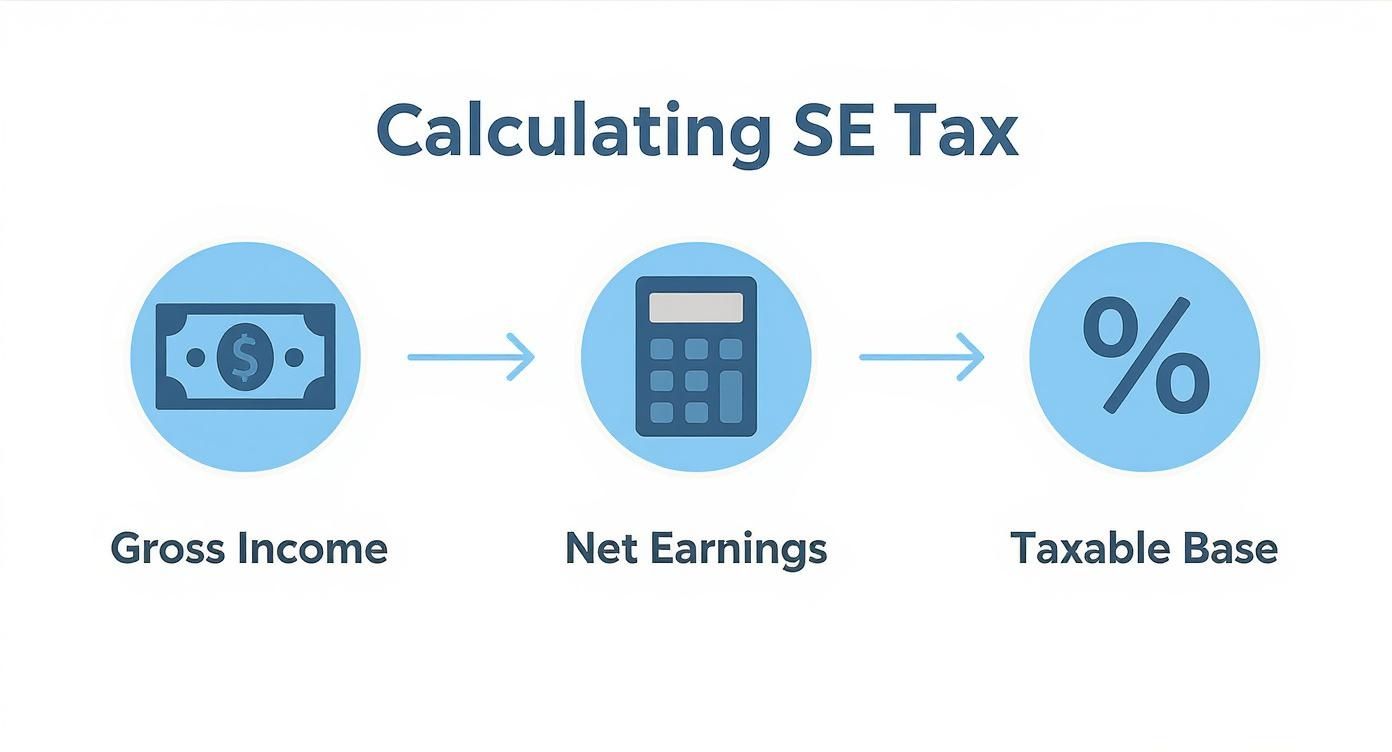
As you can see, deductions are the critical step between what you earn and what you’re taxed on. They are absolutely essential for managing your overall tax liability.
Common (And Crucial) Business Deductions
While the list of possible write-offs is long, a few core categories apply to almost every freelancer, consultant, or small business owner out there. Getting into the habit of tracking these expenses isn't just good advice—it's a non-negotiable part of minimizing your tax bill.
Some of the most common deductible expenses include:
- Home Office Costs: If you use a part of your home exclusively and regularly for your business, you can deduct a portion of your rent, mortgage interest, utilities, and insurance.
- Software and Subscriptions: All those tools that keep your business running—from accounting software to project management apps and industry-specific subscriptions—are fully deductible.
- Professional Development: The cost of courses, workshops, certifications, and industry conferences that help you sharpen your skills are valuable write-offs.
- Client Travel and Meals: You can deduct mileage for business-related driving and 50% of the cost of meals with clients or colleagues for business purposes.
To make sure you’re not leaving money on the table, it’s always a good idea to review a comprehensive guide. This 1099 tax deductions list can spark ideas for savings you might have completely overlooked.
The Single Most Important Deduction for the Self-Employed
Beyond your everyday operating expenses, there’s one deduction that’s unique to the self-employed and incredibly powerful: the ability to deduct one-half of your self-employment tax. This isn't just another line-item expense; it's a special adjustment that gives you a major tax break.
Think of it this way: W-2 employees don't pay income tax on the Social Security and Medicare taxes their employer pays for them. This deduction is the IRS's way of leveling the playing field, giving you a similar benefit for covering the "employer" half of your own FICA taxes.
This is what accountants call an "above-the-line" deduction. In simple terms, it means you can take it even if you don't itemize your deductions, and it directly lowers your Adjusted Gross Income (AGI).
How This Deduction Delivers a Double Benefit
Lowering your AGI is a big deal. It triggers a one-two punch that saves you money in two ways at once. First, it shrinks the amount of your income that is subject to federal (and usually state) income tax. Second, it creates a positive ripple effect across your entire tax return.
Let's go back to our graphic designer who paid $8,477.73 in self-employment tax.
- Deductible Amount: They get to deduct half of that, which is $4,238.87.
- AGI Reduction: This $4,238.87 is subtracted directly from their gross income before their income tax is even calculated.
This single move lowers both their income tax and SE tax obligations, making it one of the most impactful deductions available to any independent professional.
Don't forget about health insurance, either. Beyond standard business costs, eligible health insurance premiums can also be deducted from your income. For the self-employed, choosing the right health insurance plan as a self-employed individual is a key decision for both your well-being and your tax strategy. When you strategically track all of these deductions, you can dramatically lower your effective tax rate and boost your business's bottom line.
How to Report and Pay Your Self-Employment Taxes

Figuring out what you owe in self-employment tax is only half the job. Knowing how and when to actually pay the IRS is just as important for staying out of trouble and avoiding nasty penalties. Unlike a W-2 job where your employer handles withholding for you, the responsibility is now 100% yours.
The whole process boils down to two key parts: your annual tax return and your quarterly payments. Think of your annual return as the final exam, where you settle up for the whole year. The quarterly payments are like smaller assignments throughout the semester—they keep you on track and prevent a massive, stressful bill come April.
Annual Reporting with Schedule SE
When tax time rolls around, you’ll formally report your self-employment tax on Schedule SE (Form 1040), Self-Employment Tax. This is the official worksheet where you run through all the calculations we've discussed to land on your final SE tax liability for the year.
The final number from Schedule SE gets carried over to your main tax return, Form 1040. It’s added to your regular income tax and any other taxes you owe, giving you the complete picture of your total tax bill. This is how the IRS makes sure your contributions to Social Security and Medicare are officially recorded.
If you’re involved in a partnership or certain investments, understanding your Schedule K-1 for tax reporting is also a must. This form details your share of the business's income, and you'll need those numbers to fill out your personal return correctly.
Paying on Time with Estimated Taxes
The U.S. tax system is built on a "pay-as-you-go" foundation. For self-employed folks, this means you can’t just wait until next April to pay all your taxes from the previous year. Instead, you're required to make quarterly estimated tax payments if you expect to owe $1,000 or more in tax for the year.
These payments need to cover both your self-employment tax and your federal income tax. If you don't pay enough throughout the year, you can get hit with underpayment penalties and interest, so it really pays to stay on top of these deadlines.
The IRS doesn’t like surprises, and neither should you. Estimated taxes are a smart way to manage your cash flow and make sure you’re setting aside enough money to cover your obligations without getting a financial shock at tax time.
The year is split into four payment periods, and you absolutely need to get these dates on your calendar:
- 1st Quarter: (Income from Jan 1 – Mar 31) – Due April 15
- 2nd Quarter: (Income from Apr 1 – May 31) – Due June 15
- 3rd Quarter: (Income from Jun 1 – Aug 31) – Due September 15
- 4th Quarter: (Income from Sep 1 – Dec 31) – Due January 15 of the next year
Just a heads-up: if a due date ever falls on a weekend or a holiday, your payment is due on the next business day.
Calculating and Adjusting Your Payments
So, how much do you actually send in each quarter? The simplest way is to estimate your total tax liability for the entire year (income tax plus SE tax) and just divide that number by four. This gives you a nice, predictable payment amount.
But let's be real—freelance income is rarely that steady. You might have a slow first quarter and a fantastic third quarter. The good news is the IRS allows you to adjust your payments based on your actual income for each period using the annualized income method. It’s a bit more work, but it prevents you from overpaying during lean months.
Juggling these payments can feel like a lot, which is why we put together a guide on how to file quarterly taxes that dives deeper into these methods. The goal is to find a rhythm that works for your business so paying taxes becomes a predictable part of your financial routine.
How the US System Compares Globally
When that 15.3% self-employment tax hits, it’s natural to wonder if you’re getting a raw deal. How does this stack up against what freelancers and entrepreneurs in other countries pay? Taking a quick trip around the world gives you some much-needed perspective.
The U.S. system isn't an anomaly. While the numbers and names change, the core concept is pretty universal: independent workers contribute to their own social safety nets. It's the mechanism for ensuring freelancers get access to retirement, disability, and healthcare benefits funded by their own work.
A Look at Other Countries
Every country handles this a little differently. Some have higher rates tied to more extensive benefits, while others might seem more favorable on the surface. Seeing the variety shows that the responsibility for funding social security is a shared concept, even if the execution differs.
Take the United Kingdom, for instance. A self-employed Brit pays into a system called National Insurance Contributions (NICs). But it’s not a flat rate. They have different "Classes" based on profit levels, which creates a tiered structure—a world away from the straightforward 15.3% here in the States.
In other parts of Europe, the rates can be much steeper. A freelancer in Germany not only pays progressive income tax but also has to kick in another 15–20% for social security, depending on their coverage choices. And in France, social contributions can easily reach 25–30% of net earnings. Suddenly, our 15.3% doesn't look quite so intimidating. If you're curious, you can explore personal income tax rates around the world to see the full spectrum.
Balancing Tax Burden and Social Benefits
This brings us to the big trade-off: the tax burden versus the social benefits you get in return. Countries with those higher contribution rates often provide a much wider safety net—think universal healthcare, more generous public pensions, and extensive family leave policies.
The U.S. model, with its 15.3% self-employment tax, lands somewhere in the middle of the pack. It’s designed to ensure you’re funding the foundational programs of Social Security and Medicare, which is a fairly standard practice globally.
Looking at it this way helps reframe the tax. It’s not a penalty for going out on your own. It's simply the American way of making sure the independent workforce invests in the same social safety net that protects traditionally employed workers.
Here’s a quick comparative glance at how different countries manage social taxes for their independent workforces.
Global View of Self Employment Contributions
| Country | System Name | Typical Contribution Rate Range |
|---|---|---|
| United States | Self-Employment Tax | 15.3% (on most earnings) |
| United Kingdom | National Insurance | Tiered based on profit |
| Germany | Social Security | ~15-20% (plus income tax) |
| France | Social Contributions | ~25-30% (plus income tax) |
Ultimately, seeing these different approaches shows that the U.S. system is just one of many solutions to the same challenge. It helps clarify the "why" behind the self-employment tax, placing it within a broader international effort to support and protect independent professionals.
Advanced Strategies for High Earners
When your business really starts to take off, just keeping track of deductions isn't enough to move the needle. For those pulling in significant income, the real game-changer is rethinking your business structure. This is where you graduate from basic tax compliance to smart, strategic tax planning.
The most powerful move for many is making an S Corporation (S Corp) election. As a sole proprietor or a standard LLC, every last dollar of your profit gets hit with that 15.3% self-employment tax. An S Corp completely flips that script.
The S Corporation Advantage
Here’s how it works: once you’re an S Corp, the IRS requires you to pay yourself a reasonable salary for the work you perform. That salary is subject to FICA taxes, which you and your corporation split—7.65% each. Sound familiar? It's the same effective rate as the self-employment tax.
But the magic is in what happens to the rest of the money. Any profit left over after you've paid your salary can be paid out to you as a distribution. And distributions are not subject to self-employment taxes. That one simple difference can put thousands of dollars back in your pocket.
Example: S Corp vs. Sole Proprietor
Let's look at a consultant who netted $150,000 for the year.
-
As a Sole Proprietor: The entire profit is on the table for SE tax.
- $150,000 x 0.9235 = $138,525 (the taxable portion)
- $138,525 x 0.153 = $21,194 in self-employment tax. Ouch.
-
As an S Corp: They decide a reasonable salary for their work is $70,000.
- FICA tax on the salary: $70,000 x 0.153 = $10,710.
- The remaining profit is $150,000 – $70,000 = $80,000.
- This $80,000 flows through as a distribution, with $0 SE tax due on it.
Just by changing the business structure, this consultant saved $10,484 in a single year. Sure, S Corps have some extra administrative hurdles like running payroll, but for many profitable businesses, the tax savings make it a no-brainer.
Special Cases and Important Thresholds
Beyond just your business entity, there are a few specific situations and income floors that can impact what you owe.
- Real Estate Professionals: Rental income is usually considered passive and isn't subject to SE tax. To have it treated as active business income (and thus be taxable), you have to meet some very strict "material participation" tests defined by the IRS.
- Crypto Earnings: If you’re a miner or earn staking rewards, the IRS generally views that as self-employment income, and you’ll owe tax on it. On the other hand, profits you make from simply buying and selling crypto are treated as capital gains, which are completely separate from SE tax.
- The $400 Rule: Don't forget the baseline. You generally only have to file and pay self-employment tax if your net earnings from your business are $400 or more. If you're just starting out or had a slow year and came in under that, you typically won't owe any SE tax.
Figuring out a "reasonable salary" or correctly classifying different types of crypto income can get tricky, fast. Getting it wrong can attract unwanted attention from the IRS. This is precisely the point where hiring a great CPA or enrolled agent stops being an expense and becomes one of the best investments you can make in your business.
Frequently Asked Questions
When you're self-employed, a few specific tax questions tend to pop up again and again. Let's clear up some of the most common points of confusion.
Do I Owe Self-Employment Tax on a Side Hustle If I Already Have a W-2 Job?
Yes, almost certainly. Think of it this way: the IRS looks at all your earned income together to see if you've hit the annual Social Security wage cap.
Let's say in 2024 you earn $150,000 from your day job. You've already paid Social Security tax on that full amount through your W-2 withholdings. If you then bring in another $30,000 from a side business, you only have a little more Social Security to pay. You'll owe the 12.4% Social Security tax on just the first $18,600 of that freelance income, which gets you to the $168,600 annual limit.
But remember, the Medicare portion is different. The 2.9% Medicare tax applies to every single dollar of your side hustle profit, so you'd pay it on the full $30,000. It has no income cap.
What's the Difference Between Self-Employment Tax and Income Tax?
This is a crucial distinction, and one that trips up a lot of new business owners. They are two completely separate taxes, paid on the same money.
-
Self-Employment Tax: This is your 15.3% contribution to the Social Security and Medicare systems, just like FICA taxes for employees. It's a flat tax calculated directly on your net business profit.
-
Income Tax: This is the tax you pay on your total income from all sources (your job, your business, investments, etc.). It’s calculated using progressive tax brackets, so the rate gets higher as your income climbs.
You absolutely pay both. You figure out your self-employment tax first. Then, that same business profit gets added to your other income to determine what you owe for federal and state income tax.
What Happens If I Miss an Estimated Tax Payment?
If you miss a quarterly payment deadline or don't pay enough, the IRS will likely charge you a penalty. It’s not a flat fee; it’s basically an interest charge on the amount you underpaid for the time it was late.
The best thing you can do is catch up as soon as you realize you've missed a payment. Making a late payment in the next quarter can often reduce or even eliminate the penalty you would have owed for the earlier missed period. It’s all about staying current to avoid a nasty surprise—and extra fees—when you file your annual return.
At Allied Tax Advisors, we specialize in making these complex tax situations clear for freelancers, investors, and small business owners. If you're struggling to get a handle on your self-employment tax rate or want to build a better financial strategy, our team is ready to help with straightforward, practical advice. Explore our tax and accounting solutions today.