
You're good at your business. You know how to serve clients, make the product, answer emails, fix problems, and keep things moving.
Then tax season shows up and suddenly it feels like you need a second career just to stay compliant.
That's where most new owners get stuck. They aren't lazy. They aren't bad with money. They're just trying to translate a pile of forms, deadlines, and unfamiliar terms into real decisions. Should you stay a sole proprietor? Do you need quarterly payments? What counts as a write-off? If you hired someone, what now?
This guide is written the way I'd explain it in a first meeting with a new client. Plain English. Simple examples. No scare tactics. No pretending taxes are fun. Just a clear way to understand what matters, where people trip up, and how to avoid expensive mistakes.
Table of Contents
- Your Guide to Conquering Small Business Taxes
- Choosing Your Business Structure Is Your First Tax Decision
- The Three Main Taxes Every Small Business Owner Should Know
- Keep More of Your Money A Guide to Business Deductions
- How to Pay Your Taxes Without Getting Penalized
- Payroll Taxes The Rules When You Have a Team
- Recordkeeping 101 How to Stay Organized and Audit-Proof
- When to Call a Pro Your Signal to Hire a CPA
Your Guide to Conquering Small Business Taxes
A lot of owners walk into tax season with the same story. Revenue is coming in. Customers are happy. The business itself is real now. But the paperwork keeps piling up in a folder called “deal with later.”
Then later arrives.
You open your banking app, see money moving around, and realize you don't fully know what part belongs to you, what part belongs to the IRS, and what part should've been set aside months ago. That moment feels heavier than it should, mostly because nobody taught you this in a practical way.
You don't need to become a tax expert overnight. You need a working system and a few key decisions made correctly.
Small business taxes for dummies should start there. Not with a pile of code sections. Not with ten forms dropped in your lap. Start with the basics: what kind of business you are, what taxes apply, when money has to be paid, and what records protect you.
Here's the encouraging part. Once you understand the pattern, taxes become less mysterious. They turn into routines. A business structure is just a container. Deductions are just tracked business costs. Quarterly payments are just prepaying part of the bill instead of waiting until April and hoping for the best.
If you've been avoiding this because it feels embarrassing or overwhelming, don't. Most new owners are confused at first. The smart move isn't knowing everything. The smart move is slowing down, sorting the moving parts, and handling them one at a time.
Choosing Your Business Structure Is Your First Tax Decision
A common first meeting goes like this. A new owner says, “I started getting paid, then someone told me I need an LLC, then someone else said I should elect S Corp status, and now I'm worried I already messed it up.”
That reaction is normal.
Your business structure decides how the IRS sees the income you earn, which tax forms usually follow, and how much administrative work lands on your plate. It is one of the first tax choices you make, even if you never sat down and made it formally.
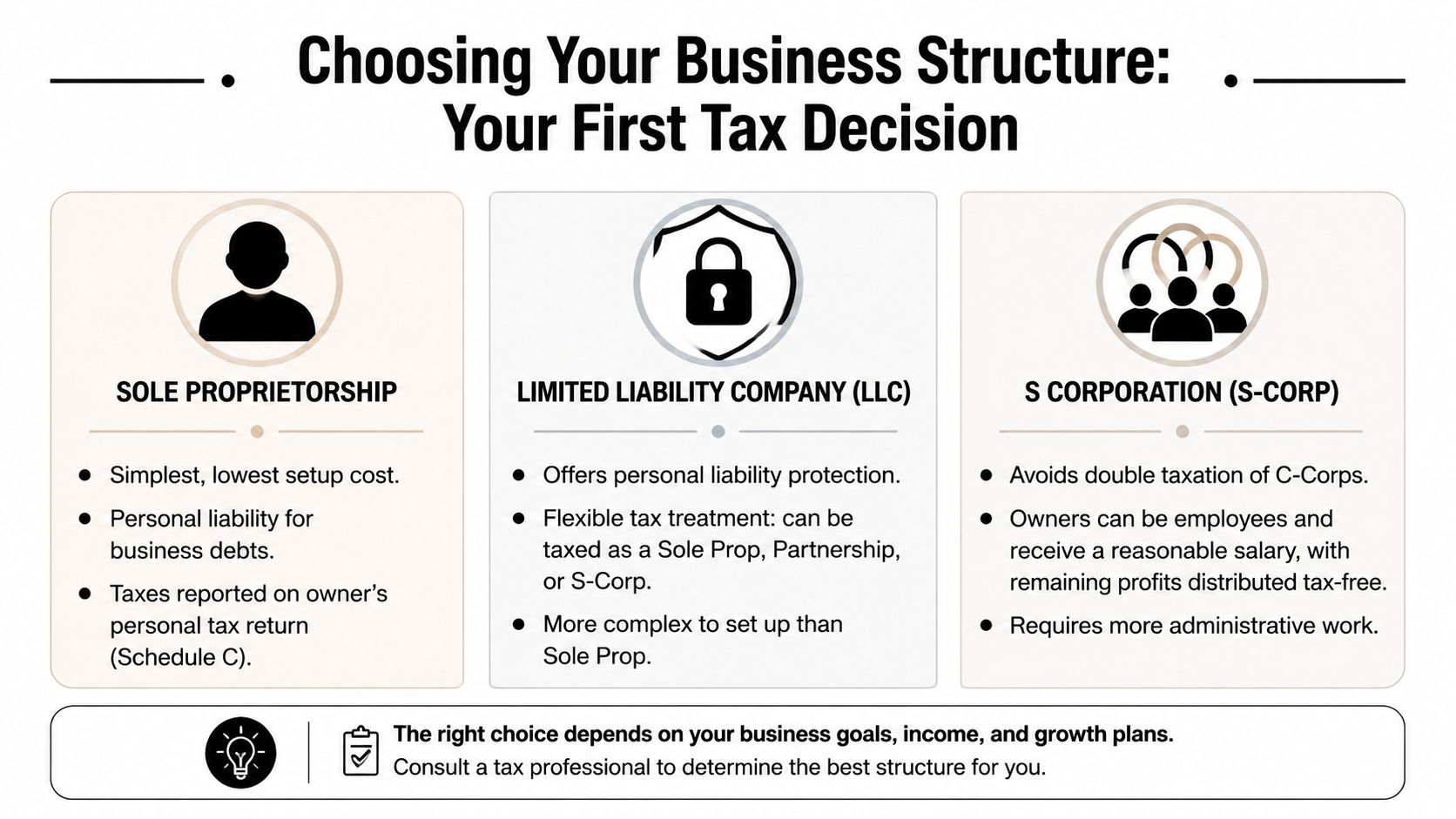
How the IRS usually classifies a new business
If you start freelancing, consulting, selling products, or doing contract work without forming anything official, you usually begin as a sole proprietorship. In plain English, the business activity goes straight onto your personal tax return. The reporting is usually simpler, but the tax bill can still surprise you because all of the profit is tied directly to you.
An LLC adds a legal layer between you and the business. That part causes a lot of confusion. Forming an LLC does not automatically create a new federal tax system. For tax purposes, an LLC can be treated in different ways depending on how many owners it has and whether it makes a tax election. The legal shell and the tax treatment are related, but they are not the same thing.
An S Corporation is where beginners often hear “tax savings” and stop asking questions. That is one of the biggest traps. S Corp status is a tax election for an eligible business, and it can reduce self-employment tax on part of the income in some cases. It also brings more rules, including payroll and stricter recordkeeping. The IRS explains the election and filing rules on its page for S corporations.
A side by side view of the common options
Here's the simple comparison:
| Structure | Common tax filing path | Main benefit | Main tradeoff |
|---|---|---|---|
| Sole Proprietorship | Form 1040 with Schedule C | Simple setup and fewer formalities | Profit is reported directly by the owner, which can mean a bigger self-employment tax hit |
| LLC | Depends on tax classification | Legal separation and flexibility | Many owners assume the LLC itself changes taxes, when it may not |
| S Corporation | Form 1120S | Potential self-employment tax savings on some income | Payroll, compliance, and bookkeeping become more demanding |
If you're comparing S Corp vs LLC for small business, the better question is not which label sounds more official. Ask which option fits your profit, your habits, and your ability to keep clean records all year.
The trap people miss when choosing too early
New owners often choose a structure based on a single promise, usually “this saves taxes.” That is like buying a bigger, more complicated filing cabinet before you know whether you can keep papers sorted in the first place.
A sole proprietorship is often fine at the beginning if income is still uneven and simplicity matters most. An LLC can make sense when you want legal separation or flexibility for later. An S Corporation usually becomes more attractive when profits are steady enough to justify payroll work, extra filings, and the cost of doing it correctly.
That last part matters more than people expect.
Practical rule: The best structure is the one that matches your current business and that you can maintain correctly, not the one that sounds smartest on social media.
Strategic choices matter more than labels
This section is not just about picking a name for your business. It is about avoiding expensive mismatches.
For example, some owners elect S Corp status too soon, then fall behind on payroll filings. Others stay as sole proprietors longer than they should and miss a chance to lower taxes once profits become consistent. Some formed an LLC years ago and still do not realize their tax treatment may be different from what they assumed.
You can usually fix a lot once you understand what you chose and why. The smart move is to review your current setup, your profit pattern, and your tolerance for paperwork before making the next election. That approach prevents the common trap of choosing a structure for the headline benefit and overlooking the day to day tax work that comes with it.
The Three Main Taxes Every Small Business Owner Should Know
You open your business bank app in April, see money came in, and assume the tax bill should be simple. Then you hear about income tax, self-employment tax, sales tax, estimates, penalties, and maybe even past credits you did not know you could revisit. That is where many new owners get stuck. They are looking at one pile of money, while the tax rules are looking at three different buckets.
A good way to keep this straight is to sort each dollar by job. Some dollars are your profit. Some cover your Social Security and Medicare obligation as the person working for yourself. Some are sales tax you are only holding for the state until you send it in.
Income tax
Income tax is based on profit. Profit is what remains after ordinary business expenses.
That sounds simple, but it causes a lot of confusion in real life. If your business collected $80,000 and spent $20,000 on software, supplies, contractors, insurance, and ads, you are usually taxed on the $60,000 left over, not the full $80,000. New owners often look at deposits in the bank and assume all of it is taxable. That mistake can lead to overpaying estimates or, just as often, spending money that should have been set aside.
Your business structure affects how this tax shows up. Many small businesses pass the profit through to the owner's personal return. A C corporation is different and pays corporate income tax at the entity level. If you are still fuzzy on what counts as profit, this is also the point where good expense tracking starts to matter, because deductions directly reduce the income tax calculation. A small business tax deductions guide can help you spot expenses that belong in that bucket.
Self-employment tax
Self-employment tax surprises a lot of first-year owners because it feels like an extra tax. It is really the Social Security and Medicare piece that used to come out of your paycheck when you worked for someone else.
Now you are wearing both hats. You are the worker and the employer, so you cover both shares through your tax return if you are self-employed.
That distinction matters because owners often plan only for income tax and forget this second layer. Then they wonder why the bill is higher than expected even in a year with modest profit. One helpful break is that part of this tax is deductible on your federal return, which softens the impact a bit, but it does not remove the need to plan for it during the year.
This is also where strategy matters more than many beginner guides admit. If your income is uneven, your quarterly payments are not just about sending in “something.” They are about avoiding penalties by using the right target, which may mean a current-year estimate or a safe harbor based on a prior return. If you want to maximize your tax savings, this is one of the places where timing, recordkeeping, and prior-year numbers can matter as much as the tax rate itself.
Sales tax
Sales tax works differently because it usually is not your income.
It works like coat-check money. The customer hands it to you, but it still belongs to someone else. Your job is to collect it, track it, and pass it along to the state or local agency when due.
That is why sales tax errors hurt so much. A business owner sees cash in the account, uses it for rent or inventory, and later finds out part of that balance was never theirs to spend. Another common trap is assuming all sales are taxed the same. In many states, the answer depends on what you sell, where the customer is located, and whether you have triggered a filing obligation there.
Keep the three buckets straight:
- Income tax applies to business profit.
- Self-employment tax covers Social Security and Medicare for your own work.
- Sales tax is collected from customers and held for the government.
Once you separate those buckets, small business taxes stop feeling like one giant mystery and start looking like a system you can handle.
Keep More of Your Money A Guide to Business Deductions
You sit down in March to total up your business expenses. You know you spent money to run the business, but half of it went on a personal card, a few receipts are buried in email, and your monthly software charges have faded into the background. That is how owners overpay. Usually not because they did anything dishonest, but because they cannot clearly show what they already paid for.
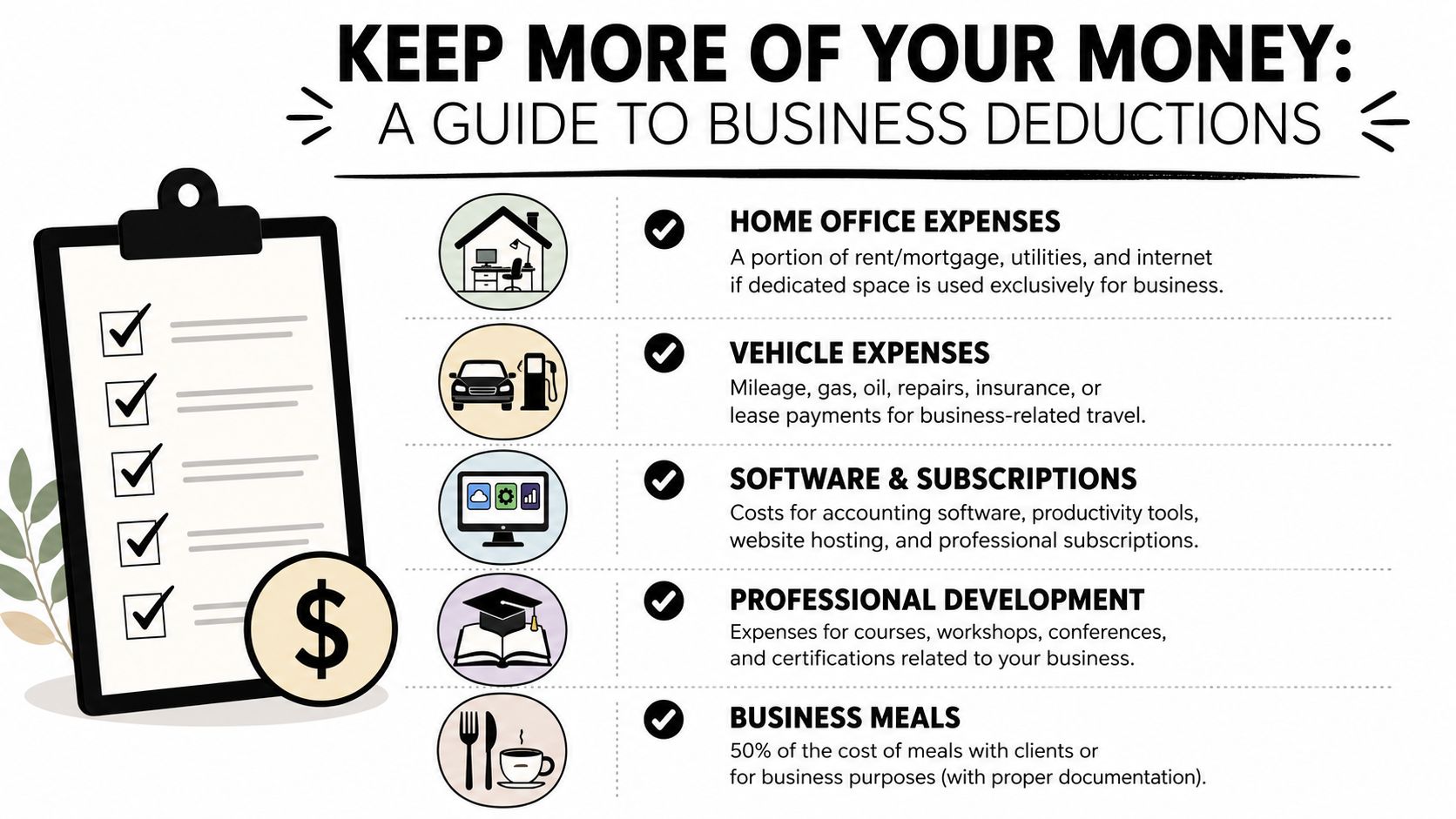
A deduction works like a coupon you already earned. If you do not hand it over at checkout, you pay full price anyway. Taxes work the same way. The trap is that many "for beginners" guides stop at naming categories and never explain the primary challenge. This primary challenge involves proof, timing, and knowing which expenses are easy to miss.
If you want to maximize your tax savings, start with the expenses that occur regularly and subtly. Subscription tools, mileage, home office costs, contractor payments, and small supply purchases often slip through because no single charge feels large.
Why deductions get missed
New owners usually miss deductions for ordinary reasons:
- They mix personal and business spending on the same card.
- They save the bank statement but not the receipt or note explaining the business purpose.
- They remember the big purchases and forget the small recurring ones.
- They assume a cost is "too minor to matter," even though a year of minor costs adds up.
- They hear about a deduction online and claim it without checking whether they qualify.
That last point matters.
A deduction is not just an expense. It is an expense that was ordinary for your type of work, necessary for running the business, and backed up by records. If one of those pieces is missing, the deduction gets weaker fast.
A practical write off checklist
Start with your actual records, not your memory. Open your business bank account, credit card statements, and email receipts. Then review common categories one by one:
- Home office costs: If you use part of your home regularly and exclusively for business, some home-related costs may qualify.
- Vehicle use: Business mileage can count, but commuting and personal errands do not. A mileage log makes this much easier to support.
- Software and subscriptions: Accounting tools, scheduling apps, website hosting, design platforms, cloud storage, and other automatic charges are easy to overlook.
- Supplies and equipment: Office supplies, shipping materials, packaging, tools, and business-only equipment belong in your review.
- Marketing costs: Website work, paid ads, email platforms, branding, photography, and printed materials are common deductions.
- Professional services: Bookkeeping, legal advice, tax preparation, and consulting fees are often deductible.
- Education tied to the business: Courses, certifications, workshops, and conferences may qualify when they relate directly to your current business.
- Business meals: Some meals connected to business activity may be partly deductible if you record who was there, when it happened, and the business purpose.
If you want a broader reference list of small business tax deductions, compare each category to your own statements line by line. That method catches far more than guessing from memory.
What makes a deduction defensible
Good deductions usually share three traits:
- A clear business purpose
- Documentation
- Consistent bookkeeping
Picture a shoebox with three labels. One says "business reason." One says "proof." One says "recorded correctly." Strong deductions fit in all three boxes.
Use a simple test. Could you explain the expense to a cautious IRS examiner in one sentence?
"This is my invoicing software for client billing." Good.
"This charge was probably business related, but I am not sure why." Weak.
The traps beginners miss
Some of the costliest mistakes are strategic, not mathematical. Owners often focus so hard on this year's deductions that they miss two bigger questions. First, did you overlook a credit or deduction on a past return that may still be worth revisiting? Second, are you recording this year's expenses in a way that will hold up if you need to support them later?
Those choices matter because a missed deduction is not always gone forever, but fixing old mistakes is much easier when the records are still clear.
Keep it simple. Separate business spending from personal spending as much as you can. Save receipts as you go. Add a short note for unusual purchases. Review recurring charges every month. Those small habits do more to reduce your tax bill than chasing obscure write offs once a year.
How to Pay Your Taxes Without Getting Penalized
You finish a strong year, send a full payment with your return in April, and assume you handled taxes responsibly. Then a notice arrives saying you still owe a penalty.
That surprise usually comes from one misunderstanding. Many small business owners do not pay income taxes only once a year. If you expect to owe at least $1,000 when you file, you generally need to send estimated tax payments during the year.
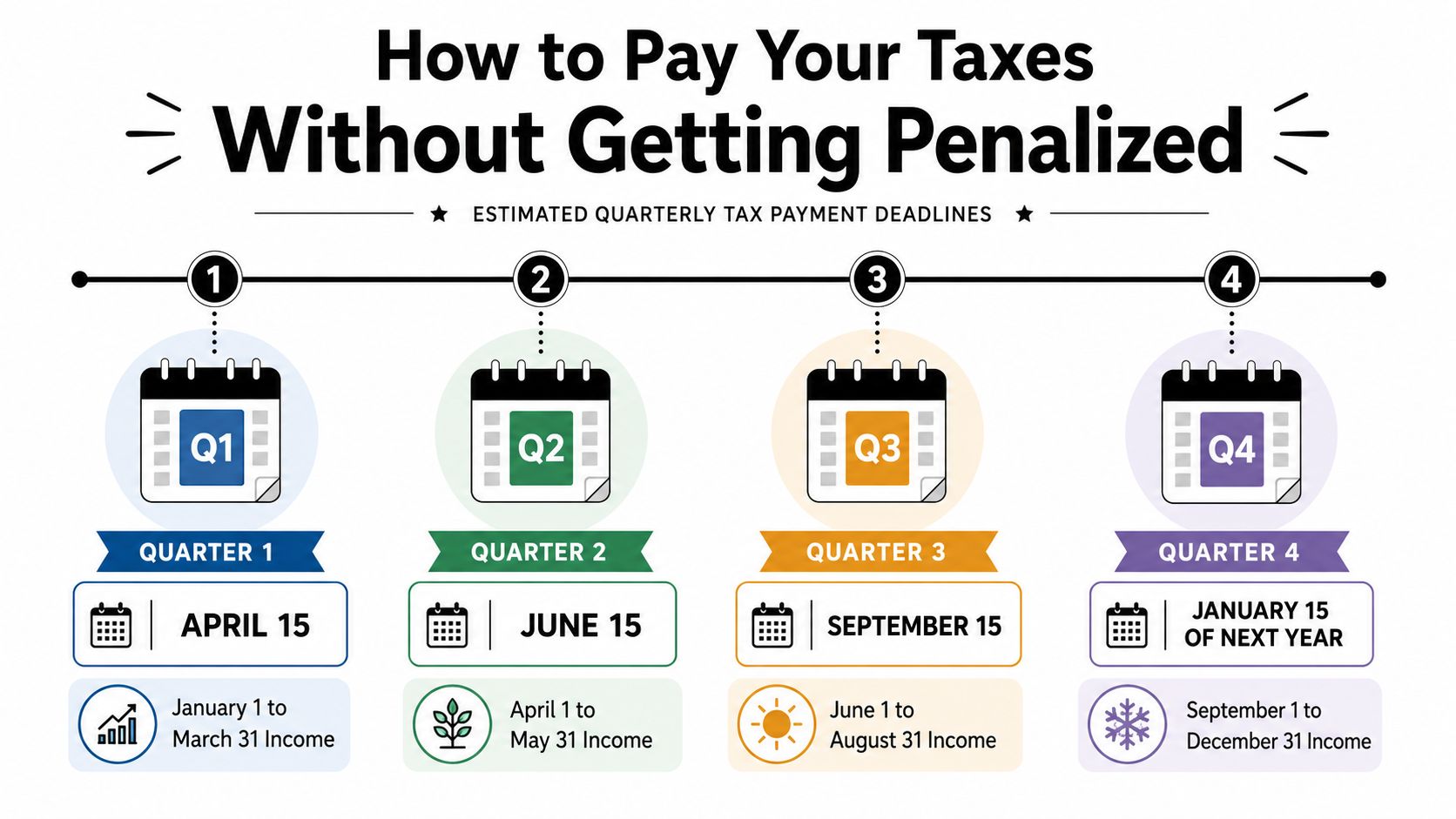
Why April is not the whole game
The tax system works more like a pay-as-you-go utility bill than a year-end invoice. Employees usually pay bit by bit through withholding from each paycheck. Self-employed owners often have to create that same rhythm for themselves through quarterly estimates.
If too little gets paid in during the year, a full payment in April may still be late for penalty purposes. That is the trap. The issue is not only how much you paid. It is also when you paid it.
The quarterly deadline pattern
The schedule catches people off guard because it does not follow four neat calendar quarters:
- Q1 payment: Due April 15 for income from January through March
- Q2 payment: Due June 15 for income from April through May
- Q3 payment: Due September 15 for income from June through August
- Q4 payment: Due January 15 for income from September through December
That second deadline is the one many owners miss. June arrives fast, and people assume they have until July.
If you want a plain-English walkthrough of quarterly estimated tax payment rules and timing, start there, then put every due date on your calendar with a reminder two weeks early.
Where the safe harbor rule helps
Basic tax guides often stop at “pay quarterly.” The smarter question is how to pay quarterly without guessing wrong every time.
Safe harbor rules can help. In simple terms, they give you a protected lane. Instead of trying to predict your exact current-year tax bill down to the dollar, you may be able to avoid underpayment penalties by paying enough based on the rules tied to your prior-year tax.
That matters when income is uneven. Maybe your business was quiet in spring and then one large contract hit in August. Maybe holiday sales doubled your normal revenue. Without a plan, those jumps can leave you short.
Safe harbor is not automatic protection in every case, and it does not mean you can ignore current results. It means you have a framework for handling uncertainty.
A simple way to stay ahead
Use a routine, not guesswork.
- Set aside tax money every month. Treat it like money that belongs in a holding bucket, not spending money.
- Review profit before each due date. Look at what the business earned, not what is left in the bank.
- Compare this year to last year. That helps you see whether a prior-year safe harbor approach still makes sense.
- Adjust after a big change. A new contract, seasonal spike, or major drop in income should trigger a fresh estimate.
- Review older returns if something was missed. Owners often focus on the next payment and forget another strategic question: did you miss a credit, deduction, or election on a prior return that is still fixable?
That last point gets overlooked. Avoiding penalties is not only about sending money on time. It is also about making better decisions while there is still time to correct them.
Keep the goal simple. You are building a payment habit that matches how your business earns money, so tax season feels like a reconciliation, not a financial ambush.
Payroll Taxes The Rules When You Have a Team
Friday arrives, payroll is due, and you realize paying an employee is not the same as writing a contractor a check. Part of that paycheck belongs to the employee, part has to be sent to tax agencies, and the timing matters. That is the trap many first-time employers do not see until after the first missed deposit notice shows up.
Payroll works like a relay. You collect information first, calculate pay second, withhold and match taxes third, and send money to the right places on schedule. If one handoff is wrong, the whole process gets harder to fix later.
The employee paperwork you need first
Before you run the first payroll, get the setup right.
For each employee, employers generally need to collect:
- Form W-4: This tells you how to handle federal income tax withholding.
- Form I-9: This verifies that the person is allowed to work in the United States.
- Direct deposit authorization: If wages will be paid that way, keep the signed authorization in your records.
A common point of confusion is timing. Do not wait until after the first paycheck to gather these forms. Payroll cleanup is a lot like trying to rebuild a recipe after the cake is already in the oven. You can do it, but it is messier, slower, and easier to get wrong.
Employees may also need to update withholding after major life changes, such as marriage or a new child. Build that reminder into your process so old W-4 information does not stay in place for years.
What you withhold and what you pay
Payroll tax is a bundle, not a single bill.
| Type | What it means |
|---|---|
| Federal, state, and local income tax | Amounts withheld based on the employee's location and withholding details |
| FICA taxes | Social Security and Medicare obligations |
| Federal or state unemployment tax | Employer-side obligations tied to unemployment systems |
| Local extras | Some places require disability or paid family leave related contributions |
That split matters because new owners often mix up money withheld from the employee with taxes the business must pay itself. Those are different buckets. If you blur them together, your books get muddy and your cash planning gets sloppy.
Another trap is assuming payroll software makes every decision for you. Software is a calculator, not a CPA. If the work location, employee classification, pay type, or withholding inputs are wrong, the software will process the wrong answer very efficiently.
The strategic choice many owners miss
The tax risk is not only the calculation. It is the schedule.
Payroll taxes usually have to be deposited during the year, not saved up until tax season. That catches owners who are used to thinking about taxes quarterly or annually. Once you have employees, tax compliance starts to run on the rhythm of each payroll cycle.
This is also where classification matters. An employee and an independent contractor are taxed differently, and misclassifying a worker can create back taxes, penalties, and amended filings. If you are unsure, pause and confirm before the first payment goes out. Fixing the structure early is easier than repairing a year of payroll later.
If you are trying to create a repeatable process, a simple intake system helps. Many firms use tools focused on streamlining 1040 client organizers and related tax workflows because consistent data collection reduces avoidable errors from the start.
A payroll routine that keeps problems small
Use a short checklist every pay period:
- Before payday: Confirm hours, salary changes, bonuses, and withholding details.
- On payday: Match pay stubs, payroll reports, and the actual amounts paid.
- Right after payroll runs: Save reports and confirm tax deposits and filings are scheduled correctly.
- After any staffing change: Review whether a new hire, termination, or address change affects tax setup.
That routine does more than keep you organized. It helps you catch the mistakes that "for dummies" guides often skip over, like a wrong work state, an outdated W-4, or a deposit schedule you assumed the software handled for you.
When you have a team, payroll taxes become an ongoing operating system for the business. Set it up carefully, review it regularly, and small mistakes stay small.
Recordkeeping 101 How to Stay Organized and Audit-Proof
Most tax stress doesn't come from taxes. It comes from disorganized records.
When your books are clean, tax prep gets faster, deductions are easier to support, and questions are easier to answer. When everything is mixed together, even simple issues become detective work.
Small business owners face a benchmark audit rate of 2% to 4%, compared with approximately 1% for the general population, according to Dummies' small business taxes cheat sheet. That same guidance stresses rigorous documentation and separate business accounts.
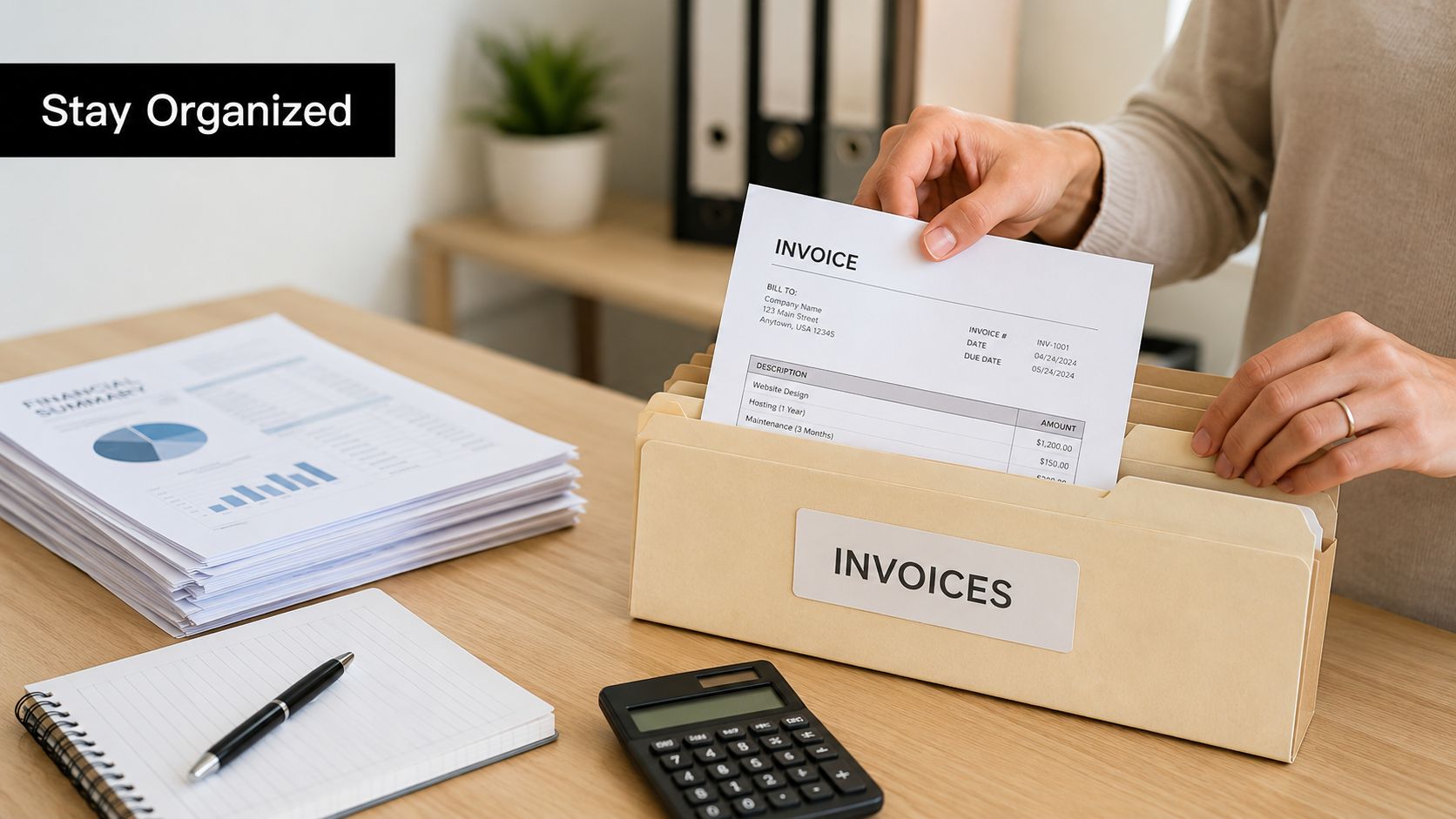
Separate accounts are not optional
If you remember one rule from this whole article, make it this one. Open a separate business bank account and use it.
That single move creates cleaner income tracking, cleaner expense tracking, and a much stronger defense if anyone ever asks you to prove a deduction. It also helps you stop “accidentally” spending tax money because your business cash is no longer sitting in the same account as rent, groceries, and weekend purchases.
Your records should let a stranger follow the trail without needing your memory to fill in the gaps.
A simple recordkeeping system that works
You don't need a complicated setup. You need a repeatable one.
Try this:
- Use one business checking account: Income lands there. Business bills get paid from there.
- Use one business card when possible: That gives you a second clean statement trail.
- Save receipts digitally: A folder in cloud storage works. So does a bookkeeping app that attaches receipt images to transactions.
- Categorize transactions monthly: QuickBooks is a common tool for this, but the habit matters more than the software.
- Store invoices and contracts together: If income is ever questioned, you want the payment, invoice, and agreement easy to match.
If you like structured intake checklists, resources on streamlining 1040 client organizers can also give you ideas for gathering tax documents in one place before filing season.
Messy books don't just raise audit risk. They also hide good information. You can't tell what the business is really earning if expenses are scattered across personal apps, old email receipts, and half-finished spreadsheets.
When to Call a Pro Your Signal to Hire a CPA
You start the year planning to handle taxes yourself. By summer, you are asking harder questions. Are your quarterly payments high enough to avoid penalties? Should you elect S corporation status? Did you miss a credit last year that you can still claim now? That shift matters. At that point, taxes are no longer just about entering numbers into software. They are about making judgment calls that can cost money if you guess wrong.
A guide like this can teach the basics. It can help you build clean habits and spot common traps. But a CPA adds something different. A good one helps you make choices before a problem turns into a notice, a penalty, or a missed refund.
When DIY is still reasonable
Doing your own taxes can still work if your business is simple.
For example, you might be a solo consultant with one business bank account, no employees, no sales tax filings, and tidy books. Your income is easy to track. Your expenses are ordinary and well documented. In that kind of setup, a careful owner can often handle the return and quarterly payments with decent software and good records.
The catch is that "simple" has a short shelf life.
A business can outgrow DIY without feeling dramatic. You add a contractor. Then a part-time employee. Then a vehicle, home office, new state filing, or a question about whether a prior return missed something. Each new piece is small by itself. Together, they create room for expensive mistakes.
When the cost of guessing gets too high
These are strong signals that it is time to bring in a CPA or tax advisor:
- You are considering an S corporation election: The savings can be real, but only if payroll, reasonable compensation, and filings are set up correctly.
- You hired your first employee: Payroll taxes have their own deadlines, forms, and deposit rules. A small error can snowball quickly.
- Your quarterly payments feel like estimates in the worst sense: A CPA can help you use safe harbor rules so you are not guessing every quarter.
- You received an IRS or state notice: Official letters deserve a careful response, not a rushed one.
- You bought property, added a partner, or changed entity type: Those changes affect depreciation, basis, allocations, and filing requirements.
- Your books are behind or inconsistent: Tax returns built on messy records are only as reliable as the bookkeeping underneath them.
- You suspect a prior return missed a credit or deduction: This comes up more often than new owners realize, and the fix may involve amended returns with deadlines that matter.
That last point deserves more attention than it usually gets. Many beginner guides focus only on this year's return. A better tax strategy also asks whether money was left behind on an earlier one.
Past credits and amended returns are a different skill set
Some tax savings are forward-looking. Others are retroactive.
A CPA can review prior-year filings and ask questions software usually does not ask well. Was the business classified the best way? Were payroll filings handled correctly? Did a credit apply in a past quarter? Is there still time to amend and claim a refund? Those are not beginner questions, but they can lead to real money.
One well-known example is the Employee Retention Credit. Many business owners heard about it late, assumed they did not qualify, or got stuck in the rules. Block Advisors' discussion of common tax questions for starting a business notes how often owners need help sorting through issues like credits, amended returns, and business setup decisions. The larger lesson is simple. Old returns are not always final in the practical sense. Sometimes they deserve a second look.
That review takes work. A professional may need to read prior returns, compare them to payroll records, test eligibility dates, and check how one amendment affects other parts of the tax picture. It is less like filling out a form and more like proofreading a contract after the deal is already signed. You are looking for missed opportunities, hidden risks, and deadlines that have not expired yet.
If you are still learning, that is okay. Learn the basics. Keep clean records. Understand the main deadlines. Then notice the moment when doing it yourself stops saving money and starts increasing risk.
If you want help making sense of your next move, Allied Tax Advisors can help you sort through entity choice, quarterly payments, bookkeeping, payroll, amended returns, and IRS issues with practical guidance specific to your business.