
Maya owns a small coffee shop near Clairemont Square. In January, she changed how she paid herself and brought on a familiar worker as a 1099 contractor instead of putting that person on payroll. By mid-March, she learned that those decisions had already shaped her 2026 tax position. She then started planning a December estimated payment, only to discover that better decisions earlier in the year could have reduced the amount substantially.
That's the problem with most tax planning for businesses. Owners treat it as a December cleanup project, when the biggest opportunities usually depend on choices made while the year is still unfolding. Entity structure, payroll, contractor classification, invoicing, equipment purchases, retirement contributions, and recordkeeping all affect the cash you keep in the business.
As a San Diego CPA, I'd rather have that conversation in January than explain in December why the available options are now limited. The practical playbook is straightforward: make tax planning part of your operating rhythm, monitor California obligations continuously, and use financial information before a transaction becomes irreversible.
Table of Contents
- The First Friday in January Most San Diego Business Owners Already Lost Money
- What Tax Planning Means and What It Is Not
- Choosing the Right Structure for a San Diego Small Business
- Deductions, Depreciation, Credits, and the Power of Timing
- Payroll, Sales Tax, and the Rising Cost of Real-Time Compliance
- Mistakes That Quietly Drain Cash From Growing Companies
- A 12-Month Tax Planning Calendar for 2026 and When to Call an Advisor
The First Friday in January Most San Diego Business Owners Already Lost Money
The first Friday in January can decide more about your tax year than a December meeting. You are paying vendors, approving payroll, ordering inventory, and transferring money to yourself. Each action can affect taxable income, payroll reporting, cash reserves, and California compliance before a tax preparer reviews the books.
Maya's coffee shop shows how ordinary choices create expensive problems. She wanted predictable owner pay, so she moved money to herself without matching the payment method to her entity structure. She also treated a regular worker as an independent contractor because the worker submitted invoices. Neither choice looked like tax planning. Both changed the company's tax and payroll exposure.
A tax return records the past. It cannot redesign January after the money has moved or the worker has already performed the work.
Practical rule: Discuss any decision affecting payroll, ownership, revenue recognition, equipment, or worker classification before you execute it.
The operating decisions that matter
For a San Diego small business, year-round planning should cover:
- Owner compensation: Match payments to the business structure. Document why money is treated as payroll, a distribution, or another payment.
- Worker classification: Review whether each person operates independently or functions like an employee under the applicable California rules.
- Cash reserves: Forecast tax payments from current profit instead of relying only on last year's return.
- Invoice timing: Decide when to bill and collect based on the accounting method and the business's actual operations.
- Purchases: Review equipment and improvements before buying them, so the business can choose an appropriate depreciation approach and preserve documentation.
- Records: Save receipts, mileage, contracts, and business purpose when the facts are still fresh.
Planning also reduces administrative waste. A World Bank compliance-cost survey found that smaller Ukrainian businesses with turnover below UAH 1 million spent an average of UAH 31,698 annually on tax compliance in 2024, while the average across surveyed businesses exceeded UAH 100,000. Ukraine is not California, so the figures do not measure San Diego businesses. The operating lesson still applies: bookkeeping, payroll, invoicing, and filings can consume a meaningful share of a small company's revenue.
Run tax planning as part of the monthly operating rhythm. Review profit, payroll, purchases, and California obligations before cash leaves or a filing position becomes difficult to change. The objective is cash retained through better decisions, not clever write-offs discovered after the year ends.
What Tax Planning Means and What It Is Not
Tax preparation is the rearview mirror. You gather the prior year's books, reconcile accounts, classify transactions, prepare forms, and file by the deadline. That work matters, but it describes a business year that has already ended.
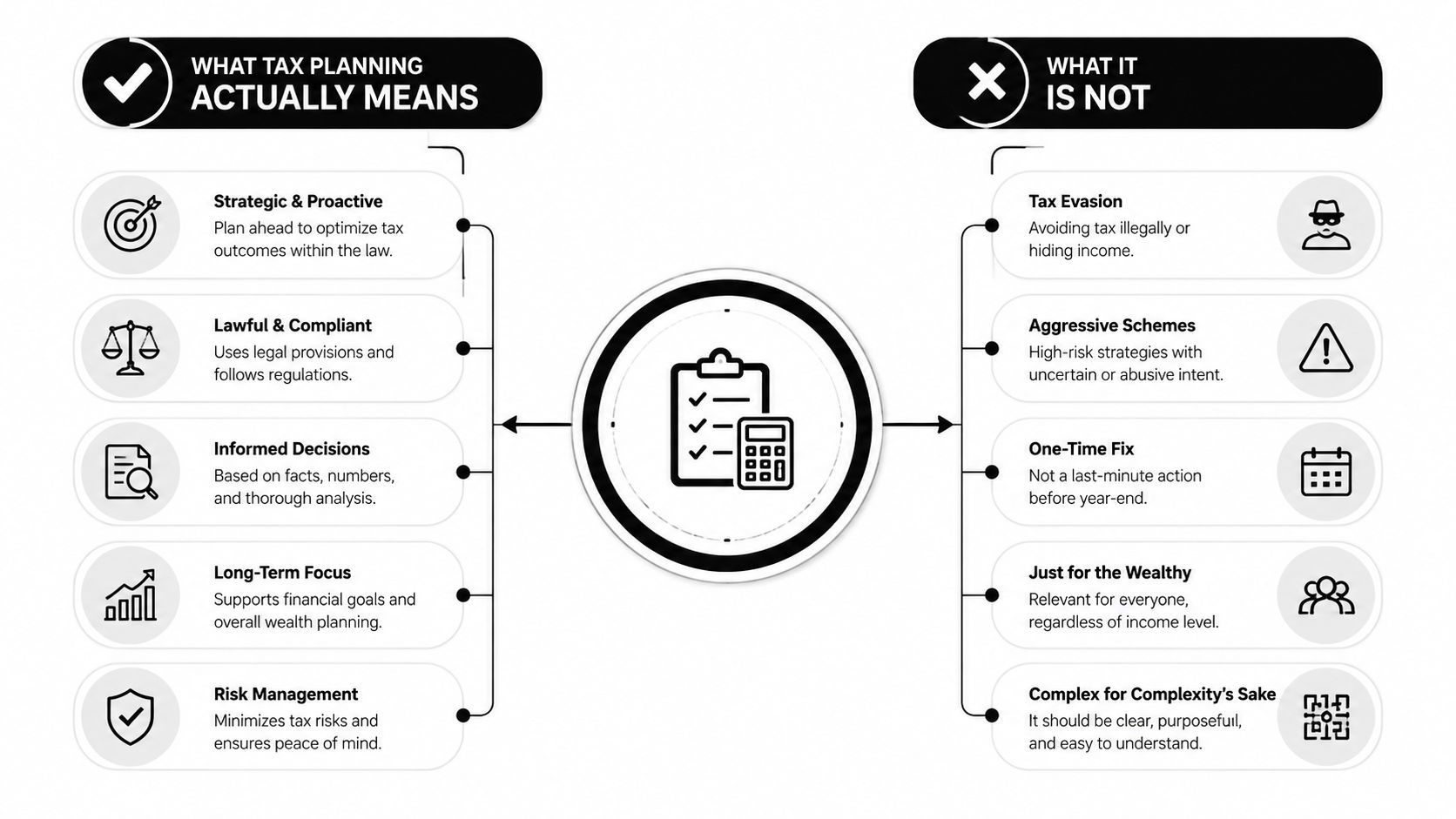
Tax planning is the windshield. It guides decisions about structure, payment methods, timing, documentation, and financial commitments before they affect the year ahead. For a San Diego owner, that means reviewing California requirements while plans can still change, not searching for write-offs after the books close.
Four disciplines belong in the process
Entity choice determines how profit reaches the owner, how payroll operates, and which state obligations apply. An LLC may fit the legal needs of the business while a different tax election better fits its profit and compensation pattern.
Transaction timing covers when you invoice, collect, buy equipment, sign a lease, establish a retirement plan, or make a distribution. Each decision can affect taxable income, cash flow, and the value of available deductions.
Incentive capture means matching deductions, credits, retirement arrangements, and depreciation elections to the facts of the business. A credit without supporting records creates a dispute instead of cash savings.
Compliance posture keeps payroll, sales tax, contractor reporting, books, and supporting records aligned. Smaller companies can spend significant time on these administrative tasks, so clean systems protect both cash and management attention.
Tax planning is lawful, documented management. It is not evasion, aggressive filing, or a once-a-year meeting. It also is not limited to depreciation or forcing every expense into a deduction category. Run it throughout the year, connecting operating decisions to tax results and keeping records strong enough to support the position.
Choosing the Right Structure for a San Diego Small Business
Entity structure should follow the business you're building, not a slogan about “saving taxes.” A North Park design studio with modest, fluctuating profit needs a different answer from a coastal biotech services firm that intends to reinvest heavily and attract outside capital.
A sole proprietorship and a single-member LLC generally report business activity through the owner's return, although an LLC can elect corporate treatment. An S corporation is a pass-through structure, but it adds payroll administration and requires reasonable compensation for an owner who performs services. A C corporation pays tax at the corporate level, and owners may face another tax layer when profits are distributed.
California adds its own cost and filing considerations. An LLC generally faces California's $800 annual fee, and an S corporation pays a California tax based on net income, including the 1.5% rate identified in the planning brief for income above the applicable threshold. A C corporation also faces federal corporate tax at 21%, plus California's separate corporate tax layer. These rates and fees must be confirmed for the company's facts and tax year before making an election.
Side-by-side outcomes
| Factor | Sole Prop / Single-Member LLC | LLC Electing S Corp | C Corporation |
|---|---|---|---|
| Federal income treatment | Generally passes through to the owner | Business income generally passes through | Corporate tax applies before owner distributions |
| Owner compensation | Usually draws, not W-2 wages from the sole proprietorship | Owner generally needs reasonable W-2 compensation for services | Owner may receive wages, dividends, or both |
| California administration | Simpler, but state obligations still apply | Payroll and corporate filings add complexity | More formal records, filings, and tax layers |
| Main planning question | Is simplicity worth the self-employment tax exposure? | Do potential payroll-tax savings justify compliance work? | Will reinvestment, investors, or exit planning outweigh complexity? |
| Best fit | Early-stage or straightforward owner-operated business | Profitable operating business with stable records and owner payroll | Venture-backed, heavily reinvesting, or investment-ready company |
The business structure guide for small businesses can help organize the initial comparison, but don't make the decision from a generic chart.
Use a decision checklist
- Stay simple when the business is new, profit is inconsistent, and administrative capacity is limited.
- Consider an S corporation election when profit is consistently strong enough to support payroll, bookkeeping, and state compliance after modeling the total cost.
- Consider a C corporation when the company expects substantial reinvestment, outside investors, or a structure that supports a venture-style growth plan.
- Review the choice annually when ownership, profit, payroll, or financing changes.
For the North Park studio, an S corporation might be worth modeling after stable profit emerges, but the payroll and filing burden could outweigh the benefit during an uneven launch period. For the biotech services firm, a C corporation may fit investor expectations and reinvestment needs even if a pass-through looks attractive on a narrow current-year calculation.
The right answer is the one that leaves the owner with more usable cash after tax, payroll, compliance, and administrative work, not the one with the lowest headline rate.
Deductions, Depreciation, Credits, and the Power of Timing
Deductions work only when the expense is real, business-related, properly classified, and documented. Start with the categories that tend to reflect how San Diego businesses operate.
A product company should reconcile cost of goods sold instead of treating inventory purchases as ordinary office expenses. A service firm should maintain contracts and invoices for contractor labor. A consultant using a vehicle for client work needs contemporaneous mileage or expense records. A home-office deduction requires a qualifying business-use arrangement, not a laptop on the kitchen table.
Software subscriptions, bookkeeping systems, merchant fees, business insurance, rent, supplies, and employee compensation may also belong in the operating books when they serve the business. Meals require special attention, and entertainment expenses shouldn't be assumed deductible merely because a client attended.
Match purchases to the business plan
Depreciation is a timing decision. Section 179 and bonus depreciation can accelerate deductions for qualifying property, but the correct election depends on the asset, business use, taxable income, and rules in effect for the tax year. Equipment, computers, certain software, and qualified improvement property may require separate analysis.
Don't buy equipment only to create a deduction. Buy it because the business needs the capacity, then choose the tax treatment that preserves cash without distorting the operating plan. The depreciation calculation guide is a useful starting point, but the final election should match the company's records and current rules.
Credits can be more valuable than deductions because they generally reduce tax directly. Review whether the business performed qualifying research activities, hired workers from eligible groups for the Work Opportunity Tax Credit, or incurred expenses that fit federal or California credit requirements. Keep technical descriptions, project records, payroll details, and eligibility support together rather than trying to recreate them during tax preparation.
Retirement planning belongs in the same conversation. A SEP-IRA or Solo 401(k) may help an eligible owner defer income while building retirement assets, but the plan must be established, funded, and documented under its specific rules. Owners with employees need to consider participation and nondiscrimination requirements before choosing a design.
A practical timing table
| Lever | Estimated Cash Impact | Action Deadline |
|---|---|---|
| Revenue timing | Can shift when taxable income is recognized, depending on accounting method and facts | Before invoicing or collecting |
| Equipment depreciation | Can accelerate deductions for qualifying purchases | Before acquiring and placing assets in service |
| Retirement contribution | May reduce taxable income for an eligible owner | Before the applicable plan and filing deadlines |
| R&D or hiring credit | May reduce tax when the business meets qualification rules | During the year, with documentation maintained continuously |
| Contractor and expense records | Protects deductions from being lost or challenged | At the time of payment |
For a cash-basis business, deferring a legitimate invoice until the next period may defer recognition, while accelerating a needed deductible expense may reduce current taxable income. Accrual-basis businesses face different rules, so don't copy a cash-timing tactic without checking the accounting method.
Estimated payments should follow updated profit forecasts. A fixed percentage of last year's income can be convenient, but it may be wrong after a major contract, hiring change, equipment purchase, or ownership transition. A rolling forecast gives you a better view of cash available for taxes, payroll, inventory, and growth.
Payroll, Sales Tax, and the Rising Cost of Real-Time Compliance
Federal income tax gets the attention. Payroll and sales tax often cause the sharper cash damage.
A missed payroll deposit can trigger penalties and interest while employees still expect accurate, on-time pay. A sales tax mistake can leave the owner responsible for tax that was collected, under-collected, or never separated from operating cash. California employers also need to budget for state payroll charges and changing wage requirements rather than treating them as surprises.
Worker classification deserves a hard review. Calling someone a contractor doesn't make that person one. If the working relationship looks like employment, reclassification can create back taxes, penalties, amended filings, and wage claims. A recurring worker who follows the shop's schedule, uses its systems, and performs a central business function should not be labeled a 1099 contractor casually.
Sales tax needs its own workflow
San Diego retailers and service businesses should review taxable products, customer locations, marketplace activity, resale certificates, and purchases from out-of-state vendors. Businesses selling through Amazon or Etsy also need to understand marketplace facilitator rules and what the platform handles versus what remains the seller's responsibility.
Sales tax planning also matters during a transaction or expansion. Owners evaluating sales tax and M&A planning should review historical collection, nexus, exemptions, and exposure before a buyer's diligence process turns those issues into a price reduction.

The compliance burden is becoming more continuous. The Sovos 2025 State of Tax Compliance findings report that 82% of companies feel more exposed to tax-related compliance risk than five years ago, and 90% expect compliance costs to rise as governments move toward real-time data collection. Those findings support a practical conclusion: tax planning is now an operations issue.
Use payroll software, sales-tax configuration, bank feeds, approval controls, and a monthly exception report. Payroll management for small businesses should produce a reviewable record, not just a completed payment. Every missed deposit, incorrect rate, and unrecorded collection reduces owner cash directly.
Mistakes That Quietly Drain Cash From Growing Companies
“I'll incorporate later” sounds harmless until the business has already built a year of profit under the wrong structure. A Kearny Mesa consulting firm that leaves $40,000 on the table by remaining a sole proprietorship for one additional year has a planning problem, but that example is only useful if the calculation reflects the firm's actual profit, payroll, state obligations, and administrative costs. No owner should assume an S corporation automatically produces that result.
The mistake is waiting until the tax return is being prepared. Once the year closes, an advisor may be able to correct reporting, but many planning choices are no longer available or become much harder to implement cleanly.
Four assumptions to retire
“My CPA handles everything.” A preparer can accurately report historical transactions and still miss a mid-year entity election, retirement-plan setup, equipment purchase analysis, or R&D documentation opportunity. The owner has to ask for forward-looking advice, and the advisor has to request current books.
“A bigger refund means I planned well.” A large refund often means too much money was withheld or paid in during the year. That may feel satisfying, but the business could have used the cash for inventory, hiring, debt reduction, or owner reserves.
“I can deduct anything on the company card.” The card proves payment, not business purpose. California and federal reviewers may question vehicle, travel, meals, and home-office deductions when logs, receipts, attendees, locations, or business explanations are missing.
“I'll fix the books later.” Later is when receipts disappear, personal and business charges become indistinguishable, and contractor files lack the information needed for reporting. Reconciliation is a monthly task because the evidence is easiest to obtain at the time of the transaction.
A deduction without a business purpose and supporting record is a hope, not a tax strategy.
Prevention is cheaper than reconstruction
Use separate accounts, require receipt uploads, record mileage promptly, and review contractor relationships before payments accumulate. Ask for a quarterly tax forecast that shows expected taxable income, estimated payments, payroll, and cash remaining after obligations.
The cash-flow math is simple. A planned expense that the business needs can preserve liquidity when timed correctly. A disallowed deduction, late deposit, or reclassification can consume cash without creating any productive asset. Growth makes these mistakes more expensive because the volume of transactions, workers, and jurisdictions grows with it.
A 12-Month Tax Planning Calendar for 2026 and When to Call an Advisor
A usable calendar turns tax planning for businesses into a management habit. Put these checkpoints on the same calendar as payroll, vendor payments, and sales targets.
The 2026 operating calendar
- January: Open the year with a tax forecast, confirm entity and payroll treatment, and reconcile prior-year contractor information.
- February: Review bookkeeping categories, collect missing vendor details, and document research, hiring, equipment, and retirement activity.
- March: Update projected profit and estimated payments before filing deadlines create pressure. Review whether the current entity still fits.
- April: Check California filings and cash reserves. If San Diego County property taxes apply, verify the installment deadline of April 10 with the San Diego County Treasurer-Tax Collector.
- May: Audit sales-tax settings, marketplace reports, resale certificates, and out-of-state purchases.
- June: Run a midyear payroll and contractor-classification review. Compare actual profit with the January forecast.
- July: Review retirement-plan options and employee eligibility. Update vehicle, home-office, and reimbursed-expense records.
- August: Test whether planned equipment or qualified improvements should be purchased for business reasons and which depreciation treatment fits.
- September: Reforecast taxable income and estimated payments. Review multi-state activity, remote workers, and customer locations.
- October: Check credit documentation, year-to-date payroll, and pending information returns. Don't wait for year-end to find missing support.
- November: Decide on legitimate purchases, retirement funding, compensation, and invoicing timing. Keep business purpose ahead of tax benefit.
- December: Complete year-end reconciliations, place eligible assets in service when appropriate, and verify the December 10 property-tax installment deadline where applicable.
The calendar should be adapted to the actual filing schedule, accounting method, and business activity. California rules can change, and local obligations don't disappear because federal income tax is the owner's main concern.
Know when DIY stops working
DIY planning can work for a simple operation with one entity, no payroll, clean books, and limited jurisdictional exposure. It becomes a poor bargain when the company has multi-state sales, remote workers, multiple owners, significant payroll, inventory, outside investors, or pending 1099-NEC filings.
Call a CPA or enrolled agent when an entity conversion is under consideration, and bring in a fractional CFO when the owner needs rolling cash forecasts, hiring analysis, financing support, or transaction planning. The advisor pays for the work by preventing expensive rework and helping the owner decide before the deadline.
My decision rule is direct: if a tax choice changes how money moves through the business, get advice before the money moves. Book a planning call before March 15, then keep the conversation alive each quarter instead of scrambling in December.
Allied Tax Advisors helps San Diego businesses coordinate entity filings, S corporation and LLC compliance, payroll, bookkeeping, sales tax, and year-round tax planning. Visit Allied Tax Advisors to start a planning conversation before your next major business decision, not after the tax bill arrives.