
Nothing makes your heart sink quite like an official-looking envelope from the IRS. But before you panic, let's get one thing straight: an IRS audit is simply a review of your financial information to make sure everything you reported on your tax return lines up with the law.
Think of it less like an accusation and more like a detailed fact-checking mission.
What to Do When That IRS Audit Letter Arrives

That letter is the official kickoff for the entire audit process. It’s not a bill and it's not a penalty—it’s a formal request for more information. This first notice is your roadmap, telling you exactly what the IRS is looking at and what you need to do next.
The worst thing you can do is ignore it. The IRS won't just go away; they'll simply make a decision based on the information they have, which almost never works out in your favor. So, take a deep breath and let's break down what's inside.
What the Initial Notice Contains
The letter itself holds all the clues you need to prepare a solid response. Instead of getting overwhelmed by the official language, focus on finding these key pieces of information:
- The Audit Type: It will clearly state whether this is a correspondence audit (handled by mail), an office audit (at an IRS location), or a field audit (at your home or business).
- Specifics Under Review: The IRS won't be vague. The letter will pinpoint exactly which items on your return raised a flag—like business meal expenses, charitable donations, or mileage deductions.
- The Deadline: You'll see a hard deadline for your response, which is typically 30 days. Mark this on your calendar immediately.
- Contact Info: The notice will provide the name, phone number, and badge number of the IRS agent or department assigned to your case.
At its core, an IRS audit is a verification process. Your job is to provide organized, clear proof that backs up every number and deduction you claimed on your return.
Your Initial IRS Audit Roadmap
Understanding these first few steps can turn that initial wave of anxiety into a feeling of control. Here’s a quick overview of what to expect right after you open that envelope.
This table breaks down the initial phase, which is all about getting organized and establishing clear communication.
| Stage | What It Involves | Your Primary Action |
|---|---|---|
| Notification | Receiving the official audit letter from the IRS via certified mail. | Read the entire letter carefully to understand what is being requested. |
| Information Gathering | Locating and organizing all the specific documents mentioned in the notice. | Collect receipts, bank statements, logs, and any other proof related to the items under review. |
| Initial Contact | Reaching out to the assigned IRS agent or department by the deadline. | Schedule a meeting or prepare to mail your documents. This is your first interaction. |
Getting this part right sets the tone for the rest of the audit. A professional, organized, and timely response shows the examiner you're taking this seriously, which can make the entire process much smoother.
The Three Flavors of IRS Audits
The word "audit" can send a shiver down anyone's spine, but it's important to know that not all audits are the same. Think of it like a vehicle inspection: some are just a quick check of your registration and emissions, while others involve putting the car up on a lift for a full teardown. The IRS has different levels of scrutiny, and the notice you get in the mail is your first clue as to what you're dealing with.
Most of the time, the IRS is just looking to clear up a specific, minor issue. Getting a handle on which type of audit you’re facing is the first step in demystifying the process and preparing for what’s ahead.
1. Mail Audits: The Simple "Show Me the Paperwork" Request
The mail audit, or correspondence audit, is by far the most common and least scary type. True to its name, the entire process is handled through the mail. You won't be sitting across a desk from an agent; instead, the IRS is essentially sending you a detailed RFI (request for information).
This kind of audit usually gets triggered by straightforward discrepancies. We’re often talking about things like:
- A missing W-2 or 1099 form that your employer or client reported.
- Questions about a specific deduction, like medical expenses or that large charitable gift.
- A simple math error or a mismatch between what you reported and what a third party sent to the IRS.
For example, maybe you claimed a $5,000 deduction for a donation to a charity. The IRS will send a letter asking for proof—usually, a copy of the canceled check and the acknowledgment letter from the non-profit is all they need. You mail back the documents, and if everything checks out, the case is closed. Simple as that.
2. Office Audits: The In-Person Sit-Down
An office audit kicks things up a notch. With this one, you (or your tax pro) will need to visit a local IRS office for an in-person meeting with an auditor. The scope is still fairly narrow and focused on specific items from your return, but the issues are usually too complex to sort out with a few letters.
The big difference here is the face-to-face examination. The auditor will sit down with you and go through your records, asking questions to understand the full picture before making a decision.
Let's say you’re a freelance photographer with significant business expenses for a home office, new camera gear, and travel to client shoots. An office audit means you’ll be packing up your receipts, mileage logs, bank statements, and other records and bringing them to the IRS office for a line-by-line review with the examiner. The conversation will stick to the items listed in the audit notice.
3. Field Audits: The Deep Dive
The field audit is the most comprehensive and serious type of examination—it’s what most people imagine when they hear "IRS audit." In this scenario, an IRS revenue agent comes to you, whether at your home, business, or accountant's office, to conduct a thorough review of your books.
These are typically reserved for more complex returns, like those from large businesses, corporations, or high-net-worth individuals with complicated financial lives. Unlike other audits, a field audit can be a bit of a fishing expedition. An agent might start by looking at one specific area but has the authority to expand the review if they spot other potential problems.
For instance, a growing restaurant might face a field audit where the agent spends days at the location, poring over everything from payroll records and tip reporting to inventory costs and supplier payments. Their goal is to get a complete understanding of the business's operations to verify the entire tax return. While field audits are the rarest, they demand the most preparation.
Comparing IRS Audit Types
To make it easier to see the differences at a glance, this table breaks down the three main audit types. It helps clarify what to expect based on the kind of notice you receive.
| Audit Type | Location | Common Triggers | Scope of Review |
|---|---|---|---|
| Mail Audit | Handled via postal mail | Missing forms (W-2, 1099), simple deduction questions, math errors. | Narrow: Focused on just one or two specific items. |
| Office Audit | At a local IRS office | More complex deductions (e.g., business expenses), self-employment income. | Limited: Restricted to the items listed in the audit notice. |
| Field Audit | Your home, business, or CPA's office | Complex business returns, high-net-worth individuals, suspected fraud. | Broad: Can start with one issue and expand to the entire return. |
Ultimately, knowing which type of audit you're facing is crucial. It dictates the intensity of the review, the records you'll need, and the best way to prepare for a successful resolution.
Navigating the Audit Examination Process
So, you've received that dreaded IRS letter and figured out what kind of audit you're up against. Now the real work starts. The examination is the core of the audit, where an IRS agent pores over your financial records to see if your tax return tells the truth.
Think of it like this: you're telling the financial story of your year. Your goal is to make that story clear, consistent, and backed up by solid proof. This isn't an interrogation; it's a verification process. Staying calm, professional, and organized can make all the difference in how this plays out.
The Opening Communication with Your Auditor
Your very first chat with the auditor sets the tone for everything that follows. Whether it's a phone call to set up an in-person meeting or a letter responding to a mail audit, this initial contact is your chance to establish the ground rules. Be polite, professional, and to the point. The goal here is simple: find out exactly what they need and agree on a reasonable deadline to get it to them.
Use this conversation to lock down the scope of the audit. Ask the auditor to be specific about which tax year and which line items are under the microscope. This simple step can prevent "scope creep"—where an audit starts small and suddenly balloons into a full-blown investigation of your entire financial life.
The type of audit you're facing will really dictate how the examination goes, from a simple back-and-forth over mail to a detailed, in-person review at your office.
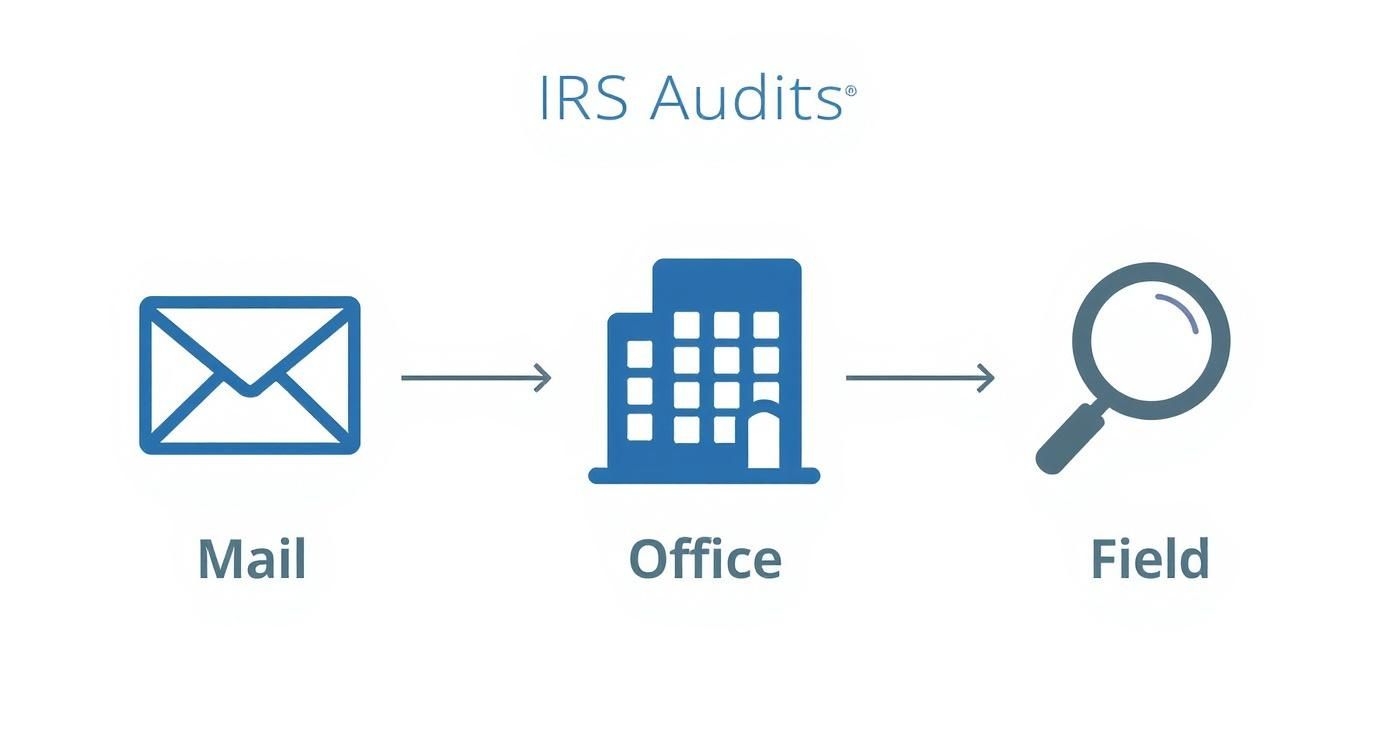
As you can see, what starts with a letter can escalate. That's why being prepared from the get-go is so important, no matter how minor it seems at first.
Responding to Information Document Requests
A huge part of any audit is the Information Document Request, or IDR. This is the auditor’s formal, written shopping list for your documents and records. It’s not a suggestion—it's a command, and how you respond is critical.
First rule: never, ever send your original documents. Always send copies. Get organized. I always recommend putting everything in a binder with tabs that line up with each item on the IDR. This simple act shows you're cooperative and makes the auditor's job easier, which is always in your best interest.
A well-organized response to an IDR does more than just provide information; it builds credibility. It shows the auditor you are meticulous, transparent, and have control over your financial records.
What if you can't find something? Don't panic and definitely don't just ignore the request. The best thing to do is communicate. Let the auditor know what's going on and ask if there’s an alternative, like a sworn affidavit or a reconstructed record, that they’ll accept. Silence is your enemy here. For a deeper look at the whole timeline, you can get more details about how long an IRS audit takes in our comprehensive guide.
Preparing Your Financial Story
The documents you hand over are the chapters of your financial story. Every receipt, bank statement, and mileage log is a piece of evidence supporting what you claimed on your tax return. Your job is to lay out this evidence so it's a breeze for the auditor to understand and verify.
Here’s a practical way to get your documentation in order:
- Gather Everything: Pull together all your relevant bank and credit card statements, receipts, invoices, canceled checks, and any logs you kept. Don't be selective; get it all.
- Organize by Category: Sort your documents into piles that match the deductions or income items being questioned. For instance, have separate folders for "Business Travel," "Office Supplies," and "Charitable Donations."
- Create Summaries: For each category, whip up a quick summary sheet or spreadsheet. List each expense with its date, amount, and a short note about its business purpose. Think of this as the table of contents for your evidence.
This isn't just about being tidy. It stops the audit from turning into a chaotic "document dump." Instead of dropping a shoebox full of receipts on the auditor's desk, you're presenting a professional, easy-to-follow case file. This proactive approach helps you control the narrative and keeps the audit focused only on the items in question.
The Auditor Interview
If you're facing an office or field audit, expect an interview. It’s a standard part of the process where the auditor will ask questions to get a feel for your business, how you keep records, and the story behind the numbers.
When you're in that interview, keep these ground rules in mind:
- Answer Only the Question Asked: This is a big one. Don't volunteer extra information. If the auditor asks, "Did you use this car for business?" the right answer is a simple "Yes." Don't launch into a long story about your commute or client visits.
- Be Honest: Never, ever lie to an IRS auditor. If you don't know the answer, it's perfectly fine to say, "I don't recall off the top of my head, but I can check my records and get back to you."
- Stay Calm and Professional: Audits are stressful, no doubt about it. But keeping a respectful, cooperative attitude is crucial. Getting defensive or argumentative will only create an adversarial relationship you don't want.
- Consider Professional Representation: Remember, you have the right to have a CPA, attorney, or Enrolled Agent represent you. In many situations, letting a professional handle the communication is the smartest move. They know the precise way to answer questions without accidentally opening up a new can of worms.
The examination phase is truly where the fate of your audit is decided. By presenting clear, organized proof and communicating like a professional, you build the strongest possible case for a fair and efficient resolution.
Understanding Audit Outcomes and Your Next Steps
After weeks, or sometimes even months, of digging up records and back-and-forth with an auditor, the examination finally wraps up. What happens next? The audit process always culminates in a formal outcome, and understanding the possibilities helps you prepare for the final stretch.
Ultimately, it all boils down to one of three results. Think of this as the final chapter of your audit story—the examiner has reviewed everything and is ready to issue their findings. Your next move depends entirely on which conclusion they land on.

Outcome 1: No Change
This is the best-case scenario. It’s the sigh of relief every taxpayer hopes for. A "No Change" determination means the IRS has accepted your tax return exactly as you filed it.
After all that work, the auditor concluded that your documentation was solid and no adjustments were needed. You’ll get a letter, often a Form 3390, that officially closes the audit with no changes. This means you don’t owe more tax, there are no penalties, and you can finally put the whole thing behind you.
Outcome 2: Agreed
The second possibility is an "Agreed" outcome. This is what happens when the auditor proposes changes to your tax return—maybe disallowing a deduction or adjusting your income—and you agree with their assessment. This is a very common result, especially if the audit uncovered a genuine mistake or you couldn't find the records to back something up.
If you agree, you’ll be asked to sign an examination report that spells out the changes. Signing it means you accept the adjustments and any additional tax, penalties, and interest that come with them. Once you sign and pay what's due, the audit is officially closed.
Key Takeaway: Agreeing with the auditor is often the quickest way to end the process. But you should only sign if you genuinely feel the changes are correct and you fully understand the financial impact.
The financial weight of these outcomes is no small thing. In a recent fiscal year, the IRS closed over 500,000 audits, which resulted in recommendations of more than $29.0 billion in additional tax. Those numbers, available in the IRS compliance and enforcement data on the official IRS website, show just how high the stakes can be.
Outcome 3: Disagreed
The third and most complicated outcome is "Disagreed." This happens when you don't accept the auditor's proposed changes. You have every right to contest the findings if you believe the examiner got the law wrong or ignored key evidence you provided. This is where your taxpayer rights are most critical.
Choosing this path means the audit isn't over. Not by a long shot. It simply moves into a new phase where you must formally challenge the IRS’s position. This isn't a decision to take lightly; it will require more time, more effort, and usually, professional help.
Navigating the Appeals Process If You Disagree
If you find yourself in a "Disagreed" situation, don't panic. This isn't the end of the road—it’s just the beginning of the appeals process. Your first step is to clearly state that you do not agree with the examiner's findings.
From there, the path typically looks like this:
- Request a Manager Conference: Your first move can be asking to speak with the auditor's direct manager. Sometimes, a fresh pair of eyes is all it takes to resolve a dispute without escalating things.
- Receive a "30-Day Letter": If you still can't agree, the IRS will issue a Letter 525, known as a "30-Day Letter." It explains the proposed changes and officially gives you 30 days to file an appeal.
- File a Formal Protest: To start the appeal, you’ll need to submit a formal written protest. This document needs to detail exactly what you disagree with and lay out the legal and factual reasons for your position.
- Enter the IRS Appeals Office: Your case then goes to the IRS Independent Office of Appeals, a completely separate division designed to mediate these disputes. An Appeals Officer, who is trained in negotiation, will review everything and try to work with you toward a resolution.
- Petition the U.S. Tax Court: If you and the Appeals Office can't find common ground, the IRS will issue a "Notice of Deficiency" (the "90-day letter"). You then have 90 days to file a petition with the U.S. Tax Court to have a judge hear your case.
This can be an intimidating ladder to climb, which is why having an expert on your side is so important. You can find out more about how a pro can help by exploring your options for professional tax audit defense and representation.
Common Audit Triggers and Red Flags
Ever wonder why one tax return gets the green light while another is pulled aside for a closer look? It’s not random chance. The IRS uses a powerful computer system that acts like a digital bloodhound, sniffing out returns that don't quite fit the statistical mold.
This system gives every return what's known as a Discriminant Information Function (DIF) score. You can think of it like a credit score for your taxes. A high DIF score tells the IRS there’s a greater chance of errors or misstatements, making your return a prime candidate for review. Your filing is compared against a massive pool of returns from people in a similar income bracket to see if anything stands out.
While the exact formula behind the DIF score is a tightly-kept secret, decades of experience have shown us what tends to catch the system's eye. Knowing these triggers is the best way to build a solid, audit-resistant return from the get-go.
Statistical Outliers and Mismatched Information
The most basic red flag is when the numbers just don't add up. This often happens when the information you report doesn't match the data the IRS has already received from third parties, like your employer or bank.
For instance, if your employer's W-2 shows they paid you $70,000, but you only report $65,000 on your return, a computer will flag that discrepancy in a heartbeat. The system is built to catch these kinds of mismatches automatically.
Another major trigger is claiming deductions or credits that seem unusually large for your income. Let's say a taxpayer earning $50,000 a year claims $25,000 in charitable donations. It's not impossible, but it's a statistical outlier—the kind of thing the DIF system is programmed to find.
High-Risk Deductions and Credits
Some deductions are naturally under a bigger microscope because, frankly, they're easier to get wrong or even abuse. If you're claiming these, your record-keeping needs to be impeccable.
- 100% Business Use of a Vehicle: It’s extremely difficult to prove that you use a personal vehicle solely for business with zero personal mileage. This claim is a classic audit trigger.
- Large Home Office Deductions: The rules for the home office deduction are very specific and strict. Claiming a huge portion of your home as an office, especially on a modest income, is likely to draw attention.
- Unreimbursed Employee Expenses: While tax law changes made this less common for most W-2 employees, it can still be a hot-button issue for certain professions and is scrutinized carefully.
The goal isn’t to shy away from legitimate deductions. It’s about making sure every claim, especially a high-risk one, is backed by clean, detailed records that can stand up to an IRS review.
The Focus on High-Income Taxpayers
The IRS is also a strategic organization—it puts its resources where it's likely to get the biggest return. A core part of that strategy involves focusing on high-income taxpayers, simply because the potential for recovering unpaid taxes is much greater.
This means as your income climbs, so does your audit risk. The data backs this up. The audit rate for individuals earning over $10 million was recently around 11%, with the IRS planning to boost that to 16.5%. This is a clear, deliberate effort to ensure the wealthiest filers are compliant.
Understanding these red flags ahead of time is a huge advantage. You can learn more about what triggers an audit and how to prepare in our detailed guide, which will help you build a stronger, more defensible tax return from the start.
Your Top Questions About the IRS Audit Process Answered
Even with a step-by-step guide, it's completely normal to have lingering questions and a sense of unease. Getting that letter from the IRS can feel incredibly isolating, but trust me, the worries running through your head are the same ones countless others have had. Let's tackle some of the most common questions head-on to give you the clarity you need to move forward.
Think of this as the practical advice you'd get from someone who's been in the trenches. We'll demystify the process so you know exactly what to expect, what your rights are, and how to make the best decisions for your situation.
How Long Does an IRS Audit Usually Take?
This is the million-dollar question, and unfortunately, the honest answer is: it depends. The uncertainty is often the most stressful part. There’s no fixed timeline, because every audit is different.
A simple mail audit where you just need to send in a missing form might wrap up in a few months. But a full-blown field audit, especially for a complex business, could easily stretch out for a year or more. The main things that dictate the clock are:
- The type of audit: Mail audits are the quickest; field audits take the longest. Simple as that.
- The complexity of the issues: A single, straightforward question about a charitable donation is a world away from untangling years of business expenses.
- Your cooperation: How quickly and completely you respond to requests for information is a huge factor. Delays on your end will absolutely prolong the process.
- The auditor's schedule: Remember, your IRS agent is juggling multiple cases. Their caseload can sometimes cause unavoidable delays.
As a general rule, the IRS tries to wrap up audits within 26 months of the date you filed your return. But my advice? Settle in and be patient. This is a marathon, not a sprint.
What Are My Rights as a Taxpayer?
It's easy to feel powerless when you're up against the IRS, but you have more protections than you might think. The Taxpayer Bill of Rights isn't just a document; it's a set of fundamental protections that ensure you're treated fairly. Knowing these rights is your first line of defense.
One of the most critical rights you have is the right to professional representation. This means you can hire a CPA, an Enrolled Agent, or a tax attorney to deal with the IRS for you. You don't even have to speak to the auditor yourself.
This is a game-changer. Having a professional in your corner creates a buffer. They speak the IRS's language, handle the technical back-and-forth, and make sure the audit stays focused on the original issues. Beyond that, always remember:
- The Right to Be Informed: The IRS can't operate in secret. They have to explain what they're looking for and why.
- The Right to Challenge the IRS's Position and Be Heard: This is your chance to present your side of the story. You can submit documents and argue your case.
- The Right to Appeal an IRS Decision in an Independent Forum: If you disagree with the final result, you don't have to accept it. You can take your case to the IRS Independent Office of Appeals.
- The Right to Privacy and Confidentiality: Your financial information is sensitive, and the IRS is legally required to protect it.
Should I Handle an Audit Myself or Hire a Pro?
This is a crossroads moment. The temptation to save money and go it alone is strong, but it can be a costly mistake unless the audit is incredibly simple.
Think of it this way: you could represent yourself in a major court case, but would you? Probably not. You’d hire a lawyer. The same logic applies here. Tax pros understand the nuances, know the right way to frame an answer, and can prevent you from accidentally opening a new can of worms.
You should seriously consider hiring a professional if:
- You're facing an office or field audit. These are invasive, complex, and the financial stakes are much higher.
- You don't agree with the auditor's findings. An expert is your best shot at successfully navigating the appeals process.
- The potential tax bill is significant. The fee for a good representative is often a small fraction of the taxes, penalties, and interest you could save.
- You're feeling overwhelmed. The stress alone can cause you to make bad decisions. A pro brings an objective and steady hand to the situation.
For a basic mail audit asking for a single W-2 that you have handy? You can probably handle that yourself. For just about anything else, professional help isn't just a good idea—it's a smart investment.
What Happens If I Ignore an IRS Audit Notice?
Let me be blunt: ignoring the notice is the absolute worst thing you can do. The IRS will not just go away. They won't forget. They will simply move forward without your input, and that almost never ends well for the taxpayer.
If you don't respond, the IRS will make its decision based on the information it has—which usually means disallowing every deduction in question. They will then issue a "Notice of Deficiency," which is a formal legal notice stating you owe more tax, plus a heap of penalties and interest.
This notice starts a 90-day countdown. You either have to pay up or file a petition with the U.S. Tax Court. If you ignore that deadline, the IRS will shift into collection mode. That's when things get serious, with actions like liens on your property, levies on your bank accounts, and wage garnishment. The problem just gets bigger, more stressful, and far more expensive.
Navigating an IRS audit is a complex challenge, but you don't have to face it alone. Allied Tax Advisors provides expert IRS audit representation to protect your rights and work toward the best possible outcome. Visit us at https://alliedtax.com to see how our experienced team can bring you peace of mind.