
Cost of Goods Sold (or COGS, as you'll often see it) is one of the most important numbers in your business. At its core, it represents the direct costs you paid to create or buy the products you sold during a certain time.
Think of it this way: COGS is the cost of the stuff that walked out the door with your customers. It covers things like raw materials and the labor needed to make the product, but it leaves out indirect expenses like your marketing budget or office rent.
Understanding Cost of Goods Sold

Let's use a local bakery as an example. The cost of the flour, sugar, and eggs that went into a loaf of bread is part of COGS. So are the wages paid to the baker who mixed and baked it. These expenses are tied directly to that specific loaf of bread.
This number is a major player on your income statement because it gets right to the heart of your business's profitability. Before you account for anything else, COGS shows you how much it costs to simply have a product to sell.
Getting this calculation right isn't just about bookkeeping—it's about strategy. Your COGS directly impacts your gross profit, which is the money you have left after subtracting product costs from your sales revenue. That simple formula (Revenue – COGS = Gross Profit) is your first real clue about how efficient your operations are and whether your pricing makes sense.
Why COGS Is a Critical Metric
If you sell a physical product, getting a handle on your COGS is essential for staying in business. When you track this number accurately, you can:
- Set smart prices: Your selling price has to do more than just cover COGS. If it doesn't, you're literally losing money on every single sale.
- Manage inventory efficiently: It helps you see exactly how much cash is tied up in products just sitting on your shelves.
- Optimize your tax strategy: COGS is a major business expense that directly reduces your taxable income, which can significantly lower what you owe the IRS.
Understanding Cost of Goods Sold is fundamental for evaluating business efficiency; for example, the Inventory Turnover Rate directly uses COGS to measure how quickly inventory is sold and replaced.
What's Included vs. Excluded
One of the most common hangups is figuring out what counts as a "direct cost" (part of COGS) versus an "indirect" or "operating expense" (which is not). It can feel a little tricky at first, but the distinction is crucial for accurate financial reporting.
Here's a quick summary table to help you instantly categorize business expenses.
COGS at a Glance: What's Included vs. Excluded
| Expense Category | Included in COGS (Direct Costs) | Excluded from COGS (Indirect/Operating Costs) |
|---|---|---|
| Materials | Raw materials, parts used in production, and merchandise purchased for resale. | Office supplies or cleaning materials. |
| Labor | Wages for factory workers or staff directly involved in making the product. | Salaries for marketing, sales, or administrative staff. |
| Logistics | Inbound shipping costs to receive inventory ("freight-in"). | Outbound shipping costs to deliver products to customers. |
| Facilities | Factory overhead, utilities, and rent for production facilities. | Rent and utilities for corporate offices or retail storefronts. |
The key takeaway is that if a cost isn't directly tied to producing or acquiring a specific product you sold, it probably doesn't belong in COGS.
Sorting these costs correctly ensures your financial statements tell the true story of your company's performance. For a deeper look at getting your books in order, you can explore more about https://alliedtax.com/basic-accounting-for-small-business/ and how it creates a solid foundation for growth.
The COGS Formula Explained Step by Step
At first glance, accounting formulas can look a little scary. But the one for the Cost of Goods Sold is actually pretty straightforward. It’s all about tracking the flow of your inventory over a set period, whether that's a month, a quarter, or a full year.
The whole thing boils down to this simple, logical equation:
Beginning Inventory + Purchases – Ending Inventory = Cost of Goods Sold (COGS)
Think of it like a story. You start with what you had, add what you bought, and then take away what's left over. What remains is the direct cost of the specific items you sold during that time. Simple as that.
Breaking Down the Beginning Inventory
Your Beginning Inventory is just a snapshot of the dollar value of all the products you had on hand the moment the accounting period started.
If you’ve been in business for a while, this number is easy to find—it’s the exact same as the ending inventory from the period before. If your business is brand new, your beginning inventory is $0. You started with empty shelves, after all. Getting this number right is critical because it's the foundation for the entire calculation.
Accounting for Purchases During the Period
Next up is Purchases. This isn't just the price tag on the new inventory you bought. It’s the total cost to get those goods into your possession and ready to sell.
Your "Purchases" number should really include:
- Cost of Merchandise: What you paid your suppliers for the goods or raw materials.
- Freight-In: The shipping and handling fees to get the inventory from the supplier to your location.
- Direct Labor: For manufacturers, this is the pay for the workers who physically build the products.
- Factory Overhead: This can include costs like the rent and electricity for the production facility itself.
For any business that actually makes its own products, there's a key step you have to take before you can even get to COGS. You need to understand the Cost of Goods Manufactured (COGM), as this figure often gets rolled right into the "Purchases" part of the main COGS formula.
The Critical Role of Ending Inventory
Last but certainly not least is your Ending Inventory. This represents the value of everything you didn't sell by the end of the period. Honestly, this is where most mistakes happen.
To get an accurate ending inventory figure, you really need to do a physical count. Relying only on your inventory software is a recipe for trouble because it won’t catch issues like theft, damage, or obsolete stock. Under accounting rules (U.S. GAAP), this number must include direct costs like materials and labor but leave out things like marketing or administrative salaries.
As any seasoned accountant will tell you, regular physical counts are non-negotiable. If you accidentally overvalue your ending inventory, you'll understate your COGS, which in turn makes your profits look artificially high. That’s a major red flag for the IRS.
A precise count is the only way to ensure your financial statements tell the true story. This accuracy feeds directly into your gross profit, a vital sign of your company's health and efficiency. To see how this all connects, check out our guide on how to https://alliedtax.com/calculate-income-from-operations/.
How Inventory Valuation Methods Impact COGS
Once you get the hang of the basic COGS formula, a critical question pops up: how do you actually figure out the cost of the specific items you sold? It sounds simple, but it gets tricky when the prices you pay for inventory are always changing.
The accounting method you pick to value your inventory directly shapes your COGS calculation. This isn't just a small bookkeeping detail—it's a strategic decision that affects your gross profit and, ultimately, how much you owe in taxes. There are three main ways to do this, and each one paints a slightly different picture of your company's financial health.
This flowchart breaks down how all the pieces fit together to arrive at your final COGS number.
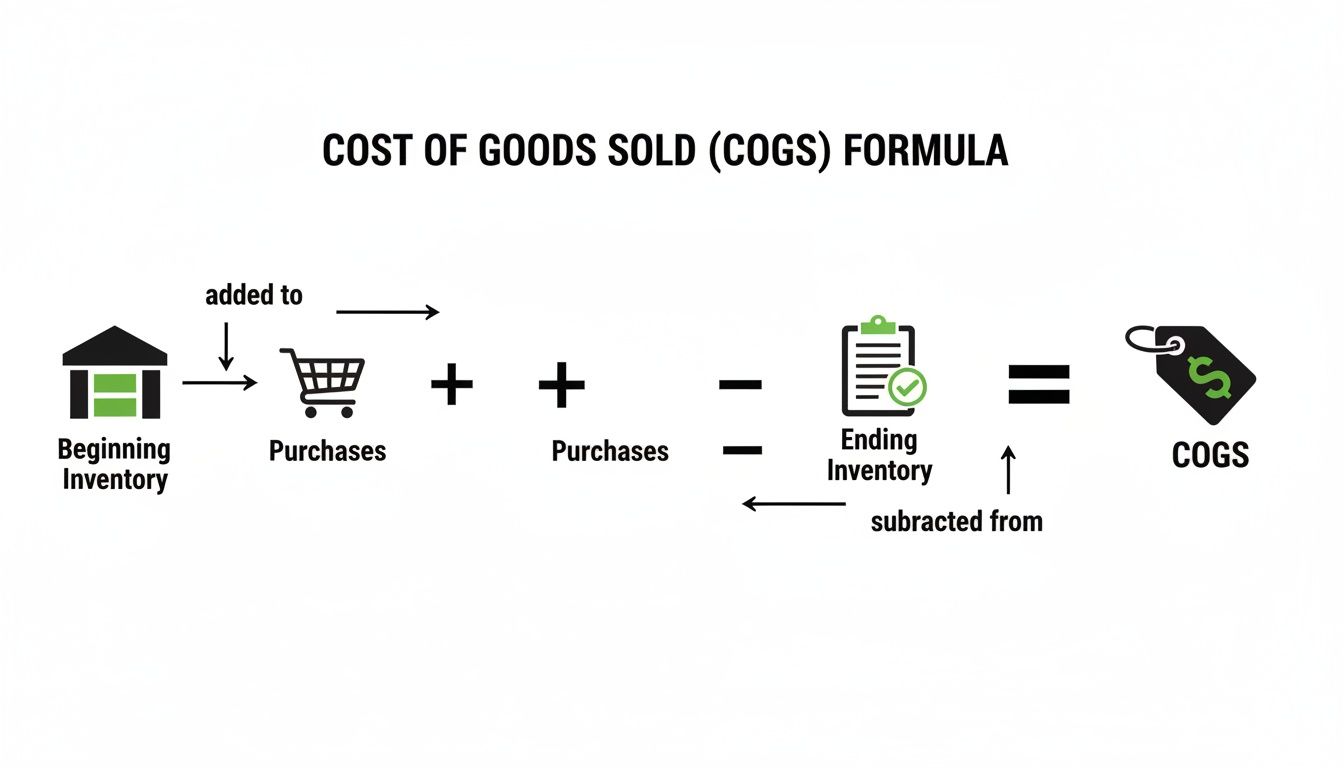
Essentially, you take what you started with, add what you bought, and subtract what you have left. That tells you the cost of what you sold. Now, let’s dig into the different ways accountants assign a dollar value to that "sold" inventory.
FIFO: The First-In, First-Out Method
The FIFO (First-In, First-Out) method is the most straightforward and widely used approach. It works on one simple assumption: the first items you bought are the first items you sold.
Think of a neighborhood bakery that gets a daily delivery of flour. The flour that arrived on Monday is assumed to be used in Tuesday's bread before the flour that arrived on Tuesday is touched. This just makes sense, especially for businesses dealing with perishable goods where selling older stock first is non-negotiable.
During times of rising prices (inflation), FIFO makes a big difference. You're matching older, cheaper costs against today's revenue, which makes your COGS look lower. This translates to a higher reported gross profit and, as a result, a higher tax bill. For example, during the inflationary period of 2022-2023, a company using FIFO would have reported much healthier profits than a competitor using LIFO, simply due to this accounting choice.
LIFO: The Last-In, First-Out Method
On the complete opposite end of the spectrum is the LIFO (Last-In, First-Out) method. This approach assumes the newest inventory you purchased is the first to be sold.
Picture a hardware store with a bin of nails. Customers grab nails from the top, and new shipments are just dumped on top of the old ones. The nails at the very bottom might sit there for years!
While LIFO is allowed in the U.S. under Generally Accepted Accounting Principles (GAAP), it’s banned under International Financial Reporting Standards (IFRS) because it doesn't reflect the physical flow of goods for most businesses. Its main advantage comes into play during inflationary times. By matching your most recent—and most expensive—costs against revenue, LIFO gives you a higher COGS. A higher COGS means lower reported profits and, therefore, a lower taxable income. It's a way to defer taxes, but it can also make your company's profitability look weaker on paper.
The Weighted-Average Cost Method
What if you can't tell your inventory apart? For a business like a gas station, all the gasoline is mixed together in one big underground tank. It’s impossible to know whether the gallon a customer just pumped was from this week's delivery or last week's.
This is where the Weighted-Average Cost (WAC) method shines. It smooths out all the price bumps by calculating a single average cost for every identical item you have in stock.
You find this by using a simple formula: Total Cost of Goods in Inventory / Total Units in Inventory = Weighted Average Cost Per Unit
You then apply this average cost to each unit sold. This method avoids the big swings in profit you might see with FIFO and LIFO when prices are all over the place, offering a more stable, middle-of-the-road picture.
FIFO vs LIFO vs Weighted Average Impact on COGS
When prices are rising, your choice of inventory method has a predictable effect on your financial statements. This table breaks down what you can generally expect.
| Method | Impact on COGS | Impact on Ending Inventory Value | Impact on Taxable Income |
|---|---|---|---|
| FIFO | Lower (older, cheaper costs are used first) | Higher (valued at recent, higher prices) | Higher (lower COGS leads to higher profit) |
| LIFO | Higher (newer, more expensive costs are used) | Lower (valued at older, cheaper prices) | Lower (higher COGS leads to lower profit) |
| Weighted Average | In the middle (smooths out price fluctuations) | In the middle (blended cost of all units) | In the middle (a moderate profit level) |
As you can see, there's a direct trade-off. LIFO can save you on taxes now, but it also undervalues your assets (inventory) on the balance sheet. FIFO presents a stronger balance sheet but could lead to a bigger tax bill.
Your choice often comes down to your accounting basis and business goals. To understand this better, you can explore our guide on the difference between accrual and cash basis accounting. The most important rule is consistency—once you pick a method, the IRS expects you to stick with it year after year.
How COGS Changes With Your Business Model
The Cost of Goods Sold isn't a one-size-fits-all number. While the core idea—calculating the direct cost of what you sold—stays the same, what you actually include in that calculation can look wildly different depending on your business.
Are you a retailer buying finished products? A manufacturer creating them from scratch? Or a service provider who also sells some physical goods on the side? Each model has its own nuances. Getting this right is fundamental to accurate financial reporting and making sure you're not paying more in taxes than you need to.
Let's walk through how to calculate COGS for the three most common types of businesses.
The Retailer's COGS Calculation
For anyone running a retail shop, boutique, or e-commerce store, the COGS calculation is about as straightforward as it gets. You buy finished products and sell them to customers. Your main job is to track the cost of that merchandise.
The key costs to keep an eye on are:
- Cost of Merchandise: This is simply what you paid your suppliers for the products you sold.
- Freight-In: Don't forget this one! The shipping and transport costs to get inventory from your supplier to your warehouse or store are a direct cost of acquiring your goods. They must be included.
- Alterations or Finishing Costs: Did you have to assemble that flat-pack furniture before putting it on the sales floor? Those costs count, too.
Example: A Retail Boutique
Imagine you own a small clothing boutique. Let’s figure out your COGS for the last quarter.
- Beginning Inventory: You kicked off the quarter with $20,000 worth of clothes on your racks.
- Purchases: You ordered $15,000 of new styles from various designers. Shipping those items to your store cost you another $1,000. So, your total purchases for the period were $16,000.
- Ending Inventory: After a physical count at the quarter's end, you find you have $12,000 worth of clothing left.
Now, we just plug those numbers into the formula:
COGS = $20,000 (Beginning Inventory) + $16,000 (Purchases) – $12,000 (Ending Inventory)
COGS = $24,000
So, for that quarter, the direct cost of the specific clothing you sold to customers was $24,000.
The Manufacturer's Complex Calculation
Things get a bit more involved for manufacturers. When you create products from scratch, your COGS has to capture every direct cost that went into turning raw materials into a finished product ready for sale.
Your calculation expands to cover three main cost buckets:
- Direct Material Costs: This is the cost of all the raw materials that physically become part of the final product. For a furniture maker, that’s the wood, screws, stain, and varnish.
- Direct Labor Costs: Think of the people on the factory floor. This includes the wages and benefits for employees who physically build or assemble the products—like the carpenter's salary, but not the marketing director's.
- Manufacturing Overhead: These are all the other costs necessary to run the factory itself. We're talking about factory rent, utilities for the production area, and the depreciation of your manufacturing equipment.
Example: A Custom Furniture Workshop
Let's say your workshop builds custom tables. Here’s how your COGS might look for the year:
- Beginning Finished Goods Inventory: You started the year with $30,000 worth of completed tables.
- Cost of Goods Manufactured (COGM): This is its own separate calculation that bundles all your material, labor, and overhead costs for the year. For this example, let's say your COGM was $150,000.
- Ending Finished Goods Inventory: At the end of the year, you have $40,000 worth of unsold tables.
The formula looks familiar, but instead of "Purchases," manufacturers use "Cost of Goods Manufactured."
COGS = $30,000 (Beginning Inventory) + $150,000 (COGM) – $40,000 (Ending Inventory)
COGS = $140,000
The direct cost of all the tables you sold that year was $140,000.
What About COGS for Service-Based Businesses?
This is where people often get tripped up. A pure service business—think a consultant, lawyer, or accountant—doesn't really have a Cost of Goods Sold because there are no "goods" to sell. Their main expenses, like salaries and office rent, are just considered operating costs.
But what about hybrid businesses? Plenty of service providers also sell products.
- A hair salon sells shampoo and styling gels.
- A mechanic uses and sells parts during a repair.
- A landscaping company buys plants, soil, and mulch for a client's project.
In these situations, the business needs to calculate COGS, but only for the product side of their operations. They would use the standard retail model to track the inventory and costs for those physical items.
The labor cost associated with providing the service is often reported separately as a "Cost of Revenue" or "Cost of Sales." This distinction is incredibly useful because it helps you see how profitable each part of your business is—the services you provide versus the products you sell.
You've done the hard work of calculating your Cost of Goods Sold. Now what? That number doesn't just sit on a worksheet; it's a key player on your official financial documents and, most importantly, your tax returns.
Getting this part right is how you connect your daily operational costs to the bigger financial picture. It’s where you translate all that inventory tracking and cost calculation into a clear, compliant story for the IRS, your investors, and yourself.
Finding COGS on Your Income Statement
The first place you'll see COGS in action is on your income statement, often called a Profit and Loss (P&L) statement. Think of the P&L as a report card for your business's performance over a certain period, like a quarter or a year.
COGS shows up right near the top, just below your total sales. The layout is designed to tell a quick story:
- Revenue (Sales): All the money you brought in.
- Cost of Goods Sold (COGS): What it cost you to make or buy the stuff you sold.
- Gross Profit: The result of subtracting COGS from Revenue.
This structure isn't an accident. It immediately reveals your core profitability before a single dollar is spent on marketing, rent, or salaries. A healthy gross profit is the first checkpoint for a viable business.
Reporting COGS on Your Tax Return
When it comes to taxes, COGS is one of your most powerful tools. It's a major business expense that directly lowers your taxable income, which means you pay less in taxes. The IRS knows how important it is, so they have specific places for you to report it based on how your business is set up.
- Sole Proprietors & Single-Member LLCs: You’ll use Schedule C (Form 1040), Profit or Loss from Business. Part III of the form is entirely dedicated to walking you through the COGS calculation.
- Corporations: C-Corps file Form 1120, and S-Corps file Form 1120-S. Both forms have a dedicated COGS section right after you list your gross receipts or sales.
- Partnerships: If you're in a partnership, you'll report COGS on Form 1065, the U.S. Return of Partnership Income.
On every one of these forms, the IRS essentially asks you to "show your work." You'll need to plug in your beginning inventory, purchases, and ending inventory—the same building blocks of the formula we've been using.
The Bottom Line: Reporting COGS correctly isn't just about following the rules. It's a strategic move to ensure you aren't paying taxes on money you never really made. A simple mistake that understates your COGS will overstate your profit, leading to a tax bill that's bigger than it needs to be.
How External Factors Affect Your COGS Reporting
Your COGS calculation doesn't happen in a bubble. It's directly tied to what's happening in the real world, and things like inflation, shipping bottlenecks, and trade disputes can send your costs soaring.
A perfect example was the U.S.-China trade war. The tariffs imposed on imported goods caused a massive headache for American companies. An analysis of S&P 500 firms found that their collective COGS shot up by 15.72% between 2015 and 2019, ballooning from $5.31 trillion to $6.3 trillion. If you want to dive deeper into how these costs hit major corporations, the data on Calcbench is pretty eye-opening.
This shows just how quickly global events can eat into your profit margins, making accurate and up-to-date COGS tracking more critical than ever.
Common COGS Mistakes and How to Avoid Them
Calculating your Cost of Goods Sold can start to feel like a routine task, but it’s surprisingly easy to make simple mistakes that throw off your financial reports and create major tax headaches down the road. An incorrect COGS number doesn't just skew your profitability; it can also wave a red flag for the IRS.
Getting this right is crucial for keeping your books clean and your business healthy.

One of the most common slip-ups? Misclassifying expenses. It's tempting to lump other business costs into your COGS, but things like marketing salaries or the rent for your office don't belong here. Remember, COGS is exclusively for costs directly tied to producing or purchasing the specific products you sold.
Key Errors to Watch For
Inaccurate inventory counts are another huge source of trouble. It's easy to trust your inventory software, but without a physical count, you won't catch discrepancies from theft, damage, or products that just went bad on the shelf. This directly messes with your ending inventory value, a cornerstone of the entire COGS formula.
Here are the top mistakes to keep on your radar:
- Forgetting Freight-In Costs: The bill for shipping inventory to your warehouse or store is a direct cost of getting those goods. It absolutely must be included in COGS.
- Inconsistent Inventory Methods: Jumping between FIFO, LIFO, and weighted-average methods year after year is a big no-no. The IRS expects consistency, so pick one method and stick with it.
- Improperly Valuing Inventory: Holding onto obsolete or damaged inventory at its full value is a classic error. Failing to write it down overstates your ending inventory, which artificially lowers your COGS and inflates your taxable profit.
A common oversight is failing to perform a diligent year-end physical inventory count. Without an accurate ending inventory figure, the entire COGS calculation is fundamentally flawed, creating a domino effect of errors across your financial statements.
Best Practices for Accuracy
The best way to sidestep these issues is to build a rock-solid process for tracking and double-checking your numbers. This means keeping meticulous records for every single purchase—supplier invoices, shipping receipts, you name it.
More importantly, schedule regular physical inventory counts. Doing a full count at least once a year is non-negotiable. It’s the only way to confirm that what’s on your shelves matches what's in your books.
Creating a simple checklist for your COGS calculation and running through it each reporting period can help you catch small errors before they snowball. This isn't just about compliance; it gives you a much clearer picture of your business's true profitability. And if you ever find yourself staring at the numbers, wondering if a cost is direct or indirect, that’s your cue to call a tax advisor.
Common Questions About Cost of Goods Sold, Answered
Once you get the hang of the basics, you'll inevitably run into some tricky situations with COGS. Let's tackle a few of the questions that pop up most often for business owners.
What About COGS for a Service Business?
This is a great question. If you run a pure service business—say, you're a consultant or a lawyer—you technically don't have a "Cost of Goods Sold" because you're not selling physical goods. Instead, you'd track something called "Cost of Revenue," which would include direct costs like paying a contractor to help on a specific client project.
But what if your service business does sell some products? Think of a hair salon that sells shampoo or a mechanic's shop that sells car parts. In that case, you absolutely have to calculate COGS for those physical items. You'll need to keep the inventory and sales of your products separate from the revenue you earn from your services.
How Do I Handle Inventory That's Damaged or Outdated?
Inventory that's broken, expired, or just plain unsellable can't sit on your books forever. You have to "write it off," which means formally removing its value from your inventory.
Writing off inventory lowers your ending inventory value. A lower ending inventory figure directly increases your Cost of Goods Sold for the period. This, in turn, reduces both your gross profit and your taxable income, so getting this right is crucial.
Just be sure to keep meticulous records of what you wrote off and why. You'll need that documentation to support the adjustment if the IRS ever comes knocking.
Do I Really Have to Do a Physical Inventory Count Every Year?
In a word, yes. The IRS generally requires businesses with inventory to do a physical count at or near the end of the tax year. Even the best inventory management software can't account for real-world issues like theft, spoilage, or items that broke and were never logged.
Think of the physical count as your annual reality check. It confirms your software records are accurate and gives you the hard number you need for your ending inventory. This isn't just a suggestion; it’s a necessary step to make sure your cost of goods sold is accurate and compliant.
Navigating the rules around COGS, inventory, and taxes can feel overwhelming. The team at Allied Tax Advisors offers expert bookkeeping and advisory services to keep your financials accurate and optimized. Learn how we can support your business's financial health and take the guesswork out of your accounting.