
January 27, 2025, was the opening date for the U.S. 2025 tax filing season. For 2025 personal returns, the standard federal deadline is April 15, 2026, with a Form 4868 extension available until October 15, 2026.
If you're in San Diego, this is probably the situation: your W-2 has arrived, one brokerage form is still missing, your employer's payroll portal says another document is being corrected, and you're wondering whether you can file now or should wait. The answer depends on which phase of the tax calendar you're in, not whether the calendar says January.
The practical timeline has five parts: preparation, IRS acceptance, the regular filing deadline, an extension, and separate state or international obligations. The dates below give you a usable plan rather than a single deadline that leaves out the decisions that create problems.
Table of Contents
- The 2025 Tax Filing Timeline at a Glance
- When the IRS Starts Accepting 2025 Returns
- Standard Federal Deadlines and Extension Options
- State-by-State Filing Windows You Should Know
- Cross-Border Filers and Non-U.S. Deadlines
- Practical Tips for Filing Early and Securely
- Filing Questions Answered for 2025 Returns
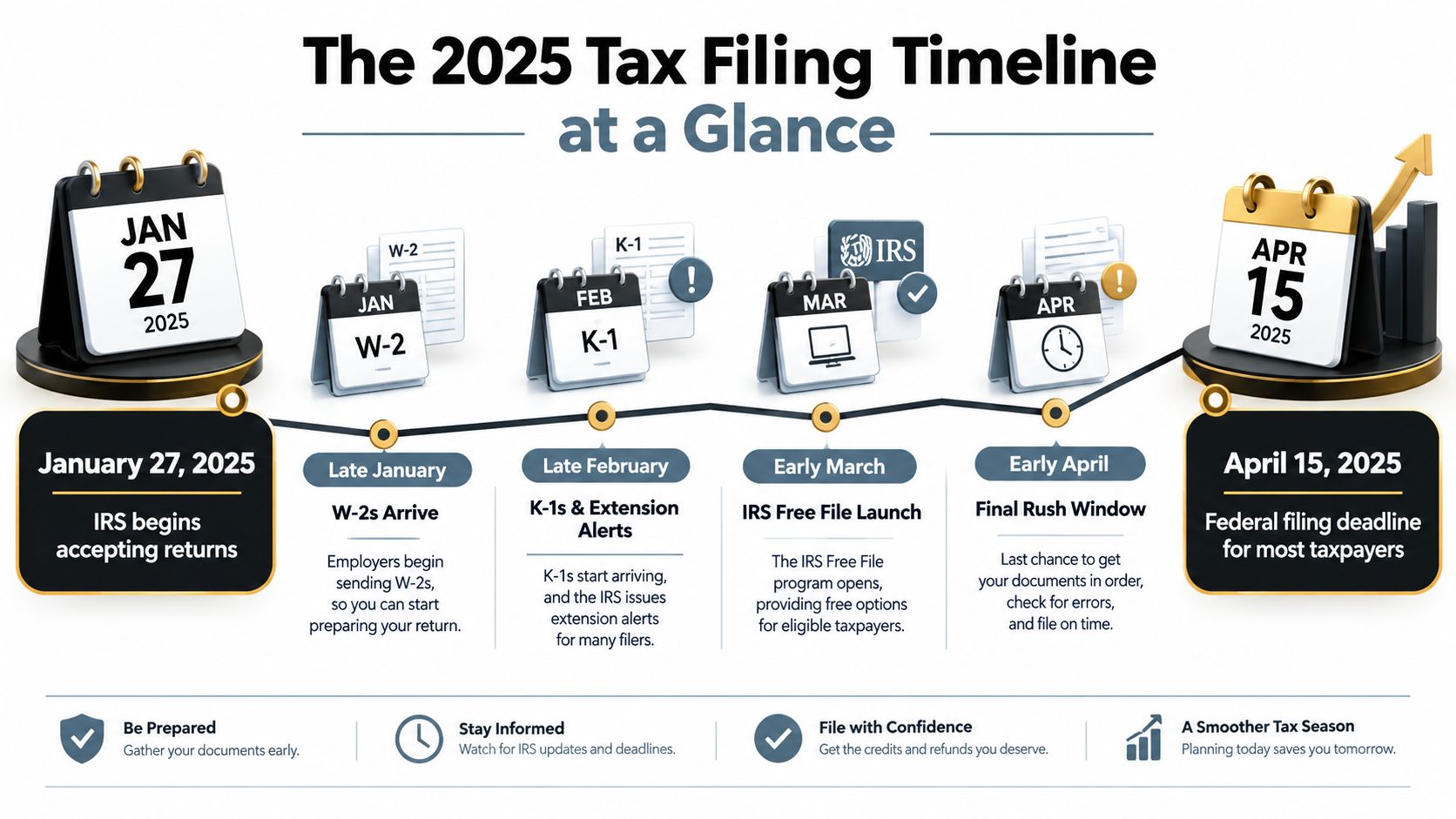
The 2025 Tax Filing Timeline at a Glance
The IRS began accepting and processing federal individual returns for the 2024 tax year on January 27, 2025, marking the opening of the 2025 filing season, as documented in the IRS filing guidance. For returns covering tax year 2025, the regular federal deadline is April 15, 2026. If you need more time to complete the return, filing Form 4868 by the regular deadline generally moves the filing date to October 15, 2026, but it doesn't move the payment date.
Think of the calendar this way:
- Preparation window: Gather income documents, organize deductions, reconcile investment activity, and review last year's return.
- Opening day: The IRS begins accepting eligible federal individual returns. Tax software may let you prepare earlier, but it holds the return until IRS transmissions open.
- Regular deadline: April 15, 2026, is the date most taxpayers must file and pay federal tax due.
- Extension window: Form 4868 gives additional time to file, not additional time to pay.
- State and international exceptions: State deadlines can differ, while other countries follow their own filing calendars.
A state return may follow the federal date, but you shouldn't assume it will. A taxpayer with foreign income, foreign accounts, or residency ties abroad needs a second calendar, because another tax authority may open filing later or impose an entirely different deadline.
For a broader checklist of documents and planning milestones, use the 2025 tax resource guide. The important point is simple: prepare as soon as your records are complete, transmit only after the relevant system opens, and use an extension deliberately rather than as a substitute for estimating what you owe.
When the IRS Starts Accepting 2025 Returns
The IRS opening date matters because tax software and preparers can't transmit a federal individual return into the IRS system before electronic filing opens. The agency uses the period after the prior tax year closes to update forms, processing rules, and electronic filing systems. That testing period helps prevent returns from entering a system that isn't ready to validate the year's new information.
The earliest practical filer is someone with a complete, internally consistent return. A San Diego employee with a single W-2, bank interest, and standard deductions may be ready quickly. A taxpayer with a brokerage account could still need to wait for a corrected Form 1099-B, even if the first version arrived earlier.
What can delay an otherwise prepared return
Watch for these trouble spots:
- Corrected income forms: A corrected W-2 or 1099 can change wages, withholding, interest, dividends, or capital gains.
- Substitute forms: If an employer doesn't provide a W-2, Form 4852 may be necessary, and that return needs more careful documentation.
- Partnership and S corporation information: K-1 forms often arrive later than wage documents, leaving owners unable to finalize their individual returns.
- Amended filings: An amended return follows a different process from an original e-filed return and shouldn't be treated as an opening-day submission.
- Refund and credit reviews: Certain refund claims can receive additional IRS review, so filing early doesn't guarantee immediate payment.
A practical example is a W-2 employee who also sold stock through a brokerage account. The taxpayer may have wage information ready, but the return isn't complete until the brokerage's cost basis and transaction reporting are accurate. Filing from an incomplete first statement can lead to an amended return, an IRS notice, or both.
Practical rule: Don't file because the first document arrived. File when the income record is complete and the numbers reconcile.
Use the opening date as a transmission milestone, not as permission to rush. If your forms are complete, early filing can reduce last-minute pressure. If a form is missing or marked corrected, waiting is usually cheaper than fixing a preventable mistake.
Standard Federal Deadlines and Extension Options
If your 2025 income documents are complete, plan around the regular federal deadline of April 15, 2026, for most individual returns. That deadline covers both filing and payment of federal tax due. Use the IRS instructions for filing individual returns to confirm the requirements that apply to your return.
Maine and Massachusetts taxpayers may follow a different calendar because Patriots' Day and Emancipation Day affect the filing date. Taxpayers officially abroad on the regular deadline can also receive special timing treatment. Confirm your date directly instead of copying a prior-year checklist or another taxpayer's schedule.
What Form 4868 changes
Form 4868 provides a filing extension. Submit it by the original deadline, and the deadline for filing the individual return moves to October 15, 2026. The extension does not erase the tax bill or postpone the IRS payment deadline.
Estimate your balance before requesting the extension. Pay as much as you reasonably can by April 15, 2026, because unpaid tax may create interest and failure-to-pay penalties. An extension addresses late filing, not the cost of late payment.
| Event | Date | What It Controls |
|---|---|---|
| IRS filing season opening for the 2025 season | January 27, 2025 | Start of IRS acceptance and processing for that filing season |
| Regular federal deadline for 2025 personal returns | April 15, 2026 | Filing and payment for most individual taxpayers |
| Automatic timing adjustment in qualifying circumstances | April 17, 2026 | Filing and payment date where the applicable holiday or abroad rule applies |
| Form 4868 extension deadline | October 15, 2026 | Final date to file the extended personal return |
| Automatic extension for qualifying taxpayers abroad or on overseas military duty | June 15, 2026 | Additional filing time, while payment remains tied to the regular deadline |
U.S. citizens or residents living and working abroad, and qualifying military personnel serving outside the United States, may receive an automatic additional two-month filing period. A further extension may be available, but it requires action and does not shield the return from an audit.
Business owners must keep the entity calendar separate from the individual calendar. An owner's personal extension does not automatically extend a partnership or S corporation return. Review this business tax extension deadline guide for the entity deadlines that apply before submitting Form 4868.
State-by-State Filing Windows You Should Know
Most state individual income tax calendars track the federal spring deadline, but alignment isn't universal. California commonly coordinates its individual filing extension with the federal extension, yet taxpayers still need to confirm the state's payment rules and whether a state form or separate payment is required.
A federal extension also doesn't mean every state obligation disappears. States may require a separate extension request, a state payment voucher, or an estimate of tax due. Disaster postponements can alter filing and payment dates for residents in affected areas, and those announcements can change during the season.
Use the state deadline as a separate checklist
Your state review should answer four questions:
- Filing date: Does the state use April 15, 2026, or publish another date?
- Payment date: Does the state require payment by the original deadline even when filing is extended?
- Extension mechanics: Does the state automatically recognize a federal extension, or must you file separately?
- Special status: Do you live in a disaster area, file on a fiscal year, or have a pass-through entity obligation?
Maine and Massachusetts may use April 17, 2026, where the relevant holiday rules apply. Texas and Louisiana, along with other jurisdictions affected by disaster declarations, can receive postponements that aren't reflected in a standard tax software calendar. Check the state revenue department's current notice before relying on a disaster-related delay.
| State | Filing Deadline | Payment Deadline | Auto-Follows IRS Extension? | Key Note |
|---|---|---|---|---|
| California | Verify with the California tax authority | Generally tied to the state's applicable original deadline | Often provides an automatic extension in qualifying situations | Confirm payment requirements and current state instructions |
| Maine | Verify for the applicable holiday adjustment | Verify with the state | Verify with the state | Patriots' Day can affect the calendar |
| Massachusetts | Verify for the applicable holiday adjustment | Verify with the state | Verify with the state | Emancipation Day and Patriots' Day can affect timing |
| Texas | Verify current state and disaster guidance | Verify current state and disaster guidance | Not applicable in the same way as an individual income-tax state | Disaster-related deadlines may matter for business or local obligations |
| Louisiana | Verify current state and disaster guidance | Verify current state and disaster guidance | Verify with the state | FEMA-related postponements may alter deadlines |
State estimated payments, fiscal-year returns, partnership filings, and pass-through entity taxes operate beside the personal return. If your software waits for federal acceptance before allowing the state filing, a federal correction or missing form can push both filings later.
Cross-Border Filers and Non-U.S. Deadlines
The question “when can I file my taxes for 2025?” is incomplete for anyone with foreign income, foreign residency, or reporting obligations outside the United States. Singapore's 2026 individual filing period runs from March 1 through April 18, 2026, according to IRAS tax season guidance. Canada opened online filing for 2024 returns on February 24, 2025, with most individuals due April 30, 2025, while its 2026 guidance sets April 30, 2026 as the standard deadline for most individual 2025 returns and June 15, 2026 for many self-employed filers, with balances still payable by April 30, as explained by the Canada Revenue Agency filing calendar.
The United States may be only one item on your list. A dual resident can have a U.S. Form 1040, foreign-country return, foreign account reporting, and treaty analysis moving on different schedules. A treaty can reduce double taxation, but it doesn't eliminate the paperwork needed to claim the applicable position.
Build one calendar for every country
Track these items separately:
- Federal return: Record the regular filing and payment dates, plus any extension.
- Foreign return: Add the opening and closing window for the country where you live or earn income.
- Foreign account reporting: Determine whether FBAR or FATCA reporting applies and connect it to the correct U.S. filing.
- Currency records: Keep the conversion method and supporting records for foreign wages, expenses, taxes, and investments.
- Treaty positions: Document why a treaty provision applies rather than relying on a tax software interview alone.
Cross-border taxpayers also need reliable access to IRS notices and correspondence. A practical resource on Cloud Residents mail handling can help someone living abroad plan for official mail without losing track of a notice deadline.
A foreign tax deadline doesn't replace a U.S. tax deadline. Put both on the same calendar before either filing window opens.
Practical Tips for Filing Early and Securely
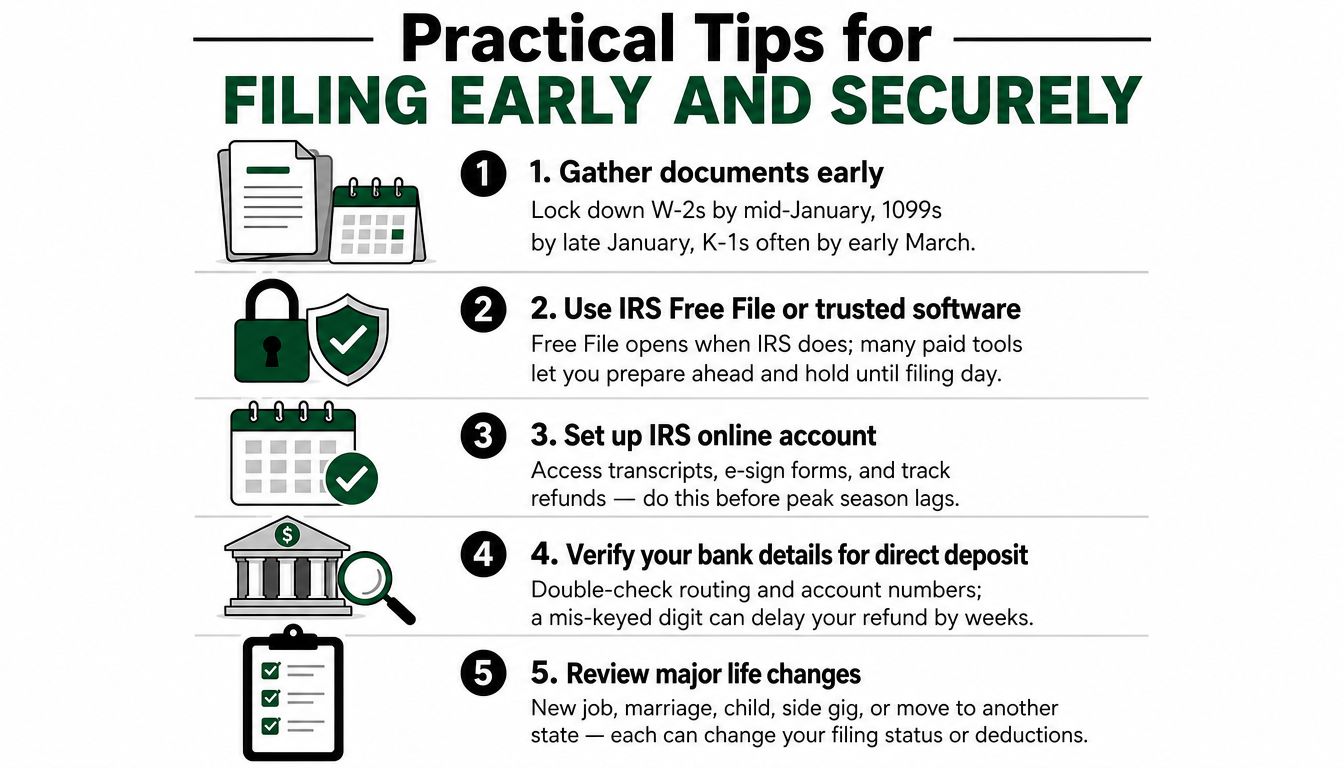
Early filing works only when the return is complete, the account is secure, and the payment plan is realistic. I recommend this order for clients who want to avoid the spring rush.
Gather documents before opening day
Start with the records most likely to determine whether the return is ready:
- Employment records: Collect W-2s and review federal and state withholding.
- Investment records: Compare brokerage statements with Forms 1099-B, especially when a broker later issues a corrected form.
- Business records: Expect K-1 information to arrive later than ordinary wage documents and don't finalize an owner's return without it.
- Life-change records: Organize documents for a marriage, move, child, new employer, rental property, side business, or digital-asset activity.
The tax season preparation guide is useful for turning that pile into a document checklist. If you want to compare the cost of paid help with the time required for self-preparation, review this 2026 tax cost comparison for busy families.
Verify before you transmit
Check your prior-year adjusted gross income before re-authenticating an e-filed return. The IRS uses prior-year information as part of the electronic signature process, and a mismatch can reject an otherwise accurate return.
Use your IRS Online Account and available transcripts to compare reported wages and withholding with your own documents. Don't treat a transcript as a replacement for reviewing the actual form. It is a second check that can reveal missing or inconsistent reporting before submission.
Secure the filing process
Use multi-factor authentication on your IRS account, tax software, email, and financial accounts. A dedicated device for tax work reduces exposure to phishing links, shared browsers, and unsecured networks.
Choose direct deposit carefully, verify the routing and account numbers, and use the IRS refund-status tool rather than responding to unsolicited refund messages. Be cautious with refund advances that package fees into the convenience of earlier access.
Security checkpoint: Confirm the recipient, domain, attachment, and payment destination before you enter tax information or approve a transfer.
After filing, schedule your first estimated payment for the next tax period if your income pattern requires it. Early filing doesn't help if it causes you to ignore the next payment obligation.
Filing Questions Answered for 2025 Returns
How do I check a refund or amended return?
Use the IRS Where's My Refund tool for an original federal return, and use the IRS amended-return tracker for Form 1040-X activity. Keep the confirmation that your return was accepted or mailed, because a status screen doesn't replace your filing records.
A refund can take longer when the IRS needs to verify income, withholding, identity, credits, or a corrected document. Paper returns generally require more handling than electronic submissions, so don't mail at the last moment and assume the postmark alone will solve every problem.
Does an ITIN change when I can file?
An expired or expiring Individual Taxpayer Identification Number can prevent successful electronic filing or delay processing. Check the ITIN requirement before submission, especially if a spouse or dependent uses an ITIN and the return depends on that person's identification number.
Do estimated payments change the personal deadline?
Estimated payments are separate from the annual filing deadline. A taxpayer may submit the personal return early and still need to make a payment for the next estimated-tax period. Keep the payment calendar beside the filing calendar so one completed task doesn't create a new underpayment problem.
What happens after a disaster declaration?
The IRS or a state tax authority may postpone filing and payment deadlines for taxpayers in a designated disaster area. The relief depends on the specific notice and affected location, so verify eligibility directly rather than assuming that a neighboring county receives the same treatment.
Accuracy and payment timing are different issues. Filing on time can reduce late-filing exposure, but it doesn't eliminate interest or payment-related penalties on an unpaid balance.
Hire a CPA or enrolled agent when the return includes foreign reporting, a business entity, rental property, substantial investment sales, an amended return, an IRS notice, or a dispute over residency. For a straightforward wage return with ordinary records, reputable self-preparation software may be sufficient. Allied Tax Advisors handles individual and business tax preparation, amended returns, investment and rental reporting, and IRS or state resolution work for clients who need a coordinated calendar.
If you want a clear filing plan for your 2025 return, Allied Tax Advisors can help organize the federal, state, business, and cross-border deadlines, estimate payment obligations, and prepare the return accurately. Contact the San Diego team before the filing rush so you can decide whether to file early, pay by the regular deadline, or use an extension responsibly.