
If you run your business as an S-corporation, one of the most important dates on your calendar is the 1120S due date. For the vast majority of S-corps that follow a standard calendar year, that deadline is March 15. It's a hard date, and missing it can trigger some painful and immediate penalties from the IRS.
Your Guide to the S-Corp Tax Deadline

So, why is this date so important? Think of your S-corp's tax return, Form 1120-S, as the official financial story you tell the IRS each year. The 1120S due date is your deadline to get that story filed correctly. This isn't just a random date the IRS picked; it’s set early in the year for a very specific reason related to how S-corps work.
Because an S-corp is a pass-through entity, it doesn't pay corporate income tax itself. Instead, the profits and losses are "passed through" to the shareholders. Each owner receives a Schedule K-1 detailing their share, which they then report on their personal tax return (Form 1040). The March 15 deadline ensures that you, as a shareholder, get that K-1 with plenty of time to file your own taxes before the personal deadline in April. To get a better handle on the form itself, you can dive into what Form 1120-S is and how it functions in our guide.
How the S-Corp Deadline Differs
One common trip-up for new business owners is mixing up the S-corp deadline with other tax dates. The most frequent confusion is with C-corporations, which file Form 1120. A C-corp’s return is due on the 15th day of the fourth month after its tax year ends—typically April 15. That one-month difference is critical and why S-corp owners have to be on the ball a little earlier. If you’re curious about the other side, you can find more insights by navigating business taxes for C-corps on aeriestechnology.com.
Getting this timing right is a fundamental part of staying compliant and avoiding a domino effect of filing problems.
Key Takeaway: The March 15 deadline for calendar-year S-corps is not arbitrary. It exists to give shareholders ample time to receive their Schedule K-1 and accurately file their own personal income tax returns by the April deadline.
This deliberate structure prevents a mad dash for both business owners and their tax preparers. It’s all about a smooth, orderly flow of information from the business to the individual. In the sections ahead, we’ll walk through exactly how to calculate this date for any S-corp, what to do if you need more time, and what happens if you miss the mark.
How to Calculate Your S-Corp Tax Deadline
While you hear March 15 thrown around a lot, your S-corp’s actual tax deadline isn’t a one-size-fits-all date. It all comes down to your company's specific tax year. The IRS has a simple rule of thumb: your Form 1120S is due on the 15th day of the third month after your tax year officially closes.
Think of your tax year-end as the starting pistol. Once that day passes, you just count forward three months and pinpoint the 15th. It’s the same simple math whether you run on a standard calendar year or a custom fiscal year.
For Calendar-Year S-Corps
Most S-corporations keep things simple by using a standard calendar year for their books. This just means their business year runs from January 1 to December 31.
For these businesses, figuring out the deadline is a piece of cake.
- Step 1: Your tax year ends on December 31.
- Step 2: You count out the next three months: January (month 1), February (month 2), and March (month 3).
- Step 3: The deadline lands on the 15th day of that third month, which is March 15.
And that’s it. This is exactly why March 15 has become the default 1120S due date so many of us work toward.
For Fiscal-Year S-Corps
What if your business doesn't follow the calendar? Many companies, especially seasonal ones, choose a fiscal year that better reflects their business cycle—say, ending the year on June 30 after a busy spring. The rule for calculating the deadline doesn't change, only your starting point does.
Let’s walk through an example. Say your S-corp’s fiscal year ends on June 30.
- Step 1: Your start date is the end of your tax year, June 30.
- Step 2: Count forward three months: July (month 1), August (month 2), and September (month 3).
- Step 3: Your tax return is due on the 15th day of that third month—September 15.
This same logic works no matter when your fiscal year wraps up. Just identify your year-end date and count forward. Of course, hitting tax deadlines is just one piece of the puzzle; you also need to know how to calculate critical financial metrics to keep your business financially healthy year-round.
The Next Business Day Rule
What if the 15th lands on a Saturday, Sunday, or a public holiday? The IRS cuts you a little slack. Your deadline automatically pushes forward to the next business day. So, if March 15 happens to be a Sunday, your real due date becomes Monday, March 16.
This is an automatic grace period, so you don't have to do anything to get it. It applies to all federal tax deadlines and can be a lifesaver.
To help you visualize this, here’s a quick look at how the 1120S due date changes for some common fiscal year-ends.
S-Corp Tax Deadlines for Common Fiscal Year-Ends (2026)
This table shows a few examples of how the due date shifts based on a company's fiscal year. Find the row that matches your year-end to see the corresponding filing deadline.
| Fiscal Year-End | 1120S Filing Due Date |
|---|---|
| March 31 | June 15 |
| June 30 | September 15 |
| September 30 | December 15 |
| December 31 | March 15 |
As you can see, the pattern is consistent. The most crucial piece of information you need is your S-corp's year-end date. Once you know that, finding your correct 1120S due date is straightforward.
Filing a Tax Extension with Form 7004
Let's be real—sometimes, tax season gets the best of us. Despite all the planning, you might find yourself needing more time to get your S-corp’s financials buttoned up. The good news is the IRS provides a simple escape hatch: Form 7004, Application for Automatic Extension of Time to File Certain Business Income Tax, Information, and Other Returns.
Filing this form gives you an automatic six-month grace period to submit your return. For a calendar-year S-corp, that pushes your 1120S due date from March 15 all the way to September 15. This gives you and your accountant the breathing room to file an accurate, complete return instead of scrambling to meet a deadline with half-baked numbers.
Understanding the Extension Lifeline
Now, here’s the single most important thing to remember about extensions. It’s a concept that trips up business owners all the time.
An extension to file is not an extension to pay.
Think of it like this: your credit card company might give you an extra week to submit your expense report for reimbursement, but your credit card bill is still due on the original date. The same logic applies to your taxes.
Even with an approved extension, you are still required to estimate what your S-corp owes and pay that amount by the original 1120S due date. For most businesses, that payment is due by March 15. If you don't pay on time, you'll start racking up penalties and interest, even if you filed Form 7004 perfectly. For a deeper look into this topic, check out our guide on the business tax extension deadline.
How to File Form 7004
Getting your extension is refreshingly straightforward. You just have to submit Form 7004 by the original due date of your return—no exceptions. You have the option to file it electronically using IRS e-file services (which is what most tax pros recommend) or send in a paper copy via mail.
To fill out the form, you'll need a few key pieces of information:
- Your S-corp's name, address, and Employer Identification Number (EIN).
- The tax form code you're extending (for S-corps, this is Form 1120-S).
- A reasonable estimate of your total tax liability for the year.
- The total amount you’ve already paid through estimated tax payments.
- The balance due, which you should pay when you file the extension.
Once you file, the six-month extension is granted automatically. You won’t get a confirmation letter from the IRS unless they deny the request, which is rare as long as the form is completed correctly. This gives you the runway you need to get your books in order and file a polished return by the new September 15 deadline.
The Steep Price of a Missed 1120S Deadline

Let's be clear: ignoring your 1120S due date isn't a minor slip-up. It's an expensive mistake. The second that deadline passes, the IRS starts the clock on penalties that can snowball into a serious financial headache for your S-corp. These penalties aren't just a slap on the wrist; they're designed to hurt enough to ensure you don't make the same mistake twice.
First up is the failure-to-file penalty, and this is the one that really catches S-corporation owners off guard. It’s not a simple flat fee. Instead, the IRS gets creative, basing the penalty on how many shareholders you have and how many months you're late.
The failure-to-file penalty for a late Form 1120-S is currently $220 per shareholder, per month (or even part of a month) the return is late, for up to 12 months.
Because of this formula, the penalty grows incredibly fast. If you have an S-corp with just two owners and you file three months late, you’re already on the hook for $1,320 ($220 x 2 shareholders x 3 months). A slightly larger business with five shareholders would be staring at a $3,300 penalty for the exact same delay.
The Double Whammy of Penalties and Interest
But wait, there's more. On top of the failure-to-file penalty, the IRS can also hit you with a failure-to-pay penalty. This one comes into play if you filed for an extension but didn't pay the taxes you estimated you owed by the original 1120S due date. This penalty is 0.5% of the unpaid taxes for each month the balance is outstanding, and it can go as high as 25% of your total unpaid tax bill.
These two penalties can stack, but the financial pain doesn't even stop there. The IRS also charges interest—not just on your unpaid taxes, but on the penalties themselves. This creates a nasty compounding effect where your debt grows faster and faster the longer it goes unaddressed.
How Late Filing Costs Can Escalate
Let's walk through a real-world scenario. Imagine an S-corp with three shareholders that owes $10,000 in taxes. They completely forgot to file their return or an extension by the March 15 deadline and finally get everything submitted four months late.
Here's how that breaks down:
- Failure-to-File Penalty: $220 x 3 shareholders x 4 months = $2,640
- Failure-to-Pay Penalty: 0.5% of $10,000 x 4 months = $200
- Interest: On top of that, interest would be charged on the original $10,000 tax bill and on the $2,840 in penalties.
In just four short months, what started as a $10,000 tax obligation has grown by nearly 30%. This is exactly why hitting your 1120S due date—or at the very least, filing an extension and paying your estimated tax on time—is one of the most critical financial tasks for your business. The cost of getting it wrong is simply too high.
Navigating Your State S-Corp Filing Requirements
Once you've filed your federal 1120S, it's tempting to breathe a sigh of relief and close the books on tax season. But hold on—you're not quite at the finish line. Your state tax filings are just as important, and ignoring them can be a costly mistake.
Every state with a corporate income tax has its own rulebook, complete with unique forms, deadlines, and procedures. It's one of the biggest "gotchas" for new S-corp owners. Many people assume their state deadline will naturally fall on the same day as the federal one. While a lot of states do align with the IRS calendar, many don't. Some want their returns sooner, some later, and their extension rules can be a world apart from the federal Form 7004.
Confirming Your State's Deadline
So, how do you stay out of trouble? You have to go straight to the source. The single point of truth for your state's S-corp requirements is its Department of Revenue (or whatever your state calls its tax agency). Head to their website and look for the business or corporate tax section. That's where you'll find the specific, non-negotiable due dates for your return.
Don't ever assume your state's S-corp deadline matches the federal 1120S due date. A five-minute check on your state's Department of Revenue website can save you from some serious penalties and compliance headaches.
Keep in mind that state returns aren't just a carbon copy of your federal one with a different cover sheet. Corporate tax compliance has gotten more complicated over the years. For instance, if your S-corp has over $250,000 in assets or receipts, you're already familiar with federal Schedules M-1 and M-2, which reconcile your books to your tax return. You can see how the IRS uses this data by reviewing their statistics on corporate return data. States often have their own versions of these detailed schedules.
Getting all your documents in order for both filings at the same time is the only way to have a smooth tax season. Juggling these dual obligations is just part of running a compliant S-corp. If you need a refresher on the fundamentals, take a look at our guide on how to file as an S-corp. When you give your state return the same respect and attention as your federal one, you're protecting your business from every angle.
Your 2026 S-Corp Tax Filing Checklist
Let’s be honest: tax season can feel like a mad dash to the finish line. But it doesn't have to. The secret to avoiding that last-minute chaos isn't some complex strategy—it’s just a bit of planning.
Instead of dreading the 1120-S due date, you can follow a straightforward timeline to stay organized and in control. Think of this as your quarter-by-quarter game plan to get from year-end closing to a successfully filed return, without all the stress.
A Practical Q1 Filing Timeline
The work for a smooth tax season starts as soon as the ball drops on New Year's Eve. By tackling a few key tasks each month, you'll have everything you need long before any deadlines are breathing down your neck.
January: Lock Down Your Books
First things first: close out the prior year’s books. This means reconciling every bank account, credit card, and loan. It's the perfect time to get into your accounting software and make sure every dollar of income and every expense is correctly categorized. A clean set of books is the foundation for an accurate tax return.February: Document Collection and Review
With your books finalized, it's time to gather the core documents your tax preparer will need. Pull your final profit and loss (P&L) statement, balance sheet, and all payroll reports for the year. This is also when you need to double-check all shareholder information—names, addresses, and especially ownership percentages. Getting this right is crucial for issuing accurate Schedule K-1s.Early March: Make the Call—File or Extend?
By the first week of March, you and your tax advisor should have a clear financial picture. This is your decision point. After reviewing everything, you'll know if you’re ready to file Form 1120-S or if you need to file for an extension using Form 7004. Making this decision early prevents any eleventh-hour surprises.
This timeline helps you visualize how all the pieces fit together, especially when juggling federal and state deadlines.
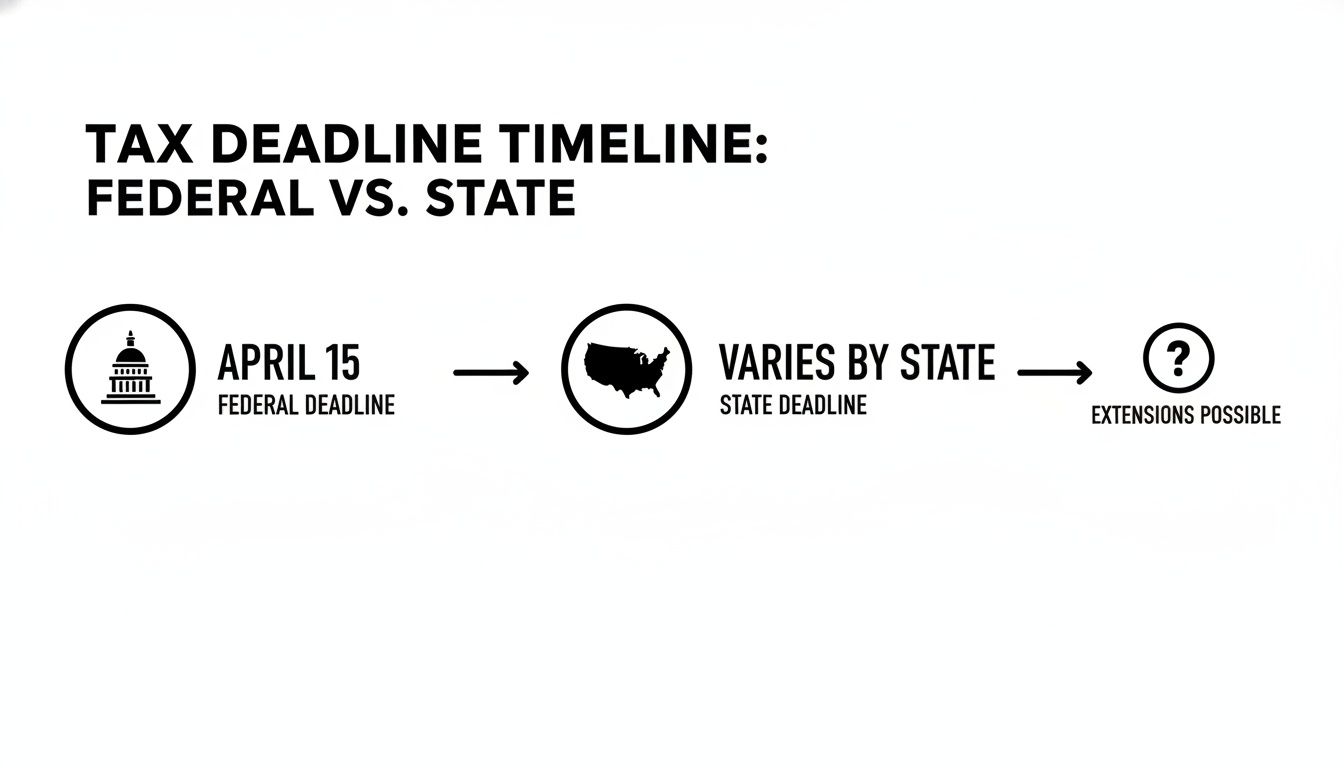
As you can see, the federal deadline is a fixed point on the calendar, but state due dates often have their own rules. Sticking to a checklist like this ensures you’re prepared to meet every deadline, without feeling overwhelmed.
Frequently Asked Questions About the 1120S Due Date
Even when you think you have the rules down, a few common questions always seem to pop up around the 1120S due date. Let's clear up some of the most frequent points of confusion so you can approach your filing deadline with confidence.
What Happens If My Due Date Falls on a Weekend?
This is a great question, and the IRS has a straightforward answer. If your S-corp's tax deadline (like March 15) lands on a Saturday, Sunday, or a public holiday, the due date automatically shifts to the next business day.
You don’t have to do anything special to get this little bit of grace. For instance, if March 15 is a Saturday, your new deadline is Monday, March 17. This rule is a handy, built-in buffer that applies to all federal tax deadlines.
Can I Get an Extension to Pay My S-Corp Taxes?
This is probably the single most misunderstood part of the extension process. Filing Form 7004 grants you an automatic six-month extension, but it's only an extension to file your return, not an extension to pay what you owe.
Think of it like this: the extension gives you more time to gather your documents and fill out the paperwork, but your tax payment is still due on the original deadline. For a calendar-year S-corp, you still need to estimate your tax liability and pay it by March 15. If you don't, you'll be hit with penalties and interest, regardless of your extension.
Key Insight: The IRS sees filing your return and paying your tax as two separate obligations. An extension only postpones the paperwork deadline, never the payment deadline.
Failing to pay on time will cost you, so always prioritize getting that payment in, even if your return isn't ready.
Is the 1120S Due Date the Same for K-1s?
Not precisely, but the two are directly linked. Your S-corp is responsible for filing its main return, Form 1120-S, by the March 15 deadline. A critical part of preparing that return is creating a Schedule K-1 for every shareholder.
The K-1 details each shareholder’s slice of the company's income, deductions, and credits for the year. The company must send these K-1s out to its shareholders by the same date it files the corporate return. This is designed so that shareholders get the information they need to complete their own personal income tax returns before the April deadline.
Staying on top of your S-corp tax obligations can be challenging, but you don't have to do it alone. The team at Allied Tax Advisors offers expert guidance on everything from bookkeeping and payroll to strategic tax planning and filing. Contact us today to ensure your business stays compliant and financially healthy.