
When you boil it down, the difference is pretty straightforward: Section 1245 property is all about the tangible personal assets you use in your business—think equipment, vehicles, and machinery. On the other hand, Section 1250 property deals specifically with real estate, like the building itself and its core structural parts.
This distinction might seem minor, but it's a huge deal when it comes to taxes. Why? Because it completely changes how depreciation is taxed when you sell the asset. Section 1245 has much tougher "recapture" rules that can hit you with higher ordinary income tax rates.
What is 1245 vs 1250 Property

When you buy an asset for your business or as an investment, the IRS lets you write off its cost over several years through depreciation. It’s a fantastic way to lower your taxable income. But, as they say, there's no free lunch.
When you eventually sell that asset, the IRS wants to "recapture" a portion of those tax benefits you enjoyed. This is precisely where the rules for Section 1245 and Section 1250 property diverge, and knowing the difference is key to avoiding a surprise tax bill.
The way an asset is classified dictates how any gain from its sale is taxed, especially the part of the gain that’s a result of the depreciation you claimed over the years. These two sections of the tax code have their own set of rules for handling this recapture, and the financial outcomes can be worlds apart.
Core Asset Classifications
At its core, the tax code is trying to separate depreciable property into two main buckets. Figuring out which bucket your assets belong in is the first and most important step in smart tax planning.
Section 1245 Property: This is the catch-all category for most types of tangible and intangible personal property that you can depreciate. We're talking about the things you use to operate your business that aren't the building itself. Classic examples include machinery, company cars, office furniture, computers, and specialized equipment.
Section 1250 Property: This is a much more focused category that only applies to depreciable real property. Think commercial buildings, warehouses, and their essential structural components—like the foundation, walls, roof, and integrated HVAC systems. It's crucial to remember that this never includes the land, as land can't be depreciated. For a deeper dive, check out our guide on the difference between real and personal property.
A simple way to think about it is permanence. If it's not a building or a permanent structural part of one, it’s almost certainly Section 1245 property.
Quick Comparison Table
| Feature | Section 1245 Property | Section 1250 Property |
|---|---|---|
| Primary Asset Type | Tangible personal property | Depreciable real property |
| Common Examples | Machinery, vehicles, equipment, furniture | Buildings, structural components |
| Recapture Rule | Gain treated as ordinary income up to total depreciation taken | Gain up to depreciation taken is taxed at a max 25% rate |
Comparing the Core Differences in Asset Treatment

While it's easy to think of the 1245 vs 1250 property distinction as just "personal" versus "real" property, the real story is in how you depreciate them. The tax treatment for each type of asset is worlds apart, affecting not just your yearly tax bill but also what happens when you eventually sell.
The main fork in the road is the asset's depreciable life, which is the timeline the IRS gives you to write off its cost. This single factor dictates how aggressive you can be with your deductions, directly influencing your tax strategy and cash flow.
Depreciable Lives and Methods
Section 1245 property covers assets with a relatively short lifespan. Think about things like computers, vehicles, office furniture, or specialized machinery. Under the Modified Accelerated Cost Recovery System (MACRS), these items typically get assigned a recovery period of 5 or 7 years.
Section 1250 property, on the other hand, is built to last. This category is for structural assets, so residential rental real estate is depreciated over 27.5 years, and commercial buildings get a 39-year timeline.
This massive gap in lifespan opens up completely different depreciation strategies. Because Section 1245 assets have shorter lives, you're allowed to use accelerated depreciation methods, like the double-declining balance method. This lets you take much bigger tax deductions in the first few years you own the asset.
In stark contrast, Section 1250 property is stuck with the straight-line method. This means you have to spread the deduction out evenly over its entire 27.5 or 39-year life, resulting in smaller, more predictable annual write-offs.
The ability to use accelerated depreciation for Section 1245 property is a fantastic way to lower your tax bill right now. But be warned: this benefit comes with a major catch in the form of much tougher tax recapture rules when you sell.
How Asset Treatment Shapes Your Tax Strategy
The depreciation rules create two fundamentally different playbooks. By front-loading deductions on Section 1245 assets, a business can dramatically improve its short-term cash flow, freeing up money to reinvest or cover other expenses.
This approach is especially powerful for businesses that need equipment that becomes outdated quickly. Getting the biggest possible tax write-off early on helps offset the constant cost of keeping your technology and machinery current.
Meanwhile, the slow and steady depreciation of Section 1250 property offers a reliable, long-term tax shield for real estate investors. The yearly deductions might not be huge, but they consistently lower the taxable income from a rental property for decades.
To make this crystal clear, here’s a quick breakdown of the key differences.
Section 1245 vs Section 1250 At a Glance
The table below provides a side-by-side look at how these two property types stack up against each other.
| Feature | Section 1245 Property | Section 1250 Property |
|---|---|---|
| Asset Type | Tangible personal property (equipment, vehicles, machinery) | Depreciable real property (buildings, warehouses, structural components) |
| Recovery Period | 5, 7, or 15 years | 27.5 years (Residential) or 39 years (Commercial) |
| Depreciation Method | Accelerated methods allowed (e.g., double-declining) | Straight-line method only |
| Tax Impact | Large, front-loaded tax deductions | Smaller, consistent annual tax deductions |
| Strategic Focus | Maximizing immediate cash flow and short-term tax savings | Providing a stable, long-term reduction in taxable income |
In the end, navigating the 1245 vs 1250 property rules is all about understanding this fundamental trade-off. The immediate tax breaks from Section 1245 assets are balanced by stricter tax consequences down the road—a critical detail we'll dive into next.
Understanding Depreciation Recapture Tax Rules
When you sell a business or investment asset, depreciation recapture is the mechanism the IRS uses to claw back the tax benefits you've enjoyed over the years. It’s not just a technicality; the difference between how Section 1245 and Section 1250 property are treated can have a huge impact on your final tax bill.
Essentially, the rules dictate whether the gain tied to your depreciation deductions gets taxed as high-rate ordinary income or as a more manageable capital gain. Getting this wrong can take a serious bite out of your net profit.
The Section 1245 Recapture Rule Explained
The rule for Section 1245 property is simple and harsh. When you sell an asset like machinery or equipment, any gain up to the full amount of depreciation you've claimed is taxed as ordinary income.
That means this portion of your profit gets hit with your highest marginal tax rate, which could be up to 37%. The IRS sees it like this: you got to lower your ordinary income with those depreciation deductions, so when you sell the asset, that "recovered" value should be taxed at the same ordinary rates.
Only the portion of the gain that exceeds your total depreciation qualifies as a Section 1231 gain, which can then get the lower long-term capital gains rates. This is a critical distinction, especially since Section 1245 property often includes assets with shorter useful lives, like 5 or 7 years, meaning depreciation adds up fast.
The Section 1250 Recapture Rule Nuances
Section 1250 property, which covers real estate like rental homes and office buildings, gets a much friendlier deal. The rules are more nuanced and generally don't hit investors as hard.
Instead of treating all recaptured depreciation as ordinary income, the IRS has a special category for it: "unrecaptured Section 1250 gain." This gain is taxed at a special maximum rate of 25%.
This is a massive advantage for real estate investors. While 25% is higher than the standard long-term capital gains rates (0%, 15%, or 20%), it's almost always a lot lower than an investor's ordinary income tax bracket.
The core takeaway is simple but powerful: Section 1245 punishes you with ordinary income rates on recaptured depreciation, while Section 1250 offers a preferential 25% maximum rate on the same type of gain. This single difference is a cornerstone of real estate tax strategy.
Any profit you make above and beyond the total depreciation you've taken is typically taxed as a long-term capital gain at the lower rates. To dive deeper into these rules, check out our guide on understanding depreciation recapture on rental property.
A Practical Comparison of Recapture Impact
Let’s see how this plays out in the real world. Imagine an investor in the 32% ordinary income tax bracket who pays 15% on long-term capital gains.
- Section 1245 Scenario: A $10,000 gain from recaptured depreciation on equipment would be taxed at 32%. That’s a $3,200 tax bill.
- Section 1250 Scenario: A $10,000 "unrecaptured gain" from depreciation on a building would be taxed at 25%. The tax bill here is $2,500.
That’s a $700 difference on a relatively small gain. When you start talking about assets held for years with significant accumulated depreciation, this gap can easily grow into tens of thousands of dollars in tax savings.
This is precisely why savvy investors pay close attention to the 1245 vs. 1250 property distinction. It's also why strategies like Cost Segregation in Real Estate require careful planning. While cost segregation can accelerate your deductions by creating more Section 1245 property, you have to account for the less favorable recapture rules when you eventually sell.
How to Calculate and Report Gains Correctly
Knowing the difference between 1245 vs 1250 property is one thing, but running the numbers is where the rubber meets the road. The calculations can look a little intimidating at first, but they really just follow a clear, step-by-step logic. When you break it down, you can see exactly where every dollar from a sale goes and how it's taxed.
To get practical, let’s walk through two classic scenarios. First, we’ll look at the sale of business equipment, a textbook Section 1245 asset. Then, we’ll shift gears to a rental property sale, which falls under Section 1250.
Each example will show you how to find the total gain and, more importantly, how to slice it up into its different tax buckets. This hands-on approach will give you the confidence to handle these transactions yourself.
Calculating Gain on a Section 1245 Asset
Let's start with a situation most businesses eventually face: selling a piece of equipment. The big rule for Section 1245 property is simple: any gain up to the amount of depreciation you've claimed gets taxed as ordinary income.
Example: Sale of Business Equipment
Imagine a small manufacturing company sells a machine it bought five years ago. Here are the numbers:
- Original Cost: $50,000
- Accumulated Depreciation: $30,000 (what they've written off over 5 years)
- Adjusted Basis: $20,000 ($50,000 cost – $30,000 depreciation)
- Sale Price: $35,000
Here’s how the calculation works, step-by-step:
Calculate the Total Gain: This is simply the sale price minus the adjusted basis.
- $35,000 (Sale Price) – $20,000 (Adjusted Basis) = $15,000 (Total Gain)
Figure Out the Recaptured Ordinary Income: Now, compare the total gain to the total depreciation taken. The amount recaptured as ordinary income is the smaller of the two.
- Total Gain: $15,000
- Accumulated Depreciation: $30,000
- Since $15,000 is the lesser amount, the entire gain is recaptured.
In this scenario, the full $15,000 gain is taxed at the company’s regular ordinary income tax rate. None of it qualifies for the lower long-term capital gains rates because the gain wasn't more than the depreciation they'd already claimed.
Calculating Gain on a Section 1250 Asset
Now for real estate. The math for a Section 1250 property is a bit more involved because the gain can be split into different tax categories, which usually results in a better tax outcome. If you're a real estate investor, this is a calculation you need to master. You can learn more about the complete picture in our guide to the tax implications of selling rental property.
Example: Sale of a Residential Rental Property
Let's say an investor sells a rental house they've owned and depreciated for ten years.
- Original Cost (Building Only): $300,000
- Accumulated Depreciation: $80,000 (claimed over 10 years)
- Adjusted Basis: $220,000 ($300,000 cost – $80,000 depreciation)
- Sale Price (Allocated to Building): $350,000
Here’s how to break down that gain:
Calculate the Total Gain:
- $350,000 (Sale Price) – $220,000 (Adjusted Basis) = $130,000 (Total Gain)
Isolate the Unrecaptured Section 1250 Gain: This piece represents the gain from depreciation and is taxed at a special maximum rate of 25%. It's the lesser of your total gain or the accumulated depreciation.
- Total Gain: $130,000
- Accumulated Depreciation: $80,000
- The unrecaptured Section 1250 gain is $80,000.
Calculate the Remaining Capital Gain: Anything left over is treated as a standard long-term capital gain, which gets the favorable 0%, 15%, or 20% tax rates.
- $130,000 (Total Gain) – $80,000 (Unrecaptured Gain) = $50,000 (Capital Gain)
So, the total $130,000 gain gets taxed in two separate ways: $80,000 at the 25% unrecaptured rate, and the remaining $50,000 at the investor's long-term capital gains rate.
Reporting on IRS Form 4797
Whether you're selling a Section 1245 machine or a Section 1250 building, the transaction gets reported on IRS Form 4797, Sales of Business Property. This is the form where you officially document these calculations and carry the final numbers to other parts of your tax return.
- Part III of Form 4797 is built specifically for these types of gains. You'll enter the original cost, depreciation claimed, and sale price.
- The form then walks you through the steps to separate the ordinary income portion (your depreciation recapture) from any Section 1231 gain.
Filling out Form 4797 correctly is more than just a compliance chore. It’s how you guarantee you’re separating your gains properly and paying the right tax—preventing overpayment and keeping you clear of any trouble with the IRS.
Advanced Tax Strategies and Planning Opportunities
Once you move past the basic rules of depreciation recapture, the differences between 1245 and 1250 property reveal some powerful tax planning opportunities. For savvy investors and business owners, knowing how to navigate these classifications is the key to minimizing what you owe the IRS and maximizing your cash flow, both while you own an asset and when you decide to sell.
These strategies aren't about just one asset in isolation; they’re about understanding how a sale fits into your entire financial picture. From deferring gains for years to accelerating deductions when you need them most, the right game plan can save you thousands.
The simple graphic below shows the journey from an asset's cost to its final gain—a fundamental concept that drives these tax outcomes.
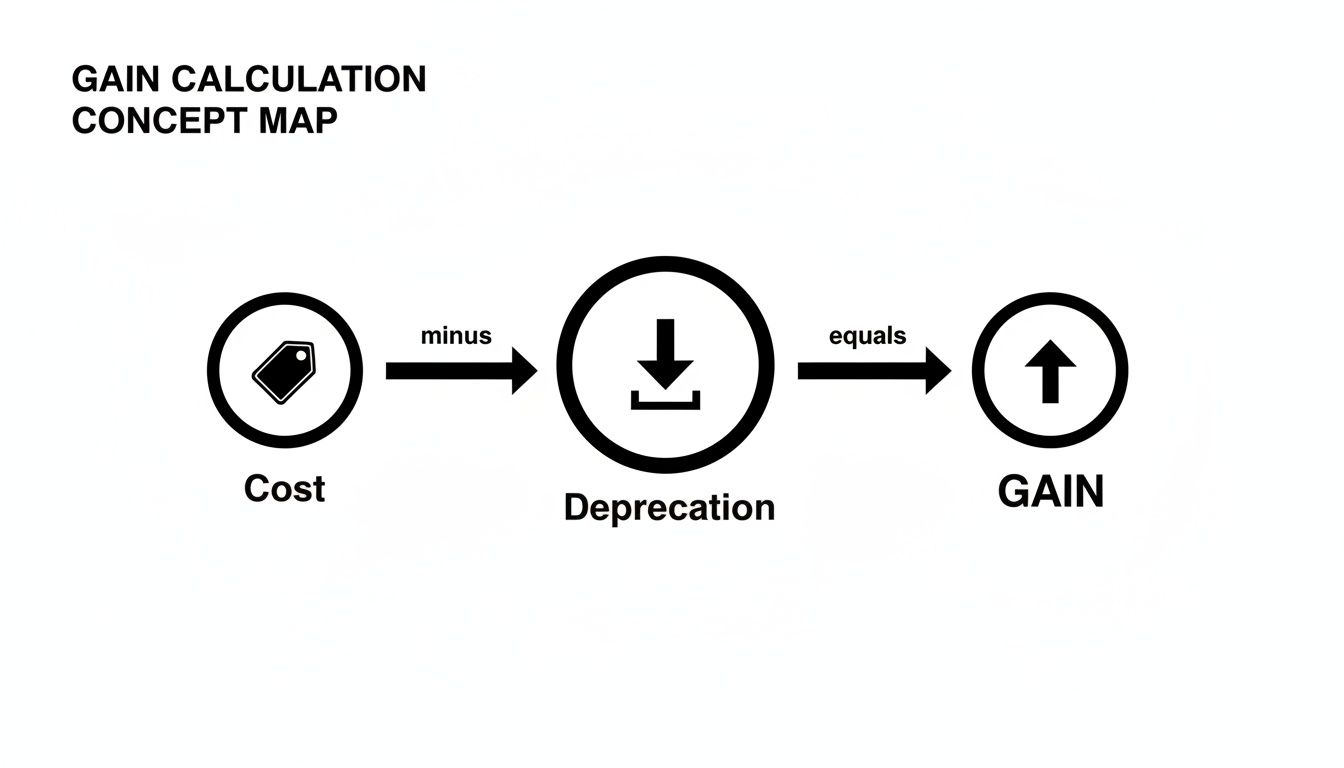
As you can see, every dollar of depreciation you take reduces your basis, which in turn increases the potential gain that will eventually be subject to recapture.
Unlocking Value with Cost Segregation Studies
One of the most effective tools in a real estate investor's kit is the cost segregation study. This isn't just an accounting exercise; it's an engineering-based analysis that dissects a building into its different components so they can be reclassified for tax purposes.
Instead of treating an entire property as a single Section 1250 asset depreciating over a sluggish 27.5 or 39 years, a cost seg study identifies components that qualify as Section 1245 personal property. These assets have much shorter tax lives—typically 5, 7, or 15 years.
What kind of items get reclassified? Think about things like:
- Carpeting and decorative light fixtures
- Specialized electrical wiring and plumbing for equipment
- Built-in cabinetry and countertops
- Land improvements like parking lots, fences, and landscaping
By shifting a chunk of the building's cost from long-term Section 1250 property to short-term Section 1245 property, investors can generate massive depreciation deductions in the first few years of ownership. This front-loading of write-offs gives an immediate cash flow boost by slashing your current tax bill.
For example, a standard $1 million commercial building (after land value) depreciates at about $20,500 per year. But after a cost segregation study shifts 30% of that value to 5-year property, the first-year deduction can easily jump to over $60,000. That’s a 200%+ increase. If you're a rental property owner, you can explore a deeper analysis of this powerful tax loophole to see the full potential.
The Trade-Off: Cost segregation provides incredible upfront benefits, but it's not a free lunch. Remember that all those reclassified Section 1245 assets will be subject to recapture at higher ordinary income rates when you sell, not the more favorable 25% rate for unrecaptured Section 1250 gain.
Leveraging Bonus Depreciation and Section 179
Accelerated depreciation methods like bonus depreciation and Section 179 expensing add another strategic layer, almost exclusively for Section 1245 assets. These tax code provisions allow businesses to immediately write off a huge percentage—or sometimes the entire cost—of qualified property in the year it’s put into service.
This creates a massive, instant deduction that can dramatically reduce or even wipe out your taxable income for the year. But there's a catch: this aggressive approach also maximizes the amount of depreciation that will be recaptured as ordinary income down the road.
This is where planning becomes crucial. A business in a high-income year might take full bonus depreciation to offset a big tax bill, fully aware it will face recapture later. In a year with lower income, it might be smarter to opt out of bonus depreciation to spread the deductions out and better manage future tax obligations.
Deferring Gains with a 1031 Like-Kind Exchange
For real estate investors, the Section 1031 like-kind exchange is the go-to strategy for managing gains on Section 1250 property. A 1031 exchange lets you sell an investment property and defer all capital gains and depreciation recapture taxes, as long as you reinvest the full proceeds into a similar replacement property.
It’s a powerful way to build wealth, allowing you to roll your equity from one investment to the next without taxes taking a bite out of it. Things get tricky, however, when Section 1245 property is involved—which is often the case if you’ve done a cost segregation study.
The rules state you can't exchange personal property (1245) for real property (1250). This means any Section 1245 assets sold as part of the deal could trigger an immediate recapture tax, even if the rest of the exchange is successful. This non-qualifying portion is known as "boot," and it requires careful calculation with a tax professional to avoid a nasty surprise.
Managing Taxes with Installment Sales
An installment sale is another great strategy for managing the tax hit from selling either Section 1245 or 1250 property. This approach allows the buyer to pay you for the property over several years.
Instead of recognizing the entire gain in the year of the sale, you report it proportionally as you receive each payment. This can help keep you in a lower tax bracket and spreads the liability out, making it far more manageable.
But the IRS has a critical rule here: all depreciation recapture—for both Section 1245 and 1250 property—must be reported as income in the year of the sale, no matter how little cash you actually receive. This can create a cash-flow crunch where you have a big tax bill in year one but haven't received enough money to pay it. Smart planning means structuring the down payment to be large enough to cover this initial tax hit.
Frequently Asked Questions
When you're dealing with depreciable property, a few common questions always seem to pop up. Let's clear up some of the usual points of confusion for investors and business owners trying to get a handle on Section 1245 and 1250 property.
What Happens If I Sell a Section 1245 Property at a Loss?
If you end up selling a Section 1245 property for less than its adjusted basis, depreciation recapture isn't a factor. The rules simply don't apply when there's no gain to recapture.
Instead, that loss is typically treated as a Section 1231 loss, which is generally an ordinary loss. This can actually be a good thing from a tax perspective—an ordinary loss can directly offset your other ordinary income (like your salary or business profits) without the $3,000 annual limit that applies to capital losses. It’s a bit of a silver lining when an asset sale doesn't go as planned.
Can Land Be Classified as Section 1245 or 1250 Property?
Nope, land never falls into either category. The reason is straightforward: you can't depreciate land. The IRS considers land to have an indefinite useful life, so it doesn't lose value in the same way a building or a piece of equipment does. Sections 1245 and 1250 only apply to assets you can depreciate.
When you buy a property, you have to split the purchase price between the land and the building. Only the building and its structural components are considered Section 1250 property and can be depreciated. Any profit you make from the land itself is just a standard capital gain.
A critical mistake is failing to separate land value from the building's value on your depreciation schedule. The IRS requires this allocation, and it directly impacts the basis and potential gain calculations for the Section 1250 portion of your property.
How Do Property Improvements Affect Classification?
This is where things get interesting, and where some real tax planning opportunities lie. Improvements are classified based on what they are and how permanent they are, which is a key part of the 1245 vs 1250 property distinction.
- Major Structural Improvements: Think big-ticket items that are part of the building itself, like a new roof, a room addition, or foundation work. These are treated as Section 1250 property and get depreciated over the long haul (27.5 or 39 years).
- Non-Structural Components: Now consider assets that are attached to the building but aren't core to its structure or function. Things like new carpeting, dedicated wiring for machinery, or removable fixtures can often be classified as Section 1245 property.
This is exactly why a cost segregation study can be so valuable. It’s a formal process to identify these Section 1245 assets hidden within a larger property, allowing you to depreciate them much faster and get bigger tax deductions sooner.
Are There Exceptions to Section 1250 Recapture Rules?
Yes, and the biggest one is your holding period. If you own a Section 1250 property for one year or less before you sell it, the tax treatment gets a lot tougher.
In that short-term scenario, any gain up to the total depreciation you've claimed is recaptured as ordinary income—just like it would be for Section 1245 property. The special 25% "unrecaptured Section 1250 gain" rate goes out the window. This rule exists to discourage investors from quickly flipping properties to get the double benefit of depreciation deductions and low capital gains rates.
Getting the details right on Section 1245 and 1250 property is fundamental to keeping your tax bill as low as possible. For expert guidance on rental property taxation, cost segregation, and smart planning, trust the team at Allied Tax Advisors. We help investors like you make sense of the complex rules to hit your financial targets. Learn more about our comprehensive tax solutions.