
Absolutely. Owning a second home comes with some fantastic tax perks, but many people don't realize just how much they can save. The two biggest benefits are the deductions for mortgage interest and property taxes, which can easily add up to thousands of dollars back in your pocket each year.
Tapping Into Your Second Home's Tax Advantages
You've worked hard to buy a second home, and it’s a wonderful escape. But when tax season rolls around, the rules can feel like a maze. The good news is, once you understand the framework, you can turn that vacation spot from a pure expense into a much smarter financial asset.
Let’s walk through exactly how to make the most of these tax benefits. We'll start with the basics everyone should know and then touch on how your use of the property can open up even more advanced strategies.
The Ground Rules for Second Home Deductions
Before we get into the nitty-gritty of the numbers, it’s crucial to get a handle on the main concepts. Think of these as the building blocks for all your potential tax savings.
At its core, it all comes down to two key deductions and one critical distinction:
- Mortgage Interest: You can deduct the interest you pay on the loan for your second home. There are, however, important limits on the total amount of mortgage debt that qualifies.
- Property Taxes: The property taxes you pay are also deductible. But this deduction gets lumped in with your other state and local taxes, and the total is capped.
- Personal vs. Rental Use: This is the big one. The way you use your home—whether it’s purely for your own enjoyment or you rent it out—completely changes the tax playbook.
A second home is more than just a place to relax; it's a major financial investment. Getting a firm grip on the tax code is the first step to making sure you're not leaving money on the table.
To help you see the big picture, here’s a quick summary of the main deductions available.
Key 2nd Home Tax Deductions at a Glance (2026)
This table breaks down the most common deductions, their limits for the 2026 tax year, and what's required to claim them.
| Deductible Expense | 2026 Limit / Rule | Primary Requirement |
|---|---|---|
| Mortgage Interest | Interest on up to $750,000 of total mortgage debt | Must itemize deductions on Schedule A |
| Property Taxes | Capped at $40,000 (for MFJ) for all State & Local Taxes (SALT) combined | Must itemize deductions on Schedule A |
| Mortgage "Points" | Fully deductible in the year paid (for purchases) | Points must be for the home purchase, not a refinance |
Keep in mind, these rules apply primarily when the property is treated as a personal-use second home. If it's a rental, the rules and forms change.
Putting the Limits into Perspective
Let’s look at a real-world example. Imagine a married couple who owns their primary residence and a vacation home. They can deduct the mortgage interest and property taxes on that second home, but this is where the caps come into play.
First, the mortgage interest deduction only applies to a combined total of $750,000 in mortgage debt across both their primary and second homes (for loans taken out after December 15, 2017).
On top of that, their total deduction for all state and local taxes—often called the SALT deduction—is capped. For the 2026 tax year, this cap will be $40,000 for married couples filing jointly. This limit includes property taxes on both homes, plus state income or sales taxes. To claim any of these benefits, you have to itemize your deductions, which is a step many people miss. You can explore more insights on maximizing these benefits at Pacaso.com.
How the IRS Defines Your Second Home
So, you've got a second home. The dream, right? But before you start thinking about the tax benefits, it’s crucial to understand what the IRS considers a "second home." It’s not just about owning another property; it's about meeting a specific set of rules. Getting this wrong can be a costly mistake.
First, the basics. For the IRS to even consider it a home, the property needs to have essential living facilities. Think of it as a three-part test: it must have a place to sleep, a toilet, and a place to cook. A rustic cabin with a bedroom, bathroom, and a small kitchenette works. An empty lot you plan to build on someday? That won't cut it.
The Critical Day-Counting Rules
Here's where it gets tricky for many owners. The way you use your property is the single most important factor in how it's treated for tax purposes. The IRS has a very clear, and very strict, set of "day-counting" tests to determine if your property is a personal residence or a rental property.
Think of it as a scale. On one side, you have your personal enjoyment of the home. On the other, you have rental days. How that scale tips determines whether your expenses land on Schedule A (as an itemized personal deduction) or Schedule E (to offset rental income). This distinction is everything.
To be treated as a personal second home, your property must pass a specific usage test. You have to use it personally for the greater of:
- More than 14 days a year, OR
- More than 10% of the total days it was rented out to others at a fair price.
Let's break that down. If you rent out your lake house for 100 days, the 10% rule means you'd need to use it yourself for at least 11 days. But because 14 is greater than 11, you must meet the 14-day minimum. If you rented it for 200 days, you’d have to use it for more than 20 days (10% of 200) for it to keep its personal-residence status.
What Counts as Personal Use?
Figuring out what the IRS considers a "personal use" day is just as vital as counting rental days. It’s not just about your own vacations. The IRS casts a wide net.
A day counts as personal use if the property is occupied by:
- You, or any other person who has an ownership stake in the home.
- A member of your family. This includes your spouse, siblings, parents, grandparents, kids, and grandkids—even if they pay you rent.
- Anyone you have a "house swap" arrangement with.
- Anyone paying less than fair market rent.
Imagine you let your cousin stay at your beach condo for a week, and you don't charge him. Even though you weren't there, the IRS counts those seven days as personal use days. This can actually help you meet the threshold to classify it as a personal home.
This decision tree gives you a great visual of how to walk through the process.
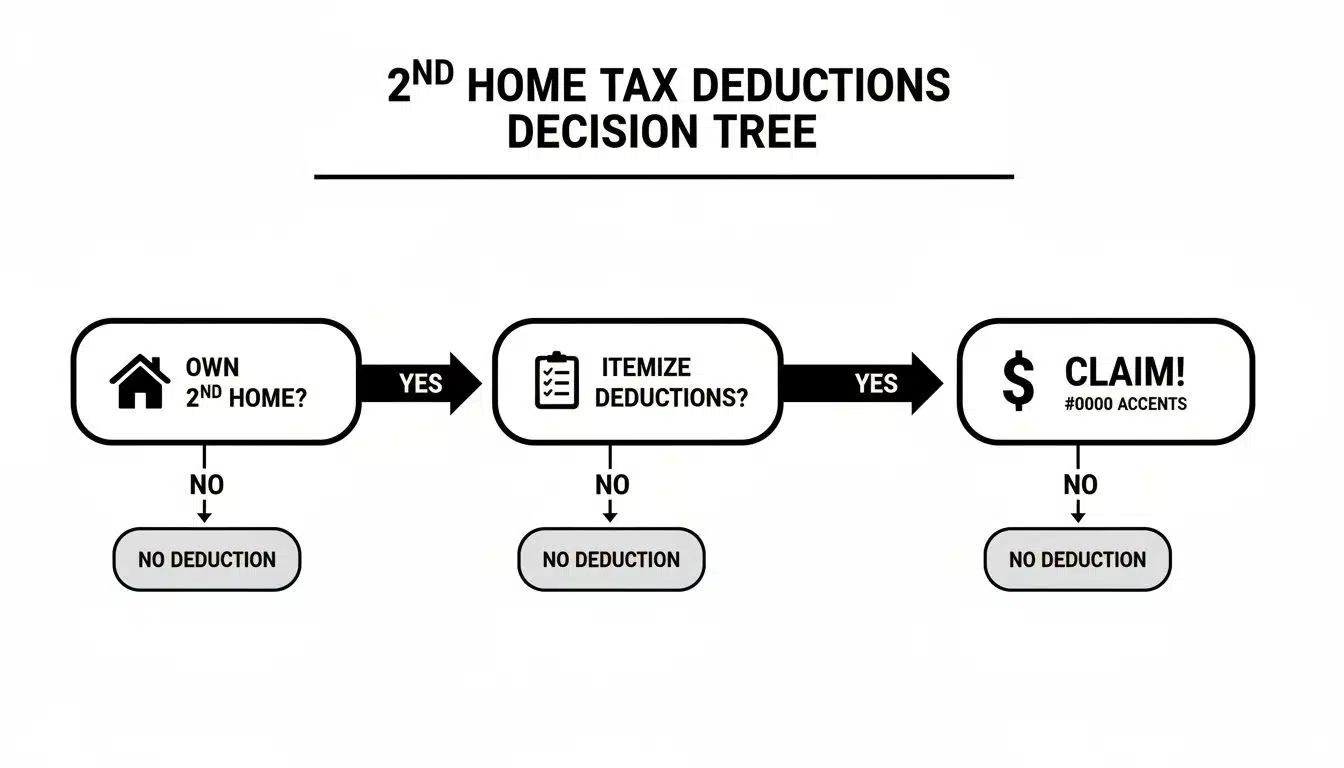
As you can see, the path always starts with one simple question: did you use the home personally and rent it out? From there, the number of days becomes the deciding factor.
Let's look at a real-world scenario. You own a mountain cabin and rent it out for just 13 days all year. Because you rented it for fewer than 15 days, the IRS has a special rule: you don't have to report that rental income. The flip side? You can't deduct any rental expenses, either. Your cabin is simply treated as a personal second home, allowing you to deduct mortgage interest and property taxes on Schedule A (subject to other limits).
But if you rent it for 15 days? Everything changes. By crossing that 14-day threshold, you now must report every dollar of rental income. This tiny two-day difference completely flips the tax treatment of your property and underscores why keeping meticulous records isn't just a good idea—it's essential.
Mastering the Core Tax Deductions

Alright, so you've confirmed your property is officially a 'second home' in the eyes of the IRS. Now for the fun part: the tax deductions. When your property is for personal use, you gain access to some significant tax write-offs that can make a real difference to your bottom line.
The two heavy hitters here are mortgage interest and property taxes. To claim them, you’ll file them on Schedule A of your tax return. This just means you have to itemize your deductions instead of taking the standard deduction, but for most second homeowners, the value of these write-offs makes itemizing a no-brainer.
The Mortgage Interest Deduction Limit
One of the best-known tax benefits of homeownership is deducting your mortgage interest, and this extends to your second home. But there’s a catch. The IRS puts a ceiling on how much total mortgage debt qualifies for the deduction.
For any home bought after December 15, 2017, you can only deduct the interest on a total of $750,000 of mortgage debt. Crucially, this isn't a per-property limit—it’s a combined total across both your primary residence and your second home.
Let’s say your main home has a $500,000 mortgage and your vacation cabin has a $400,000 mortgage. That puts your total debt at $900,000. Because you're over the $750,000 limit, you won't be able to deduct 100% of the interest you paid.
In that scenario, you'd calculate the deductible portion of your interest by dividing the limit by your total debt ($750,000 ÷ $900,000), which comes out to 83.3%. If you paid $30,000 in total mortgage interest across both homes for the year, your actual deduction would be capped at $24,990. For more detail on this, check out our complete guide on how to maximize your mortgage interest deduction.
This $750,000 limit (or $375,000 if you're married filing separately) was put in place by the 2017 Tax Cuts and Jobs Act. It’s a powerful deduction, but you have to be mindful of that total debt number.
The State and Local Tax (SALT) Cap
The other major deduction is for the property taxes you pay. This is another fantastic benefit, but it also comes with a significant limitation you need to know about: the State and Local Tax (SALT) cap.
This rule puts a firm ceiling on the total amount you can deduct for all your state and local taxes combined. For the 2026 tax year, the SALT cap is $40,000 for married couples filing jointly. This single bucket includes:
- Property taxes on your primary residence
- Property taxes on your second home
- Your state and local income taxes or state and local sales taxes (you have to pick one)
This cap can really sting if you live in a state with high income and property taxes. It's easy to hit that $40,000 limit with just your primary home's taxes and your state income tax, which can unfortunately wipe out the federal tax benefit from your second home's property taxes.
Don't Forget About Mortgage Points
Here’s a valuable write-off that people often overlook: mortgage points. Points are essentially prepaid interest, with each point typically costing 1% of your total loan amount.
If you paid points when you first bought your second home, the IRS generally lets you deduct the full amount in the year you paid them. This can give you a nice, one-time bump in your deductions. Just be aware that if you pay points for a refinance, the rules change—you have to spread that deduction out evenly over the life of the new loan.
Getting a handle on these core deductions is the first step, but there's a lot more to explore when it comes to real estate investment tax write-offs that can further reduce your tax liability.
When Your Second Home is a Rental Property
So, what happens when your quiet vacation spot starts seeing more renters than family members? There’s a magic number here, and it’s 14 days. The moment you rent out your second home for more than 14 days in a year, the IRS stops seeing it as just a personal getaway. It becomes a rental property—essentially, a small business.
This is a huge shift. Your tax strategy flips from personal itemized deductions on Schedule A to the world of rental real estate on Schedule E, "Supplemental Income and Loss." This is where you'll report your rental income, but more importantly, it unlocks a whole new category of business-related expenses you can write off.
The Business of Renting Your Home
Once your property is officially a rental in the eyes of the IRS, you can start deducting all the "ordinary and necessary" costs to keep it running. Think of it like any other business: the money you spend to operate and maintain it can lower your taxable income.
This opens the door to deducting a wide variety of operating expenses, such as:
- Utilities: The electricity, gas, water, and internet bills that service the property for your tenants.
- Insurance: Premiums for your landlord or homeowner's policy.
- Maintenance: Costs for landscaping, pest control, pool service, and general upkeep.
- Repairs: Anything from fixing a leaky pipe to patching a hole in the wall.
- Management Fees: If you hire a company to manage bookings and maintenance, their fees are deductible.
These expenses are gold because they directly reduce the amount of rental income you have to pay taxes on. But, there’s a catch. You can't just write everything off.
Allocating Expenses Between Personal and Rental Use
The IRS is smart. They won't let you deduct the electricity bill for the week you and your family spent at the lake house. You have to split your expenses between your personal use and the time the property was rented.
The formula is pretty simple: you take the number of days the home was rented at a fair market price and divide it by the total number of days it was used (both rental and personal).
Example: Let's say you rented your beach house for 90 days and used it yourself for 30 days. That’s a total of 120 days of use. Your rental-use percentage is 75% (90 rental days ÷ 120 total use days). If your utility bills for the year were $2,000, you could deduct $1,500 (75% of $2,000) as a rental expense on your Schedule E.
The other 25% of some costs, like your mortgage interest and property taxes, might still be deductible on your Schedule A as an itemized personal deduction, subject to the usual limits. This is why keeping a meticulous log of personal vs. rental days is absolutely essential. While tax codes differ globally, this principle of careful documentation is key for property investors everywhere. For example, the rules around Australian rental income tax also hinge on accurate expense tracking.
The Power of Depreciation
Here’s where things get really interesting. The biggest, and often most overlooked, deduction for rental properties is depreciation. This is a fantastic non-cash deduction where the IRS lets you write off the cost of your property over time to account for wear and tear.
For residential rental properties, the IRS has determined a "useful life" of 27.5 years. You get to deduct the value of the building (the land itself doesn't depreciate) spread out evenly over that period.
Let's say you bought a property for $550,000, and the structure itself is valued at $440,000. Your annual depreciation deduction would be around $16,000 ($440,000 ÷ 27.5). That’s a $16,000 write-off you can claim every year, even if you didn't spend a single extra dollar out of pocket.
Understanding Passive Activity Loss Rules
Now, what if your deductions—especially after a hefty depreciation write-off—are more than your rental income? It's very common to show a loss on paper. But here’s the rub: rental real estate is generally considered a "passive activity" by the IRS.
The Passive Activity Loss (PAL) rules mean you usually can't use those rental losses to offset income from your day job. Instead, those losses get "suspended" and can only be used to offset income from other passive activities. For a deeper dive into how rental income and losses work, you can explore our comprehensive guide on the taxes on rental income.
What Happens When It’s Time to Sell? Navigating Capital Gains
It's easy to get caught up in the year-to-year deductions, but the biggest financial event for any second homeowner is the sale. When you eventually sell your property, any profit you've made is considered a capital gain, and that's where the IRS can take a serious slice of your earnings if you haven't planned ahead.
This is probably the single biggest tax difference between your main home and your vacation spot. The tax code gives primary homeowners an incredible break. If you've owned and lived in your main home for at least two of the five years leading up to the sale, you can shield a huge chunk of your profit from taxes.
A Tale of Two Tax Treatments
The primary home exclusion is a game-changer. Married couples filing a joint return can exclude up to $500,000 in profit from their taxable income. For single filers, it's a $250,000 exclusion. This isn't just a small deduction; it can literally save you tens of thousands of dollars.
Unfortunately, a property that has always been just a second home doesn't get this special treatment. Any profit you realize from the sale is typically subject to capital gains tax.
Think of it this way: The IRS rewards you for the home you live in day-to-day. But in their view, a second home is an investment or a luxury item. When you sell an investment for a profit, that profit is taxable.
Calculating Your Gain
Figuring out your capital gain sounds simple, but the details matter. The basic formula is straightforward:
Selling Price – Adjusted Basis = Capital Gain
Your Adjusted Basis is more than just the price you paid for the house. It starts with the original purchase price, then you add the cost of any significant capital improvements (like a new roof or a kitchen remodel) and subtract any depreciation you might have claimed over the years. Keeping meticulous records of improvements is key, as every dollar you add to your basis is a dollar less the IRS can tax. You can find more detail in our article that covers the basics of the capital gains tax on a house sale.
The Smart Play: Converting Your Second Home
So, is there a way to get that coveted tax exclusion on your second home? Absolutely. The most powerful strategy is to make it your primary residence. By moving in and making it your main home, you can start the two-year countdown needed to qualify.
Here’s the rule: You must own the property for at least five years and live in it as your main home for at least two of those years. The two years of use don’t even have to be back-to-back. If you meet this test, you can claim the exclusion when you sell, although the amount might be prorated if the property spent a long time as a second home or rental.
Let's say a couple buys a vacation home for $600,000 and later invests $50,000 in a new deck and windows, bringing their basis to $650,000. Years later, they sell it for $850,000, realizing a $200,000 gain. If it was always a second home, that entire $200,000 is taxable. But if they moved in, made it their primary home for two years, and then sold, they could potentially exclude the entire $200,000 from taxes. Fidelity offers some great additional insights on these second home tax rules.
The Hidden Sting of Depreciation Recapture
If you ever rented out your second home and took depreciation deductions to lower your rental income taxes, watch out. The IRS has a long memory. When you sell, they want that tax benefit back through a process called depreciation recapture.
All the depreciation you claimed over the years is tallied up and taxed at a special rate—up to a maximum of 25%. This is a separate tax from your capital gain, and here's the kicker: you owe it even if you sell the property at a loss. For anyone who has mixed personal and rental use, planning for this tax bill is absolutely crucial to avoid a nasty surprise.
Your Action Plan for Tax Savings

Alright, now that you have a handle on the rules for second home tax deductions, it's time for the most important part: putting that knowledge into practice. After all, understanding the tax code is one thing, but actually saving money is what matters. This is where we shift from theory to a concrete, year-round strategy designed to boost your savings and cut down on tax-season headaches.
If there’s one habit I can’t stress enough for every second homeowner, it’s meticulous record-keeping. This is so much more than tossing receipts into a folder. It’s about building a clear financial narrative for your property that justifies every single deduction you claim. An organized system is your absolute best defense in an audit, and frankly, it’s the only way to ensure you’re not leaving money on the table.
Your Essential Documentation Checklist
Get ahead of the game by saving these documents as they come in. Set up a dedicated digital folder or a simple binder for your second home. Trust me, you'll thank yourself later when you're not scrambling to find everything in April.
- Closing Documents: That settlement statement (often called a HUD-1) from your purchase is gold. It establishes your initial cost basis and is where you'll find any deductible mortgage points you paid.
- Proof of Payments: Hang on to every mortgage interest statement (Form 1098) and cancelled check or bank statement showing your property tax payments.
- Improvement Receipts: Every invoice for capital improvements needs to be saved. Think big projects like a kitchen remodel, a new HVAC system, or adding a deck.
- Repair Invoices: In a separate file, keep receipts for day-to-day repairs. This is for things like fixing a leaky pipe or replacing a cracked window pane.
- Usage Log: This is critical. Keep a simple calendar that tracks how the home was used each day of the year: was it for personal use, rented to a tenant, or empty while undergoing repairs?
Think of your record-keeping like building a case for a court. Each document is a piece of evidence. The more organized and complete your evidence, the stronger your position is and the more confident you can be in the deductions you claim.
Avoiding Common and Costly Mistakes
In our experience, homeowners lose out on thousands of dollars in legitimate deductions simply due to a few common, and entirely avoidable, slip-ups. Knowing what to watch for is half the battle.
One of the most frequent errors we see is misclassifying repairs as improvements, or vice-versa. A repair (like repainting a room) keeps the property in good working order. An improvement (like adding a new bathroom) substantially adds value or extends its life. This distinction is vital—improvements are added to your property's basis, which lowers your capital gains tax when you eventually sell. Many repair costs, on the other hand, are only deductible if the property is a rental.
Another classic mistake is guessing when allocating expenses between personal and rental use. Don't just estimate. Use that detailed usage log you're keeping to calculate the exact percentage of rental use and apply that to shared expenses like utilities, insurance, and HOA fees.
The truth is, once you start mixing personal use with rental income, or if you're thinking about selling, the tax picture gets complicated fast. The rules around depreciation, passive activity losses, and capital gains are genuinely nuanced. That's the point where having a professional in your corner becomes invaluable. At Allied Tax Advisors, we live and breathe this stuff. We can help you build a proactive plan to make sure you capture every last dollar you're entitled to.
A Few Common Questions We Hear
Owning a second home often brings up some very specific, real-world questions. Let's walk through a few of the scenarios we see all the time with our clients.
Can I Deduct Interest on a HELOC for My Second Home?
Yes, you can, but this is a big "gotcha" for many homeowners. The rules are strict: you can only deduct the interest on a Home Equity Line of Credit (HELOC) if you use the funds to buy, build, or substantially improve the property the loan is tied to.
Think of it this way: if you take out a HELOC on your lake house to add a new deck or finally remodel that dated kitchen, the interest is generally deductible. But if you use that same line of credit to pay off credit cards, buy a boat, or cover college tuition, that interest is not deductible. It's all about what you do with the money.
And remember, this interest still gets bundled into the overall $750,000 mortgage debt limit that applies across both your primary and second homes.
What if My Second Home Is in a Foreign Country?
Good news for global property owners: the same fundamental tax rules usually apply. You can often deduct the mortgage interest and any property taxes you pay to a foreign government on your U.S. tax return.
Of course, these deductions are still subject to the same caps we've discussed, like the $750,000 mortgage debt limit and the SALT cap. The real trick here is the administrative headache. You have to meticulously convert all your expenses from the foreign currency to U.S. dollars using an accepted exchange rate and keep flawless records.
A Word of Advice: Dealing with foreign currency conversions and navigating international tax treaties adds a significant layer of complexity. We strongly recommend working with a tax professional who has specific experience with expatriate and foreign property issues. It's the only way to be sure you're compliant.
How Do I Prove Personal Use Versus Rental Use?
If you ever find yourself facing questions from the IRS, your single best defense is a contemporaneous log or calendar. If you mix personal and rental days, this isn't optional—it's essential.
For every day of the year, your log needs to clearly state the property's status. It doesn’t have to be fancy, but it does have to be detailed.
- Personal Use Days: Make a note of who was there—you, your family, or even a friend staying for free.
- Rental Days: Mark every day the home was rented at a fair market price. You'll also want to keep copies of rental agreements and bank statements showing you received the income.
- Maintenance Days: Note any days you spent on-site making repairs or improvements. Keep receipts for supplies and invoices from contractors to back this up.
This simple log becomes the foundation for how you allocate your expenses. Without it, defending your deductions becomes incredibly difficult.
Do I Have to Itemize to Claim These Deductions?
Yes, 100%. The deductions for second-home mortgage interest and property taxes are itemized deductions, which means they are claimed on Schedule A of your tax return.
To get any benefit, you have to itemize your deductions. This only makes sense if your total itemized deductions (mortgage interest, SALT, charitable giving, etc.) add up to more than the standard deduction available for your filing status. If your itemized total is lower, you'll simply take the standard deduction, and you won't get a specific tax break for those second-home costs that year.
As you can see, the rules around second homes, capital gains, and rental properties are full of nuances. At Allied Tax Advisors, our specialty is helping clients build smart, personalized tax strategies so they never leave money on the table. If you're ready to get clarity and optimize your financial picture, get in touch with our team today.