
So, can you write off that new car purchase on your taxes? The short answer is: it depends entirely on how you use it.
If your car is for personal trips only—think grocery runs, family vacations, or commuting to your W-2 job—then the purchase price is almost never tax-deductible. But if you're a business owner or self-employed and use the car for work, the answer changes to a definite yes. You can absolutely recover its cost through several different tax strategies.
Your Quick Answer on Car Purchase Tax Deductions

The first thing to get straight about vehicle deductions is that they all hinge on one core IRS principle: you can write off ordinary and necessary expenses for your business. A vehicle is often a critical tool, but you can't just subtract the full sticker price from your income the year you buy it. It's a bit more structured than that.
Instead, the tax code gives you specific methods to claim these costs over time. The value of your deduction is directly linked to your business-use percentage—that is, what portion of your total mileage is for work versus personal errands.
Key Factors Influencing Your Deduction
A few key things will decide if you can claim a deduction and, if so, how much. Here’s what matters most:
- Primary Use: The car must be used for genuine business activities. This means driving to meet clients, visiting job sites, or making deliveries—not just commuting from home to an office.
- Ownership vs. Leasing: The rules are a little different if you buy the vehicle versus leasing it.
- Vehicle Type and Weight: This is a big one. Heavier vehicles, like many trucks and large SUVs, often qualify for much bigger upfront deductions.
The core idea is that you're recovering the cost of a business asset over its useful life. Think of it less as a one-time discount and more as a systematic way to reduce your taxable income over several years.
Vehicle Purchase Deductibility at a Glance
For a quick reference, this table breaks down the basics of who can deduct a vehicle purchase.
| User Type | Is the Purchase Price Deductible? | Key Requirements |
|---|---|---|
| Business Owner/Self-Employed | Yes | Vehicle must be used for business; deduction is based on business-use percentage. |
| W-2 Employee | No (post-TCJA) | Unreimbursed employee expenses, including vehicle costs, are no longer deductible. |
| Personal Use Only | No | The purchase price and related costs are considered personal expenses. |
As you can see, the ability to deduct a car's cost is a benefit reserved for business use.
The Role of Tax Credits and Deductions
It’s also crucial to know the difference between a deduction and a credit. A deduction lowers your taxable income, which in turn reduces your tax bill. A tax credit, on the other hand, is a dollar-for-dollar reduction of your actual tax liability.
For anyone eyeing an EV, it's worth checking out available Electric Vehicle Tax Credits which can offer huge savings right off the bat, often in addition to the business-use deductions we're about to cover.
This guide will walk you through all the different methods—from the simple standard mileage rate to powerful depreciation strategies—that help you turn your business vehicle into a valuable financial asset.
The Critical Line Between Business and Personal Use
Think of your car as having two separate lives. In one life, it's a workhorse—driving you to meet clients, visit suppliers, or travel between job sites. In its other life, it's your personal vehicle, used for grocery runs, family trips, and the daily commute from home to your main office.
This distinction is the absolute bedrock of vehicle tax deductions. Before you can claim a single dollar for depreciation, gas, or repairs, you have to prove how much of your car's time was spent on the clock for your business.
Defining What Counts as Business Use
The IRS has a very clear line in the sand for what constitutes business travel. The most common mistake people make is trying to deduct their daily drive from home to their primary workplace. This is considered commuting, and it's never deductible. It’s a hard-and-fast rule that trips up countless taxpayers.
For a deeper dive, our guide on business miles vs. commuting miles breaks down this crucial difference in detail.
So, what actually qualifies as a business-related trip?
- Traveling between two different work locations: Think driving from your main office to a satellite branch or from one rental property to another.
- Meeting with clients or customers: Any travel to a client's office for a pitch or a customer's home for a service call counts.
- Running business-related errands: This includes dedicated trips to the bank, post office, or a supplier to pick up materials essential for your business.
- Visiting a job site: For contractors, real estate agents, and many others, driving to a construction site you manage or a property you're inspecting is pure business use.
In the United States, a car purchase can be tax-deductible under these specific conditions. The IRS allows you to write off the business portion of your vehicle's costs, which is determined by this business-use percentage. You'll calculate this using either the actual expense method or the standard mileage rate. If you're curious, you can see how this compares to global automotive tax structures in other countries.
The Importance of Meticulous Record-Keeping
Since every deduction hinges on that business-use percentage, you absolutely must track your mileage. You can't just guess or estimate at the end of the year and hope for the best. The IRS won't accept it.
Key Takeaway: An accurate, contemporaneous mileage log is your best defense in an audit. Without it, the IRS can throw out your entire vehicle deduction, even if your business use was perfectly legitimate.
Your log needs to be detailed. For every business trip, you should record:
- The date of the trip.
- Your starting and ending odometer readings.
- The total miles driven.
- The specific business purpose (e.g., "Lunch meeting with Jane Doe at XYZ Corp").
Thankfully, you don't have to do this with a paper notebook anymore. Dozens of modern apps use your phone's GPS to track trips automatically, making it incredibly simple to keep compliant records. Mastering this habit is the single most important step you can take to make your vehicle deductions audit-proof.
Choosing Your Path: Standard Mileage vs. Actual Expenses
When it comes to writing off your business vehicle, the IRS gives you two main roads to choose from. Think of it like this: you can either take the simple, flat-rate toll road or you can meticulously track every penny you spend on the scenic route. Neither is inherently better, but one is likely a much better fit for your specific business and vehicle.
The first option is the Standard Mileage Rate. This is the straightforward, no-fuss approach. Each year, the IRS sets a rate per business mile—for 2024, it's 67 cents per mile. That single number is meant to cover almost everything: gas, oil changes, insurance, registration, and even the wear and tear (depreciation) on your car.
This path is a lifesaver for people who hate paperwork. You just need a solid log of your business miles. Multiply that by the yearly rate, and voilà, you have your deduction. No need to hoard a shoebox full of gas receipts and repair invoices.
The Itemized Approach: Actual Expenses
The other road is the Actual Expense Method. This is the detailed, "à la carte" option. Instead of a simple per-mile rate, you add up every single eligible expense you incurred to keep your car running for business. It’s more work, absolutely, but it can often lead to a significantly larger deduction, especially if you have a newer, pricier vehicle or high operating costs.
So, what counts as an "actual expense"? The list is pretty comprehensive:
- Gas and oil
- Repairs and routine maintenance
- New tires
- Car insurance premiums
- Registration fees and property taxes
- Garage rent and business-related parking fees
- Depreciation (a big one we'll cover more later)
You add all this up and then multiply the total by the percentage of time you used the car for business. For example, if you spent $10,000 on your car for the year and used it 70% for business, your deduction would be $7,000.
It all starts with separating your driving into two buckets: business and personal.
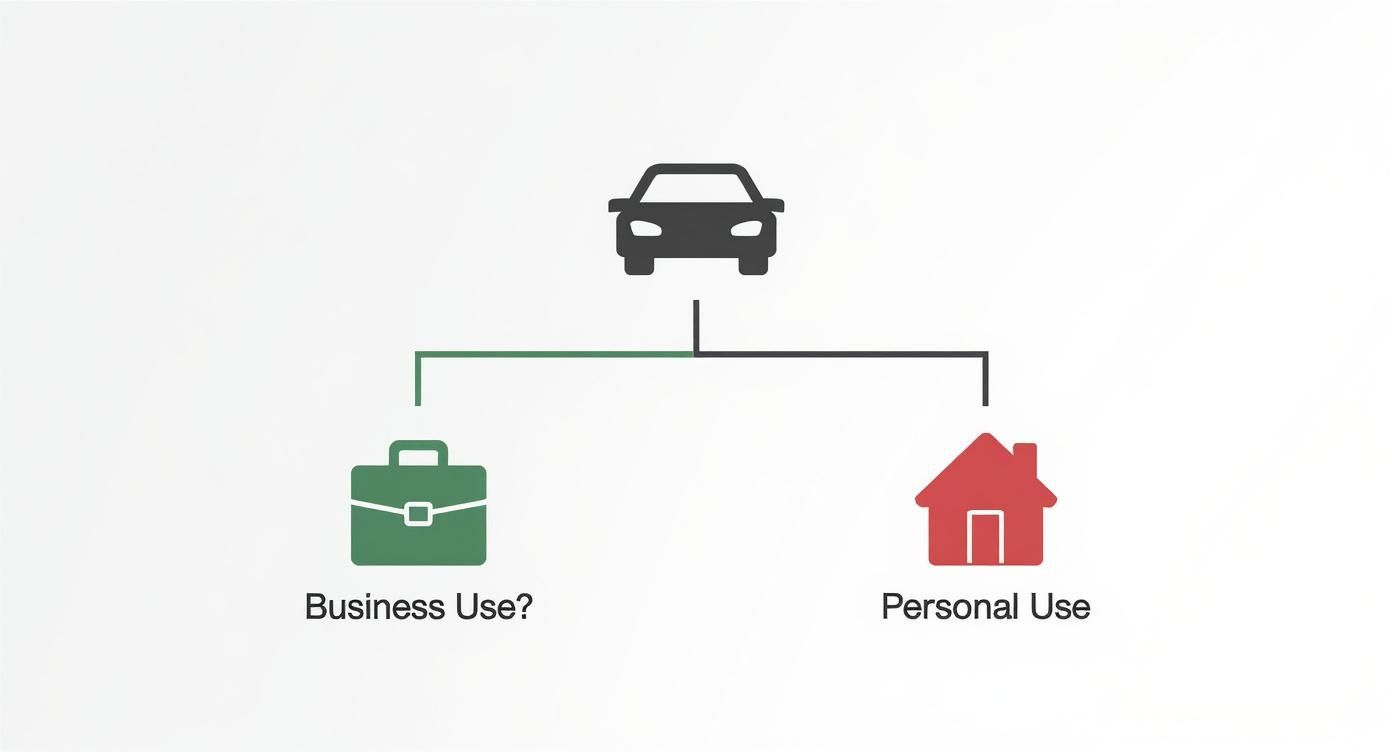
This split is the foundation of your entire deduction, no matter which method you choose.
Standard Mileage Rate vs. Actual Expense Method
To help you see the differences side-by-side, here’s a quick comparison of the two methods. This table breaks down the key features of each approach so you can start to see which one might align better with your situation.
| Feature | Standard Mileage Rate | Actual Expense Method |
|---|---|---|
| Simplicity | High. Just track business miles. | Low. Requires tracking and documenting all vehicle-related expenses. |
| Record-Keeping | Requires a detailed mileage log (date, destination, purpose, miles). | Requires receipts and records for every expense (fuel, repairs, insurance, etc.). |
| Best For | High-mileage drivers, older or more fuel-efficient cars, and those who prefer simplicity. | Newer or more expensive cars, vehicles with high operating costs (e.g., gas guzzlers). |
| Depreciation | Included in the per-mile rate. You can't take a separate depreciation deduction. | You can deduct depreciation separately, often resulting in a larger write-off. |
| Flexibility to Switch | You can switch to the Actual Expense method in a later year. | If you choose this method first, you're generally stuck with it for that vehicle's life. |
Ultimately, choosing the right method is a strategic decision. The Actual Expense method often provides a larger deduction in the early years of a car's life due to depreciation, while the Standard Mileage rate might be more beneficial as the car gets older and repair costs level out.
Making the Right Choice for Your Bottom Line
So, which path is yours? If you have a newer, more expensive vehicle, the depreciation you can claim under the Actual Expense method might make it the clear winner. The same goes if your car isn't very fuel-efficient or has high insurance costs.
On the other hand, if you drive a ton of miles for work in an older, paid-off car that sips gas, the Standard Mileage Rate could easily give you a bigger write-off with a fraction of the record-keeping headache.
Expert Tip: There's a crucial rule you need to know. If you pick the Actual Expense Method in the first year you use a car for business, you can't switch back to the Standard Mileage Rate for that same car. Ever. But if you start with the Standard Mileage Rate, you have the flexibility to switch over to Actual Expenses in a future year if your situation changes.
The only way to know for sure is to run the numbers both ways for the first year. It takes a little extra time upfront, but that one-time calculation could easily put thousands of dollars back in your pocket over the life of your car.
Unlocking Upfront Savings with Section 179 and Bonus Depreciation

While the Actual Expense method lets you write off a vehicle's cost over several years, two powerful tax codes can supercharge your deduction in the very first year. These are Section 179 and Bonus Depreciation, and they're designed to give your business an immediate cash-flow boost by letting you take your deductions now instead of later.
Think of standard depreciation as slowly sipping a drink over an evening. Section 179, on the other hand, is like taking a huge gulp right at the start. It gives you the option to "expense"—or immediately deduct—a massive chunk, or even the entire price, of qualifying business equipment in the year you start using it.
This is a complete game-changer for many business owners. Instead of tiny yearly write-offs, you can potentially wipe out a huge portion of your taxable income right away.
What Is the Section 179 Deduction?
At its core, Section 179 isn't an extra write-off; it's a way to accelerate the depreciation you would have taken over many years and cram it all into year one.
For 2024, businesses can expense up to $1,220,000 on new or used equipment, provided their total investment stays under $3,050,000. While those figures are massive, the limits for most typical passenger vehicles are much, much lower.
The real magic of Section 179 happens when you get into heavier vehicles.
- Light Vehicles: Your standard cars, small SUVs, and light trucks (under 6,000 pounds gross vehicle weight rating, or GVWR) are subject to strict annual deduction limits.
- Heavy Vehicles: This is where it gets good. Trucks, vans, and large SUVs with a GVWR over 6,000 pounds can qualify for a much bigger Section 179 deduction—sometimes the entire purchase price, as long as business use is over 50%.
Knowing which vehicles qualify is absolutely critical to getting the most out of this benefit. Our guide on Section 179 vehicles that qualify breaks down the GVWR rules and lists exactly what to look for.
The biggest advantage of Section 179 is immediate financial relief. By deducting the full cost of a heavy work truck upfront, you slash this year's tax bill and free up cash you can put right back into growing your business.
Adding a Supercharger with Bonus Depreciation
Bonus Depreciation is another accelerated deduction that often pairs perfectly with Section 179. Think of it as an automatic power-up that kicks in after you've taken your Section 179 deduction, letting you write off a percentage of the remaining cost. It applies to both new and used assets, which is a big plus.
For 2024, the Bonus Depreciation rate is 60% of the asset's cost. This rate is scheduled to drop in the coming years, so it pays to act sooner rather than later. A key difference from Section 179 is that there’s no income limit; even businesses operating at a loss can claim it.
Here’s a quick look at how they might work together:
- Buy a qualifying heavy vehicle: Let's imagine you buy a $70,000 truck used 100% for business.
- Apply Section 179: You could potentially elect to deduct a large portion, say $25,000, right off the bat.
- Apply Bonus Depreciation: Of the remaining $45,000, you can take a 60% bonus depreciation deduction.
- Regular Depreciation: Any leftover amount can then be depreciated using the normal multi-year schedule.
Using these tools strategically can turn a vehicle purchase into a major tax win, dramatically improving your company's financial footing in the year you buy.
Deducting Sales Tax and How the US System Compares Globally
So you've bought a new car. What about that hefty sales tax you paid on top of the sticker price? How the IRS treats that expense really boils down to one simple question: is the car for business or personal use?
If you're a business owner, you can't just write off the sales tax as a separate, immediate deduction. Instead, it gets rolled into the vehicle's cost basis. Think of the cost basis as the total starting value you'll use for calculating depreciation.
Let's say you buy a new work truck for $50,000 and pay $3,000 in sales tax. Your new depreciable basis isn't $50,000; it's $53,000. This means you'll recoup the cost of that sales tax, just spread out over several years as part of your depreciation deductions.
For personal use, the rules are different. If you're an individual who itemizes deductions on your tax return, you get a choice: you can deduct either your state and local income taxes or your state and local sales taxes. A major purchase like a car can make the sales tax option a real winner, but you have to pick one—you can't deduct both.
How US Vehicle Taxes Stack Up
It's easy to get bogged down in the complexity of American tax laws, but it helps to look at the bigger picture. When you see how things work globally, you realize the U.S. system offers some pretty unique, business-friendly incentives.
Many other developed countries hit car owners with a much heavier tax burden right out of the gate, making ownership far more expensive. For a different perspective on incentivizing certain vehicles, you can check out the various UK electric car tax benefits. This kind of comparison really shines a light on the advantages available to business owners here in the States.
The ability to depreciate the full cost of a vehicle—including the sales tax—is a huge advantage for American businesses. It’s a stark contrast to tax systems elsewhere that often impose high upfront taxes with very little relief for business operations.
A Look at Global Tax Burdens
To really drive this point home, let's look at a country like Japan, which has one of the highest automobile tax burdens on the planet. According to 2024 data, the total tax cost tied to owning a car in Japan is roughly 3.4 times higher than in Germany.
And compared to the United States? It's an incredible 23.4 times higher. These figures show that while navigating IRS rules takes some effort, the system is fundamentally set up to encourage businesses to invest in assets like vehicles. That’s a world away from systems that treat vehicle taxes primarily as a cash cow for government revenue.
Of course, sales tax is just one piece of the puzzle. We've also put together a guide that explores if car registration fees are tax deductible, as those rules have their own quirks.
Common Mistakes That Can Cost You Thousands
Claiming vehicle deductions is one of the best ways for a business owner to lower their tax bill. But a few simple slip-ups can turn those savings into a major headache, especially if the IRS comes knocking. The good news is that staying on the right side of the rules is easy once you know what to look out for.
Let's start with the most common mistake of all: trying to deduct your daily commute. The drive from your home to your main office or primary place of work is never considered a business trip. It doesn't matter if your commute is five minutes or two hours—the IRS sees it as a personal expense. This is a hard-and-fast rule that trips up thousands of taxpayers every year.
Sloppy Record-Keeping and Inaccurate Logs
Another surefire way to get into hot water with the IRS is keeping messy or incomplete mileage logs. You can't just pull a number out of thin air at the end of the year and guess your business use percentage. You need a detailed, "contemporaneous" log, which means you record trips as they happen.
For every business drive, your log must show the date, total mileage, your destination, and the specific business reason for the trip. Without this proof, an auditor has every right to throw out your entire vehicle deduction. That could mean thousands of dollars in back taxes and penalties.
This isn't just an American issue, either. Governments worldwide keep a close eye on vehicle taxes. In Belgium, for example, the government brings in over €2,896 in tax revenue per vehicle each year. You can see more about how different countries handle this in these European vehicle tax revenues statistics.
Audit-Proofing Tip: Think of your mileage log as a critical financial document, because that's exactly what it is. The easiest way to keep it accurate and compliant is with a GPS-tracking app that does the work for you.
Misunderstanding Depreciation Rules
Finally, depreciation is a fantastic tax-saver, but it's also where many people get tripped up. Two mistakes stand out:
- Ignoring Luxury Auto Limits: The IRS has strict caps on how much depreciation you can claim each year for a passenger vehicle. These limits apply even if you're using Section 179. Claiming more than you're allowed is a glaring red flag for an audit.
- Forgetting About Depreciation Recapture: This one can be a nasty surprise. If you use an accelerated method like Section 179 but your business use of the vehicle later drops to 50% or less, the IRS makes you "recapture" the extra deduction you claimed. In plain English, you have to pay it back.
Common Questions About Vehicle Tax Deductions
Let's tackle a few of the questions that come up all the time when business owners start thinking about writing off a vehicle. These are the tricky "what if" scenarios that can make a big difference.
Can I Deduct My Car Lease Payments?
Absolutely. If you lease a vehicle for your business, those payments are generally deductible. The catch is that you have to use the Actual Expense method. The standard mileage rate is off the table because it already has a depreciation component baked into it.
One thing to watch out for: the IRS has special rules for luxury vehicles to prevent overly generous write-offs. They use something called a "lease inclusion amount," which basically reduces your deduction to keep things fair compared to someone who buys a similar car.
What Happens if My Business Use Drops Below 50%?
This is a big one, and it can catch people by surprise. If you’ve taken an aggressive depreciation deduction like Section 179 and your business use of that vehicle later drops to 50% or less, the IRS wants some of that money back.
It’s a process called depreciation recapture. Essentially, the extra tax savings you got from that accelerated deduction gets added back to your taxable income in the year your business use fell. It’s a painful but important rule to remember.
Key Takeaway: If you start with the Actual Expense method for a car, you're stuck with it. You can't switch over to the Standard Mileage Rate for that same vehicle down the road.
Can I Switch Between Deduction Methods?
It depends on which way you're going. The rules are a bit of a one-way street.
If you start with the Standard Mileage Rate, you have the flexibility to switch to the Actual Expense method in a future year. This can be a smart move if your repair or gas costs suddenly spike. But, as mentioned above, you can't go the other way.
Feeling like you're navigating a tax minefield? The experts at Allied Tax Advisors can help you find the right path for your vehicle deductions and make sure you're maximizing your savings with confidence. Get professional tax guidance today.