
Let's get right to it: The best time to file your taxes is as soon as you have all your documents in hand, which for most people is from late January through February. This isn't just about beating a deadline; it’s a strategic decision that comes with some serious perks.
Why Filing Your Taxes Early Is a Winning Strategy
Think of tax season like a race. Everyone has to cross the same finish line in April, but getting an early start turns a frantic sprint into a comfortable jog. It gives you the space to avoid sloppy mistakes and make sure you're getting the best possible financial outcome.
Filing early is more than just checking a box. It puts you in the driver's seat of your finances and, frankly, brings a lot of peace of mind. Let’s break down exactly why being an early bird pays off.
Get Your Refund in Your Pocket Sooner
The most obvious win? Getting your money back faster. If you e-file, the IRS usually issues direct deposit refunds within 21 days. Filing in late January or early February means that cash could be in your account by mid-March, long before the late-season logjam slows everything down.
That early influx of cash can be a huge boost to your financial goals. You could use it to:
- Knock out high-interest credit card debt.
- Beef up your emergency fund.
- Make a meaningful contribution to your retirement account.
Lock the Door on Identity Thieves
Tax-related identity theft is a real and growing problem. A thief gets your Social Security number, files a fake return in your name, and pockets your refund. When you finally go to file, the IRS rejects your return because one has already been processed for you. It's a nightmare.
Filing as soon as your W-2s and other forms arrive slams the door on these criminals. You claim what's rightfully yours before they even have a chance to make a move. It's one of the simplest yet most powerful ways to guard your identity.
The rule is straightforward: The first valid tax return filed is the one the IRS accepts. By filing early, you make sure that return is yours, not a scammer's.
Cut Down on Stress and Costly Mistakes
That last-minute scramble to meet the April deadline is a breeding ground for errors. When you're rushing, it's easy to miss a deduction, transpose a number, or forget a source of income—mistakes that can shrink your refund or even attract unwanted attention from the IRS.
Giving yourself plenty of time means you can gather your paperwork without the pressure. You can double-check everything, and our guide on how to prepare for tax season has a great checklist for that. An early start also gives you the breathing room to explore different tax savings strategies that you might otherwise miss.
Tax Filing Timeline At a Glance
To help you visualize the trade-offs, here’s a quick summary of what to expect depending on when you decide to file.
| Filing Period | Primary Advantage | Potential Disadvantage |
|---|---|---|
| Early Bird (Late Jan – Feb) | Fastest refund, lower risk of identity theft, less stress. | Might have to wait for all tax forms to arrive. |
| Mid-Season (March) | Still plenty of time, all forms have likely arrived. | Processing times can start to slow down. |
| Last Minute (April) | Maximum time to gather complex documents or save for a tax bill. | High stress, increased risk of errors, long refund delays. |
Ultimately, the goal is to find the sweet spot that works for your financial situation while minimizing risk and stress. For most taxpayers, that sweet spot is right at the beginning of the season.
Navigating the Most Important Tax Deadlines
Before you can figure out the best time to file your taxes, you need to know the must-file-by dates. Think of the tax calendar as a map—knowing the key landmarks is the first step to a smooth and stress-free journey. While "Tax Day" gets all the attention, a few other dates can sneak up on you if you're not careful.
Getting ahead of the game makes a huge difference. Just look at how quickly things can move if you're prepared.
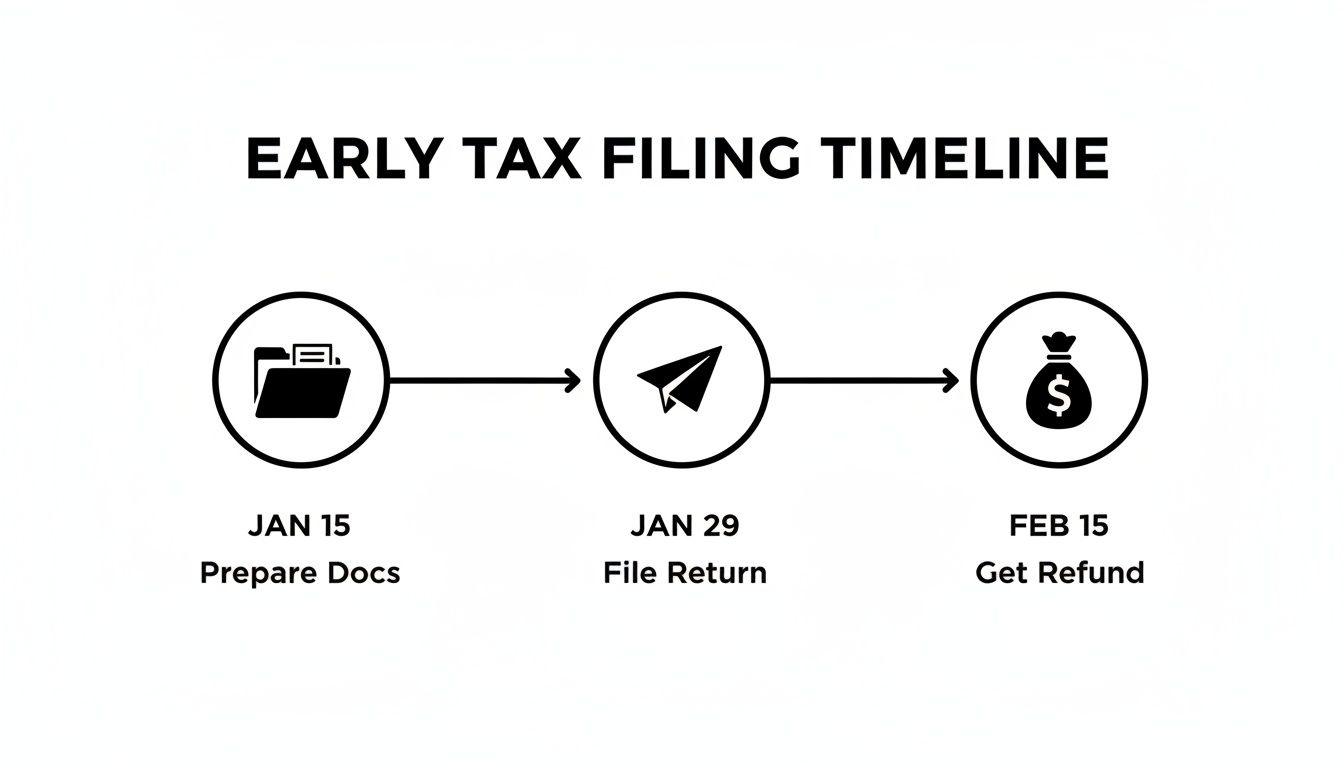
As you can see, a little prep work in January can mean having your refund in hand by mid-February, long before the chaos of the April rush even begins.
The Famous Federal Deadline
For most of us, the big day is April 15. That’s the deadline for filing your federal income tax return. If it happens to land on a weekend or a holiday, the IRS pushes it to the next business day, but that single date is what everyone circles on their calendar.
But here’s the thing: treating April 15 as your target is a recipe for stress. It's much smarter to see it as the final safety net, not the starting line.
Beyond the Individual Filer
Not everyone is on the same April 15 schedule. If you run a business, you've got some earlier deadlines you absolutely cannot miss.
- March 15: This is the big one for S Corporations (using Form 1120-S) and partnerships (using Form 1065). Why so early? It’s designed so that partners and shareholders can get their K-1 forms in time to complete their own personal returns.
- April 15: C Corporations (using Form 1120) share the same deadline as individual filers.
Blowing past these business deadlines is a big deal. The penalties can be steep, often calculated for each partner or shareholder, so staying on top of them is crucial.
A lot of people think that if you owe money, you have to pay it the second you file. That's not true. You can file your return in February and still wait until the April 15 deadline to pay what you owe. You can read more about how that works here: https://alliedtax.com/if-i-owe-taxes-when-are-they-due/
The Self-Employment and Investor Calendar
If you're a freelancer, gig worker, or an active investor, your tax life isn't a once-a-year event. When you earn income without any taxes withheld, the IRS expects you to pay as you go. This is done through quarterly estimated tax payments, which prevents you from getting hit with a massive bill in April.
These quarterly deadlines are almost always the same:
- April 15 (for income earned Jan 1 – Mar 31)
- June 15 (for income earned Apr 1 – May 31)
- September 15 (for income earned Jun 1 – Aug 31)
- January 15 of the next year (for income earned Sep 1 – Dec 31)
Putting these on your calendar is non-negotiable for managing cash flow and avoiding underpayment penalties. It's always a good idea to keep an eye on the key financial dates for the upcoming years to stay ahead of the curve.
One last thing—don't assume your state's deadlines match the federal ones. Most do, but some states have their own unique tax calendars. Always double-check your state’s specific rules to stay fully compliant and avoid any nasty surprises.
Using a Tax Extension as a Strategic Tool
A tax extension often gets a bad rap, seen as a last-ditch effort for procrastinators. But honestly? It can be one of the smartest tools in your financial toolbox. Filing an extension isn’t about delaying the inevitable; it’s about strategically buying yourself time to file an accurate, complete, and optimized tax return.

This distinction is absolutely crucial. An extension gives you more time to file your paperwork, but it does not give you more time to pay the taxes you owe. Getting that right is the key to using an extension effectively and avoiding costly penalties.
When an Extension Makes Perfect Sense
Sometimes, rushing to meet the April deadline is far riskier than taking the extra time. A hurried return is just begging for errors and missed opportunities. In certain complex situations, opting for an extension is absolutely the best time to file taxes.
Think about these common scenarios where filing an extension is a wise move:
- Waiting on Corrected Forms: You got a Form K-1 from a partnership or a 1099 from your broker, but you know it’s wrong. Waiting for the corrected version is far better than filing an inaccurate return you'll just have to amend later.
- Complex Investment Records: If you're a crypto investor or an active trader, pulling together thousands of transactions to accurately calculate capital gains is a monumental task. An extension gives you the breathing room you need to get it right.
- Maximizing Retirement Contributions: For self-employed individuals, this is a game-changer. An extension gives you until the October deadline to fund a SEP IRA or solo 401(k) for the previous tax year.
- Organizing Business or Rental Records: A real estate investor might need a few more weeks to track down every last receipt to maximize rental property deductions. For businesses, learning about your options, like the business tax extension deadline, provides critical flexibility for sound financial reporting.
In every one of these cases, the extension serves a clear purpose: putting accuracy and financial optimization ahead of speed.
How to File an Extension Correctly
The good news is that filing for an automatic six-month extension is surprisingly simple. For individual taxpayers, it's done with Form 4868, Application for Automatic Extension of Time To File U.S. Individual Income Tax Return. This one form pushes your filing deadline from April 15 to October 15.
The most critical step, however, is estimating your tax liability for the year. You have to figure out what you think you owe and pay that amount by the original April 15 deadline.
Key Takeaway: An extension to file is not an extension to pay. If you don't pay your estimated tax bill by the April deadline, you'll start racking up penalties and interest charges, even with a valid extension.
This payment shows the IRS you're acting in good faith. You don't have to be perfect, just reasonable. Think of it as telling the IRS, "I know I owe you money, and here it is. I just need a bit more time to get the paperwork perfect."
This strategic pause ensures you can gather every document, claim every rightful deduction, and submit a return you can be confident in. It turns a potential compliance headache into a well-managed financial task.
Tax Extension Myths vs Reality
There's a lot of misinformation out there about tax extensions. Let's clear up a few of the most common myths so you can make an informed decision.
| Common Myth | The Reality |
|---|---|
| "Filing an extension increases my audit risk." | This is completely false. The IRS has stated that filing an extension does not make you a target for an audit. In fact, a rushed, error-filled return is far more likely to raise red flags. |
| "An extension means I don't have to worry about taxes until October." | Not quite. It's an extension to file, not an extension to pay. You still must estimate and pay your tax liability by the original April 15 deadline to avoid penalties and interest. |
| "I need a good reason to get an extension." | Nope. The extension is automatic for anyone who files Form 4868 on time. You don't have to provide any explanation or justification to the IRS. |
| "It's complicated and expensive to file an extension." | Filing an extension is free and can be done electronically in just a few minutes through the IRS Free File program or your tax software. It's one of the simplest tax forms out there. |
Understanding these realities helps you see the extension for what it is: a valuable tool for ensuring tax compliance and accuracy, not a sign of trouble. When used correctly, it’s a smart move for any taxpayer facing a complex situation.
How Your Situation Dictates Your Filing Timeline
Forget the idea of a single "best time to file taxes." It's a myth. The right time isn't a date you circle on the calendar; it’s a strategy that bends and flexes with your financial life.
Think of it this way: someone with a simple W-2 from a single job has a pretty straightforward path to the April deadline. They can file in late January and be done with it. But if you're a small business owner, a real estate investor, or a crypto trader, your journey is far more complex. For you, filing isn't just about meeting a deadline—it's about timing things just right to set yourself up for the year ahead.
Let’s break down how different financial lives call for different tax filing game plans.
For Small Business Owners
If you run your own business, tax season isn't just about compliance. It’s a vital check-up on the health of your company. Filing as soon as your books are closed for the year gives you a powerful snapshot of where you stand. It's less about the refund and more about gaining mission-critical intel.
An early, accurate return spells out your net profit, your total tax liability, and your cash flow in black and white. This isn't just history; it's data you can use to make smarter decisions right now. For example, knowing your exact tax bill helps you budget for those pesky quarterly estimated payments, so you're not caught off guard and strapped for cash later.
A Small Business Owner’s Strategic Filing in Action
Imagine you own a growing e-commerce shop. You get your books in order and file your business return in February. The numbers show a higher-than-expected profit and, consequently, a hefty tax bill. This early insight is a game-changer. It allows you to:
- Adjust Your Strategy: You see an immediate need to be more aggressive with expense tracking. You can put a new system in place now, not in July when half the year is gone.
- Plan for Growth: That clear financial picture might also reveal you have enough retained earnings to invest in that new marketing campaign you’ve been dreaming of, giving you a jump on the competition.
- Secure Financing: Need a business loan? Walking into a bank with a completed, professional tax return shows you’re organized and on top of your finances. It builds instant credibility with lenders.
For the savvy business owner, the best time to file taxes is as soon as you can turn last year’s numbers into this year’s battle plan.
For Real Estate Investors
As a real estate investor, you’re juggling a unique mix of numbers—rental income, operating expenses, depreciation, capital gains. The moving parts are complex, and that makes early preparation a cornerstone of a smart investment strategy. Putting it off can lead to uninformed decisions that cost you real money.
Getting a firm grasp on your portfolio's performance early in the year is crucial. Calculating depreciation, for instance, does more than just lower your taxable income. It also affects your property's cost basis, which is absolutely critical for figuring out capital gains when it’s time to sell.
By getting your tax return done early, you get a precise, no-nonsense look at your financial position. This clarity can directly shape your next move—whether that's buying a new property, selling an underperformer, or budgeting for that big roof replacement.
For Cryptocurrency Traders
Welcome to one of the biggest headaches in modern tax preparation. If you’re an active crypto trader, the sheer volume of transactions—trades, swaps, staking rewards, airdrops—can easily run into the thousands. The IRS views every single one as a taxable event that you have to track and report.
For crypto investors, "last-minute" isn't in the vocabulary. The work involved in pulling transaction data from multiple exchanges and wallets, piecing it all together, and calculating your capital gains and losses is monumental. You absolutely have to start this process in January or February.
Why a Crypto Trader Needs a Serious Head Start
Let's say you actively traded on three different exchanges and dabbled in two DeFi protocols last year. To file an accurate return, you have to:
- Download All Your Histories: You’ll need to pull complete CSV files from every single platform you touched.
- Use Crypto Tax Software: This isn't optional. You'll upload your data into a specialized service like CoinLedger or Koinly to make sense of the chaos and match buys with sells.
- Hunt for Errors: You then have to manually review everything for missing data or discrepancies. This is a painstaking but unavoidable step.
This whole process can take weeks, not hours. Starting early gives you the breathing room to do it right and avoid the kind of costly mistakes that trigger scary notices from the IRS. For crypto traders, the best time to start preparing is yesterday, and the best time to file is the moment you’ve finally solved that incredibly complex puzzle.
The Hidden Dangers of Last-Minute Filing
We've all been there. That nagging feeling as the tax deadline inches closer. But waiting until the last minute isn't just a recipe for stress—it’s a high-stakes gamble with your money. Procrastination does more than just cause a few sleepless nights; it swings the door wide open to a whole host of risks you could have easily sidestepped. Thinking of the best time to file taxes as a loose suggestion instead of a strategic move is the first mistake so many people make.

That final-hour scramble is where problems are born—problems that can drain your time, your bank account, and your peace of mind. Let's get past the obvious anxiety and dig into the real, tangible consequences of pushing your tax filing to the absolute limit.
The High Cost of Rushed Mistakes
When you're racing against the clock, accuracy is almost always the first casualty. Think of it like cooking a complicated recipe for the first time. If you have plenty of time, you can measure everything perfectly, follow each step, and end up with a delicious meal. But if you rush, you'll probably misread a measurement or skip an ingredient, and the result will be… disappointing.
In the world of taxes, that "disappointing result" can look like this:
- Simple Math Errors: It’s shockingly easy to transpose a couple of numbers or make a basic calculation mistake when you're under pressure. Unfortunately, these are also huge red flags for the IRS.
- Forgetting Income: Did you forget about that 1099-INT from your savings account? What about the 1099-NEC from that small side gig you did last summer? When you're in a hurry, it's easy for these to slip through the cracks, leading to underreported income.
- Claiming Incorrect Credits: Tax credit eligibility rules can be tricky. A quick glance might make you think you qualify, but a misunderstanding can lead to an improper claim that you'll eventually have to pay back, plus interest.
These aren't just tiny slip-ups. They can shrink your refund, stick you with an unexpected tax bill, or even trigger an official IRS notice months down the road.
Overlooked Deductions and Lost Money
A hasty filing process almost guarantees you’ll leave money on the table. Finding every single deduction and credit you're entitled to requires a careful review of your year—not a frantic, last-minute search for crumpled receipts.
When you wait until the eleventh hour, you give up the chance to do any real tax planning. You could miss out on valuable deductions for things like student loan interest, HSA contributions, or home office expenses simply because you ran out of time to get your documents in order.
This is especially true for anyone with a more complex tax situation, like small business owners or freelancers, where every single dollar in deductions really matters.
Your Refund Gets Stuck in a Traffic Jam
Filing at the absolute peak of tax season is like trying to merge onto the freeway at 5 p.m. on a Friday—everything slows to a crawl. The IRS systems get flooded with a massive wave of returns, and processing times get stretched out.
The last two weeks before the deadline see the highest volume of filings by far. During the 2024 peak, more than 50 million returns hit IRS servers in that final stretch, causing 20-30% longer refund wait times for e-filers compared to those who filed back in January. This backlog can delay your refund by weeks, which can really throw a wrench in your financial plans. You can find more details about how filing volume affects refund speed.
The Scarcity of Professional Help
Finally, one of the biggest risks of waiting is that you might not be able to get expert help when you need it most. The best tax professionals and CPAs are often completely booked up weeks, if not months, before the April deadline. If you hit a snag or realize your situation is more complicated than you thought, you could find that there’s no one available to help you.
That leaves you on your own, trying to navigate complex tax laws under immense pressure. It's a risky position to be in, and one you can easily avoid by simply planning ahead.
Got Tax Questions? Let's Get You Some Answers.
Even the most organized person usually has a few questions come tax time. That's completely normal. The tax code can feel like an impossible puzzle, but once you understand how the key pieces fit together, the big picture gets a whole lot clearer.
I'm going to tackle some of the most common questions I hear from clients about tax timing and strategy. Think of these as straightforward, practical answers to help you file with confidence and avoid unnecessary stress.
What Documents Do I Absolutely Need Before I Can Start My Taxes?
If there's one virtue in tax season, it's patience. The absolute best time to file taxes is after you've gathered every single one of your necessary documents. Jumping the gun is one of the easiest ways to create a massive headache for yourself down the road.
Before you even think about starting your return, run through your checklist. At a minimum, this means having:
- W-2s from every single employer you worked for last year.
- All your 1099 forms, which cover everything from freelance income (1099-NEC) to interest (1099-INT) and dividends (1099-DIV).
- Form 1098 if you paid mortgage interest—this is a big deduction you don't want to miss.
- All your records for potential deductions, like receipts for business expenses, proof of charitable giving, and medical bills.
And if you’re involved in something like crypto trading, that list gets much longer. You’ll need complete transaction histories from every exchange and wallet you used. Rushing to file without this data almost guarantees inaccuracies that force you to file an amended return—a process that takes far more time than simply waiting a few more weeks for all your documents to arrive.
If I File Early and Owe Money, Do I Have to Pay Right Away?
Not at all. This is probably the biggest and most helpful misconception about filing early. Submitting your return in January or February locks in your tax liability, but it does not move up your payment due date. You still have until the official deadline, usually April 15, to pay what you owe without any penalties or interest.
This approach really gives you the best of both worlds. You get the peace of mind of knowing your exact tax bill months ahead of time, which gives you plenty of runway to budget and make sure the funds are ready.
Think of it this way: Filing early is like getting the bill at a restaurant long before you're ready to leave. You know what you owe, but you can settle up when the time is right. You can file your return and then schedule your payment to the IRS for a future date, hitting both deadlines with zero stress.
It’s a simple strategy that eliminates last-minute surprises and puts you in control of your finances.
Does Filing Early or Late Affect My Audit Risk?
The specific date you file your taxes has no direct bearing on your audit risk. The IRS uses powerful automated systems to flag returns for review, and frankly, those systems don't care about the calendar. They're looking for statistical outliers, math errors, or major disconnects between what you report and the data they get from your employer or bank.
However, your filing habits can indirectly raise your audit risk. When you rush to file at the last minute, you’re far more likely to make simple mistakes—transposing numbers on a W-2, forgetting to report a 1099, or flubbing a calculation. These are exactly the kinds of red flags the IRS systems are built to catch.
Filing with time to spare gives you (or your tax pro) the breathing room to double-check every detail. That careful review is your best defense against an audit. A clean, accurate, and well-supported return is always less likely to get a second look from the IRS, no matter when it's filed.
What If I Find a Mistake After I've Already Filed My Return?
First off, don't panic. Discovering you made a mistake after filing is more common than you'd think, and the IRS has a specific process for correcting it. You’ll need to file an amended return using Form 1040-X, Amended U.S. Individual Income Tax Return. The key here is that you must use this specific form, not just file a new 1040.
Here’s the game plan:
- Wait for Processing: Don't do anything until your original return has been fully processed. You can track its status on the IRS "Where's My Refund?" tool.
- Prepare Form 1040-X: This form walks you through explaining the changes and recalculating your tax. It will clearly show if you owe more or are due a larger refund.
- Mind the Clock: You generally have three years from the date you filed the original return (or two years from when you paid the tax, whichever is later) to submit an amendment.
If the change means you owe more tax, file and pay as quickly as possible to keep interest and penalties to a minimum. If you're owed a bigger refund, the IRS will process your 1040-X and mail you a check for the difference. Because amendments can be tricky, this is a great time to consult a tax professional to make sure it's done right the first time.
Trying to figure out taxes on your own can be a challenge, but you don't have to go it alone. The team at Allied Tax Advisors has spent decades helping people and businesses handle everything from simple annual filings to the complexities of crypto taxation. Schedule a consultation with our experts today to get the peace of mind that comes from knowing your taxes are done right.