
You're looking at a profitable LLC, someone has told you to “just elect S corp,” and the deadline is approaching fast. The tax idea may be sound, but the filing itself is where many owners get into trouble. A late submission, an election filed before the entity legally exists, or one missing shareholder signature can derail the result before payroll and tax planning even begin.
The IRS filing framework is straightforward when you treat it as a process rather than a checkbox. An eligible entity files Form 2553, obtains shareholder consent, meets the effective-date deadline, and then operates consistently with S corporation rules. The IRS explains the basic election and reporting requirements in its official Form 2553 guidance. The practical advice below focuses on the mistakes that cause rejected or defective elections, not on selling you a generic tax-savings story.
Table of Contents
- Why Electing S Corp Status Matters for Your Business
- Meeting the IRS Eligibility Requirements
- Filling Out Form 2553 the Right Way
- Deadlines and State-Level Filings You Cannot Miss
- Payroll, Reasonable Compensation, and Post-Election Compliance
- Weighing the Real Pros and Cons Before You File
- Your S Corp Election Checklist and Next Steps
Why Electing S Corp Status Matters for Your Business
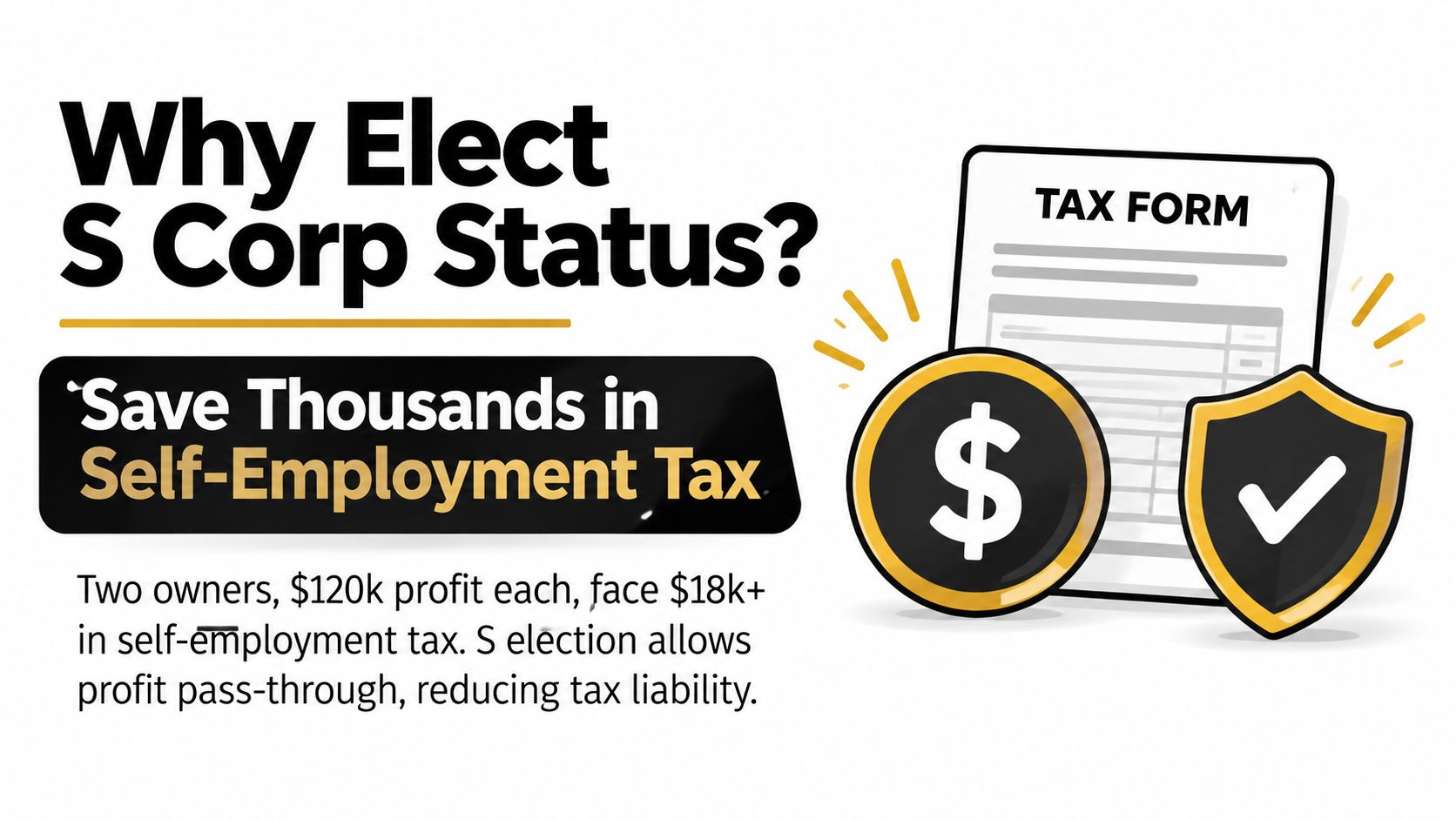
Consider a two-owner business generating substantial profit. Each owner may be taking draws, paying tax on pass-through income, and wondering whether an S corporation election would separate compensation for services from returns on ownership. That question deserves a calculation, not a slogan.
An S corporation generally passes operating income through to its shareholders. An owner who works in the business receives compensation through payroll, while remaining profit may be distributed through the shareholder structure. The salary is subject to employment taxes, while distributions aren't treated as wages merely because cash leaves the company. The distinction is why owners often investigate whether they should elect S Corp taxation for an LLC.
The tax benefit isn't automatic. A shareholder-employee must receive compensation that reflects the services performed, and the business must support the separation with accurate payroll and books. A distribution can't be disguised wages just because the owner prefers a lower payroll number.
The business advantages extend beyond tax
S corporation treatment can give the company a more defined compensation and distribution framework. That structure may also make financial reporting easier for lenders, clarify how new investors or owners would be onboarded, and encourage cleaner separation between company funds and personal spending.
Those benefits come with real obligations:
- Payroll administration: The business must process owner wages and handle related filings.
- Stricter bookkeeping: Wages, distributions, shareholder loans, and operating expenses need distinct treatment.
- Annual reporting: The entity reports on Form 1120-S for tax years covered by the election, as the IRS explains in its Form 2553 instructions and filing framework.
- State costs: State tax treatment and filing requirements can reduce the practical value of the federal election.
Practical rule: Don't file Form 2553 until you've decided who will be on payroll, how compensation will be documented, and which state filings will follow.
The election is a procedural roadmap with a tax consequence. If the paperwork is defective, the expected benefit never gets a chance to work.
Meeting the IRS Eligibility Requirements
Before completing Form 2553, test the entity against the eligibility rules. Filing first and checking eligibility afterward is backwards. The IRS cares about the entity's ownership and capital structure because S corporation treatment depends on a controlled pass-through framework.
A qualifying entity generally must be domestic and have no more than 100 shareholders, with only permitted shareholder types. Eligible owners commonly include individuals, certain estates, and certain trusts. Non-resident alien shareholders generally aren't permitted, and partnerships, most corporations, most LLCs, and many trusts can't hold S corporation shares directly.
The company must also have one class of stock. Voting rights may differ in some arrangements, but the economic rights attached to ownership can't be structured to create a second class. Governing documents, side agreements, redemption rights, and disproportionate distributions can create problems even when the stock certificates appear simple.
Run the ownership test before filing
An LLC may need a federal classification election before it can receive S corporation tax treatment. Review the entity's operating agreement, articles, ownership ledger, and community-property interests. In a community-property state, a spouse's interest may affect who must consent to the election even if only one spouse appears on the business records.
| Eligibility Rule | What the IRS Allows | Common Disqualifier |
|---|---|---|
| Domestic entity | A qualifying entity organized in the United States | An entity formed outside the United States |
| Shareholder limit | No more than 100 shareholders | Exceeding the shareholder limit |
| Shareholder type | Eligible individuals, certain estates, and certain trusts | Non-resident aliens, partnerships, and most corporations |
| Stock structure | One class of stock | Preferred economic rights or side agreements |
| Entity classification | A corporation or eligible entity making the proper election | Filing before legal formation or without the required classification step |
Use the IRS's Form 2553 PDF and instructions as the controlling document, not an online checklist copied from an unrelated business. Confirm the legal formation date, identify every beneficial owner, inspect the governing documents for different economic rights, and verify that each person whose consent is required can sign.
A short eligibility checklist can prevent a long correction process:
- Entity: Is the business legally formed before the election is filed?
- Owners: Is every shareholder an eligible type?
- Count: Does the ownership remain within the permitted shareholder limit?
- Capital: Does every owner hold the same economic class of stock?
- Consent: Have all affected shareholders and required spouses been identified?
If any answer is uncertain, stop before filing. A correct tax strategy built on an ineligible ownership structure is still a defective election.
Filling Out Form 2553 the Right Way
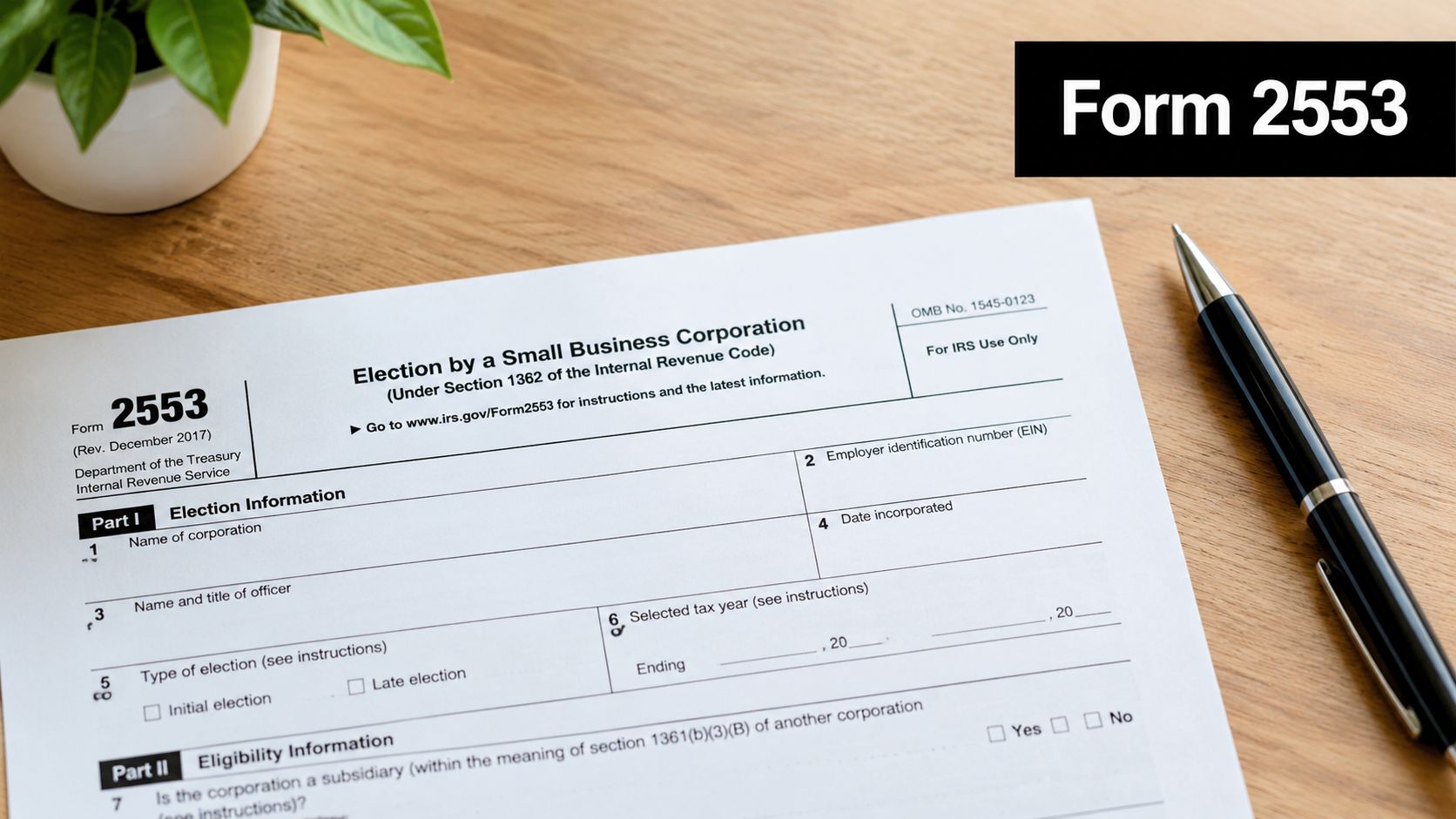
Form 2553 fails most often because the filer treats it like a basic name-and-address form. It isn't. Every date, ownership entry, and signature supports a separate part of the election.
Start with the entity's exact legal name, EIN, mailing address, and incorporation or organization information. The date and state of formation describe when and where the entity legally came into existence. They aren't the same as the date on which the S election should take effect. Confusing those fields can create a mismatch that invites an IRS question or rejection.
The effective date deserves deliberate attention. For a calendar-year business, the IRS generally requires the election no later than 2 months and 15 days after the beginning of the tax year, commonly March 15, according to the IRS Form 2553 filing guidance. Enter the intended tax year and effective date consistently throughout the form.
Complete the shareholder information carefully
The shareholder table needs more than names. Enter each shareholder's address, taxpayer identification number, number of shares, and the date those shares were acquired. Use the ownership records, not memory or an outdated operating agreement.
The signature requirement is the most common avoidable failure. Every shareholder whose consent is required must sign. If community-property rules give a spouse an ownership interest, that spouse may also need to consent. Missing one signature can invalidate the election even when every other field is perfect.
Part III applies to certain trust situations and requires careful attention to the shareholder's status. Don't use it casually. Confirm whether the trust qualifies and whether the person signing has authority to provide consent.
Handle tax-year and late-election issues before submission
If the business wants a fiscal year other than a calendar year, review the tax-year requirements and any related Section 1.444 filing. Don't select a non-calendar year just because it appears convenient.
If the election is late, use the late-election relief procedure only when the facts support it. The IRS form includes a late-election relief representation, but checking a box doesn't replace a proper explanation or consistent shareholder reporting. The form instructions also identify a $6,760 user fee in the applicable relief context, so verify the current instructions before sending payment.
Most rejections trace back to a short list:
- Premature filing: The form was submitted before the corporation or entity legally existed.
- Late filing: The effective-date deadline passed without a valid relief position.
- Incomplete consent: A shareholder's signature or required information was omitted.
- Administrative mismatch: The EIN, legal name, formation date, ownership data, or effective date doesn't agree with the entity's records.
For a plain-English explanation of the form's purpose and mechanics, review what Form 2553 does. Then have every shareholder review the completed form before anyone signs.
Deadlines and State-Level Filings You Cannot Miss
Federal timing has two separate tracks. The first applies to the entity's formation or the beginning of the tax year the election is intended to cover. The second concerns existing businesses that want S corporation treatment beginning with a particular tax year.
For a calendar-year business, the IRS generally requires Form 2553 by the 15th day of the third month, which commonly falls on March 15. The IRS also describes the rule as filing no later than 2 months and 15 days after the beginning of the tax year in its official election guidance. Count from the first day of the intended tax year, then confirm the deadline against the calendar and IRS instructions.
A newly formed entity must also avoid filing before formation. The legal existence date and the desired tax effective date are separate checkpoints. January and February formations create particular pressure because owners often assume the new business can wait until the general annual deadline.

Late relief is a correction path, not a filing strategy
Rev. Proc. 2013-30 may provide relief for a late election when the taxpayer meets the applicable conditions. The process generally requires a reasonable-cause statement and shareholder statements showing that income was reported consistently with the intended S corporation treatment. The relief framework includes a three-year look-back window and a $198 user fee, as described in the IRS revenue procedure.
Don't assume relief is available because the deadline was overlooked. Check the effective date, tax returns already filed, payroll treatment, shareholder reporting, and the required representations before submitting a late election.
State compliance is a separate risk. Many states follow the federal election, but some require a state S election, a franchise-tax filing, or another state-level submission. California, New York, New Jersey, and Pennsylvania are examples of jurisdictions where state treatment can require separate review.
The federal acceptance letter doesn't prove that every state obligation was satisfied. Before filing, identify the business's registration states, owners' resident states, payroll states, and any state-specific election or franchise-tax requirements.
Payroll, Reasonable Compensation, and Post-Election Compliance
The election changes how money moves through the business. An owner who previously took draws or a guaranteed payment cannot relabel future transfers as distributions and continue operating as before.
An owner-employee who performs services should be placed on formal payroll. That means W-2 wages, payroll tax withholding, quarterly Form 941 filings, state withholding, and unemployment-insurance compliance. The business should establish this system at the beginning of the effective S corporation period, not after the first year-end tax appointment.
Compensation must match the work
The salary question isn't answered by a preferred percentage or a convenient cash target. Evaluate the owner's duties, hours, experience, geographic market, industry, comparable employee pay, revenue, and profitability. A full-time operator who performs the company's core revenue-producing work needs a compensation analysis that reflects those facts.
If the salary is artificially low, the IRS may reclassify distributions as wages. That can produce employment-tax assessments, interest, and penalties. Owners who need a practical overview of avoiding IRS penalties for S Corp owners should focus on documentation as much as the payroll amount.
Compensation standard: Pay for the services first. Treat the remaining amount as a distribution only after the payroll record supports the owner's role.
Build the operating system around the election
Your books should make it obvious what happened to every dollar. Use separate accounts or clearly defined chart-of-accounts lines for wages, payroll taxes, distributions, shareholder loans, reimbursements, and ordinary operating expenses. Keep payroll records and retain the analysis supporting compensation decisions.
| Operational Area | Before S Election | After S Election |
|---|---|---|
| Owner payments | Draws or guaranteed payments may apply | W-2 wages plus properly recorded distributions |
| Payroll | Owner payroll may not be required | Payroll withholding and employment filings are required |
| Books | Simpler owner-equity tracking | Separate wages, taxes, distributions, and shareholder activity |
| Year-end return | Entity treatment depends on classification | Form 1120-S and shareholder Schedule K-1 reporting |
| Controls | Informal transfers may occur | Transfers need consistent documentation and authorization |
At year-end, the S corporation files Form 1120-S for the covered tax year and issues Schedule K-1 information to shareholders. The annual return doesn't repair missing payroll or weak books. It reports what the business did.
A useful review of reasonable salary for an S Corp owner can help frame the analysis, but your documentation must reflect your own role and business facts.
Weighing the Real Pros and Cons Before You File
S corporation status isn't a universal upgrade. The potential advantage comes from separating compensation for services from the owner's remaining business return, but the election also imposes ownership restrictions and administrative work.
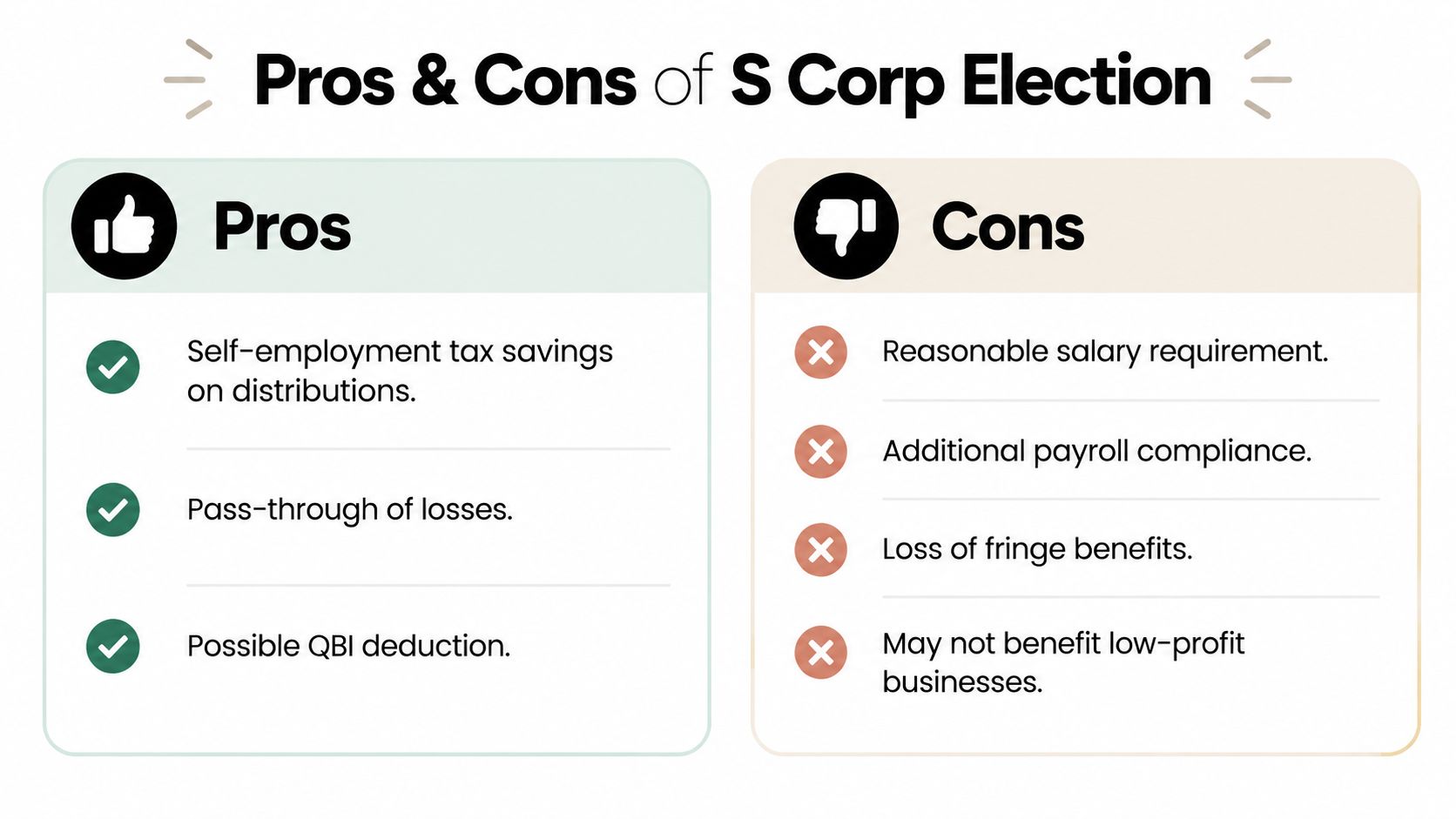
The strongest case usually involves a business with stable profit that remains after paying a defensible salary. Pass-through treatment can avoid corporate-level double taxation in the ordinary federal structure, and losses may pass through subject to basis and other tax limitations. Qualified business income treatment may also matter, but it must be modeled alongside salary and other limits rather than treated as a guaranteed bonus.
The costs are less glamorous and more predictable:
- Payroll burden: The owner must run payroll and meet employment-tax obligations.
- Ownership limits: The shareholder rules can restrict future investment and transfers.
- Capital rigidity: One class of stock limits flexible economic arrangements.
- Administrative expense: Bookkeeping, payroll, and Form 1120-S preparation require ongoing attention.
- State exposure: State elections, franchise taxes, and filing rules can change the result.
When the LLC is the better answer
An LLC often remains the better fit for a new or inconsistent business, especially when the owner needs flexible distributions, outside investors, foreign ownership, multiple economic arrangements, or simpler administration. A consulting business with modest or unpredictable profit may gain little after payroll and tax-compliance costs.
An S corporation can also be a poor choice for a business planning to add an ineligible owner or issue different economic rights. The restrictions matter before the investment conversation starts, not after the term sheet is signed.
Owners comparing broader self-employed deductions may also find a separate UK self employed tax deductions guide useful for understanding how tax planning differs across systems. It isn't a substitute for U.S. S corporation analysis, but it reinforces the central point: entity and compensation choices must match the taxpayer's actual circumstances.
A default C corporation may be more suitable when the company plans to retain earnings for growth, seek institutional investment, or pursue a future stock-sale strategy. Don't elect S status because another owner did. Model salary, distributions, payroll costs, state treatment, ownership plans, and exit goals first.
Your S Corp Election Checklist and Next Steps
Treat the filing as a controlled handoff from tax planning to operations. Use this checklist before submitting anything:
- Confirm eligibility: Verify domestic status, shareholder eligibility, ownership count, stock rights, and entity classification.
- Confirm legal formation: Make sure the entity existed before the election was signed and filed.
- Gather ownership records: Collect every shareholder's legal name, address, taxpayer identification number, share count, and acquisition date.
- Set the effective date: Match the intended tax year to the deadline described in the IRS's Form 2553 instructions.
- Complete the form: Check the legal name, EIN, formation details, tax year, shareholder entries, and applicable relief representations.
- Collect consents: Obtain every required shareholder signature, including any consent affected by community-property ownership.
- File and retain proof: Submit the form through the permitted IRS channel and preserve the signed copy and delivery evidence.
- Review state obligations: Identify separate state elections, franchise-tax filings, payroll registrations, and deadlines.
- Start payroll: Establish owner compensation, withholding, unemployment compliance, and payroll records.
- Update the books: Separate wages, payroll taxes, distributions, loans, reimbursements, and shareholder basis activity.
Professional help is worth the cost when the ownership structure includes trusts or unusual arrangements, when the deadline has already been missed, or when the business operates across multiple states. Those situations create factual and procedural issues that a blank form can't resolve.
The election itself is only the beginning. Keep annual support for reasonable compensation, file Form 1120-S, issue Schedule K-1 information to shareholders, and maintain books that agree with payroll and distributions. Disciplined execution determines whether the S corporation delivers its intended result.
Allied Tax Advisors can help eligible businesses prepare and submit Form 2553, evaluate the procedural requirements, and establish the payroll and compliance systems that follow acceptance. Visit Allied Tax Advisors to request guidance before you file, especially if your deadline, ownership structure, or state obligations are unclear.