
Accounts Payable (AP) is really just a formal term for the money your business owes its suppliers for goods or services you've already received. Think of it as your company's running tab—a collection of short-term debts for everything from raw materials and inventory to the monthly electricity bill.
It might sound simple, but this concept is a cornerstone of business finance. Every dollar you owe sits on your balance sheet as a liability, and how you manage it says a lot about your company's financial health.
What Is Accounts Payable and Why It Matters
Let's use a real-world example. Imagine you run a small coffee shop. You order 50 pounds of fresh coffee beans from a local roaster. They drop off the beans along with an invoice for $500, due in 30 days. The moment you accept that delivery, that $500 becomes part of your accounts payable. It’s not just another bill to file away; it's a formal financial obligation that directly impacts your cash on hand.
This cycle of receiving goods and paying for them later is fundamental to how businesses operate, no matter how big or small. Whether you're a large corporation or a one-person sole proprietorship, getting a handle on your AP is non-negotiable.
More Than Just Unpaid Bills
At its core, accounts payable represents the total amount of short-term debt you owe to your vendors. On your balance sheet, it’s listed under current liabilities because these debts are typically due within a year. But managing AP is so much more than just paying bills on time. It's a critical function that influences several key parts of your business:
- Cash Flow Management: Smartly timing your payments lets you hold onto your cash a little longer, giving you more flexibility for day-to-day operations or unexpected expenses.
- Vendor Relationships: Paying your suppliers consistently and on time builds a ton of goodwill. This trust can lead to better pricing, priority service, and even more flexible payment terms down the road when you really need them.
- Financial Accuracy: A clean, up-to-date AP ledger is essential for accurate financial statements. It gives you a crystal-clear picture of your company's debts and its true financial standing.
- Budgeting and Forecasting: When you know exactly what you owe and when it's due, you can predict your future cash needs with much greater confidence. This makes creating reliable budgets and financial forecasts a whole lot easier.
To help break it down, here’s a quick look at the core ideas behind Accounts Payable.
Key Accounts Payable Concepts at a Glance
| Concept | Simple Definition | Impact on Business |
|---|---|---|
| Invoice | A bill from a supplier for goods or services rendered. | The official trigger for an AP entry; it details what you owe and when it's due. |
| Vendor/Supplier | The company or individual you purchased from. | Strong vendor relationships are built on timely payments and are key to a healthy supply chain. |
| Current Liability | A short-term debt that must be paid within one year. | AP is a primary current liability that directly affects your company's working capital. |
| Balance Sheet | A financial statement showing a company's assets, liabilities, and equity. | Accounts Payable is a key line item here, showing outsiders how much you owe. |
Ultimately, these components work together to form the complete picture of your company's obligations.
In essence, accounts payable is the financial engine that manages a company's outgoing payments to suppliers. It is the flip side of accounts receivable, which tracks money coming into the business from customers.
The growing importance of a solid AP process is clear when you look at the numbers. The global market for AP automation software has exploded to an estimated $7.95 billion. This massive investment shows just how vital businesses believe effective AP management is for success. You can explore more about these accounts payable trends and statistics to see where the industry is heading.
Walking Through the Accounts Payable Process
It’s one thing to know the definition of accounts payable, but seeing it play out in a real business makes it all click. The AP process isn't a single action—it's a complete workflow, a series of steps that takes a supplier's invoice and turns it into a paid bill. For small business owners, getting this system down is everything. A consistent, repeatable process is your best defense for managing cash flow and staying organized.
Let's walk through an example. Imagine a local bakery, "The Rolling Pin," orders 100 lbs of specialty flour from its main supplier. When the supplier delivers the flour, they also provide an invoice. That invoice is the starting gun for the accounts payable process.
Step 1: Receiving and Verifying the Invoice
First things first, the invoice arrives—maybe in an email, maybe tucked into the delivery paperwork. The bakery owner doesn’t just toss it in a pile to deal with later. They start the verification process right away. This is where a cornerstone of good financial control comes in: the three-way match. It sounds technical, but it’s a surprisingly simple way to catch errors and prevent overpaying.
Here’s how it works:
- Purchase Order (PO): They pull up the original purchase order. Does it match the invoice? Did they really order 100 lbs of flour? Check.
- Receiving Report: They look at the delivery slip or packing list. Did 100 lbs of flour actually show up, and was it in good shape? Check.
- Invoice: Finally, they review the supplier's invoice. Does it bill them for the correct quantity (100 lbs) at the price they agreed on? Check.
When all three of these documents align, the invoice is confirmed as legitimate and moves to the next stage.
Step 2: Recording and Approving the Bill
Once the invoice is verified, it’s time to log it in the accounting software, like QuickBooks. This is a crucial step for your financial statements. By recording the bill, you officially add that debt to your books under the accounts payable account. This is absolutely essential if you use accrual basis accounting, as it gives you a true, real-time picture of your company's financial obligations.
After it's recorded, the invoice needs a final sign-off. At "The Rolling Pin," the owner is probably the one giving the green light. In a larger company, a department manager might approve it. This approval is the official confirmation that the expense is valid and authorized for payment.
The core AP workflow really boils down to three key actions, as you can see below.
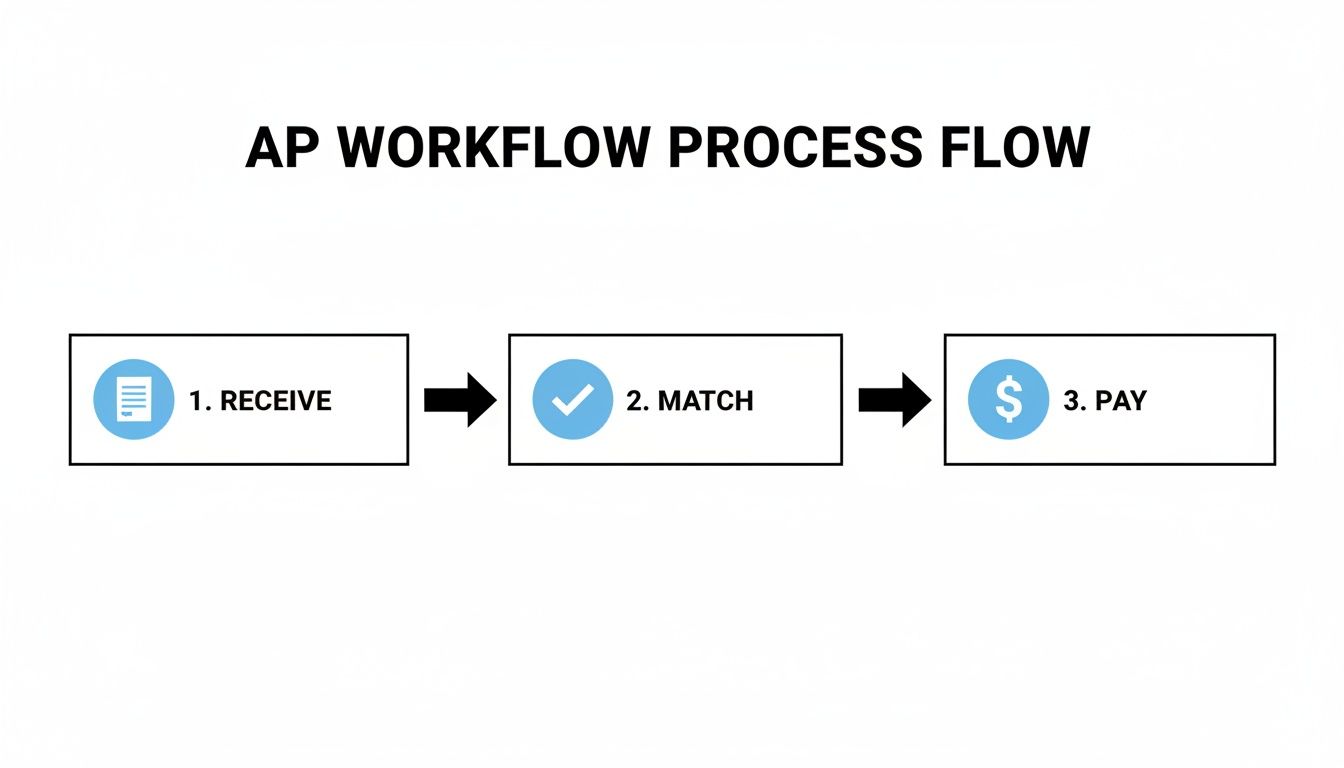
This visual really simplifies it, showing how the process flows smoothly from receiving and matching the invoice to finally making the payment.
Step 3: Scheduling and Making the Payment
The last piece of the puzzle is actually paying the bill. Smart business owners rarely pay an invoice the moment it's approved. Instead, the bakery owner schedules the payment according to the terms on the invoice, like "Net 30."
This simple act of scheduling lets the business hang onto its cash for as long as possible, improving cash flow. At the same time, paying on schedule keeps the relationship with the flour supplier strong. When the due date arrives, the bakery sends the payment—whether by check or an electronic transfer—and the AP cycle for that one invoice is officially complete.
How Accounts Payable Works on Your Books
When a bill from a vendor lands on your desk (or in your inbox), you know you owe money. But how do you actually reflect that IOU in your company's financial records? It all comes down to some straightforward accounting that keeps your books balanced and tells the true story of your business's financial health.

The system that makes this all work is called double entry bookkeeping. It’s a foundational concept in accounting, and the main idea is that every transaction affects at least two accounts. For every "debit" in one account, there's an equal and opposite "credit" in another, keeping your financial equation (Assets = Liabilities + Equity) perfectly in sync.
Your Accounts Payable account is classified as a current liability on your balance sheet. Think of it as your company's official "we owe this" list for short-term debts. When you buy something on credit, this liability account goes up. When you pay the bill, it goes back down.
Let's walk through the two main steps of any AP transaction.
Journal Entry 1: When You Get the Bill
Imagine your marketing consultant sends you an invoice for $1,000 for this month's social media campaign. You've received the service, so you need to record the expense and the new debt right away—even though you haven't paid a dime yet.
This is the journal entry your bookkeeper would make:
- Debit (Dr.) Marketing Expense $1,000: This entry increases your total expenses, which will later be used to calculate your net income.
- Credit (Cr.) Accounts Payable $1,000: This entry increases your liabilities, showing that your company now owes an additional $1,000.
This simple entry paints an accurate picture: you've officially incurred an expense, and you've created an obligation to pay for it. Keeping these accounts organized is essential, which is where a good chart of accounts comes into play.
Journal Entry 2: When You Pay the Bill
A few weeks later, you're ready to pay that $1,000 invoice. The act of paying is a separate financial event, so it needs its own journal entry to close the loop. This entry will clear out the liability and show that cash has left your business.
Here’s what the second entry looks like:
- Debit (Dr.) Accounts Payable $1,000: This debit reduces your liability account, effectively wiping the $1,000 debt off your books.
- Credit (Cr.) Cash $1,000: This credit reduces your cash (an asset), reflecting the money flowing out of your bank account.
Once this second entry is posted, your Accounts Payable balance for this specific bill goes back to zero, and your cash is lower. The expense itself remains on your records, correctly matched to the period when the service was delivered.
This two-step dance is what ensures your financial statements give a clear and accurate view of what your company owns, what it owes, and how it's performing at any moment.
Optimizing Your AP Workflow for Better Cash Flow
Let's be honest, most people see accounts payable as just paying the bills—a necessary chore. But if you handle it strategically, your AP process can become one of the most powerful tools you have for managing your company's cash flow and building a rock-solid financial foundation.
A well-oiled AP machine does more than just avoid late fees and keep your vendors happy. It lets you hold onto your cash longer, putting it to work for you.

The shift toward automating AP has been a game-changer. I’ve seen it firsthand, and the research backs it up. Companies that bring in technology can slash their invoice processing time by as much as 50%. Think about the operational savings that unlocks! You can dig into more stats about how automation is shaping accounts payable trends on flairstech.com.
That kind of efficiency gives you the breathing room to make much smarter decisions about when and how you pay your bills.
Centralize and Systematize Your Invoices
The first step is to stop invoices from falling through the cracks. It's chaos when bills are sitting in different email inboxes, physical mail trays, or on someone's desk. You need one central, organized system where every single invoice lands.
This could be as simple as a dedicated email address or a specific shared folder. Or, you could level up with AP automation software. The tool doesn't matter as much as the discipline.
A central hub means no more frantic searching or accidental late payments. It creates a single source of truth, giving you a crystal-clear, real-time view of exactly what you owe. That clarity is the bedrock of good financial planning.
An optimized accounts payable workflow is not an expense center; it's a strategic asset. By controlling the timing and process of your payments, you directly influence your company's liquidity and operational agility.
Getting this system in place immediately cuts down on the chaos and sets the stage for everything else.
Establish Strong Internal Controls and Approval Workflows
Once you have all your invoices in one place, it's time to build a firewall. You need clear, non-negotiable rules for how bills get approved and paid. This is your number one defense against costly errors, duplicate payments, and even fraud.
A formal approval workflow ensures every bill is reviewed and signed off on by the right person before a single dollar leaves your bank account.
Here are a few best practices I always recommend:
- Define Approval Hierarchies: Create simple rules based on dollar amounts. For instance, any invoice over $1,000 might need a manager’s approval, while anything over $5,000 has to be approved by the owner. It keeps everyone accountable.
- Segregate Duties: This is a classic for a reason. The person who approves an invoice should never be the same person who processes the payment. This simple separation of duties is a powerful internal control that dramatically reduces risk.
- Negotiate Better Payment Terms: Don't be afraid to ask your key vendors for more time. See if you can turn a "Net 30" term into "Net 45" or even "Net 60." An extra 15-30 days of holding onto your cash can make a massive difference to your operations. Our guide on cash flow management for small businesses has more on this.
These controls add much-needed structure and security, turning your AP process from a vulnerability into a strength.
Schedule Payments Strategically
Finally, it’s time to change your mindset. Stop paying bills the moment they get approved. Instead, pay them based on their actual due dates.
Unless a vendor is offering you a sweet early payment discount that makes financial sense (and you should always run the numbers), hold onto your cash for as long as you ethically can. A great way to do this is to schedule "payment runs" once or twice a week to batch-process all the bills coming due.
This simple shift maximizes your working capital, giving you more flexibility for payroll, buying inventory, or jumping on unexpected opportunities. It's a powerful strategy that redefines accounts payable—it's no longer just a list of debts, but a tool for financial empowerment.
Turning AP Data into Strategic Business Decisions
Your accounts payable ledger is far more than just a running list of bills. It's actually a goldmine of business intelligence just waiting to be tapped. If you learn to look at it differently, you can turn a routine bookkeeping task into a powerful tool for making smarter, more informed decisions that fuel your company’s growth.
Think about it: the information tucked away in your AP reports tells the story of your company's spending. Analyzing this data can reveal patterns you’d otherwise never see—like which suppliers you rely on most, where costs are slowly creeping up, or which departments are doing a great job of sticking to their budgets.
From Data Points to Actionable Insights
By regularly digging into your AP aging report and other payment records, you can start asking some really important strategic questions. For example, what if you identified your top ten vendors by annual spend? That simple piece of information could be the starting point for negotiating a volume discount or hammering out better payment terms. A quick analysis like this can lead directly to cost savings that flow straight to your bottom line.
This data is also crucial for financial forecasting. When you have a solid handle on your regular payment obligations, you can build much more reliable cash flow projections and budgets. You can see future cash needs coming from a mile away, preventing nasty surprises and making sure you have the capital to fund both daily operations and new growth projects.
Think of your accounts payable data as a financial map of your operations. It shows you exactly where your money is going, helping you navigate vendor relationships, manage cash flow, and chart a course toward greater profitability.
Building a Stronger Financial Position
A well-oiled accounts payable process also sends a powerful message to the outside world. Consistently paying your suppliers on time builds a rock-solid credit history for your business. Lenders and credit rating agencies look at this positive payment record very closely when you apply for any kind of financing.
A strong credit profile makes it easier—and often cheaper—to get the loans, lines of credit, or other capital you need to expand. It signals to financial institutions that your business is stable, reliable, and a low-risk bet. And it all starts with a disciplined approach to managing what you owe.
Ultimately, by digging into your AP data, you’re empowered to:
- Pinpoint cost-saving opportunities: See where spending is highest and use that knowledge to negotiate better deals with key suppliers.
- Improve budget accuracy: Use real historical payment data to forecast future expenses and create financial plans you can actually stick to.
- Strengthen vendor relationships: Use your reliable payment history as leverage to build trust and secure better terms with your most important partners.
- Boost your company's creditworthiness: Create a track record of on-time payments that makes it much easier to get financing for your next big move.
When to Partner with an Accounting Professional
At first, managing accounts payable can feel pretty straightforward. You get a bill, you pay it. But as your business grows, that simple stack of invoices has a funny way of multiplying, quickly turning into a mountain of paperwork that pulls you away from what you actually need to be doing: running your business.
If you’re constantly wrestling with unpredictable cash flow or find yourself losing precious hours every week just to keep up with bookkeeping, those are clear signals. It might be time to bring in a pro. This isn't just about paying bills on time anymore—it's about compliance, tax strategy, and the long-term financial health of your company.
Recognizing the Tipping Point
So, how do you know when you've hit that tipping point? A good accountant or tax advisor becomes invaluable when you start seeing these signs:
- You're Drowning in Paperwork: Are you spending your evenings and weekends manually entering invoices and chasing down payment approvals? That's time you could be investing in sales, marketing, or product development.
- You're Worried About Making a Mistake: Even small data entry errors can snowball into big problems—overpayments, missed early payment discounts, or accidentally damaging a great relationship with a key supplier. An expert brings a second set of eyes and a system built for accuracy.
- You Need a Financial Game Plan, Not Just a Scorekeeper: A great accountant does more than just crunch the numbers. They act as a strategic partner, offering insights that can improve your cash flow, pinpoint opportunities to cut costs, and get you perfectly prepared for tax season.
Bringing in a professional isn't giving up; it's a strategic move. You're reclaiming your time and adding a financial ally to your team who is 100% focused on helping you grow smarter.
At Allied Tax Advisors, our specialty is taking these complex, time-consuming tasks off your plate. We can help you build a smarter AP system, guarantee your books are accurate, and provide the strategic advice you need to scale your business with confidence.
Common Questions About Accounts Payable
Even after you've got the basics down, you'll run into practical questions when you're in the thick of managing your business's finances. Let's tackle some of the most common ones that pop up, connecting the dots between the textbook definition and your daily reality.
Nailing these details is how you build an AP process that truly supports your company’s financial health, not just one that pays the bills.
What’s the Difference Between an Invoice and a Purchase Order?
It's easy to use these terms interchangeably, but they're two completely different steps in the buying process. Getting them straight is foundational for good bookkeeping and preventing payment mix-ups.
A Purchase Order (PO) is the document you create and send to a vendor before you receive anything. It’s your official request, spelling out exactly what you want to buy, how much of it, and the price you’ve both agreed on. Think of it as formally placing your order.
An invoice, on the other hand, is the bill the vendor sends to you after they've delivered the goods or completed the service. The invoice is their formal request for payment, and its arrival officially kicks off your accounts payable process. You'll match the invoice against your original PO to make sure you’re being billed correctly.
How Does Accounts Payable Affect My Business Taxes?
While the accounts payable line on your balance sheet isn't a direct tax deduction, the expenses it represents are absolutely essential for your tax return. When you get an invoice for a legitimate business cost—whether it's for rent, marketing, or office supplies—you're officially recognizing an expense.
Those business expenses are what you subtract from your revenue to figure out your net income. Every single valid expense you record lowers your taxable profit, which ultimately lowers your tax bill.
The Bottom Line: A well-managed AP system is your best defense against overpaying taxes. It ensures you capture and document every deductible expense, so you don't leave money on the table for the IRS.
This is exactly why a messy AP system is so dangerous. A lost invoice isn't just a bookkeeping headache; it's a lost tax deduction.
Should I Pay Bills Early or on the Due Date?
This is a great question, and the answer is a strategic one that depends entirely on your cash flow and your vendors' payment terms. There’s no single right answer, but there is a smart way to approach it.
Paying Early: Why would you pay before you have to? Discounts. Some suppliers offer incentives like "2/10, n/30," which means you get a 2% discount if you pay within 10 days. If not, the full amount is due in 30 days. If you have the cash on hand, taking advantage of these discounts is a fantastic way to cut your costs.
Paying on Time: If there's no early-pay discount on the table, or if cash is tight, paying closer to the due date is usually the way to go. This lets you hold onto your cash for as long as possible, improving your working capital and giving you more flexibility to run your business.
The goal is to strike the right balance between snagging those early payment savings and preserving your cash flow.
Managing your accounts payable is about more than just paying bills—it's a key part of your financial strategy, tax planning, and growth. If you feel like you're spending too much time buried in bookkeeping or need a professional eye to help you optimize your finances, Allied Tax Advisors is here to help. Our team offers the accounting and advisory services you need to scale your business with confidence.
Learn more about how we can support your financial journey at https://alliedtax.com.