
So, you bought new glasses this year. It's a common question we get: can you write them off on your taxes? The short answer is yes, prescription eyeglasses are considered a tax-deductible medical expense.
But—and with taxes, there's always a but—it's not quite that simple. You can't just subtract the cost from your tax bill. The IRS has a couple of significant hurdles you have to clear first.
The Two Big Hurdles: Itemizing and the 7.5% Rule
First, you have to itemize your deductions using Schedule A. If you take the standard deduction, which many taxpayers do, you can't deduct medical expenses separately. It's one or the other.
Second, and this is the tougher one for most people, you can only deduct the portion of your total medical expenses that exceeds 7.5% of your Adjusted Gross Income (AGI).
Think of that 7.5% figure as your personal deductible, like with an insurance plan. You have to pay that amount out-of-pocket before the tax deduction even begins to kick in. Only the dollars you spend above that threshold are deductible.
Let's say you're a small business owner in San Diego with an AGI of $80,000. Your 7.5% threshold would be $6,000. If you spent $350 on new prescription glasses, that cost counts toward the $6,000, but you wouldn't get a deduction unless your total qualified medical bills for the year topped that amount.
This flowchart breaks down the decision-making process.
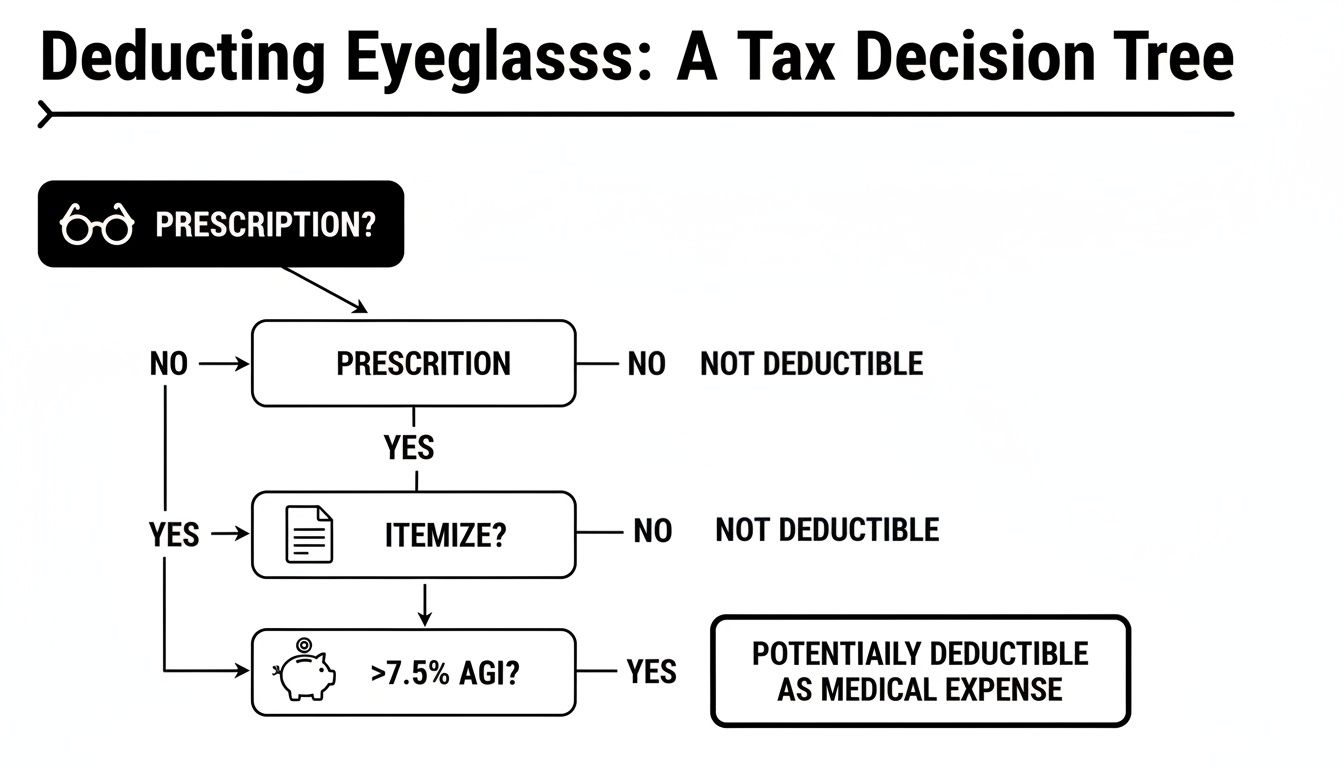
As you can see, if the glasses aren't prescribed by a doctor or if you take the standard deduction, the conversation ends right there.
To help you figure out which of your vision-related costs can help you clear that 7.5% hurdle, here's a quick summary of what the IRS generally allows.
Quick Guide to Deductible Vision Expenses
| Expense Item | Generally Deductible? | Key Condition |
|---|---|---|
| Prescription Eyeglasses & Sunglasses | Yes | Must be medically necessary to correct a vision problem. |
| Contact Lenses | Yes | Must be prescribed by a doctor. |
| Eye Exams | Yes | Includes exams for glasses, contacts, and general health. |
| Over-the-Counter Reading Glasses | No | Not considered a medical expense; no prescription needed. |
| Eyeglass Repair Kits | Yes | Costs to maintain medically necessary eyewear are included. |
| Contact Lens Solution & Cleaners | Yes | Part of the cost of using prescribed contacts. |
Remember, every qualifying expense helps you get closer to meeting your deduction threshold. The key is to track all of them, from the big-ticket items down to the small but necessary supplies.
This is just one piece of a much larger puzzle. You can find more detail in our comprehensive guide on how to write off medical expenses.
Conquering the 7.5% Medical Expense Threshold

So, are eyeglasses tax deductible? While the glasses themselves usually qualify, the real challenge is clearing the 7.5% of Adjusted Gross Income (AGI) hurdle. This rule is what trips up most taxpayers and is often the reason people can’t write off their vision expenses, even if they itemize.
Think of it like the deductible on your car insurance policy. If you have a $500 deductible and get into a fender bender that costs $450 to fix, you're on the hook for the entire amount. The insurance company pays nothing. The medical expense deduction works the same way—the IRS only lets you deduct the portion of your expenses that goes above your personal threshold, which is 7.5% of your AGI.
Because of this, someone earning a higher income has a much bigger number to surpass than a person with a lower income. This structure tends to make the deduction more helpful for those who have significant medical costs in a given year compared to what they earn.
How to Calculate Your Threshold
First things first, you need to know your Adjusted Gross Income. Your AGI is your total income (from your job, side hustles, investments, etc.) after subtracting certain specific deductions, like contributions to a traditional IRA or student loan interest. You'll find this number on line 11 of your Form 1040.
The Threshold Formula:
(Your Adjusted Gross Income) x 0.075 = Your Personal Medical Expense Threshold
Once you have your AGI, the math is straightforward. For example, if your AGI is $60,000, your threshold is $4,500 ($60,000 x 0.075). This means you must spend more than $4,500 on qualifying medical expenses before a single dollar becomes deductible. If your total costs were only $4,000, you get no deduction.
Our guide on what is Adjusted Gross Income breaks down this crucial figure in more detail.
The Power of Bundling Your Medical Costs
Here's the secret to getting over that threshold: bundle every single qualifying medical expense you paid for during the year. Your new $400 glasses probably won't get you there on their own. But when you start adding them to all your other out-of-pocket health costs, you might just have a shot.
This is where diligent record-keeping pays off. Track everything, including:
- Vision Costs: Eye exams, prescription glasses and sunglasses, contact lenses, and even lens solution.
- Dental Bills: Payments for cleanings, fillings, braces, and other non-cosmetic procedures.
- Doctor Visits: All your co-pays, deductibles, and direct payments to specialists.
- Prescription Medications: The cost of all drugs and medicines prescribed by a doctor.
- Hospital Care: Bills for inpatient stays, surgeries, and related services.
- Mental Health: Costs for therapy, counseling, and psychiatric appointments.
By pooling all these expenses together, you create a much larger total that stands a far better chance of surpassing your 7.5% AGI floor. IRS data from 2021 filings shows that taxpayers claimed over $20 billion in medical deductions, with vision expenses like eyeglasses and exams playing a key part in helping many reach those totals.
Sample 7.5% AGI Threshold Calculations
Let's look at a few real-world scenarios to see how the medical expense deduction works at different income levels.
The table below shows that the deductible amount is never your total medical expense bill. It is only the amount that exceeds your personal threshold.
| Filing Status | Adjusted Gross Income (AGI) | 7.5% AGI Threshold | Total Medical Expenses | Deductible Amount |
|---|---|---|---|---|
| Single Filer | $60,000 | $4,500 | $3,500 | $0 |
| Single Filer | $60,000 | $4,500 | $7,000 | $2,500 |
| Married Filing Jointly | $120,000 | $9,000 | $8,000 | $0 |
| Married Filing Jointly | $120,000 | $9,000 | $15,000 | $6,000 |
As you can see, the single filer with $7,000 in costs can't deduct that full amount. The first $4,500 is non-deductible because it's below the threshold, leaving the remaining $2,500 as the valid tax deduction.
What Vision Costs You Can Actually Deduct
To get a tax break for your vision expenses, you first have to clear the 7.5% AGI threshold. But meeting that number isn't just about one big purchase—it's about adding up all the little, qualified costs the IRS allows. Many people miss out on this deduction simply because they overlook smaller expenses that could have pushed them over the edge.
Think of it as collecting puzzle pieces. Your new prescription glasses might be the biggest piece, but you also have eye exams, contact lens solution, and even eyeglass repairs. You need all the pieces to see the full picture and, in this case, to potentially unlock a valuable deduction.
The Complete Checklist of Deductible Vision Expenses
So, when you ask, "Are eyeglasses tax deductible?" the answer is a lot bigger than just the frames and lenses. The IRS has a clear standard: if the expense is for diagnosing, treating, or preventing an eye condition, it generally counts.
Here are the costs you can confidently add to your running total:
- Prescription Eyeglasses: This is the big one. The full cost of glasses—frames and all—prescribed by your eye doctor to correct a vision problem is deductible.
- Eye Exams: That annual check-up fee is a qualified medical expense. In fact, knowing the typical comprehensive eye exam cost is a great starting point for tallying your potential deductions for the year.
- Prescription Sunglasses: This is a huge one that people often forget. If your sunglasses have corrective lenses prescribed by a doctor, they count. Don't assume they're just a personal fashion item.
- Contact Lenses: Whether you wear dailies, bi-weeklies, or monthlies, the cost of your prescription contact lenses is fully deductible.
- Contact Lens Supplies: All the stuff that keeps your contacts usable is fair game. Saline solution, cleaning liquids, and disinfecting products can add up fast, so track those receipts.
- Eyeglass Repairs: Life happens. If you sit on your glasses and need a new frame, or just need to replace a screw or a cracked lens, that repair cost is a valid medical expense.
Notice the common thread? All these expenses are medically necessary. That’s the bright line the IRS draws to separate a deductible medical expense from a personal one.
What Vision Costs Are Not Deductible
Knowing what not to include is just as critical as knowing what to include. Claiming non-qualified expenses can trigger an IRS audit, so it pays to get this right. These items are typically considered personal choices, not medical necessities.
Key Takeaway: The IRS draws a hard line between medical necessity and personal preference. If an item doesn't require a doctor's prescription to treat a specific vision problem, it's almost certainly not deductible as a medical expense.
Here’s a look at the vision-related items you cannot deduct:
- Over-the-Counter Reading Glasses: Those "cheaters" you grab at the drugstore don't count. Because they're available without a specific prescription for a diagnosed condition, the IRS sees them as a personal convenience item.
- Standard (Non-Prescription) Sunglasses: While your prescription sunglasses are deductible, regular ones you buy off the rack are not. Their main purpose isn't to correct your vision.
- Non-Prescription Blue Light Glasses: If the glasses only filter blue light and don't include a corrective prescription, they are considered a personal expense and can't be deducted.
- Cosmetic Contact Lenses: Contacts that just change your eye color for fun, with no vision correction, are not deductible.
- Vision Insurance Premiums (with a catch): This one is tricky. If your employer takes money for vision insurance out of your paycheck before taxes (a "pre-tax" deduction), you can't deduct those premiums again on your tax return. You’ve already gotten the tax benefit. However, if you pay for a private policy with your own after-tax money, those premiums can be included in your medical expense total.
By carefully separating your personal costs from your medical ones, you can file your taxes with confidence. The best strategy is to keep detailed records of every qualified expense, so you're always prepared.
A Smarter Way to Pay: Using an FSA or HSA for Vision Expenses

Let’s be honest: trying to hit that 7.5% of AGI threshold to deduct medical expenses feels like a long shot for most of us. It’s a high bar, and many people never get there. But what if you could sidestep that whole process and get a guaranteed tax break on every dollar you spend on vision care?
Thankfully, there's a much more direct route. Tax-advantaged accounts like a Flexible Spending Account (FSA) or a Health Savings Account (HSA) let you pay for your glasses, contacts, and eye exams with pre-tax money. This is a fundamentally different—and often better—way to save, because the tax benefit is locked in from the start.
The Real Power of Pre-Tax Dollars
Think about it this way. If you're in the 22% federal tax bracket, every $100 you earn shrinks to about $78 by the time it lands in your bank account. To buy a $400 pair of glasses with that money, you actually had to earn closer to $512.
Now, picture using an FSA or HSA. That $400 comes straight out of your paycheck before any taxes are taken. You’re using the full, untaxed amount. It’s essentially like getting an automatic discount on your vision expenses equal to your tax rate. This is a much more reliable strategy than trying to qualify for a deduction later.
Flexible Spending Accounts (FSAs): The "Use-It-or-Lose-It" Option
An FSA is a special account offered through an employer that you fund with pre-tax dollars for your out-of-pocket medical costs. You decide how much to contribute for the year, and that amount is deducted from your paychecks in small increments.
The beauty of an FSA is its simplicity for predictable expenses. You can use it right away for things like:
- New prescription glasses or sunglasses
- A year's supply of contact lenses and solution
- Co-pays for your annual eye exam
- Other approved medical, dental, and prescription costs
The one major catch with FSAs is the infamous "use-it-or-lose-it" rule. You generally have to spend the money by the end of your plan year. Many companies now offer a grace period or a small rollover amount, but it’s crucial to plan your contributions so you don't forfeit your hard-earned money. If you’re considering this option, learning the ins and outs of flexible spending accounts is a must.
Health Savings Accounts (HSAs): A Powerful Long-Term Tool
An HSA is a whole different animal, and for good reason—it’s often called a "super IRA" because of its incredible triple tax advantage. To open and contribute to an HSA, you must first be enrolled in a High-Deductible Health Plan (HDHP).
Here's what makes HSAs so special:
- Contributions are tax-deductible, which directly lowers your taxable income for the year.
- The money grows tax-free, and you can even invest it in the market.
- Withdrawals are completely tax-free when used for qualified medical expenses.
Best of all, there's no "use-it-or-lose-it" pressure. Your HSA balance rolls over every single year, making it a fantastic tool for both immediate healthcare needs and long-term retirement savings. It's no surprise that by the end of 2023, Americans held an estimated $123 billion in HSA assets.
An HSA is more than just a healthcare account; it's a long-term investment in your financial and physical well-being. The funds are yours to keep, grow, and use whenever you need them, year after year.
FSA vs. HSA: Which Is Right for Your Vision Care?
The choice often comes down to your employer's offerings and the type of health plan you have. But if you have the option, this quick comparison can help you decide.
| Feature | Flexible Spending Account (FSA) | Health Savings Account (HSA) |
|---|---|---|
| Eligibility | Available with most employer health plans. | Requires a High-Deductible Health Plan (HDHP). |
| Ownership | Employer-owned. You lose the funds if you leave your job. | Personally owned. The account is yours to keep, always. |
| Rollover | Use-it-or-lose-it (with some modern exceptions). | All funds roll over every year, without limit. |
| Investing | No investment options available. | Funds can be invested in stocks, bonds, and mutual funds. |
| Best For | Predictable, short-term expenses you know you'll have. | Long-term savings and covering unpredictable medical costs. |
Whether you go with an FSA or an HSA, you’re making a savvy move to cut your healthcare spending. Just remember, you can't also deduct expenses that you paid for with these pre-tax funds—that would be "double-dipping." But the immediate, guaranteed savings you get upfront is almost always the better deal.
For a deeper dive into what else you can and can't write off, check out our guide on whether medical premiums are tax deductible.
Tax Rules for the Self-Employed
Working for yourself opens up a whole different world of tax rules, and when it comes to healthcare, that's often a good thing. While the basic answer to "are my glasses tax deductible?" doesn't change, being your own boss provides some unique routes to saving money that aren't available to regular employees.
For freelancers, consultants, and business owners, the goal is often to lower your taxable income before you even start thinking about itemizing. Let's look at how that works.
The Self-Employed Health Insurance Deduction
Here’s the first major advantage: the self-employed health insurance deduction. As an independent worker, you’re paying for your own insurance policy, not getting it subsidized through an employer. The tax code recognizes this.
You get to deduct 100% of the premiums you paid for your medical, dental, and vision plans. This deduction covers insurance for yourself, your spouse, and your dependents.
The best part? This isn't an itemized deduction you have to qualify for on Schedule A. It's what's called an "above-the-line" deduction, taken right on Schedule 1 of your Form 1040. It directly reduces your Adjusted Gross Income (AGI), which is a huge benefit.
For instance, if you paid $4,800 in health and vision insurance premiums throughout the year, you can subtract that entire amount from your total income. It lowers the income you're taxed on from the get-go, no 7.5% AGI threshold involved.
But there’s a critical distinction to make here:
- The insurance premiums you pay are what you deduct above the line.
- The actual cost of your glasses, contacts, or eye exams is still considered a personal medical expense, which goes on Schedule A.
So, while deducting your insurance premiums gives you a fantastic head start, you’ll still need to lump the cost of the glasses themselves with your other medical bills to see if you can clear that 7.5% AGI hurdle.
A Powerful Strategy for Business Owners
If you've set up a formal business structure like an LLC or S-Corp, you have an even more powerful tool at your disposal: a Health Reimbursement Arrangement (HRA).
An HRA is a formal, employer-funded plan that reimburses employees for medical costs tax-free. And yes, in many cases, you are an employee of your own business.
It’s a way to turn a personal expense into a business expense. Instead of buying your $500 glasses with after-tax money from your personal bank account, the business can reimburse you for that exact cost. The business gets to write it off as an expense, and the money you receive is completely tax-free.
This strategy completely sidesteps the 7.5% AGI threshold for any costs you run through the HRA. Your glasses, contacts, and exams essentially become a deductible cost of doing business.
Setting up an HRA isn't something you do on a whim. It involves specific plan documents and rules, especially if you have other employees, to ensure fairness and compliance. This is definitely one of those areas where getting it right matters, and talking to a tax professional can save you a lot of headaches while ensuring you get the full benefit.
Keeping Good Records and Avoiding Common Mistakes
A deduction is only as good as the records you keep to prove it. If the IRS ever sends a letter asking for backup, you’ll be glad you have everything in order. Think of it this way: your paperwork is your insurance policy against having your deduction denied.
This doesn't mean you need a complex filing system. A simple, organized approach is your best defense. Let's walk through how to build an audit-proof file for all your medical expenses, including vision care.
Building Your Audit-Proof File
The key is to have a clear paper trail for every single vision-related expense you intend to claim. You'll need to hang onto these records for at least three years after you file your tax return.
Here’s a simple checklist of what to keep in your file:
- Itemized Receipts: Hold onto receipts from your eye exams, prescription glasses, and contact lens purchases. Make sure they clearly list the date, the provider, and exactly what you bought.
- Proof of Payment: A credit card statement or a canceled check is the perfect companion to an itemized receipt. It proves you actually paid the bill.
- Prescriptions: While you don't need to mail it in with your taxes, having a copy of the prescription is solid gold. It instantly proves the medical necessity of your glasses or contacts.
- Mileage Logs: Did you drive to the optometrist? Keep a simple log of the miles for any medical-related travel. The standard mileage rate for medical travel can add a surprising amount to your total deduction.
A great tip I give my clients is to go digital. Just snap a photo of each receipt with your phone and save it to a dedicated cloud folder. It takes ten seconds and can save you hours of panic-induced searching down the road.
Common Pitfalls That Invalidate Your Deduction
Knowing what to do is important, but knowing what not to do is often where people get into trouble. A few simple, avoidable errors can get an otherwise valid deduction thrown out.
The most significant mistake is "double-dipping"—trying to get a tax benefit twice for the same expense. The IRS explicitly forbids this, and it’s a major red flag during an audit.
Here are the top three mistakes to steer clear of when deducting your vision expenses:
- Deducting FSA/HSA Purchases: If you paid for your glasses using funds from a pre-tax account like a Flexible Spending Account (FSA) or Health Savings Account (HSA), you can't also deduct it on your taxes. You've already received a tax break on that money, so claiming it again is a classic case of double-dipping.
- Forgetting to Subtract Reimbursements: You can only deduct your true out-of-pocket costs. If your new glasses cost $500 and your vision insurance paid $200 back to you, your deductible amount is only the $300 you actually paid.
- Claiming Non-Prescription Items: It’s easy to make this mistake, but over-the-counter readers, standard sunglasses, or blue-light-blocking glasses without a prescription are considered personal expenses by the IRS. They aren't deductible.
Frequently Asked Questions About Vision Deductions
We've covered the main rules, but as with all things tax-related, the real world is full of tricky "what if" scenarios. Let's walk through some of the questions I hear most often from clients to clear up any lingering confusion.
Are Prescription Safety Glasses for My Job Tax Deductible?
This is a great question, and the answer hinges on one key detail: the prescription.
If your safety glasses include a corrective prescription from your eye doctor, then yes, they are a qualified medical expense. You would add their cost to your total medical expenses on Schedule A, which are subject to that 7.5% AGI threshold.
But what if they're just standard, non-prescription safety glasses your job requires? In that case, they used to fall under the "unreimbursed employee expenses" deduction. Unfortunately, that deduction was suspended for most people, so for now, you can't write them off.
What if My Insurance Paid for Part of My Eyeglasses?
You can only deduct the money that actually came out of your own pocket. It's a common mistake to claim the full price, but the IRS is very clear on this: you must subtract any payments made by your vision insurance.
For example, let's say your new glasses had a $500 price tag. If your insurance plan paid $200, you are only eligible to deduct the $300 you paid yourself.
Don't Forget: Your deduction is based on your net out-of-pocket cost. Always check your insurance statements to confirm the exact amount you paid before adding it to your tax worksheet.
Can I Deduct the Cost of My Children's Eyeglasses?
Absolutely. The IRS allows you to combine qualified medical expenses for yourself, your spouse, and your dependents.
This means your children's eye exams, prescription glasses, and contacts all go into the same pot. Pooling these expenses together makes it much easier for families to reach that single 7.5% of AGI threshold and qualify for the deduction.
Tax laws are notoriously complex, and your ability to claim any deduction really depends on your specific financial picture. For personalized guidance that helps you save the most while staying fully compliant, the best move is always to talk with a professional.
The team at Allied Tax Advisors can review your situation and build a strategy that fits your needs. You can learn more by visiting our website: https://alliedtax.com.