
Yes, you can deduct state taxes on your federal return, but there's a huge "but" you need to know about. The entire deduction is capped at $10,000 per household each year. On top of that, this tax break is only available if you itemize your deductions.
Let's dive into what that really means for your tax bill.
Understanding the Basics of State Tax Deductions

For a long time, deducting the taxes you paid to your state from your federal income was a cornerstone of tax planning. But the game completely changed with the Tax Cuts and Jobs Act (TCJA) of 2017. This law introduced what’s famously known as the SALT cap.
SALT is simply an acronym for State and Local Taxes. Think of the SALT deduction as a single bucket where you collect all the different state and local taxes you pay during the year. The TCJA put a lid on that bucket. Now, you can only pull a maximum of $10,000 from it to deduct on your federal return (that drops to $5,000 if you're married and filing separately).
This one change had a massive ripple effect, especially for people in high-tax states like California, New York, and New Jersey. Suddenly, the standard deduction started looking a lot more appealing than the work of itemizing.
Who Qualifies for This Deduction?
Before you even think about what’s in the SALT bucket, there’s one major hurdle: you can only claim the deduction if you itemize deductions on your tax return.
It really comes down to simple math. Add up all your potential itemized deductions—your state and local taxes (up to the cap), mortgage interest, charitable donations, etc. If that total is less than your standard deduction amount, you’re better off just taking the standard deduction and forgoing the SALT write-off entirely. You always want to choose the path that gives you the biggest tax break.
What Taxes Are Included in the SALT Cap?
The $10,000 limit isn't just for one type of tax; it's a combined total for several key state and local taxes. Getting a handle on which ones qualify is the next critical step. Generally, you can include:
- State Income Taxes OR State Sales Taxes: This is a crucial choice. You have to pick one or the other—you can't deduct both.
- State and Local Real Property Taxes: This is the big one for homeowners. It covers the property taxes on your primary residence and any other real estate you own.
- State and Local Personal Property Taxes: This is less common but often includes the annual taxes you pay on vehicles or boats, but only if the tax is based on the item's value.
To make this easier to visualize, here’s a quick summary of what goes into that $10,000 bucket.
State Tax Deductibility at a Glance
This table provides a quick summary of which state and local taxes are generally deductible on your federal tax return, subject to the $10,000 SALT cap.
| Tax Type | Generally Deductible? | Key Considerations |
|---|---|---|
| State Income Tax | Yes | You must choose between deducting income or sales tax—not both. |
| State Sales Tax | Yes | A great alternative if you live in a state with no income tax. |
| Real Property Tax | Yes | Included in the $10,000 cap along with your income or sales tax choice. |
| Personal Property Tax | Yes | Must be an ad valorem tax, meaning it's based on the value of the property (like a car tax). |
As you can see, the cap forces you to be strategic. For many taxpayers, property taxes alone can eat up most, if not all, of the $10,000 limit, leaving little room for deducting state income or sales taxes.
Cracking the Code: The $10,000 SALT Deduction Cap
Before we go any further, we have to talk about the elephant in the room: the $10,000 SALT deduction cap. This isn't just a rule; it's the rule that has completely changed the game for millions of taxpayers, especially if you live in a state with higher taxes.
For over 100 years, going all the way back to the Revenue Act of 1913, deducting state and local taxes was a cornerstone of the federal tax system. There was no limit. If you itemized, you could subtract what you paid in state income, sales, and property taxes, often leading to some serious tax savings. You can get a sense of how varied tax burdens can be by checking out summaries of personal income tax rates around the world.
Then, the Tax Cuts and Jobs Act (TCJA) of 2017 came along and changed everything. It put a hard ceiling on this popular deduction.
The rule is simple and unforgiving: your total deduction for State and Local Taxes (SALT) is capped at a combined $10,000 per household each year. If you're married but file separately, that limit is sliced in half to just $5,000 each.
This $10,000 limit has to cover all of it—your property taxes plus either your state income taxes or state sales taxes. It doesn't matter if you paid $15,000, $25,000, or more. The most you can write off on your federal return is ten grand.
How the Cap Plays Out in Real Life
The impact of this cap is wildly different depending on your zip code. Imagine you’re given a $100 gift card for groceries. If your weekly bill is only $80, you feel great. But if your bill is $250, that $100 doesn't feel like nearly enough. The SALT cap works the same way.
Let’s walk through a couple of quick examples.
Example 1: Homeowner in a High-Tax State
- Lives in: New Jersey
- Pays in Property Taxes: $12,000 a year
- Pays in State Income Tax: $8,000 a year
- Total State & Local Taxes: $20,000
Before the TCJA, this person could have potentially deducted the full $20,000. Now? They’re stuck at $10,000. They completely lose the federal tax benefit on the other $10,000 they paid. In fact, their property taxes alone are more than the entire cap allows.
Example 2: Homeowner in a Lower-Tax State
- Lives in: Tennessee (which has no state income tax)
- Pays in Property Taxes: $2,500 a year
- Pays in State Sales Tax (estimate): $3,000 a year
- Total State & Local Taxes: $5,500
For this homeowner, the $10,000 cap is a non-issue. As long as they itemize their deductions, they can write off the entire $5,500 they paid without hitting the limit.
Why Is Everyone Arguing About the SALT Cap?
The SALT cap is, without a doubt, one of the most controversial parts of the 2017 tax law. The heart of the debate is that it hits residents of certain states much harder than others—specifically, states with higher costs of living that fund robust public services through higher taxes.
The states feeling the most pain are usually:
- California
- New York
- New Jersey
- Illinois
- Connecticut
- Massachusetts
For countless taxpayers in these areas, the cap made itemizing deductions pointless. At the same time the TCJA introduced the SALT cap, it also nearly doubled the standard deduction. Suddenly, millions of people realized that their capped $10,000 SALT deduction, plus other write-offs like mortgage interest and charitable gifts, didn't even add up to the new, higher standard deduction.
This triggered a massive shift in tax strategy across the country. For the first time in generations, taking the standard deduction became the better financial move for a huge slice of the American population.
Choosing Between Income and Sales Tax Deductions
When you decide to itemize your deductions, you'll hit a fork in the road every single year: Do you deduct the state and local income taxes you paid, or the state and local sales taxes you paid?
You have to pick one. You can't have both. This single choice is a major piece of the puzzle that determines how much of your $10,000 SALT cap you get to use.
Making the right call isn't about some secret tax loophole; it comes down to your personal finances and, crucially, where you hang your hat. For most people, the decision is pretty clear-cut.
If you live in a high-income-tax state like California or New York, deducting your income taxes is almost always the way to go. It’s simple math—your state income tax bill will likely dwarf what you paid in sales tax, giving you a bigger deduction.
When to Choose the Sales Tax Deduction
So, who on earth would choose to deduct sales tax? It's the go-to strategy for anyone living in a state with no income tax.
Right now, that list includes nine states:
- Alaska
- Florida
- Nevada
- New Hampshire
- South Dakota
- Tennessee
- Texas
- Washington
- Wyoming
If you're in one of these places, the sales tax deduction isn't just a good option; it's your only option for this part of the SALT deduction. It lets you claim a federal deduction you'd otherwise miss out on completely.
This choice can also be a smart move even if you do have state income tax, but your income was low for the year. Say you didn't earn much but made a major purchase—like a new car, boat, or RV—that came with a hefty sales tax bill. In that scenario, the sales tax deduction might just come out on top.
This flowchart gives you a bird's-eye view of how this all fits into the bigger federal tax picture.
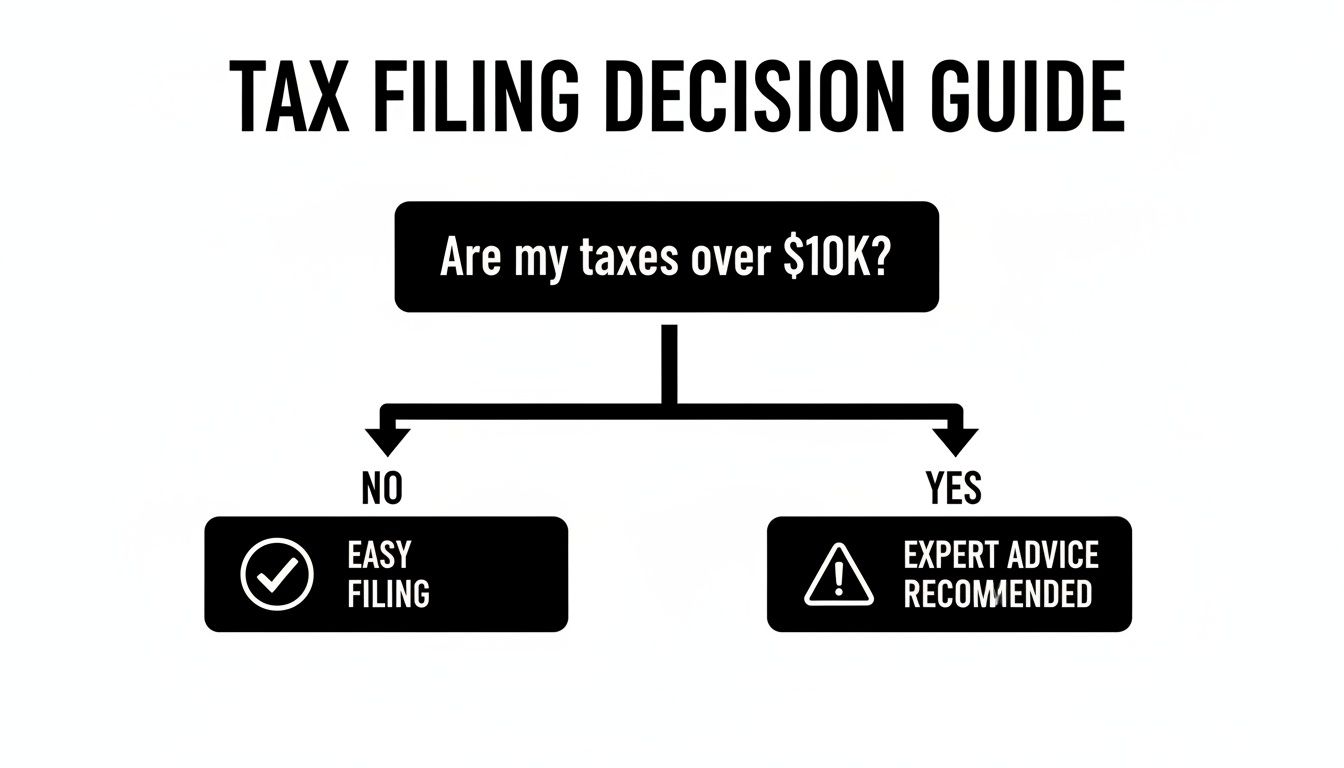
The core question it illustrates is simple: Are your total state and local taxes over the $10,000 line? If not, you deduct it all. If they are, you're capped.
Two Ways to Calculate Your Sales Tax Deduction
Okay, so you've decided to go the sales tax route. Now you have another choice: how to actually figure out the number. The IRS gives you two methods.
-
The Actual Expense Method: This is exactly what it sounds like. You meticulously save every receipt for every single purchase you made all year and add up the sales tax. While it’s the most accurate way, it's a massive pain and wildly impractical for just about everyone.
-
The Optional Sales Tax Tables: Here's the much simpler, saner option. The IRS publishes tables that give you a standard sales tax deduction amount based on your income, family size, and state. The best part? You can still add the actual sales tax you paid on big-ticket items—like vehicles or major home building materials—on top of the table amount.
For the vast majority of people, using the IRS tables is the clear winner. You get a solid deduction without the nightmare of hoarding a year's worth of receipts.
Of course, all of this only matters if you're itemizing in the first place. For a deeper dive into that fundamental decision, check out our guide on the standard deduction vs. itemized deductions. Sometimes, seeing how these rules apply in specific situations can help, such as with understanding tax filing for resellers, who deal with complex sales tax issues daily.
At the end of the day, the only way to know for sure is to run the numbers for both income and sales tax. That's how you'll find out which path saves you the most money.
How Property Taxes Fit into the SALT Cap
For most homeowners, property taxes are the single biggest slice of the state and local tax pie. When people think about the SALT deduction, this is often the first expense that comes to mind. Figuring out exactly how this major expense plays into the $10,000 cap is absolutely essential.
The rule is actually pretty simple: the state and local real estate taxes you pay are deductible, but they get bundled together under that same $10,000 ceiling with your state income or sales taxes. This means a hefty property tax bill can eat up your entire SALT deduction allowance all by itself.
Let's say you pay $11,000 a year in property taxes and another $6,000 in state income taxes. Your total state and local tax bill is $17,000. Because of the cap, though, you can only deduct $10,000 of that on your federal return. In this scenario, your property taxes alone pushed you over the limit.
Deducting Property Taxes on Multiple Homes
One question we get a lot is, "Can I deduct property taxes on more than one house?" The answer is yes, you absolutely can. You’re allowed to include the real estate taxes you pay on all the properties you own for personal use, which could be:
- Your main home: The place you live most of the time.
- A vacation spot: A second home that you don't rent out.
- Empty land: Any vacant lot you own for personal enjoyment.
Here's the catch, though. All of those property tax payments still have to fit under that one, combined $10,000 SALT cap. Owning more properties doesn't get you more deductions; it just means you'll likely hit that ceiling a lot faster.
The Escrow and Closing Year Scenarios
When it comes to property taxes, timing is everything. This is especially true if you pay through an escrow account or just bought a new home.
A crucial detail many people overlook is that you can only deduct the property taxes that have been actually paid to the government during the tax year. The money you contribute to your escrow account each month doesn't count until your lender physically sends that payment to the local tax authority.
Thankfully, your lender takes the guesswork out of this. They'll report the exact amount of property taxes they paid on your behalf for the year on your Form 1098.
Things can also get a little confusing in the year you buy or sell a house. At closing, the property taxes are typically prorated between the buyer and seller. You can only deduct the portion of the tax that applies to the time you actually owned the home. You'll find this amount spelled out clearly on your final settlement statement.
The Investor Exception: Property Taxes as a Business Expense
Now, this is where things get really interesting, especially for real estate investors. The rulebook changes completely when a property is used for a rental or business.
Property taxes on a rental property are not subject to the $10,000 SALT cap. Why? Because the IRS doesn't see them as a personal tax. Instead, they're considered a necessary business expense, which you can deduct directly against your rental income on Schedule E of your tax return.
This is a huge advantage for landlords. You get to fully deduct every penny of property tax for your rental portfolio as a business expense. On top of that, you can still claim up to $10,000 for your personal SALT deductions (from your primary residence's property tax and state income/sales tax) on your Schedule A. Think of them as operating in two completely separate lanes—a vital distinction for anyone with investment properties.
Navigating Other State Taxes You Might Pay
Beyond the big three of income, sales, and property taxes, states have all sorts of other ways to collect revenue. It’s easy to get tangled up trying to figure out which of these miscellaneous payments count towards your federal SALT deduction and which are just the cost of living. The lines can get blurry, but the IRS has specific rules you need to know.
A perfect example is the tax you pay on your car. Many states have a personal property tax on vehicles. If that tax is ad valorem—a fancy way of saying it’s based on the value of your car—it’s generally deductible. But if it’s just a flat annual registration fee, the IRS sees it as a non-deductible user fee, not a tax.
Another one that often slips under the radar is State Disability Insurance (SDI). If you live in a state like California, those mandatory contributions withheld from your paycheck are actually treated as state income taxes. That means they count toward your SALT deduction, a small but important detail many people miss.
What Is Not Deductible
To avoid confusion, the IRS is crystal clear about certain state and local charges you can't deduct. Think of it this way: if you’re paying for a specific service or a privilege, it’s probably not a deductible tax.
It’s crucial to remember that you can't write off payments like:
- Driver's license fees
- Vehicle inspection fees
- Flat-rate car registration fees (the ones not based on value)
- Transfer taxes when you sell a home
- Hunting or fishing licenses
- Parking tickets, speeding fines, or other penalties
These rules also have wider economic implications. The way federal deductions work can sometimes mean lower-income households face a higher effective tax rate. In fact, research shows the bottom 20% of earners pay about 11.4% of their income in state and local taxes, while the top 1% pay only 7.3%. A big reason for the gap is that high earners can get a much larger benefit from federal deductions. You can dig into the numbers in the full Institute on Taxation and Economic Policy report.
The Tax Benefit Rule and State Refunds
The conversation between your state and federal tax returns doesn’t just stop on April 15th. What happens if you get a state tax refund? The following year, you’ll have to figure out if that money is taxable federal income. The answer hinges on something called the "tax benefit rule."
The rule is simple: If you itemized and deducted your state income taxes on last year’s federal return—and that deduction actually lowered your tax bill—then your state refund is considered taxable income this year.
On the flip side, if you took the standard deduction last year, your state refund is completely tax-free. Why? Because you didn't get a "benefit" from deducting those state taxes in the first place, so the IRS doesn't get to tax you when a portion of it is returned. This is a common tripwire for many taxpayers. If you want to dive deeper, check out our guide on whether state income tax refunds are taxable.
Tax Planning Strategies with the SALT Cap

Knowing the rules of the SALT cap is one thing. Actually using them to your advantage is where the real savings are found. With the $10,000 limit here to stay (for now), smart tax planning is no longer a luxury—it’s a necessity. It’s all about thinking a year or two ahead to legally and strategically lower what you owe.
Instead of just accepting the cap as a fixed cost, you can work around it. Two of the most effective techniques we use with clients are “bunching” deductions and tapping into state-level workarounds designed specifically for business owners.
The Power of Bunching Deductions
Bunching is a simple but powerful strategy. You intentionally pack as many of your itemized deductions as you can into a single year. The goal is to get your total well over the standard deduction amount for that year. The next year? You just take the easy route and claim the standard deduction.
Think of it like this: if your total itemized deductions, including the $10,000 SALT limit, are always hovering just below the standard deduction, you’re not getting any extra tax benefit. Bunching lets you create one "big" deduction year, followed by a "lean" year, maximizing your tax savings over a two-year cycle.
Here’s how it works in the real world:
- Property Taxes: Let's say your second property tax installment is due in early January. You could strategically prepay it in late December of the current year, effectively pulling that deduction forward.
- Charitable Donations: Instead of giving steady amounts each year, you could make two years' worth of contributions in your "bunching" year.
- Medical Expenses: If you have flexibility, you could schedule elective medical or dental work to fall within your high-deduction year.
By carefully timing these payments, you can create a total large enough to make itemizing worthwhile. You get a bigger tax break in one year and then enjoy the simplicity of the standard deduction in the next. It’s the best of both worlds.
This strategy requires careful planning. You can't prepay state income taxes that aren't yet due, but you can control the timing of other deductible expenses like property taxes and charitable gifts to work in your favor.
The debate over the SALT cap is always evolving. You can get up to speed on the latest proposals and what they might mean for you in our breakdown of the latest SALT deduction changes.
State Workarounds for Business Owners
Seeing how the federal SALT cap impacts their residents, more than 30 states have come up with some clever workarounds. The most popular solution by far is the Pass-Through Entity (PTE) tax.
This approach lets partnerships and S corporations choose to pay state income tax at the business level. Why is this a big deal? Because the business can then claim that payment as an ordinary and necessary business expense on its federal tax return—a deduction that is not subject to the $10,000 SALT cap.
The individual owners then get a credit on their personal state tax returns for the tax the business already paid. It’s a completely legal and powerful maneuver that effectively bypasses the federal limit for eligible business owners, allowing them to deduct their full state tax liability.
This is just one of many ways to optimize your tax situation. For investors, there are many other real estate investment tax strategies that can help maximize returns while legally minimizing your tax bill.
Frequently Asked Questions About State Tax Deductions
It’s completely normal to still have questions, even after getting a handle on the basics. Tax rules, especially around state deductions, have a lot of moving parts. To make sure you’re feeling confident, we've pulled together some of the most common questions we hear from clients and answered them in plain English.
Think of this as a quick-reference guide to clear up any lingering confusion so you can move forward with your tax planning.
Can I Deduct State Taxes If I Take the Standard Deduction?
In a word, no. This is one of the most common points of confusion, but the rule is straightforward. You have to choose one path: either itemize your deductions or take the standard deduction. You can't mix and match.
The option to deduct state and local taxes lives exclusively in the world of itemizing. If the standard deduction saves you more money than adding up all your individual itemized deductions (like mortgage interest, charitable giving, and state taxes up to the $10,000 limit), then you'll take the standard deduction. It’s the smarter financial move, even though it means you won’t be deducting your state taxes separately.
Are State Tax Refunds Considered Taxable Income?
This is a classic "it depends" scenario, and it all comes down to whether you got a tax break for those state taxes on last year's federal return. The IRS calls this the "tax benefit rule." Essentially, if you benefited from the deduction last year, the refund you get this year is considered income.
Here's the simple breakdown:
- If you took the standard deduction last year, your state tax refund is not taxable. Since you never deducted the state taxes you paid in the first place, you didn't receive a "tax benefit" to begin with. The refund is just your money coming back to you, plain and simple.
- If you itemized last year, your refund is almost always taxable income. You lowered your federal tax bill by deducting your state tax payments, so when the state gives some of that money back, the IRS wants its cut of that returned amount.
What Happens to the SALT Deduction Cap in the Future?
The $10,000 SALT deduction cap isn't permanent. It was introduced as part of the Tax Cuts and Jobs Act (TCJA) and has a built-in expiration date. As things stand now, the cap is set to expire after the 2025 tax year.
What does this mean for you? If Congress doesn't act, the SALT deduction will revert back to its pre-2018 rules. Beginning with the 2026 tax year, the deduction for state and local taxes would once again become unlimited.
Of course, tax law is constantly in flux. The SALT cap is a major political talking point, and its future is anything but guaranteed. Keeping an eye on legislative changes is a crucial part of smart, long-term tax strategy.
Navigating the complexities of the SALT deduction requires more than just knowing the rules—it demands a proactive strategy built around your specific financial life. At Allied Tax Advisors, our team is here to help you make the most of every deduction you're entitled to. Whether you're an individual, a real estate investor, or a small business owner, we can build a tax plan that minimizes what you owe and puts you on the path to financial success.
Ready to take control of your taxes? Schedule a consultation with Allied Tax Advisors today.