
A balance sheet is more than just an accounting exercise; it’s a powerful snapshot showing what your business owns (assets) and what it owes (liabilities) at a single moment in time. Many people think of it as a financial report card for their company, and that's not far off. It's an essential tool for making smart, strategic decisions to keep your business healthy and growing.
Why Your Balance Sheet Is a Financial Health Snapshot

Let's be real—financial statements can feel a bit overwhelming. Most small business owners I talk to are laser-focused on their income statement (the P&L) because it feels more immediate—it's all about profit and loss. But ignoring the balance sheet is like driving a car without a dashboard. You might be moving forward, but you have no clue if you're about to run out of gas or if the engine is overheating.
To really get started, it helps to understand what a balance sheet is and why it's important. It gives you a clear, organized picture of your company's net worth, providing the clarity you need to steer the ship.
The Foundational Accounting Equation
At its heart, every balance sheet—no matter how simple or complex—is built on one straightforward formula. This is the bedrock principle that ensures the statement always lives up to its name and stays in balance.
Assets = Liabilities + Owner's Equity
This is the core of double-entry bookkeeping. It simply means that everything your business owns (its assets) was paid for in one of two ways: by borrowing money (liabilities) or by using money from its owners (equity).
Grasping this simple relationship is the first real step to demystifying your company’s finances. It frames your entire financial structure in one clean line.
Beyond Compliance to Strategic Decisions
A balance sheet isn't just about keeping the tax authorities happy. It's a critical tool for planning your next move and securing your company's future. With this one document, you're empowered to:
- Secure Loans: When you walk into a bank for a loan, they'll want to see your balance sheet. It’s how they judge your company's stability and your ability to repay debt.
- Attract Investors: Potential investors use it to size up the fiscal health of your business and figure out what it's worth before they write a check.
- Make Smarter Moves: It helps you spot financial trends, manage your debt load, and decide if now is the right time to buy that new piece of equipment or expand into a new market.
In the current economic climate, keeping a close eye on your balance sheet is more critical than ever. The Q1 2025 MetLife and U.S. Chamber of Commerce Small Business Index revealed that 35% of small business owners named revenue as their top challenge—a sharp 10-point jump from the previous quarter. With inflation also squeezing nearly 60% of owners, maintaining healthy cash reserves and manageable debt levels is absolutely key to staying afloat.
Understanding Your Assets, Liabilities, and Equity
To get a real grip on your balance sheet, you first have to understand its three core parts. Think of them as the three legs of a stool—if one is off, the whole thing wobbles. They are Assets, Liabilities, and Equity.
Let's break down each one.
Assets: What Your Business Owns
First, let's talk about Assets. These are simply all the valuable things your business owns. For a small bakery, your assets are everything from the cash in your till and the flour in your pantry to the industrial oven in the back.
We usually split assets into two buckets to get a clearer picture of financial health, especially how quickly things can be converted to cash.
-
Current Assets: These are things you expect to use up or turn into cash within a year. For our bakery, this would be cash, the money in the business checking account, inventory (flour, sugar, butter), and maybe accounts receivable if you're waiting on a payment from a big wedding cake order.
-
Non-Current Assets: Sometimes called fixed assets, these are the long-term workhorses you don't plan on selling anytime soon. We're talking about the big-ticket items: your delivery van, that fancy new mixer, the ovens, and your point-of-sale system.
It's important to remember that these long-term assets don't stay new forever. They lose value over time, which is a concept called depreciation. That shiny new oven won't be worth the same amount in five years. To get the full story, check out our guide that explains what is accumulated depreciation and how it affects your books.
Liabilities: What Your Business Owes
Next up are Liabilities. This is the other side of the financial coin—it's everything your business owes to someone else. For our little bakery, this could be the outstanding bill from the flour supplier or the small business loan you took out to buy that new oven.
Just like with assets, we split liabilities based on when they're due.
-
Current Liabilities: These are the debts you need to settle within the next 12 months. This includes things like accounts payable (that invoice from your egg supplier), short-term loans, credit card balances, and the portion of any long-term debt that's due this year.
-
Long-Term Liabilities: These are debts that aren't due for more than a year. A classic example for a small business is a multi-year bank loan used to get the bakery off the ground or to finance a major renovation.
Taking on debt isn't a sign of failure; it's often a necessary step for growth. The balance sheet is your tool for making sure that debt is managed wisely and doesn't get out of hand.
Equity: What Your Business is Actually Worth
Finally, we get to Owner's Equity. This might be the simplest part to calculate, but it's arguably the most important. It's the bottom-line, real-world value of your business.
The formula is straightforward:
Equity = Assets – Liabilities
For the owner of our bakery, equity is what’s left after every supplier has been paid and every loan is accounted for. It represents their initial cash injection to start the business, plus all the profits they’ve plowed back in over the years (known as retained earnings). It’s the truest measure of the value you've built from the ground up.
To help visualize how this all fits together, here’s a quick summary of the core components using our bakery example.
Key Components of a Small Business Balance Sheet
| Component | Definition | Example for a Bakery |
|---|---|---|
| Assets | Everything of value that the business owns. | Cash in the register, delivery van, ovens, flour, sugar, and unpaid invoices for catering jobs. |
| Liabilities | Everything the business owes to outside parties. | Loan for the delivery van, unpaid bills to suppliers, credit card balances, and sales tax payable. |
| Equity | The net worth of the business; what's left after subtracting liabilities from assets. | The owner's initial investment plus all the profits that have been reinvested into the bakery over time. |
Seeing these three pieces together on one sheet gives you that crucial snapshot of your business's financial standing at a single point in time.
Building Your First Balance Sheet from Scratch
Alright, let's roll up our sleeves and put together your first balance sheet. Don't worry, this is less about getting a degree in accounting and more about being organized and methodical. We'll walk through it step-by-step, focusing on what you actually need to do.
First things first: pick a date. A balance sheet is a financial snapshot, so every number on it has to be accurate for that specific day. Most business owners choose the end of a month, quarter, or year. The key is to be consistent so you can compare apples to apples down the road.
Identifying and Valuing Your Assets
Let's start with the good stuff—everything your business owns. This is the "assets" part of the equation. You'll need to go through all your accounts and physical items and put a dollar value on them as of the date you chose.
To keep everything straight, it helps to categorize your assets properly. A well-structured list of accounts is a lifesaver for clean bookkeeping. If this is new territory for you, taking a moment to understand what a chart of accounts is will give you a solid foundation for organizing your finances from day one.
For the balance sheet itself, assets get split into two buckets:
- Current Assets: Think of these as things that are either cash or will likely turn into cash within a year. This includes cash in your business checking account, invoices your clients haven't paid yet (accounts receivable), and any inventory you have sitting on the shelves.
- Non-Current (or Fixed) Assets: These are your long-haul investments—the things you'll be using for more than a year. We're talking about your work computers, office furniture, a company van, or any machinery. A crucial detail here is to list them at their current book value, which is simply the original price you paid minus the depreciation you've claimed so far.
Listing Your Liabilities
Next up, it's time to list everything your business owes. These are your liabilities. Being thorough here is just as important as on the asset side; missing a debt can paint a misleadingly rosy picture of your financial health.
Just like with assets, liabilities are also broken down into two main groups based on when they need to be paid:
- Current Liabilities: These are the debts breathing down your neck—the ones you have to pay off within the next 12 months. Common examples are bills from suppliers (accounts payable), outstanding balances on company credit cards, and the portion of a long-term loan that’s due this year.
- Long-Term Liabilities: These are obligations with a longer runway, due more than a year from your balance sheet date. This category is home to things like a multi-year small business loan or the financing on a company vehicle.
Putting these pieces together reveals the three core components of any balance sheet: assets, liabilities, and equity.
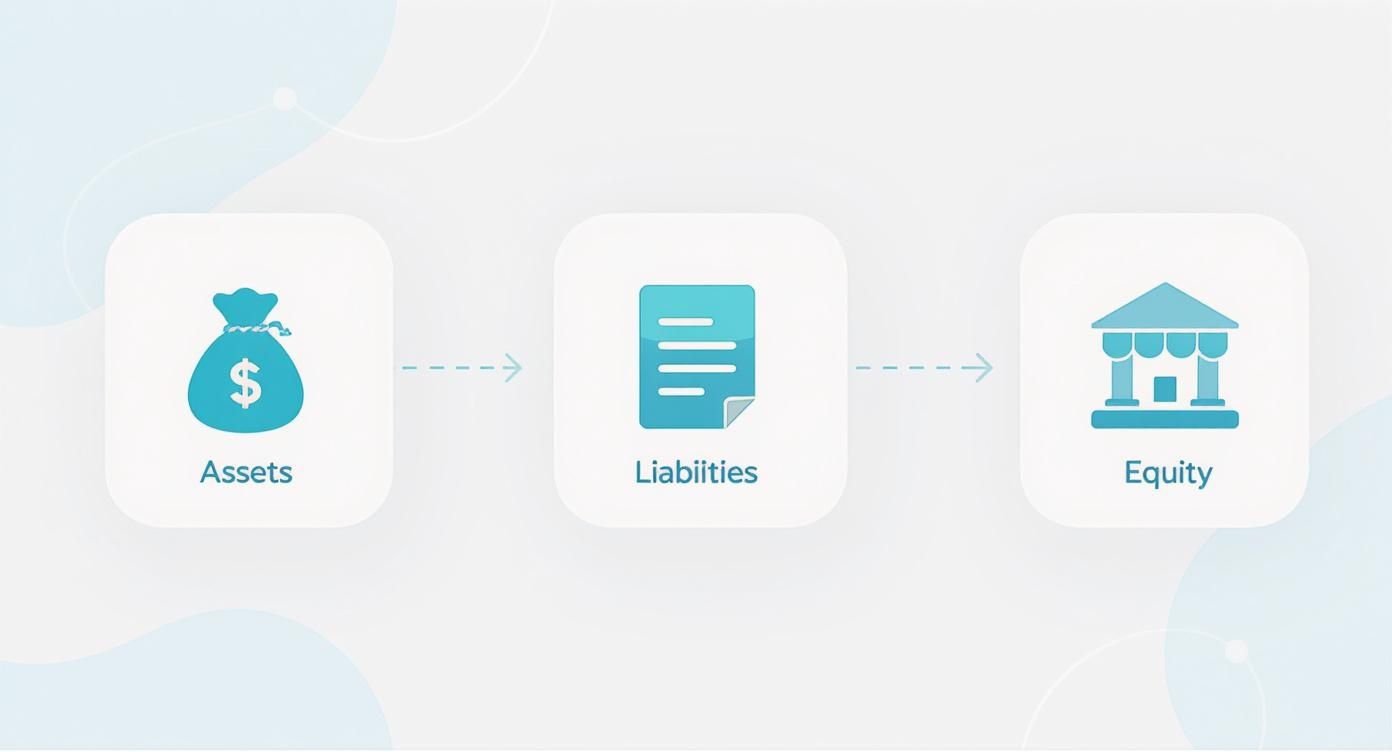
This simple flow really brings the fundamental accounting equation to life, showing how everything you own is balanced by what you owe and your own stake in the business.
Calculating Equity and Finalizing Your Sheet
The last piece of the puzzle is owner's equity. Thankfully, you don't need to go digging for new information. It's a straightforward calculation using the numbers you just pulled together.
Owner's Equity = Total Assets – Total Liabilities
This figure is essentially your business's net worth. It’s what you initially put into the company, plus any profits you've kept in the business over time (known as retained earnings).
With your three totals—assets, liabilities, and equity—in hand, you can lay them out in a simple, two-column format. Assets get one side, while liabilities and equity share the other. The magic moment is when you check the bottom line: the grand totals for each column must match. If they don't, it’s a red flag telling you to go back and find the error. A sheet that balances is the ultimate confirmation that your numbers are solid.
Turning Balance Sheet Data into Business Insights

So, you’ve put in the work and have a completed balance sheet. That’s a huge step, but don't just file it away. The real magic happens when you start to read between the lines. Think of it less as a compliance document and more as a treasure map for your business.
The secret is using financial ratios. These are simple calculations that shine a light on the relationships between the different numbers on your balance sheet. They take a static list of figures and turn it into a dynamic story about your company's performance and financial health.
Once you get comfortable with the basics, you can really dig in. If you're ready to take the next step, there are great resources on how to analyze a balance sheet like a pro that can help you transform that raw data into real, actionable intelligence.
Assessing Short-Term Health With The Current Ratio
One of the first questions any business owner should ask is, "Can we pay our bills over the next year?" The current ratio gives you the answer. It’s a direct measure of your liquidity—your ability to cover short-term debts without having to scramble.
Calculating it is refreshingly simple:
Current Ratio = Current Assets / Current Liabilities
A ratio of 2:1 is often considered the gold standard. It means you have two dollars in easily accessible assets for every one dollar you owe in the near term. If your ratio dips below 1:1, that's a potential red flag that you might struggle to meet your immediate financial obligations.
Let's say your bakery has $20,000 in current assets and $10,000 in current liabilities. Your current ratio is a solid 2.0, signaling a strong and healthy financial position for the short term.
Understanding Your Long-Term Stability
Beyond just paying this month's bills, you need to know if your business is built to last. That’s where the debt-to-equity ratio comes in handy. This metric shows you exactly how your business is financed—is it running on borrowed money or on your own investment?
Here’s the formula:
- Debt-to-Equity Ratio = Total Liabilities / Owner's Equity
A high ratio means your business is leaning heavily on debt, which can be risky, especially if interest rates rise or sales dip. A low ratio, on the other hand, shows that the owners are funding most of the operations, which is almost always a safer bet.
If that same bakery has $50,000 in total liabilities and $100,000 in owner's equity, your ratio is 0.5. That's a very healthy number that lenders and investors love to see.
This kind of analysis is the bedrock of smart cash flow management. With 51% of small businesses globally citing uneven cash flow as a major hurdle, getting a handle on these numbers is more important than ever. It helps you see problems coming and manage them before they become crises. To learn more, check out our guide on cash flow management for small businesses.
Common Balance Sheet Mistakes and How to Fix Them
Even the most careful business owners can make mistakes on their balance sheets. These aren't just simple typos, either. These errors can seriously warp your financial picture and lead you to make some pretty bad decisions. The best way to sidestep these issues is to build solid accounting habits from the get-go.
A classic error I see all the time is misclassifying debt. Let's say you took out a five-year loan for a new piece of equipment. It's tempting to just drop the whole amount into long-term liabilities and call it a day. But that's not quite right. The portion of that loan you have to pay back within the next 12 months is actually a current liability.
It seems like a small detail, but getting this wrong can make your business look much more stable in the short term than it really is.
Incorrect Asset Valuation
Another common trip-up is how assets are valued. Too many owners list their equipment at the price they paid for it and then never touch that number again. They completely forget about depreciation. That delivery van you were so proud of when you bought it for $30,000 two years ago? It's definitely not worth that anymore.
- The Mistake: You’re recording a fixed asset at its original price and not accounting for the value it loses over time through wear and tear.
- The Fix: You need to regularly calculate the depreciation and subtract that accumulated amount from your fixed assets. This gives you the asset’s “book value,” which is a much more realistic picture of what it’s worth to your business today.
Making this simple adjustment ensures your balance sheet gives you an honest look at what your business actually owns.
Inconsistent Reporting Periods
Finally, inconsistency will kill your ability to get useful insights from your financials. If you prepare a balance sheet for March 31st one quarter and then April 15th the next, you can't really compare them. You're not looking at apples to apples. This turns any attempt at trend analysis into pure guesswork.
Let’s be real: effective financial management is a matter of survival. About 20% of small businesses fail in their first year, and that number jumps to 50% by year five. Accuracy is not optional. In fact, poor cash management—a problem a good balance sheet can help you spot—is the top reason 38% of startups go under. You can dig deeper into these numbers with these small business revenue statistics.
The fix is simple: pick a consistent closing date for each reporting period. Whether it’s the last day of the month, the quarter, or the year, just pick one and stick to it religiously. Your future self will thank you.
Got Questions About Your Balance Sheet? We've Got Answers
Stepping into the world of financial statements can feel like learning a new language. When you're running a small business, you're wearing all the hats—CEO, marketing guru, and, yes, CFO. Let's tackle some of the most common questions that pop up when business owners start digging into their balance sheet.
How Often Should I Run a Balance Sheet?
Honestly, there's no one-size-fits-all answer here; it really depends on what you need it for.
For your own internal use, getting into a monthly or at least quarterly rhythm is a game-changer. It gives you a real-time pulse on your business's financial health. You'll start to see trends, manage your cash flow more effectively, and catch potential problems before they escalate.
For outsiders, the schedule is a bit more defined. You’ll definitely need to prepare an annual balance sheet when you’re:
- Filing business taxes. This is non-negotiable for getting your taxes done right.
- Applying for a business loan. Lenders will always ask for one to gauge your financial stability.
- Reporting to investors. They'll want to see a clear picture of the company's financial position at year-end.
What’s the Difference Between a Balance Sheet and an Income Statement?
This is probably the most frequent question I hear, and the distinction is critical. Here’s the simplest way I can put it: a balance sheet is a photograph, and an income statement is a video.
A balance sheet captures your financial position on a single, specific day. It’s a snapshot showing exactly what your business owns (assets) and owes (liabilities) at that precise moment. Its whole job is to tell you your company’s net worth on, say, December 31st.
The income statement (often called a P&L) tells a story over a period of time—a month, a quarter, or a full year. It tracks your revenues and subtracts your expenses to show whether you were profitable during that period. You absolutely need both to understand what’s really going on with your money.
It's entirely possible for a business to look profitable on its income statement but be on the verge of a cash-flow crisis. The balance sheet is what sounds the alarm on issues like poor liquidity.
Can I Prepare This Myself, or Do I Need an Accountant?
You can absolutely start out doing this yourself. In the early stages of a business, many owners manage their own bookkeeping with modern accounting software. Tools from companies like QuickBooks or Xero are designed for non-accountants and make generating a basic balance sheet pretty straightforward. Going the DIY route is a great way to save cash and get intimately familiar with your company's numbers.
But as your business gets bigger and your transactions get more complicated, bringing in a professional accountant is one of the smartest investments you can make. They do more than just crunch numbers; a good accountant provides strategic advice, makes sure you're staying compliant, and can find tax-saving opportunities you'd never spot on your own.
Even if you handle the daily bookkeeping, having an accountant review your financials periodically is a wise move that can save you major headaches down the road.
Feeling like you're in over your head? The team at Allied Tax Advisors can take the stress out of your financials. We help business owners create accurate, clear balance sheets that become a tool for making smarter decisions, not just a compliance headache.
Let us help you turn your financial data into your greatest asset. Learn more at https://alliedtax.com.