
When you buy a big-ticket item for your business—like a vehicle, a piece of machinery, or a new server—it doesn't stay new forever. Over time, it wears out and loses value. Accumulated depreciation is simply the running total of all the value an asset has lost since you first started using it.
Think of it like the total mileage on a delivery van. Each year, you add more miles (depreciation expense for the year), and the odometer reading (accumulated depreciation) keeps climbing, reflecting the total wear and tear it's endured.
Understanding the Basics of Accumulated Depreciation

The yearly loss in an asset's value is an expense called depreciation. But accumulated depreciation is the grand total of all those annual expenses added together. This distinction is key. For a deeper dive into this foundational concept, check out our guide on what is depreciation in accounting.
This figure is essential for painting a realistic financial picture. It’s not a savings account you're building to buy a replacement. Instead, it’s an accounting tool that helps you show the asset's declining value on your balance sheet, which is critical for accurate reporting.
The Role of a Contra-Asset Account
Accumulated depreciation has a special home on the balance sheet: a contra-asset account. The name might sound technical, but its job is straightforward. It's an account with a credit balance that works to decrease the value of a related asset account.
A contra-asset account is like the other side of the coin for a regular asset. It pairs up with an asset, such as "Company Vehicles," to show both the original price you paid and how much of that value has been "used up" so far.
This pairing is how you calculate an asset’s book value (its original cost minus the accumulated depreciation). This number is a crucial indicator of a company's financial health.
As a general rule of thumb, most fixed assets depreciate between 3% and 10% each year. For example, long-term data from the U.S. Bureau of Economic Analysis shows that equipment and other fixed capital assets have consistently depreciated at rates around 4% to 4.2% annually. You can explore more of the data behind these historical asset depreciation rates.
How Accumulated Depreciation Works on the Balance Sheet
When you look at a balance sheet, you’ll find that accumulated depreciation has a very specific job. It isn't an asset in the traditional sense—it doesn't add value. Nor is it a liability you have to pay off. Instead, it lives in its own unique category as a contra-asset account.
Think of it as the other side of the coin to your asset's original cost. You’ll see one line for "Company Vehicles" showing what you paid for them, and right below it, you'll see "Accumulated Depreciation" showing how much of that value has been used up. Together, these two accounts give a much more honest picture of what your assets are actually worth today.
This pairing is essential for calculating an asset's book value—simply its original cost minus the total accumulated depreciation. Without this, you'd be carrying assets on your books at their full purchase price forever, which would be incredibly misleading as they wear out over time.
The Contra-Asset Account in Action
A contra-asset account has a credit balance, which is the opposite of a normal asset account (which has a debit balance). This clever accounting setup allows it to directly reduce an asset's value on the balance sheet without ever erasing the original price you paid. Keeping that historical cost visible is vital for good financial analysis.
By keeping the historical cost and accumulated depreciation separate, anyone reading your financials can see two critical things at a glance: how much you invested in an asset and how much of its useful life has been consumed.
This approach ensures you aren't overstating the value of your assets, giving lenders, investors, and you a more accurate snapshot of your company's financial health. To see exactly how this looks on paper, check out this sample balance sheet for a small business. It’s a great way to visualize the layout.
To really see how this works, let's look at how an asset's value changes on the books year after year.
How Accumulated Depreciation Affects Book Value
The table below tracks a simple asset over three years, showing how depreciation expense chips away at its book value.
| Year | Beginning Book Value | Annual Depreciation Expense | Accumulated Depreciation | Ending Book Value |
|---|---|---|---|---|
| 1 | $10,000 | $2,000 | $2,000 | $8,000 |
| 2 | $8,000 | $2,000 | $4,000 | $6,000 |
| 3 | $6,000 | $2,000 | $6,000 | $4,000 |
As you can see, while the annual depreciation expense stays the same, the accumulated depreciation balance grows each year. This is what causes the asset's book value to systematically decrease over its life.
How to Calculate Accumulated Depreciation
Figuring out accumulated depreciation isn't a one-size-fits-all process. The method you choose really depends on the asset itself—how it's used and how quickly it loses its value. After all, a delivery truck doesn't wear out at the same rate as an office desk.
The core idea is to spread an asset's cost over its useful life in a logical way. Let's walk through the three most common methods accountants use to get this done.
The Straight-Line Method
The straight-line method is by far the most popular because it's simple and predictable. It evenly distributes the depreciation expense over the asset's entire useful life. Think of assets that lose value consistently over time, like office buildings or furniture—this method is perfect for them.
The formula is as straightforward as its name:
(Asset Cost – Salvage Value) / Useful Life = Annual Depreciation Expense
Let's say you buy a piece of equipment for $50,000. You expect it to last for 5 years and have a salvage value (what it’s worth at the end of its life) of $5,000.
Using the formula, the calculation is ($50,000 – $5,000) / 5 years, which equals $9,000 in depreciation per year. So, after three years, the accumulated depreciation on your books would be $27,000.
The Double-Declining Balance Method
Some assets lose a huge chunk of their value right at the beginning. Cars and computers are classic examples. For these, the double-declining balance method makes more sense. It's an "accelerated" method that front-loads the depreciation expense into the first few years.
Here’s how it works. First, you find the straight-line rate. For our 5-year asset, that’s 20% per year (100% / 5). Then, you just double it to 40%.
- Year 1: You'd depreciate 40% of the initial $50,000 cost, which is $20,000.
- Year 2: The asset's book value is now $30,000, so you calculate 40% of that, which is $12,000.
In just two years, the accumulated depreciation is already $32,000, reflecting that fast initial drop in value.
The Units of Production Method
What if an asset's value is tied directly to how much you use it? For a factory machine or a commercial printer, the units of production method is the way to go. Instead of tracking time, you track output.
Imagine our $50,000 machine is expected to produce 200,000 widgets in its lifetime. The depreciation per widget would be ($50,000 – $5,000) / 200,000 units, or $0.225 per unit.
If you crank out 40,000 units in the first year, your depreciation expense is simply $9,000 (40,000 x $0.225). If you produce less the next year, the depreciation expense will be lower, too. It perfectly mirrors actual use.
This visual breaks down how an asset's book value is determined by subtracting its total accumulated depreciation from its original cost.
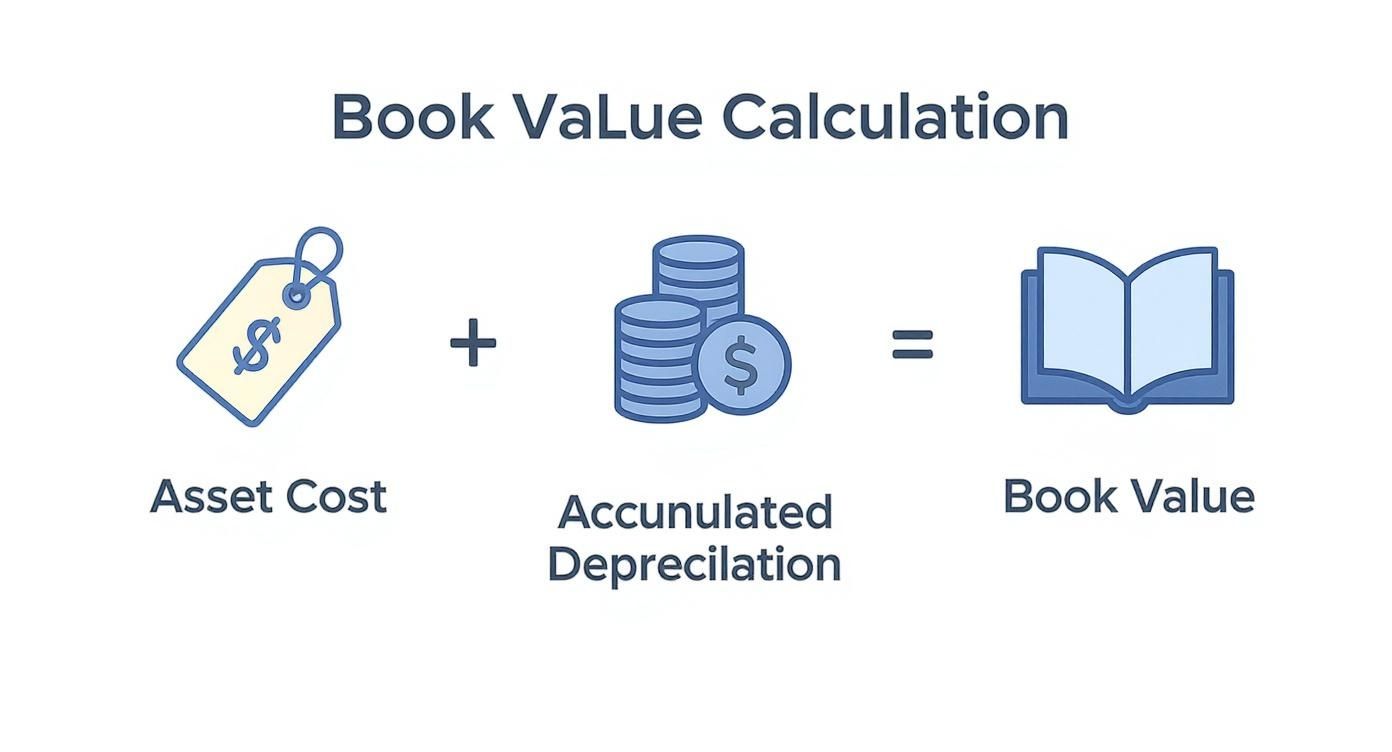
This basic formula is key to understanding how assets are presented on the balance sheet over time. While these three methods are the most common, there are other nuances to consider, which you can explore in our complete guide on how to calculate depreciation.
Here’s the rewritten section, designed to sound like it was written by an experienced human expert.
What Accumulated Depreciation Actually Tells You About a Company
Think of accumulated depreciation as more than just a number on a balance sheet. It’s a vital clue that tells a story about a company’s history, its spending habits, and what it might need to do next to stay competitive. For any sharp investor or analyst, this one line item can speak volumes.
A high accumulated depreciation balance, especially when compared to the original cost of the assets, often points to a company running on older equipment. Now, that's not always a bad thing. It could mean the company is brilliant at maintaining its assets and squeezing every last drop of value out of them. But it can also be a warning sign. Aging machinery can be slower, less efficient, and more likely to break down, putting the company a step behind its rivals.
Reading Between the Financial Lines
This is where you can get a real feel for a company's capital spending strategy. A business with a sky-high accumulated depreciation balance is probably facing a big bill in the near future. They'll likely need to pump serious cash into new property, plant, and equipment just to keep up, which can put a major dent in their profits and cash reserves.
Here’s how analysts typically break it down:
- How old are the assets? A high ratio of accumulated depreciation to the gross asset cost is a strong indicator of older assets.
- Is a big shopping spree coming? It helps predict if the company needs to budget for replacing or upgrading core equipment soon.
- Are they falling behind? Using outdated assets could mean they're losing ground to competitors who have invested in newer, better technology.
Accumulated depreciation helps you look past what a company simply owns and focus on the real-world condition and lifespan of those assets. It's about assessing the company's long-term ability to operate effectively.
Take a giant like The American Pacific Corporation (APA), for example. They reported an accumulated depreciation of roughly -$32.993 billion around late 2025. A number that massive reflects decades of depreciation on huge assets like industrial plants and heavy machinery. It underscores the sheer scale of their operations and shows just how much their assets have aged over the years.
Ultimately, learning to interpret what accumulated depreciation is telling you is a crucial skill for making smarter financial decisions.
Why Tracking Accumulated Depreciation Is a Smart Strategy
Keeping an eye on accumulated depreciation isn't just some bean-counter chore; it's a core part of running a smart business. Think of it less as an accounting entry and more as a powerful tool that gives you a window into your company's financial future.
When you track the total wear and tear on your assets, you’re not just looking backward. You’re gaining a clear, forward-looking view that helps you anticipate big expenses down the road. It’s the difference between planning to replace a critical piece of machinery and having it fail unexpectedly, bringing your operations to a screeching halt.
Informing Financial Planning and Tax Strategy
Let's talk about the immediate, tangible benefits. One of the biggest is its impact on your taxes. Depreciation is a non-cash deductible expense, which is a fancy way of saying it reduces your taxable income without you actually spending any cash. Getting this right means you avoid overpaying the taxman.
It also becomes incredibly important when you're looking for a loan or investment. Bankers and investors will scrutinize an asset's book value—that's its original cost minus accumulated depreciation—to gauge your company's stability. A well-kept balance sheet with accurate asset values shows you're on top of your finances and gives them a clear picture of what your collateral is truly worth.
Tracking accumulated depreciation allows a business to move from simply owning assets to strategically managing their lifecycle, ensuring resources are available when they're needed most.
A Global Perspective on Asset Value
Understanding the value of your assets isn't just a concern for your own business—it's a massive driver of the global economy. As physical assets depreciate, the nature of capital stock changes, and that has ripple effects worldwide.
In fact, global capital-output ratios have climbed to around 600–650%, which underscores the sheer scale of investment in assets and their eventual depreciation. This whole process is fundamental to figuring out the net capital stock that powers production and economic stability. You can dive deeper into the global accumulation of wealth and assets from the World Inequality Database to see the bigger picture.
In the end, diligently tracking this number transforms it from a simple historical record into a proactive tool for managing risk and planning for a financially sound future.
Common Questions About Accumulated Depreciation
Even after you get the hang of the basics, a few things about accumulated depreciation can still feel a bit fuzzy. Let's clear up some of the most common questions people have with straightforward answers. Getting these details right will help you handle your books with confidence.
These are the questions I hear most often from business owners, students, and even investors. They touch on key distinctions and practical situations you're likely to encounter.
What Is the Difference Between Depreciation Expense and Accumulated Depreciation
This is probably the most important distinction to nail down.
Think of depreciation expense as the cost of an asset's "wear and tear" for just one period, like a single year. It shows up on the income statement and directly reduces your taxable income for that year.
Accumulated depreciation, on the other hand, is the grand total—the running sum of all the depreciation you've ever recorded for that asset since you started using it. You'll find this on the balance sheet, where it chips away at the asset's original value.
Does Accumulated Depreciation Represent a Cash Fund for Replacement
No, and this is a huge misconception. Accumulated depreciation is purely an accounting concept; it's a non-cash entry that helps you spread an asset's cost over its useful life.
It does not mean you've got a pile of cash sitting in a bank account waiting to buy a replacement. It’s simply an accounting tool for matching an asset's cost to the revenue it helps you earn.
If you want to save up to replace an asset, that requires a separate strategy involving budgeting and managing your cash flow.
What Happens to Accumulated Depreciation When an Asset Is Sold
When you sell or get rid of an asset, you have to close the book on it, literally. Both the asset's original cost and all of its accumulated depreciation are wiped clean from the balance sheet.
This is where things get interesting. You compare the cash you got from the sale to the asset's final book value (which is its cost minus the total accumulated depreciation). If there’s a difference, you must record either a gain or a loss on the sale, which then gets reported on your income statement.
Can Accumulated Depreciation Be Higher Than the Asset's Cost
Nope, that's a scenario that shouldn't happen under standard accounting principles. The total accumulated depreciation can never be more than the asset's depreciable base (its original cost minus any salvage value).
Once an asset is fully depreciated, its book value sits at its salvage value, and you just stop recording depreciation for it. This ensures an asset's value on your books never dips into the negative, keeping your financial statements grounded in reality.
Getting a handle on depreciation and other accounting rules is crucial for accurate financial reporting and smart tax planning. The team at Allied Tax Advisors has spent decades helping businesses and individuals navigate their finances. Visit us online to learn how our expert advisory services can support your financial journey.