
You’re probably at the point where your business stopped feeling like a hobby. Money is coming in. Clients expect professional invoices. Maybe you signed a lease, hired a contractor, bought software, or started taking on work that carries real risk. Then the obvious question hits: if something goes wrong, are you on the hook, or is the business?
That’s where the benefits of llc become practical instead of theoretical. For a freelancer, it can mean keeping a business dispute from spilling into personal savings. For a real estate investor, it can mean containing risk around a rental. For a crypto trader, it can mean opening the door to a more serious tax posture and cleaner expense tracking. For a family with California property, it can also become part of a bigger estate plan.
An LLC isn’t magic paperwork. It’s a business boundary. If you’re still mixing business activity with your personal checking account, you’re operating without one of the most useful guardrails available. If you want a broader personal finance framework while you’re getting organized, mastering the five personal finance pillars is a helpful companion to the business side of this decision.
Table of Contents
- Why Smart Entrepreneurs Separate Business and Personal Finances
- The Cornerstone Benefit Personal Asset Protection
- Unlocking Tax Flexibility and Savings
- Streamlining Operations and Building Credibility
- How LLCs Empower Different Entrepreneurs
- Comparing Business Structures Where the LLC Fits
- Your Next Steps and When to Call a Tax Advisor
Why Smart Entrepreneurs Separate Business and Personal Finances
A new business owner usually makes the same mistake first. They get paid through Venmo, buy supplies on a personal card, use one checking account for everything, and assume they’ll clean it up at tax time. That works right up until the business has a refund dispute, a customer complaint, a contractor issue, or an IRS notice.
I’ve seen this play out with designers, consultants, online sellers, and rental owners. The business is profitable enough to matter, but not organized enough to protect them. They’re not avoiding structure because they’re reckless. They’re delaying it because they think an LLC is complicated. It isn’t. Cleaning up a mess later is what gets expensive.
If you haven’t fixed the separation yet, start with your books and bank flow before you do anything else. This practical guide on separating business and personal expenses covers the habit that makes the LLC work effectively.
Separation changes decision making
Once owners draw a clean line between personal and business activity, they stop guessing. They know what the business earns. They know what it spends. They can document deductions, defend filings, and make better tax elections.
A business that isn’t separated from the owner is hard to protect, hard to value, and hard to manage.
The real payoff
The benefits of llc aren’t just about legal language. They show up in day to day operations:
- Cleaner records: You stop burying business expenses inside personal statements.
- Better tax prep: Your return becomes easier to prepare and easier to support.
- More confidence: You can sign contracts and take on clients without wondering whether one bad outcome reaches into your personal life.
- A stronger foundation: Banks, vendors, and partners tend to take a formal entity more seriously than a loosely run side hustle.
That’s why forming an LLC is often the first serious move an owner should make after proving there’s real business activity.
The Cornerstone Benefit Personal Asset Protection

The risk most owners ignore
The biggest reason to form an LLC is simple. It puts a legal barrier between you and the business. If you operate as a sole proprietor, there is no barrier. You and the business are the same taxpayer, the same risk bucket, and in many cases the same target if a claim shows up.
Say you run a small e-commerce shop and a customer claims your product caused damage. Or you’re a consultant and a client alleges negligence. In a sole proprietorship, that dispute can point straight at your personal bank account, your car, and other personal assets. That’s not theory. That’s the structure you chose.
By contrast, LLCs provide limited liability protection, shielding personal assets from business debts and lawsuits, and keeping the owner’s risk confined to the investment in the business. They represented over 40% of new business formations in the U.S. by 2023, which tells you owners are prioritizing liability protection over unnecessary complexity, as explained by Wolters Kluwer’s overview of LLC benefits.
What the LLC firewall actually does
I explain it to clients as a legal firewall. The LLC owns the business activity. The LLC signs the contract. The LLC receives the income. The LLC holds the liability. If the LLC is formed and maintained properly, your personal life doesn’t automatically become collateral damage.
That firewall is often described as the corporate veil. You don’t need to memorize the term, but you do need to respect what keeps it intact.
Here’s what matters most:
- Use separate accounts: If business money and personal money move through the same account, you weaken the separation.
- Sign in the company’s name: Contracts, invoices, leases, and vendor agreements should reflect the LLC.
- Track records consistently: Sloppy books create problems fast when a dispute or audit lands.
- Follow state requirements: A neglected entity is easier to attack than a properly maintained one.
Practical rule: An LLC protects owners who treat the business like a real entity. It does far less for owners who treat it like a nickname on a personal account.
There’s another layer people miss. LLCs can also offer charging order protection, which limits what a creditor can do with an owner’s interest. That matters for multi-member structures and for owners who want stronger separation between personal creditor issues and business control.
What this means in plain English
If your business gets sued, you want the claim aimed at the business, not your household. That’s the core value. The benefits of llc start here, and if this part doesn’t matter to you, the rest probably won’t either.
For most small owners, this isn’t optional sophistication. It’s basic risk control.
Unlocking Tax Flexibility and Savings

Liability protection gets people to form the LLC. Tax flexibility is what makes them glad they did.
An LLC gives you options. That’s the point. You’re not boxed into one rigid tax outcome for the life of the business. For a new owner, the default treatment is usually straightforward. As profit grows, you may want a different election. That flexibility is one of the strongest benefits of llc and one of the most misunderstood.
Pass through treatment is the default advantage
Most LLCs start as pass-through entities for federal tax purposes. Income flows to the owner’s personal return instead of being taxed first at the entity level the way a C corporation can be. In practical terms, the business profit lands on your return and gets taxed there.
That structure is simpler for many small owners. It also avoids the classic double-tax framework associated with C corporations. If you’re a solo consultant, online seller, landlord, or service provider, pass-through treatment is often the cleanest place to begin.
When an S corporation election deserves a look
Here’s where I get opinionated. Too many owners either elect S corporation status too early or ignore it too long.
An LLC can elect to be taxed as an S corporation when the economics support it. The appeal is straightforward. If the business produces enough profit, the owner may take part of the earnings as salary and the rest as distributions, which can improve the self-employment tax picture. But this only works when payroll is handled correctly and the salary is reasonable. If you can’t support the compensation, don’t force the election just because someone on social media said it’s a hack.
If you want a deeper explanation of how this choice works, this guide to LLC tax classification options is a solid next read.
The deduction many owners leave on the table
The Tax Cuts and Jobs Act gives eligible LLC owners access to the Section 199A deduction, which allows up to 20% of qualified business income to be deducted. The commonly cited example is simple: for an LLC with $100,000 in qualified business income, $20,000 may be deducted, reducing taxable income to $80,000 before personal deductions, as outlined in Finally’s explanation of LLC tax benefits.
That deduction matters. It also isn’t permanent under current law. It’s currently set to expire after 2025 unless Congress extends it, so owners who qualify shouldn’t treat it like background noise.
Don’t build a tax strategy around a headline. Build it around your entity, your profit level, your payroll reality, and your records.
If you’re self-employed and still operating informally, there’s another smart companion resource on how to maximize independent contractor deductions. It’s useful because entity choice and deduction discipline should happen together, not separately.
What I recommend
Use this framework:
- Start with the default LLC tax treatment if the business is new and profit is still uneven.
- Review S corporation treatment later when income is stable enough to justify payroll and compliance.
- Track every legitimate expense now, because no tax strategy works if your books are weak.
- Revisit the plan annually, especially while current deduction rules remain in flux.
The owners who save the most aren’t the ones chasing tricks. They’re the ones choosing the right classification at the right stage.
Streamlining Operations and Building Credibility
A lot of business owners focus on taxes and lawsuits and miss the operational upside. An LLC is often easier to live with than a corporation.
That matters more than people admit. Most small businesses don’t need extra formality. They need a structure they can easily maintain.
Less red tape means lower friction
LLCs require significantly fewer administrative burdens than traditional corporations. They aren’t generally required to hold formal board meetings or maintain extensive corporate minutes in the way C corporations do, which lowers internal time costs and outside accounting fees, as described in Wave’s discussion of LLC tax and compliance benefits.
That reduction in formality has real effects:
- Less administrative drag: Owners spend less time creating paperwork that doesn’t help operations.
- Lower professional fees: Simpler governance often means simpler support work from accountants and attorneys.
- Cleaner annual maintenance: There’s still compliance, but it’s usually more manageable than full corporate formalities.
- Easier bookkeeping integration: Tools like QuickBooks, Wave, and receipt capture apps work better when the entity is clean and transactions are clearly business-related.
This doesn’t mean “do nothing.” It means focus on the records that matter instead of pretending your two-person shop needs a boardroom ritual.
LLC on the name matters
The branding side is real too. When customers, lenders, vendors, or partners see “LLC” after the business name, they read it as commitment. You formed an entity. You opened proper accounts. You’re operating as a business, not testing a weekend idea.
That perception helps in small but important ways. Vendors are more comfortable. Clients are less likely to treat the engagement casually. A landlord or lender may see a more credible operator. None of that replaces good financials, but it absolutely improves first impressions.
A formal entity won’t make a weak business strong, but it does make a serious business look serious.
If you want the shortest version of this section, it’s this: an LLC cuts avoidable friction while giving the market a cleaner signal that you’re established.
How LLCs Empower Different Entrepreneurs

The benefits of llc get more interesting when you stop talking in generalities and look at actual owner situations. The same structure solves different problems depending on how you make money.
Real estate investors
A rental owner usually learns the value of entity structure the moment a tenant issue appears. If a property creates liability, you want clear separation around that activity. Holding rentals through an LLC can help contain operational risk and make ownership cleaner to document.
For families thinking beyond current cash flow, the planning angle matters too. An LLC can also support smoother transfers of ownership interests over time. That becomes especially useful when the goal is to move property to the next generation without turning every transfer into an administrative mess.
A well-drafted operating agreement also gives real estate families more control over how interests move, who manages the property, and how income gets allocated. That’s far better than leaving everyone to sort it out after a death, disagreement, or rushed sale.
Cryptocurrency traders and investors
Most generic LLC articles barely touch crypto. That’s a mistake.
For crypto investors, an LLC can enable trader tax status, the deduction of unlimited trading losses against other income instead of the $3,000 personal cap, deductions for costs like secure wallets and data feeds, and a Section 475 mark-to-market election for ordinary loss treatment. That becomes more important as IRS Form 1099-DA takes effect in 2025, as discussed in Business Rocket’s summary of LLC benefits for crypto-focused owners.
If you trade actively, this isn’t niche trivia. It affects how you document activity, how you classify the operation, and how you support deductions for the tools you use. That can include portfolio tracking software, exchange records, wallet security expenses, and research subscriptions.
Crypto traders who operate like a business should structure and document like a business.
Multi-member LLCs can also be useful when more than one person is participating economically and the operating agreement needs to govern who gets what. That’s the kind of detail standard online templates usually handle badly.
Small businesses and freelancers
A solo graphic designer. A consultant billing monthly retainers. A mobile notary. A short-form video editor. A local shop that finally hired help. These owners often wait too long because the business still feels “small.”
That’s backward. Small businesses need protection early because one dispute can hurt more when cash reserves are thin.
Here’s where an LLC helps the most for operators like this:
- Client work: Contracts, invoices, and payments run through the business.
- Expense discipline: Software, subscriptions, travel, supplies, and home office support are easier to track cleanly.
- Growth readiness: Adding a contractor, changing tax treatment, or opening a new account is easier from an entity base.
- Professional posture: Clients take the engagement more seriously when the business is formalized.
If you’ve moved beyond occasional side income and started relying on the business, the LLC usually stops being optional and starts being overdue.
Comparing Business Structures Where the LLC Fits
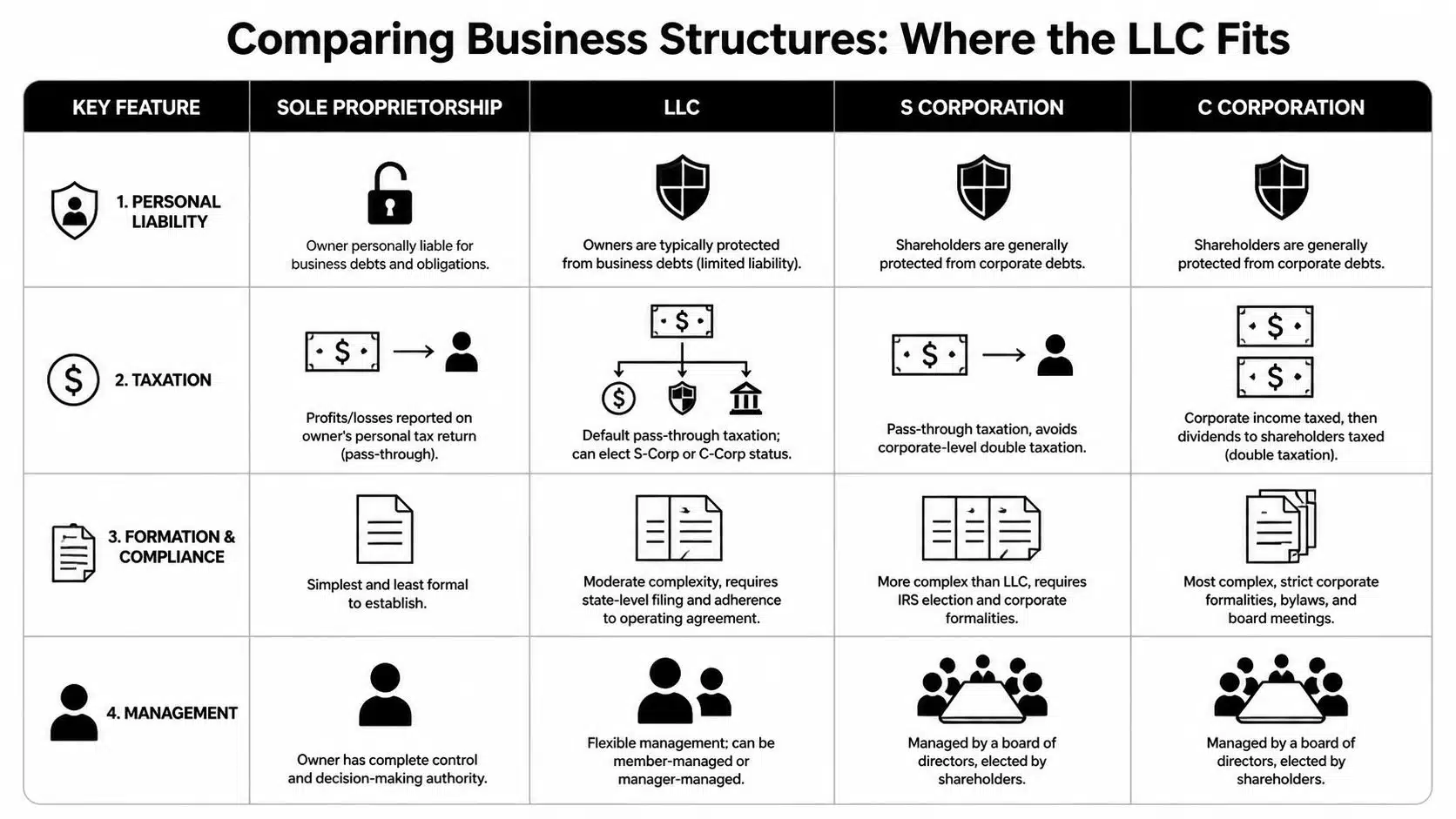
Side by side comparison
Here’s the practical way to look at the main structures.
| Structure | Personal liability | Tax treatment | Compliance burden | Management flexibility | Best fit |
|---|---|---|---|---|---|
| Sole Proprietorship | No meaningful separation between owner and business | Generally reported on the owner’s return | Lowest upfront formality | Complete owner control | Very small, low-risk activity |
| LLC | Limited liability protection when maintained properly | Default pass-through, with election flexibility | Moderate and manageable | High flexibility | Most small businesses, investors, and growing operators |
| S Corporation | Liability protection comes from the underlying entity, not the tax election itself | Pass-through taxation with added payroll considerations | Higher than a standard LLC setup | More structured | Owners with stable profit and payroll discipline |
| C Corporation | Strong liability separation | Entity-level taxation with possible double taxation | Highest formality | Formal corporate governance | Businesses seeking a corporate model |
A lot of owners confuse an LLC with an S corporation. They aren’t rivals in the way people talk about them online. An LLC is a legal structure. S corporation is usually a tax election layered onto a structure when it makes sense. If you need a fuller side by side breakdown, this guide on S corp vs LLC for small business owners is worth reviewing.
Where the LLC wins
For most small operators, the LLC is the sweet spot. It gives you liability protection, flexible tax treatment, and manageable administration without forcing you into the full machinery of a corporation.
That’s especially true for owners with real estate and family transfer concerns. For family farms and real estate holdings in high-tax states like California, LLCs can support estate planning through asset valuation discounting of 20% to 40% for gift and estate tax purposes and smoother generational transfers without probate, which becomes more important with the federal estate tax exemption set to be halved after 2025, as noted in this farm-focused discussion of LLC planning considerations.
That isn’t a reason for every owner to build a family entity tomorrow. It is a reason for California property owners to stop treating the LLC as just a liability tool. In the right fact pattern, it’s also an estate planning tool.
Your Next Steps and When to Call a Tax Advisor
If you’re still operating in your own name, using personal accounts, and hoping insurance plus good intentions will cover the gap, fix that. The benefits of llc are too practical to ignore. You get a cleaner liability boundary, more tax flexibility, easier administration than a traditional corporation, and a more credible business presence.
But don’t confuse forming an LLC with finishing the job. Owners lose protection when they commingle funds, sign carelessly, ignore state requirements, or choose tax treatment without understanding the consequences. A badly maintained LLC can create false confidence, which is worse than no confidence at all.
Your next steps are straightforward:
- Form the entity correctly
- Open separate business banking
- Keep the books clean from day one
- Review whether the default tax treatment still fits
- Get specialized advice if you own rentals, trade crypto, or are planning family transfers
For owners trying to tighten their bookkeeping habits, Receipt Router's accounting guide is a useful operational read because entity structure only works when the records support it.
The short answer is simple. If the business is real, the LLC should probably be real too. And if the tax strategy, ownership structure, or compliance details feel fuzzy, that’s the point where professional advice saves money instead of costing it.
If you want help setting up an LLC the right way, choosing the right tax classification, or handling complex issues around rentals, crypto, payroll, or IRS notices, talk with Allied Tax Advisors. They can help you turn the benefits of llc into actual protection, cleaner reporting, and a tax strategy that fits how your business really operates.